The Soft Landing
Compound evidence detail1 SCR / 2 parts
- Documentedthe human attachment evidence base together with the canine-direct secure-base findings (Topal 1998, Horn 2013) and Schoberl-documented physiological effects of secure caregiving in dogs
- Heuristicthe full attachment-theory apparatus transfer to canine relationships, including internal working models and attachment-classification systems
The Soft Landing is JB's term for the ideal puppy transition from breeder to family home. Heuristic The goal is not a dramatic welcome. The goal is continuity. The puppy should arrive into a home that already has shape, calmness, and adult leadership, so the move feels like a translation of the same developmental language rather than a crash into an entirely new world.
What It Means
Most families are taught to mark puppy arrival as a major event. There are excited greetings, a circle of admirers, lots of handling, new toys everywhere, changed routines, inconsistent rules, and a human emotional tone that says, "Everything is different now." From the human point of view, this feels loving. From the puppy's point of view, it often means loss of the old structure, overload from the new environment, and no clear adult rhythm to orient toward.
JB's answer is the opposite: pretend like the puppy has been there.
That phrase sounds almost too simple until you unpack what it means. It means the house is already functioning before the puppy arrives. The adults already know what the rules are. Rest areas are already decided. Greeting style is already calm. Furniture rules are already set. Doorways, feeding flow, sleep routines, visitor policies, and handling expectations already have shape. Heuristic The puppy is entering a system, not creating one.
This is what makes the landing soft. The puppy still experiences novelty, of course. The rooms are new. The smells are new. The people are new. But the social grammar is familiar: calm adults, predictable routines, limited stimulation, and clear boundaries. That continuity matters because puppies learn heavily through observation and social referencing. Documented The human's behavior becomes a developmental cue.
The attachment side matters too. Puppies cope better when caregiving is consistent, predictable, and sensitively responsive. The new family cannot replicate the breeder overnight, but it can carry forward the same basic logic. The adult is calm. The adult is available. The adult notices stress early. The adult does not flood the puppy with emotional noise.
This is also where JB parts company with the "special day" mentality. A special day is often destabilizing because it turns the puppy into a social event. The puppy is passed around, spoken to constantly, introduced to everyone immediately, and kept awake past its limit because the humans are celebrating. A Soft Landing does not deny joy. It simply refuses to let joy become physiological chaos.
Transition research supports the broader principle even if JB's exact protocol has not been directly tested. Moving dogs into novel rehoming, shelter, kennel, or foster contexts reliably produces stress, and stable home environments improve recovery over time. Documented JB's specific breeder-to-family method is therefore an inference from a documented principle: transitions are real stressors, and stability helps.
Practically, the Soft Landing has three layers.
The first layer is environmental continuity. Keep the physical environment quiet and low-drama. Limit traffic. Limit novelty. Do not immediately turn the first days into a parade of visitors, outings, or performance expectations.
The second layer is social continuity. The human should behave like a calm adult from the first hour. No wrestle-style bonding. No frantic comforting. No alternating between indulgence and correction. The puppy should feel that the adults in this new place already know how to be adults.
The third layer is rule continuity. The boundaries you want later should begin now, at the lowest-intensity version possible. If the couch will be off-limits, it is off-limits on day one. If greetings will be calm, they are calm now. If the puppy will sleep in a crate or designated space, that routine begins immediately and gently. Heuristic
This is not severity. It is kindness through coherence.
A crash landing is the opposite. The environment is overstimulating. The adults are emotionally loud. The rules are undecided. The puppy is indulged for a few days, then abruptly corrected once the indulgence becomes inconvenient. The home first says, "Everything goes," and later says, "Why is the puppy doing this?" That is not transition support. That is role confusion.
The Soft Landing is also a mentorship concept. Puppies copy what is in front of them. If what is in front of them is excitement, urgency, and novelty-seeking, that becomes the immediate social curriculum. If what is in front of them is calm observation, rest, and steady adult rhythm, that becomes the curriculum instead.
Why It Matters for Your Dog
The first week does not freeze the whole future, but it does establish a tone. Families often underestimate how much information the puppy is taking in during those first days. Observed-JB The puppy is not just learning where the water bowl is. The puppy is learning whether this new world is emotionally legible.
The Soft Landing means the puppy arrives into an already-functioning home. The human continues the language of calmness, mentorship, and structure instead of making the transition louder than it needs to be.
What a Soft Landing looks like in practice:
- Calm arrival with minimal spectators
- Quiet orientation to the house instead of a social event
- Immediate consistency on rest spaces, handling style, and household rules
- Short, low-stimulation first days
- Warmth delivered through steadiness, not excitement
What a crash landing looks like:
- everyone crowds the puppy
- the puppy is passed from person to person
- rules are suspended because it is the first day
- sleep is disrupted by attention and novelty
- the puppy is rewarded for intensity, then later scolded for repeating it
A simple homecoming rhythm:
- First 48 hours: keep the circle small, the floor quiet, and the expectations simple.
- First week: establish sleep, feeding, elimination, and handling routines with as little emotional turbulence as possible.
- First month: keep building the same grammar of calmness, structure, and observation rather than replacing it with entertainment.
The point is not perfection. The point is continuity. A Soft Landing lets the puppy spend less energy surviving the transition and more energy adapting to it.
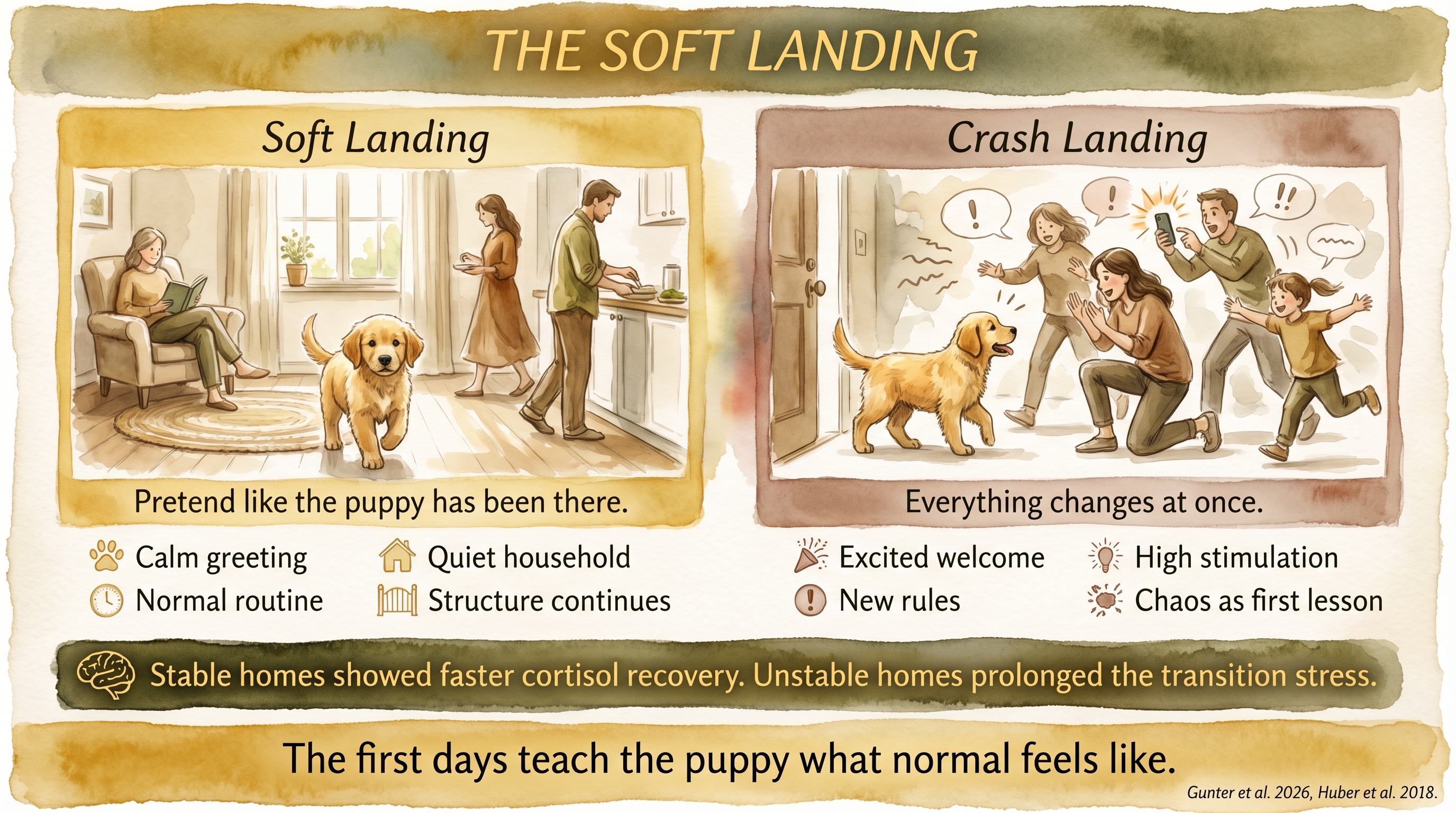
Pretend like the puppy has been there - the first days teach the puppy what normal feels like.
Key Takeaways
- Pretend the puppy has been there already - the home's rules, routines, and calmness should be in place before arrival, not waiting to be invented.
- The first week is not a celebration event; it is a transition. Quiet, low-stimulation introduction helps more than crowds and excitement.
- Your puppy learns social grammar from what they see in front of them, so calm adults, steady routines, and clear boundaries become the puppy's curriculum from day one.
- Soft landing means continuity of structure and tone, not the loss of them - the puppy moves to a new place but into familiar leadership language.
The Evidence
This entry uses observed claim-level tags beyond the dedicated EvidenceBlocks below. These tags mark JB program observation or practice-derived claims that need dedicated EvidenceBlock coverage in a later content pass.
- Huber et al. (2018, 2020, 2022)domestic dogs
Dogs copy demonstrated actions and are sensitive to social modeling, supporting the idea that the family's arrival-day behavior becomes part of the puppy's learning environment. - van der Laan et al. (2022)domestic dogs
Rehoming and shelter transitions are associated with measurable stress change in dogs, reinforcing that transition itself is not neutral. - Gunter et al. (2026)domestic dogs
Stable foster or home contexts support behavioral and cortisol recovery better than ongoing unstable housing conditions.
- JB synthesisdomestic dogs
The claim that a breeder-to-family transition should be handled as a calm continuation rather than a celebration event is an applied developmental framework built from attachment and transition-stress principles. - JB synthesisdomestic dogs
No study has directly compared JB's exact Soft Landing protocol against a high-excitement homecoming protocol in newly placed puppies.
- Evidence gapdomestic dogs
The documented transition literature comes mainly from shelter, foster, kennel, and rehoming contexts, not breeder-to-family protocols designed around calm continuity.
SCR References
Sources
- Gunter, L. M., Feuerbacher, E. N., Gilchrist, R. J., & Wynne, C. D. L. (2026). Behavioral and cortisol adaptation in foster and shelter dogs. PeerJ, 14, e18487.
- Huber, L., Popovova, N., Riener, S., Salobir, K., & Cimarelli, G. (2018). Would dogs copy irrelevant actions from their human caregiver? Learning and Behavior, 46(4), 387-397.
- Huber, L., Salobir, K., Mundry, R., & Cimarelli, G. (2020). Selective overimitation in dogs. Learning & Behavior, 48, 113-123.
- van der Laan, J. E., Vinke, C. M., Arndt, S. S., & Di