Transition in a Household with Young Children
Homes with young children are not a special case for JB. They are one of the main cases. That matters because many of the households Just Behaving serves are already running at a naturally high tempo before the puppy arrives. Children move quickly, speak loudly, change the timing of the house, and bring joy and unpredictability in the same package. None of that makes a soft landing impossible. It does mean the adults have to hold much more of the calm floor intentionally, because the puppy cannot build a steady baseline from a social environment that changes every few minutes. Observed-JB
What It Means
The first month in a child-dense home is not a democratic project.
That is the first reality families need.
If the puppy is handled by: every child, every visiting friend, and every excited adult.
then the puppy is calibrating to too many different nervous systems at once.
JB does not want that.
One Adult Carries the Core Vocabulary
This is the cleanest practical rule in the page.
One adult should be the primary puppy handler in the first month.
That does not mean the children are excluded.
It means the puppy has a stable reference point while everything else in the home is more variable.
The primary adult becomes the one who most consistently carries: greetings, naps, meals, handling, and transitions into and out of stimulation. Observed-JB
Children then enter that vocabulary gradually rather than writing a different one every few hours.
Young Children and Puppies Share a Risk
They can dysregulate each other quickly.
Children often escalate because the puppy is exciting.
Puppies escalate because the children are exciting.
Then the adults try to solve the loop after it has already been written.
The smarter move is earlier: sacred nap windows, short calm child contact, retreat spaces the children truly respect, and no performance-based greetings.
The Quiet Retreat Is for the Children Too
One underappreciated benefit of good puppy structure in these homes is that it clarifies boundaries for the whole household. Observed-JB When adults teach that the puppy has a quiet place no child enters, they are not only protecting the dog. They are teaching respect, pause, and relational discipline to the children too.
That is part of the philosophical beauty of the JB structure.
The puppy does not have to compete socially with the children in order to belong to the family. Observed-JB
What Recovery Looks Like
If the first weeks have been too loose, recovery usually starts with re-centralizing the adult.
That means: fewer child-led interactions, calmer supervised contact, more management around the puppy's retreat space, and lower tolerance for excited chasing or grabbing.
Families often fear this is unfair to the children.
It is not.
It is giving the children a version of participation the puppy can actually handle.
As the puppy settles, the children can be invited further into the relationship.
The order matters.
Stability first.
Broader participation second.
Why It Matters for Your Dog
This page matters because many puppies in family homes do not really struggle with the existence of children. They struggle with the absence of an adult strong enough to organize the children's contact. When that adult role is clear, a child-filled home can still produce a remarkably steady dog.
It also matters because children often magnify adult guilt. Observed-JB Adults feel they should let the children have more access because the puppy is "for them too." In the first month, that instinct can quietly undermine the whole transition.
The puppy is for the family.
But the first month is still a calibration window.
The adults protect it first so everyone gets a better dog later.
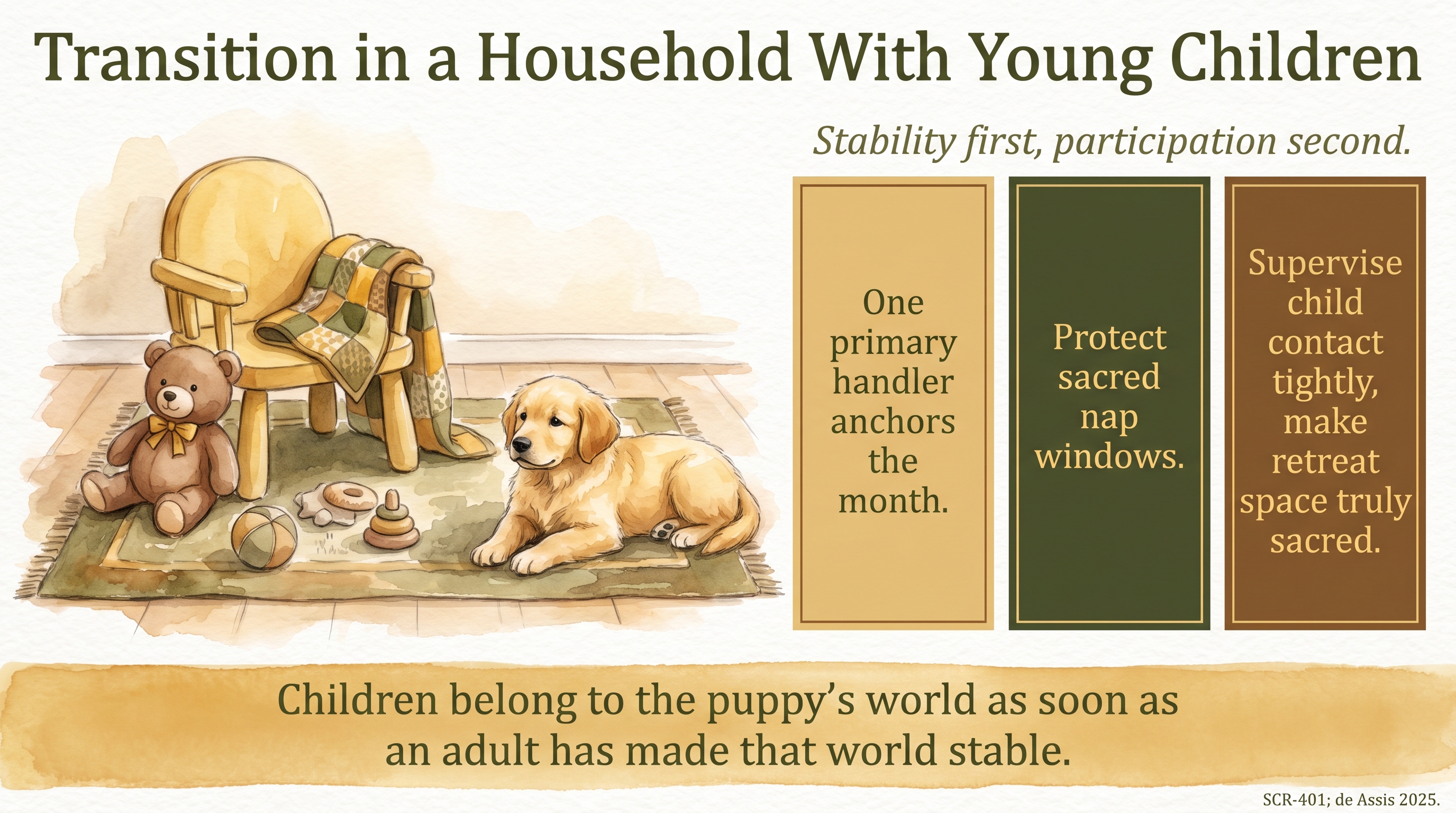
Children belong to the puppy's world as soon as an adult has made that world stable.
Key Takeaways
- A house with young children can still produce a beautiful soft landing, but the adults must hold much more of the calm floor deliberately.
- One primary adult should carry the core puppy vocabulary in the first month so the puppy is not calibrating to too many different handlers at once.
- Sacred nap windows, quiet retreat spaces, and tightly supervised child contact protect both the puppy and the family rhythm.
- The early goal is not equal access for everyone; it is enough stability that the puppy can later belong calmly to the whole household.
The Evidence
- Brubaker & Udell (2023); van Herwijnen et al. (2018, 2020); de Assis et al. (2025)domestic dogs
Household composition, handling style, and owner consistency all shape canine outcomes, making multi-person variation a meaningful early-life factor. - Bray et al. (2015); Affenzeller et al. (2017, 2020); Kis et al. (2017)domestic dogs with general learning parallels
Higher arousal narrows behavioral flexibility and reduces the likelihood of calm regulation, which is especially relevant in highly stimulating home environments.
- JB family-coaching observationfamily-raised Golden Retriever puppies
Child-dense homes do best when one adult carries the primary puppy vocabulary early, while children join the calm structure gradually rather than driving the transition themselves.
No published study directly tests the specific Just Behaving guidance on transition in a household with young children within a breeder-to-family transition, so this entry relies on broader canine evidence, breeder observation, and practical synthesis rather than a direct trial of the full protocol.
SCR References
Sources
- Brubaker, L., & Udell, M. A. R. (2023). Does pet parenting style predict the social and problem-solving behavior of pet dogs (Canis lupus familiaris)? Animal Cognition, 26(1), 345-356. https://doi.org/10.1007/s10071-022-01694-6
- van Herwijnen, I. R., van der Borg, J. A. M., Naguib, M., & Beerda, B. (2018). The existence of parenting styles in the owner-dog relationship. PLOS ONE, 13(2), e0193471. https://doi.org/10.1371/journal.pone.0193471
- van Herwijnen, I. R., van der Borg, J. A. M., Naguib, M., & Beerda, B. (2020). Dog-directed parenting styles predict verbal and leash guidance in dog owners and owner-directed attention in dogs. Applied Animal Behaviour Science, 232, 105131. https://doi.org/10.1016/j.applanim.2020.105131
- de Assis, L. S., Georgetti, B., Burman, O. H. P., Pike, T. W., & Mills, D. S. (2025). Development of a dog owner caregiving style scale (Lincoln Owner Caregiving Questionnaire, LOCQ) and its relationship with behaviour problems in dogs. Applied Animal Behaviour Science, 287, 106628. https://doi.org/10.1016/j.applanim.2025.106628
- Bray, E. E., MacLean, E. L., & Hare, B. A. (2015). Increasing arousal enhances inhibitory control in calm but not excitable dogs. Animal Cognition, 18(6), 1317-1329.
- Affenzeller, N., Palme, R., & Zulch, H. (2017). Playful activity post-learning improves training performance in Labrador Retriever dogs (Canis lupus familiaris). Physiology & Behavior, 168, 62-73. https://doi.org/10.1016/j.physbeh.2016.10.014
- Affenzeller, N. (2020). Dog-Human Play, but Not Resting Post-Learning Improve Re-Training Performance up to One Year after Initial Task Acquisition in Labrador Retriever Dogs: A Follow-On Study. Animals, 10(7), 1235. https://doi.org/10.3390/ani10071235
- Kis, A., Szakadat, S., Gacsi, M., Kovacs, E., Simor, P., Torok, C., Gombos, F., Bodizs, R., & Topal, J. (2017). The interrelated effect of sleep and learning in dogs (Canis familiaris); an EEG and behavioural study. Scientific Reports, 7, 41873.