Preventing the Common First-Month Mistakes
Most first-month mistakes do not look reckless when families are making them. They look normal. They look like what friends recommend, what the broader dog culture rewards, or what seems kind in the moment. That is why they matter so much. The mistakes JB sees most often are not wild outliers. They are the ordinary defaults of modern puppy life. Naming them is not about shame. It is about giving families a cleaner picture of what to avoid before the cleanup becomes necessary. Observed-JB
What It Means
The most common first-month mistakes usually fall into a few recognizable categories. Observed-JB
Mistake 1: Excited Greetings
The puppy comes through the door and everyone lights up. Observed-JB
The redirect is simple: lower the social intensity and keep arrivals ordinary.
Mistake 2: Treating the Honeymoon as the Finished Product
The puppy seems easy in the first week, so the adults relax structure too early. Observed-JB
The redirect: build routine before the regression arrives.
Mistake 3: Interrupting Naps
Families wake the puppy for play, photos, children, or visitors. Observed-JB
The redirect: protect rest as aggressively as meals.
Mistake 4: Overscheduling the Calendar
Too many errands, too many guests, and too much novelty stack the calendar until the puppy stops getting enough recovery. Observed-JB
The redirect: fewer environments and more recovery.
Mistake 5: Changing Food Too Fast
The family upgrades the diet immediately and then confuses digestive instability with a deeper problem. Observed-JB
The redirect: keep the base diet stable first.
Mistake 6: Flooding Socialization
The puppy gets pushed through checklists instead of digestible exposure. Observed-JB
The redirect: quality over quantity.
Mistake 7: Sleeping the Puppy Too Far Away Too Soon
The family expects independence on night one and creates a harder first week than needed. Observed-JB
The redirect: proximity first and distance later.
Mistake 8: Waiting for a Problem Prevention Could Have Avoided
The family waits until the puppy is fully in the pattern, then responds harder. Observed-JB
The redirect: set up the moment earlier.
Mistake 9: Undermining the Resident Dog or the Calm Adult Role
The family lets every interaction become peer-level excitement or prevents the calm adult from regulating at all. Observed-JB
The redirect: preserve adult proportion and protect safe mentorship where it exists.
Mistake 10: Treating the Puppy as a Shared Project Too Quickly
Every person handles the dog in a different way, which gives the puppy conflicting social grammar before the household has a stable baseline. Observed-JB
The redirect: centralize the main vocabulary first.
Why It Matters for Your Dog
This page matters because prevention always looks quieter than recovery. Families often do not realize how much later work a small early choice can create. Observed-JB
That is especially true in the first month, when the puppy is writing assumptions about: greetings, rest, novelty, humans, and the pace of ordinary life.
The mistakes are recoverable.
But not having to recover from them is still easier.
This page also matters because it gives families a humane way to self-audit. Instead of asking, "Are we good at this?" they can ask, "Which ordinary defaults are we accidentally running?"
That is a much more useful question.
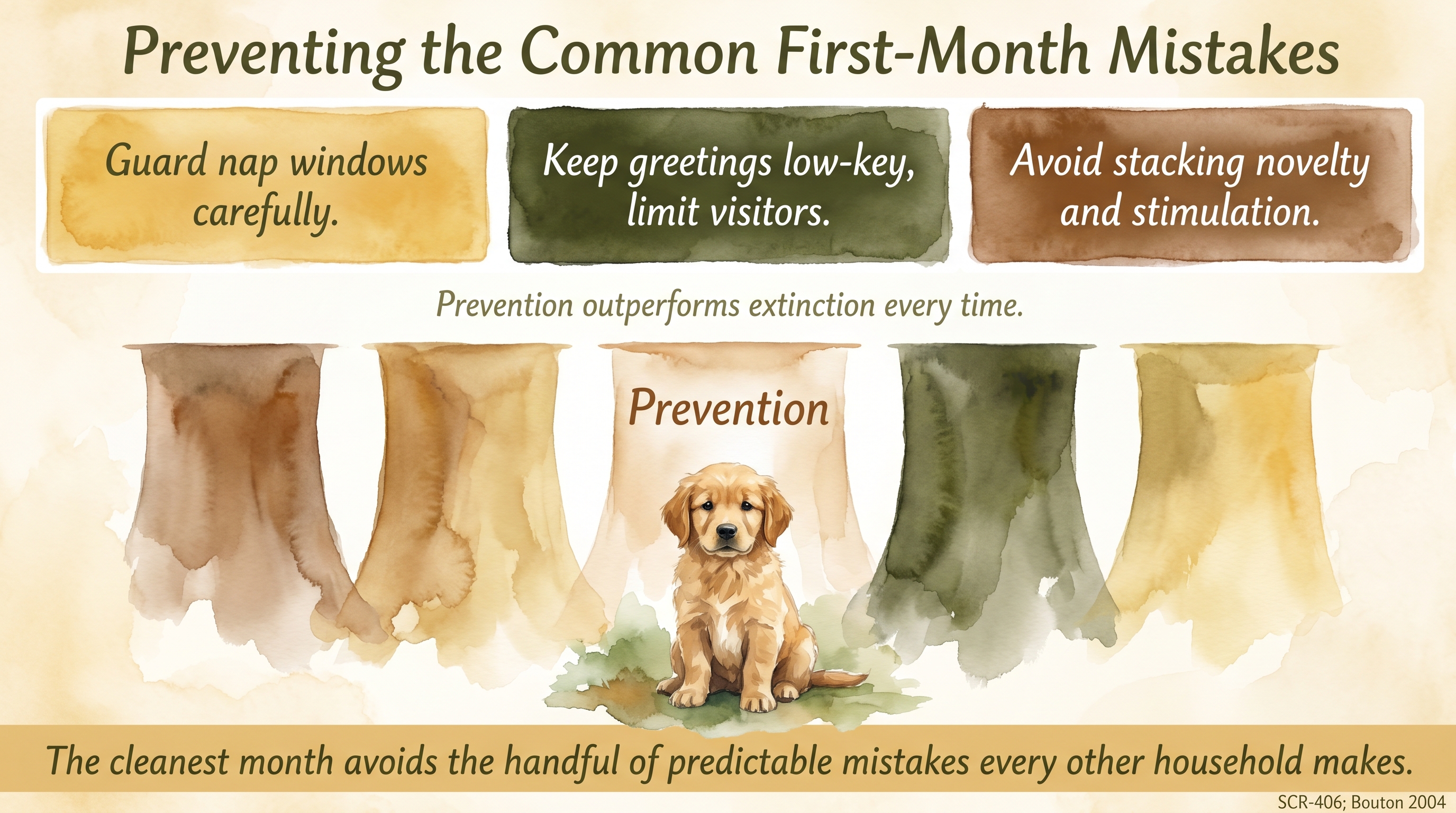
The cleanest month avoids the handful of predictable mistakes every other household makes.
Key Takeaways
- The most common first-month mistakes are usually ordinary cultural defaults rather than dramatic acts of poor judgment.
- Excited greetings, nap disruption, overscheduling, fast diet changes, and prevention failures create much of the cleanup families later experience.
- Most of these mistakes are recoverable, but avoiding them is still easier than unwinding them later.
- A useful self-audit asks which ordinary defaults the household is accidentally running, not whether the family is somehow good or bad at puppies.
The Evidence
- Bray et al. (2015); Affenzeller et al. (2017, 2020); Kis et al. (2017)domestic dogs with general learning parallels
Higher arousal states reduce flexibility and make calmer responding harder to maintain, which helps explain why many common first-month errors cluster around excitement and overstimulation.
- JB breeder-network observationfamily-raised puppies
The most common first-month mistakes are ordinary household defaults such as excited greetings, nap disruption, overscheduling, fast food changes, and waiting to respond after a problem begins instead of preventing the rehearsal earlier.
No published study directly tests the specific Just Behaving guidance on preventing the common first-month mistakes within a breeder-to-family transition, so this entry relies on broader canine evidence, breeder observation, and practical synthesis rather than a direct trial of the full protocol.
SCR References
Sources
- Bray, E. E., MacLean, E. L., & Hare, B. A. (2015). Increasing arousal enhances inhibitory control in calm but not excitable dogs. Animal Cognition, 18(6), 1317-1329.
- Affenzeller, N., Palme, R., & Zulch, H. (2017). Playful activity post-learning improves training performance in Labrador Retriever dogs (Canis lupus familiaris). Physiology & Behavior, 168, 62-73. https://doi.org/10.1016/j.physbeh.2016.10.014
- Affenzeller, N. (2020). Dog-Human Play, but Not Resting Post-Learning Improve Re-Training Performance up to One Year after Initial Task Acquisition in Labrador Retriever Dogs: A Follow-On Study. Animals, 10(7), 1235. https://doi.org/10.3390/ani10071235
- Kis, A., Szakadat, S., Gacsi, M., Kovacs, E., Simor, P., Torok, C., Gombos, F., Bodizs, R., & Topal, J. (2017). The interrelated effect of sleep and learning in dogs (Canis familiaris); an EEG and behavioural study. Scientific Reports, 7, 41873.