Transition with a Reactive or Anxious Resident Dog
The mentorship model is easiest when the resident adult dog is stable, readable, and fundamentally generous with the puppy. Some homes do not have that advantage. When the resident dog is reactive, anxious, resource-guarding, or specifically unsettled by puppies, the family is no longer just adding a puppy to a calm canine system. It is managing two nervous systems at once, one of which may not be able to teach what the puppy most needs to learn. JB takes that reality seriously. The soft landing still applies here, but the human carries more of the mentorship load and the margin for improvisation gets smaller. Observed-JB
What It Means
Families often hope the resident dog will do a large part of the work. Observed-JB
Sometimes that happens.
Sometimes it does not.
When the resident dog is reactive or anxious, several things change immediately: the puppy has less access to calm canine modeling, proximity itself may be activating, feeding and rest need more separation, and the adults become the main regulators of both dogs' space.
That does not make success impossible.
It does mean the household must stop relying on spontaneous dog-to-dog resolution as its main plan. Observed-JB
Zero Forced Interaction
This is the first rule because it is the one families most often violate.
They want the dogs to get used to each other.
So they encourage contact, shorten distance too quickly, or interpret tension as something the dogs should work through. Observed-JB
That is exactly what JB does not want in this setting.
If the resident dog has a credible history of dog aggression or cannot be kept below threshold around the puppy, this is no longer a do-it-yourself introduction problem. It is a management and professional-guidance problem first. Observed-JB
The first goal is not friendship.
It is stable coexistence.
That usually begins with: separate rest spaces, separate feeding areas, shared space only at workable distance, and brief contact, not prolonged social expectation. Observed-JB
The Human Becomes the Mentor
When the adult dog cannot safely or consistently model calm social life, the humans take over much more of the mentorship role.
That means the puppy learns from: the way the adults move through tension, the way they interrupt escalation, and the way they keep both dogs safe without drama.
A calm human can preserve a great deal here.
Not everything.
But much more than families often realize.
Parallel Work May Be Necessary
The resident dog may also need help that is not really about the puppy.
That can include: veterinary evaluation, behavioral consultation, and a calmer daily structure for the resident dog itself.
The family is not betraying the puppy by helping the older dog in parallel.
It is doing the only sensible thing when the household system is strained.
What Recovery Looks Like
Recovery in these homes is slower because there are more variables and because the adult dog already has history.
Good recovery usually looks like: widening distance before forcing closeness, lowering pressure on both dogs, letting coexistence become boring, and reducing moments where either dog has to defend space or resources.
The family should expect weeks to months of careful management, not a quick emotional breakthrough.
That expectation protects everyone.
The relationship may become warm over time.
It may also remain mainly respectful and managed.
That can still be a successful household.
Why It Matters for Your Dog
This page matters because a reactive resident dog changes the transition more than many families realize. If the adults pretend the mentorship channel is still available when it is not, the puppy can learn confusion, vigilance, or over-arousal right where JB would rather teach calm social life.
But this page is also reassuring.
The absence of a calm canine mentor does not remove the philosophy from the home.
It shifts more of the burden onto the humans.
That is harder, but it is still workable.
The most important protection the family can offer the puppy is not forcing a relationship before the older dog can bear it.
Safety first.
Readability second.
Warmth only when it becomes honest.
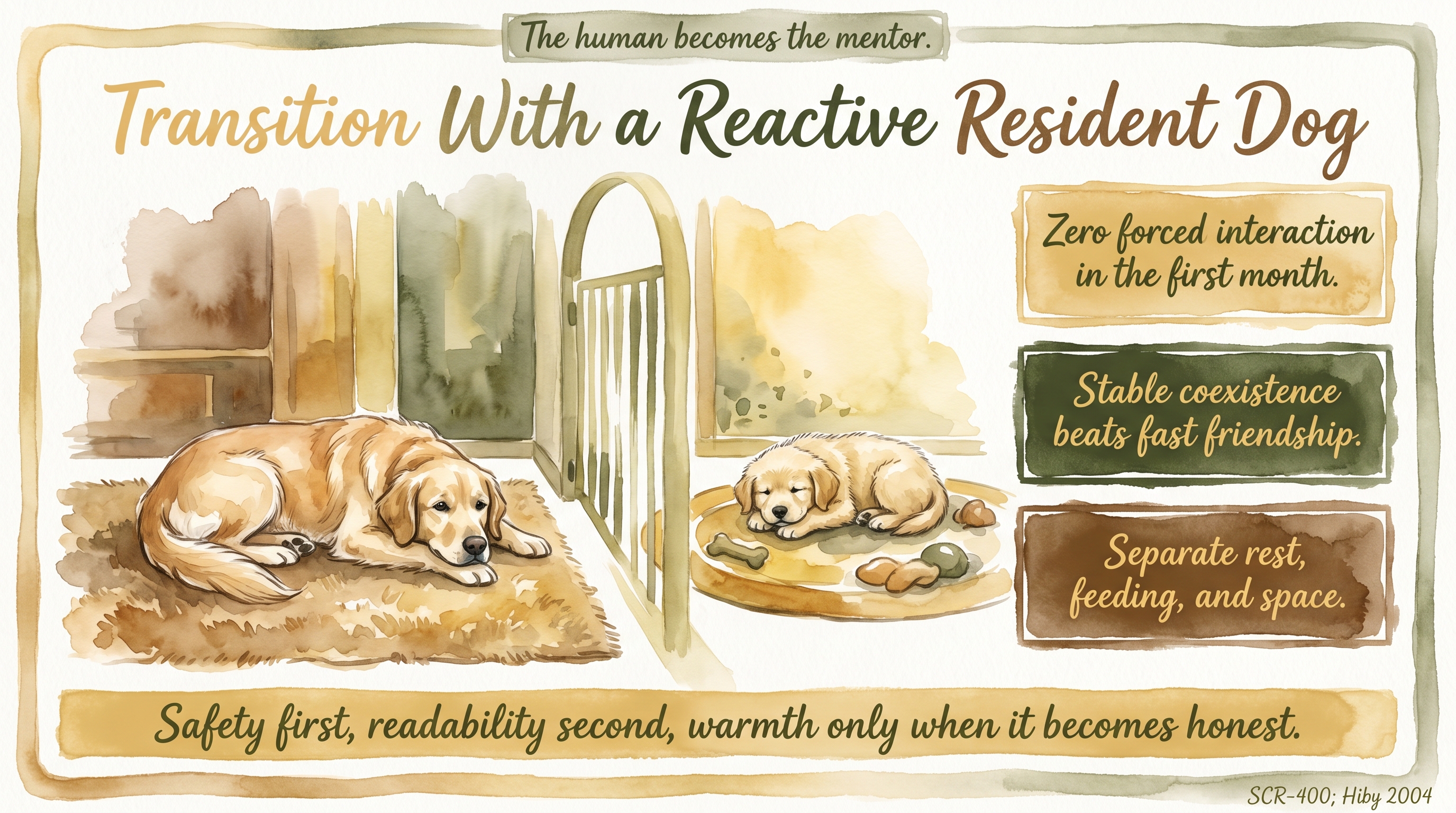
Safety first, readability second, warmth only when it becomes honest.
Key Takeaways
- A reactive or anxious resident dog removes much of the calm adult mentorship channel the puppy would ideally receive at home.
- The first goal is stable coexistence, not fast friendship, which is why forced interaction is such a damaging early mistake.
- Separate rest, separate feeding, distance-based coexistence, and human-led regulation are the core architecture in these homes.
- The soft landing still applies here, but the human has to carry more of it directly and the timeline is usually slower.
The Evidence
- Hiby et al. (2004); Herron et al. (2009); Vieira de Castro et al. (2020); Ziv (2017)domestic dogs
Dogs with fear, anxiety, or aggressive tendencies can worsen under coercive handling and poorly managed conflict, making environmental and relational management central to welfare. - Brubaker & Udell (2023); van Herwijnen et al. (2018, 2020); de Assis et al. (2025)domestic dogs
Household behavior and management style shape canine outcomes, which means human handling becomes especially important when dog-to-dog mentorship is unavailable.
- JB breeder-network observationfamily-raised puppies entering multi-dog homes
Reactive or anxious resident dogs require slower, more separated transitions with far more human-led regulation, because forced interaction reliably destabilizes both animals.
No published study directly tests the specific Just Behaving guidance on transition with a reactive resident dog. This entry relies on broader canine evidence, breeder observation, and practical synthesis.
SCR References
Sources
- Hiby, E. F., Rooney, N. J., & Bradshaw, J. W. S. (2004). Dog training methods: Their use, effectiveness and interaction with behaviour and welfare. Animal Welfare, 13(1), 63-69.
- Herron, M. E., Shofer, F. S., & Reisner, I. R. (2009). Survey of the use and outcome of confrontational and non-confrontational training methods in client-owned dogs showing undesired behaviors. Applied Animal Behaviour Science, 117(1-2), 47-54. https://doi.org/10.1016/j.applanim.2008.12.011
- Vieira de Castro, A. C., Fuchs, D., Morello, G. M., Pastur, S., de Sousa, L., & Olsson, I. A. S. (2020). Does training method matter? Evidence for the negative impact of aversive-based methods on companion dog welfare. PLOS ONE, 15(12), e0225023. https://doi.org/10.1371/journal.pone.0225023
- Ziv, G. (2017). The effects of using aversive training methods in dogs - A review of the current evidence. Journal of Veterinary Behavior, 19, 50-60.
- Brubaker, L., & Udell, M. A. R. (2023). Does pet parenting style predict the social and problem-solving behavior of pet dogs (Canis lupus familiaris)? Animal Cognition, 26(1), 345-356. https://doi.org/10.1007/s10071-022-01694-6
- van Herwijnen, I. R., van der Borg, J. A. M., Naguib, M., & Beerda, B. (2018). The existence of parenting styles in the owner-dog relationship. PLOS ONE, 13(2), e0193471. https://doi.org/10.1371/journal.pone.0193471
- van Herwijnen, I. R., van der Borg, J. A. M., Naguib, M., & Beerda, B. (2020). Dog-directed parenting styles predict verbal and leash guidance in dog owners and owner-directed attention in dogs. Applied Animal Behaviour Science, 232, 105131. https://doi.org/10.1016/j.applanim.2020.105131
- de Assis, L. S., Georgetti, B., Burman, O. H. P., Pike, T. W., & Mills, D. S. (2025). Development of a dog owner caregiving style scale (Lincoln Owner Caregiving Questionnaire, LOCQ) and its relationship with behaviour problems in dogs. Applied Animal Behaviour Science, 287, 106628. https://doi.org/10.1016/j.applanim.2025.106628