Four-Week Review: What to Watch For
The end of the first month is a good moment to pause and look honestly at what is settling. It is not a pass-fail exam, and it is not a promise that every puppy should look identical by day thirty. It is a practical checkpoint. By now, the family can usually tell whether the soft landing is consolidating into ordinary life, whether a few pieces need more support, or whether something is still off enough to justify reaching back out to the breeder or veterinarian. Observed-JB
What It Means
Month-one reviews work best when families stop asking, "Is the puppy perfect yet?"
The better question is:
what direction is the puppy moving in
By the four-week mark, a puppy does not need to be finished.
It should usually be becoming more readable.
Signs the First Month Is Landing Well
Different puppies show progress in different combinations, but the broad picture often includes: naps that are becoming more predictable, meals that happen with less agitation, short leash outings that feel calmer, stranger exposure that stays neutral instead of explosive, car rides that no longer feel like major events, and recovery after stimulation that is faster than it was in week two. Observed-JB
The key word is not perfect.
It is settling.
Signs the Family Should Check In
Some month-one concerns are worth bringing back to the breeder, the veterinarian, or a trusted veterinary behaviorist rather than trying to push through alone.
Those include patterns like: persistent sleep disturbance beyond the first unsettled weeks, arousal that does not reset even after good rest, recurrent loose stool or GI discomfort, repeated flinching, hiding, or durable social withdrawal, and family exhaustion so high that the calm floor is clearly not holding. Observed-JB
Needing support here is not failure.
It is exactly what support relationships are for.
The Popular Week-Three Story
This is also the point where many families expect some kind of official turning point because popular transition graphics often place a milestone around week three. JB's audit position stays the same as it was in the overview. The mnemonic captures a real rhythm people often notice, and something meaningful frequently does shift around weeks three to four. But it is still a heuristic, not a clinical stopwatch. A puppy who needs more time is not "behind" because a popular graphic drew a line on a certain day.
The Review Is About the Household Too
This page is not only a puppy review.
It is also a family review.
By one month, adults can usually answer: are we protecting naps consistently, are greetings calmer than they were, have we kept novelty sparse enough, are meals, outings, and absences still low drama, and do we need to simplify anything again.
That matters because month-one drift often begins with the humans, not the puppy.
What a Crash Landing Looks Like
Month-one crash landings often show up as pressure.
The family feels behind.
The puppy is not settling on the schedule someone online promised.
So the adults respond by adding: more outings, more social exposure, more engagement, and more attempts to "fix" the puppy quickly.
That usually makes the picture noisier, not clearer.
Another version is quieter but just as important. The family is tired, routines have loosened, rest has become inconsistent, and everyone is living a little more reactively than they meant to. The puppy's behavior then looks like the problem when the real issue is that the soft landing stopped being held with enough steadiness. Observed-JB
The review is meant to catch both versions early.
Why It Matters for Your Dog
This review matters because a month of life is enough time for patterns to begin showing themselves. It is long enough to notice whether the puppy is trending toward regulation, and it is short enough that course correction is still easy when something needs attention.
That is good news.
Families do not have to wait for a major problem before asking for help.
They also do not have to panic over every imperfect detail. A puppy can still be very much in process and still be on a good path.
The month-one review gives the family a steadier way to tell the difference.
It also reinforces one of JB's central relationship claims: the breeder relationship does not end at pickup. Questions at one month are expected. Check-ins are normal. Good support is part of the handoff.
From here, the work changes shape. Dispatch 5 moves into the problems families hit after the first month, how recovery works when transition mistakes have been made, and how signal continuity carries the dog deeper into ordinary life. Observed-JB
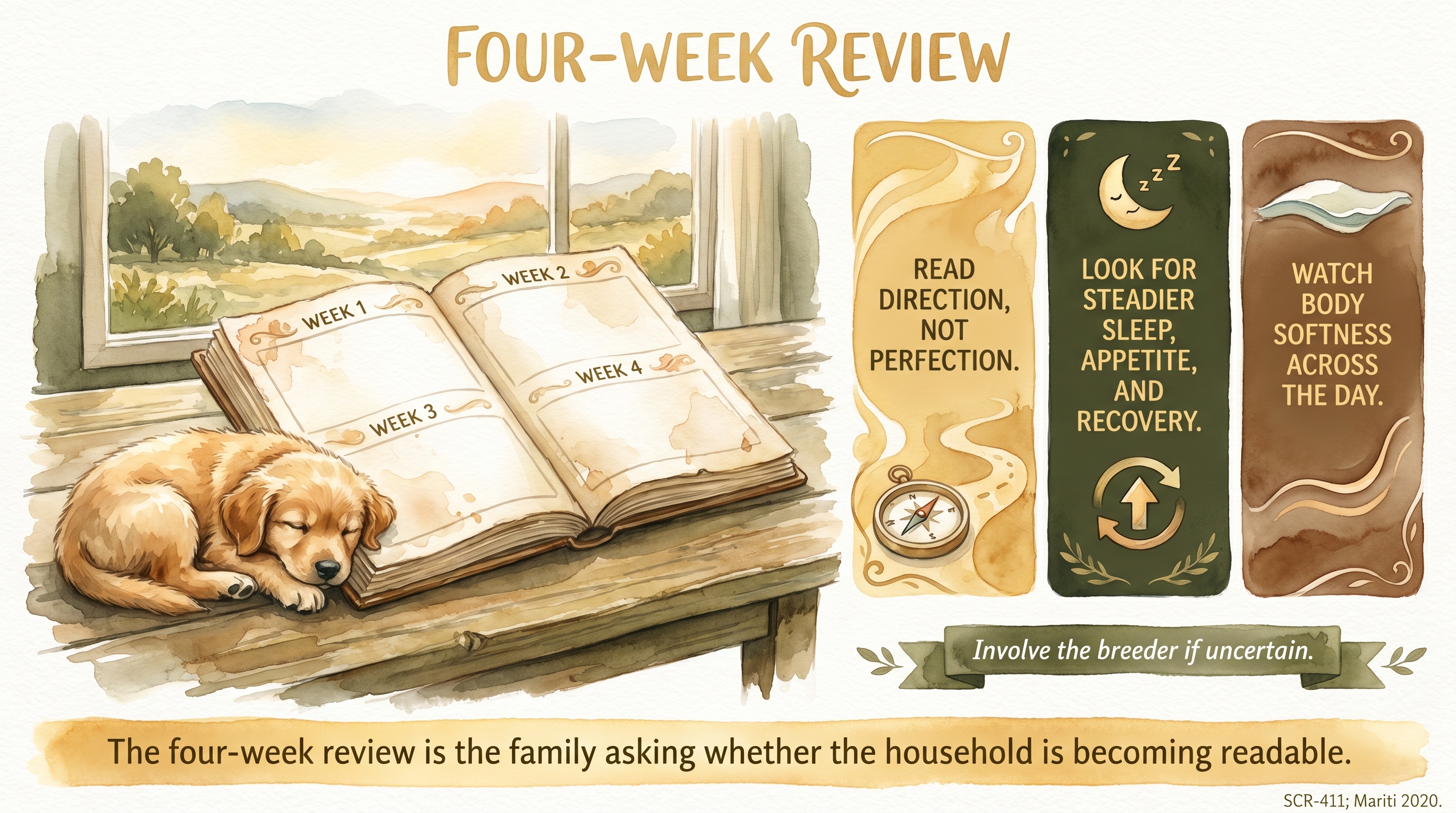
The four-week review is the family asking whether the household is becoming readable.
Key Takeaways
- The four-week review is a checkpoint about direction and settling, not a pass-fail test of whether the puppy is finished.
- Predictable naps, calmer meals, neutral stranger exposure, calmer travel, and faster recovery after stimulation are encouraging month-one signs.
- Persistent sleep disruption, poor reset after rest, recurrent GI upset, durable withdrawal, or family exhaustion are all good reasons to ask for support.
- Popular transition mnemonics can be useful reminders, but they should not be treated as rigid deadlines that every puppy must meet on schedule.
The Evidence
- Vaterlaws-Whiteside & Hartmann (2017); Stolzlechner et al. (2022); Howell et al. (2015); Freedman et al. (1961)domestic dogs
Young dogs do not mature on identical schedules, and early adjustment should be interpreted as a directional process rather than as a rigid calendar milestone. - Sundman et al. (2019); Hoglin et al. (2021); Beerda et al. (1999); Hennessy et al. (2009)domestic dogs
Recovery after stimulation, quality of rest, and environmental predictability are useful indicators of how well the puppy is settling into a new baseline.
- JB transition observationfamily-raised puppies
By the end of the first month, families can usually see whether naps, meals, stranger neutrality, car rides, and recovery after arousal are consolidating into a calmer everyday baseline.
- JB audit positionpopular dog-adjustment guidance
The week-three checkpoint captured in common transition mnemonics is a useful rough marker, but it is not a clinically validated deadline for settling.
No published study directly tests the specific Just Behaving guidance on four-week review within a breeder-to-family transition, so this entry relies on broader canine evidence, breeder observation, and practical synthesis rather than a direct trial of the full protocol.
SCR References
Sources
- Vaterlaws-Whiteside, H., & Hartmann, A. (2017). Improving puppy behavior using a new standardized socialization program. Applied Animal Behaviour Science, 197, 55-61.
- Stolzlechner, L., Bonorand, A., & Riemer, S. (2022). Optimising Puppy Socialisation-Short- and Long-Term Effects of a Training Programme during the Early Socialisation Period. Animals, 12(22), 3067. https://doi.org/10.3390/ani12223067
- Howell, T. J., King, T., & Bennett, P. C. (2015). Puppy parties and beyond: The role of early age socialization practices on adult dog behavior. Veterinary Medicine: Research and Reports, 6, 143-153. https://doi.org/10.2147/VMRR.S62081
- Freedman, D. G., King, J. A., & Elliot, O. (1961). Critical period in the social development of dogs. Science, 133(3457), 1016-1017.
- Sundman, A.-S., Van Poucke, E., Svensson Holm, A.-C., Faresjo, A., Theodorsson, E., Jensen, P., & Roth, L. S. V. (2019). Long-term stress levels are synchronized in dogs and their owners. Scientific Reports, 9, 7391. https://doi.org/10.1038/s41598-019-43851-x
- Hoglin, A., Van Poucke, E., Katajamaa, R., Jensen, P., Theodorsson, E., & Roth, L. S. V. (2021). Long-term stress in dogs is related to the human-dog relationship and personality traits. Scientific Reports, 11, 8612. https://doi.org/10.1038/s41598-021-88201-y
- Beerda, B., Schilder, M. B. H., van Hooff, J. A. R. A. M., de Vries, H. W., & Mol, J. A. (1999). Chronic stress in dogs subjected to social and spatial restriction. I. Behavioral responses. Physiology & Behavior, 66(2), 233-242. https://doi.org/10.1016/S0031-9384(98)00289-3
- Hennessy, M. B., Voith, V. L., Mazzei, S. J., Buttram, J., Miller, D. D., & Linden, F. (2009). Behavior and cortisol levels of dogs in a public animal shelter, and an exploration of the ability of these measures to predict problem behavior after adoption. Applied Animal Behaviour Science, 113(4), 798-810. https://doi.org/10.1016/j.applanim.2008.06.004