Handling the First House-Training Regression
House-training regressions feel especially discouraging because they make families doubt something that had seemed to be working. The puppy was going out, accidents were decreasing, the rhythm looked readable, and then suddenly the floor is wet again or the same corner is being used twice in a week. JB treats that moment as ordinary enough to plan for. The first regression is usually not a discipline crisis. It is much more often a sign that schedule, sleep, arousal, or health needs to be re-checked before anyone starts talking about stubbornness. Observed-JB
What It Means
Regressions tend to appear when the household starts drifting from first-week clarity.
Common causes include: missed post-nap trips, later meals, lighter sleep, more access to rooms that had not been earned yet, and a body that is off for medical reasons. Observed-JB
That last point matters.
If the regression persists, families should not assume it is all behavioral. Puppies can have health issues that make accidents more likely, and urinary irritation or infection is one of the most important practical examples. Observed-JB
This Is Usually Not Defiance
Humans often assign meaning too quickly: he knows better, she is testing us, and he is being lazy. Observed-JB
Those interpretations usually add more frustration than insight.
A puppy in week two or week three is not running a moral campaign around elimination.
The better framing is functional: what changed in the day, what changed in the body, and what changed in the level of supervision.
Prevention Rebuilds Faster Than Scolding
Families can lose hours or days to the after-the-fact reaction: loud voices, rubbing the puppy's nose near the mess, and dragging the puppy over to "show it". Observed-JB
These are not only ineffective.
They are harmful.
They teach nothing useful about where to eliminate, and they can make human involvement around elimination feel less safe.
The cleaner response is to go back to first-week prevention: more direct supervision, more restricted access, more timely trips, and more carrying to the door at key moments.
What Recovery Looks Like
Recovery is usually short when the cause is ordinary drift.
The family tightens the structure for several days: outside after sleep, outside after meals, outside after play, and fewer unsupervised freedoms.
If accidents keep happening or the pattern feels physically abnormal, that is the point to involve the veterinarian rather than to simply double down on behavioral explanations.
A quick medical rule-out often saves families a great deal of unnecessary confusion.
When health is clear and rhythm is restored, the regression often resolves more quickly than the family feared.
Why It Matters for Your Dog
This page matters because house training is one of the easiest places for adults to become punitive after the fact. Nothing about that helps the puppy, and plenty about it can damage trust.
The prevention approach is more effective and more humane.
It treats the problem where it actually lives: timing, supervision, access, and physiology.
That is especially important in the first month because a regression can make families think all the earlier progress was fake.
It was not.
The puppy simply needs the architecture tightened again.
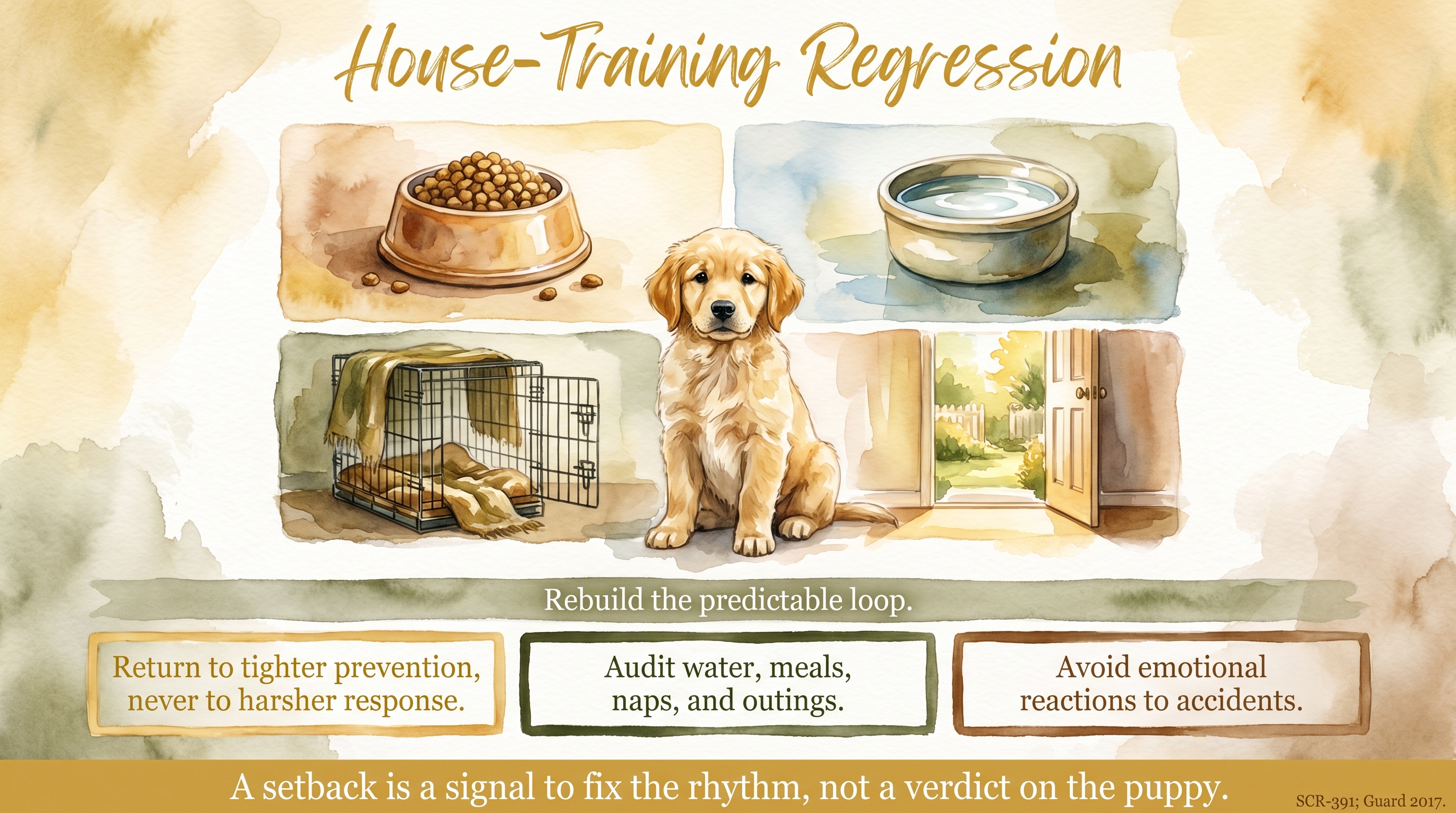
A setback is a signal to fix the rhythm, not a verdict on the puppy.
Key Takeaways
- A first house-training regression is usually a schedule, sleep, supervision, or health issue before it is a discipline issue.
- After-the-fact punishment teaches very little and can create unnecessary fear around human involvement with elimination.
- The best first response is a return to first-week prevention structure plus a health check if the pattern persists.
- Regression does not erase the earlier progress; it usually means the architecture needs tightening again.
The Evidence
- Bouton (2002, 2004); Gazit et al. (2005); Hall & Wynne (2016)domestic dogs
Early behavior is strongly context-dependent, which means small changes in schedule and setting can alter performance in ways owners misread as loss of learning. - WSAVA (2024); AAHA (2022); Schultz (2006); Stepita et al. (2013)domestic dogs
Urinary and gastrointestinal causes can complicate young-puppy elimination patterns, so persistent regression deserves medical consideration rather than punishment.
- JB family-coaching observationfamily-raised puppies
Most first house-training regressions improve when families re-tighten first-week prevention architecture, protect naps, and rule out health issues rather than escalating into after-the-fact scolding.
No published study directly tests the specific Just Behaving guidance on handling the first house-training regression within a breeder-to-family transition, so this entry relies on broader canine evidence, breeder observation, and practical synthesis rather than a direct trial of the full protocol.
SCR References
Sources
- Bouton, M. E. (2002). Context, ambiguity, and unlearning: Sources of relapse after behavioral extinction. Biological Psychiatry, 52(10), 976-986. https://doi.org/10.1016/S0006-3223(02)01546-9
- Bouton, M. E. (2004). Context and behavioral processes in extinction. Learning & Memory, 11(5), 485-494. https://doi.org/10.1101/lm.78804
- Gazit, I., Goldblatt, A., & Terkel, J. (2005). The role of context in extinction of searching behavior in dogs. Animal Cognition, 8(2), 91-99.
- Hall, N. J. (2017). Persistence and resistance to extinction in the domestic dog: Basic research and applications to canine training. Behavioural Processes, 141(Part 3), 67-74. https://doi.org/10.1016/j.beproc.2017.04.001
- Squires, R. A., Crawford, C., Marcondes, M., & Whitley, N. (2024). 2024 guidelines for the vaccination of dogs and cats - compiled by the Vaccination Guidelines Group (VGG) of the World Small Animal Veterinary Association (WSAVA). Journal of Small Animal Practice, 65(5), 277-316. https://doi.org/10.1111/jsap.13718
- Ellis, J., Marziani, E., Aziz, C., Brown, C. M., Cohn, L. A., Lea, C., Moore, G. E., & Taneja, N. (2022). 2022 AAHA Canine Vaccination Guidelines. Journal of the American Animal Hospital Association, 58(5), 213-230. https://doi.org/10.5326/JAAHA-MS-Canine-Vaccination-Guidelines
- Schultz, R. D. (2006). Duration of immunity for canine and feline vaccines: a review. Veterinary Microbiology, 117(1), 75-79. https://doi.org/10.1016/j.vetmic.2006.04.013
- Stepita, M. E., Bain, M. J., & Kass, P. H. (2013). Frequency of CPV infection in vaccinated puppies that attended puppy socialization classes. Journal of the American Animal Hospital Association, 49(2), 95-100. https://doi.org/10.5326/JAAHA-MS-5825