When the Family Has Made Mistakes Already
One of the most common quiet moments in this whole category is the family who reads the wiki in week three and realizes, with a sinking feeling, that they have been doing the opposite of what JB wanted. Greetings have been loud. Visitors have been too frequent. Responses were harsher than they meant to be. Naps were not protected. The puppy class already happened. JB has to answer that moment well or the philosophy becomes a purity test. It is not one. Families make mistakes. Many of those mistakes are recoverable. The task now is not self-punishment. It is a calmer and more honest reset. Observed-JB
What It Means
The first emotional job is naming what happened without dramatizing it beyond usefulness.
That may sound like: we let the house get too loud, we corrected harder when we got tired, we introduced too much too fast, and we did not realize the honeymoon period was not the settled baseline. Observed-JB
Those are hard sentences to say.
They are also productive sentences.
Guilt Is a Poor Regulator
Many families try to recover from mistakes while carrying guilt, and guilt usually produces one of two bad responses: overcorrection and collapse. Observed-JB
Overcorrection makes the house suddenly rigid, anxious, and loud with intention.
Collapse makes the adults feel there is no point trying now.
Neither response helps the puppy.
The better emotional posture is simpler: acknowledge, simplify, and restart.
Some Patterns Will Push Back
This page also needs honesty about extinction.
If the family already rehearsed: excited greetings, loud reunion rituals, and over-aroused mouthing.
then the reset may not feel smooth immediately.
The puppy may push harder at first because the older pattern has reinforcement history behind it, which is consistent with canine extinction findings and with broader persistence work from laboratory species. Documented-Cross-Species That does not mean the recovery is failing. It means the household is no longer working with a blank slate.
JB should not promise that nothing early is lasting. Some early experiences do have durable effects. The safer reassurance is narrower: a great deal can still improve, and the direction of the household still matters enormously going forward. Observed-JB
What Recovery Looks Like
Good recovery starts with auditing specific drift rather than vaguely "doing better."
Families usually make the fastest gains when they pick the real problems: greetings, naps, handling, visitors, food changes, and over-scheduling. Observed-JB
Then they return to first-week architecture for a defined stretch: quieter mornings, tighter supervision, simpler evenings, calmer contact, and fewer social demands.
Often the recovery also includes a shift in the adults themselves.
They stop trying to perform competence and start trying to make the home more readable.
That shift is a real part of the intervention.
Why It Matters for Your Dog
This page matters because families who feel ashamed tend to stop asking for help right when help would make the biggest difference. The puppy then lives inside the adults' discouragement as much as inside the original mistake.
JB wants to interrupt that.
The dog is not broken.
The family is not failing beyond repair.
The direction still matters.
That is a hopeful claim, but it is also a realistic one. Every day the household becomes calmer, more consistent, and less reactive is a day the puppy learns from the new pattern more than from the old one.
That is how homes recover.
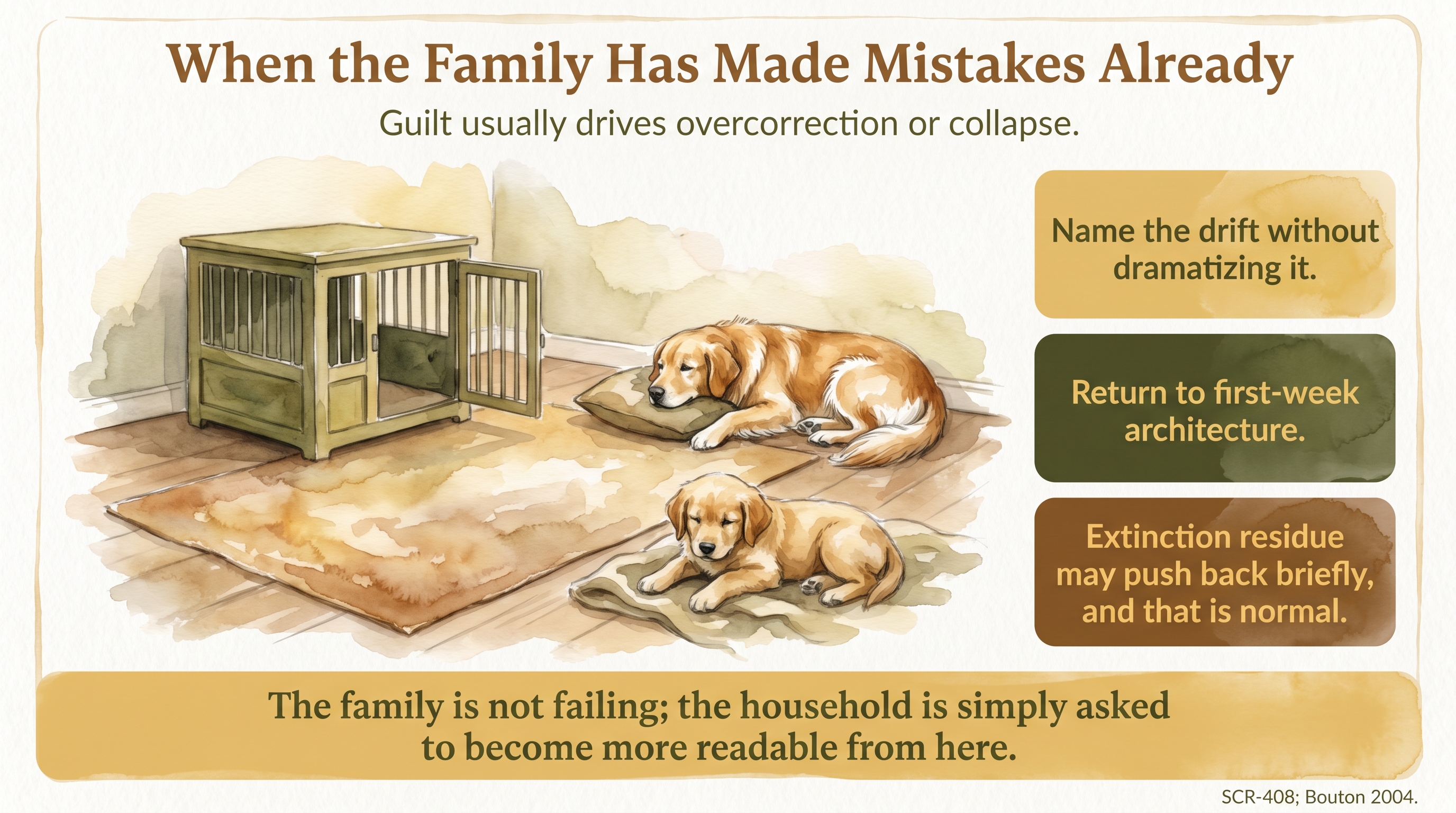
The family is not failing; the household is simply asked to become more readable from here.
Key Takeaways
- Realizing the family made early mistakes is common and should be treated as a reset moment, not as a purity-test failure.
- Guilt is a poor regulator because it usually produces either collapse or anxious overcorrection.
- Already rehearsed patterns may push back during recovery, which is consistent with persistence and extinction dynamics rather than proof of doom.
- The safest reassurance is not that nothing early matters, but that calmer direction still matters a great deal from here forward.
The Evidence
This entry uses documented cross-species claim-level tags beyond the dedicated EvidenceBlocks below. Species and application scope should be checked during the next evidence-chain authoring pass.
- Bouton (2002, 2004); Gazit et al. (2005); Hall & Wynne (2016)dogs and other laboratory species
Already learned responses often persist or temporarily intensify during extinction, which helps explain why unwanted first-month patterns may push back during recovery. - Brubaker & Udell (2023); van Herwijnen et al. (2018, 2020); de Assis et al. (2025)domestic dogs
Owner handling patterns, stability, and chosen methods are major parts of the behavioral environment, which means changing the household still matters even after drift has occurred.
- JB audit positionfamily transition recovery
The strongest nothing-is-permanent claim goes beyond what the literature can guarantee. The safer claim is that substantial improvement is often possible even though not every early effect can be assumed to vanish fully.
- JB family-coaching observationfamily-raised puppies
Families who stop spiraling about early mistakes and return to a simpler, calmer, first-week-style structure often recover more quickly than families who respond to guilt with either collapse or overcorrection.
No published study directly tests the specific Just Behaving guidance on when the family has made mistakes already within a breeder-to-family transition, so this entry relies on broader canine evidence, breeder observation, and practical synthesis rather than a direct trial of the full protocol.
SCR References
Sources
- Bouton, M. E. (2002). Context, ambiguity, and unlearning: Sources of relapse after behavioral extinction. Biological Psychiatry, 52(10), 976-986. https://doi.org/10.1016/S0006-3223(02)01546-9
- Bouton, M. E. (2004). Context and behavioral processes in extinction. Learning & Memory, 11(5), 485-494. https://doi.org/10.1101/lm.78804
- Gazit, I., Goldblatt, A., & Terkel, J. (2005). The role of context in extinction of searching behavior in dogs. Animal Cognition, 8(2), 91-99.
- Hall, N. J. (2017). Persistence and resistance to extinction in the domestic dog: Basic research and applications to canine training. Behavioural Processes, 141(Part 3), 67-74. https://doi.org/10.1016/j.beproc.2017.04.001
- Brubaker, L., & Udell, M. A. R. (2023). Does pet parenting style predict the social and problem-solving behavior of pet dogs (Canis lupus familiaris)? Animal Cognition, 26(1), 345-356. https://doi.org/10.1007/s10071-022-01694-6
- van Herwijnen, I. R., van der Borg, J. A. M., Naguib, M., & Beerda, B. (2018). The existence of parenting styles in the owner-dog relationship. PLOS ONE, 13(2), e0193471. https://doi.org/10.1371/journal.pone.0193471
- van Herwijnen, I. R., van der Borg, J. A. M., Naguib, M., & Beerda, B. (2020). Dog-directed parenting styles predict verbal and leash guidance in dog owners and owner-directed attention in dogs. Applied Animal Behaviour Science, 232, 105131. https://doi.org/10.1016/j.applanim.2020.105131
- de Assis, L. S., Georgetti, B., Burman, O. H. P., Pike, T. W., & Mills, D. S. (2025). Development of a dog owner caregiving style scale (Lincoln Owner Caregiving Questionnaire, LOCQ) and its relationship with behaviour problems in dogs. Applied Animal Behaviour Science, 287, 106628. https://doi.org/10.1016/j.applanim.2025.106628