The Crate Question in the Transition
Compound evidence detail1 SCR / 2 parts
- Documentedcanine sleep architecture, rest physiology, and observed den-seeking behavior in domestic dogs
- HeuristicJB approach to crate use as a rest-support tool that protects proximity, safety, and the calm floor during the transition
The crate question matters because families are often told there is one morally correct answer when there is not. Some are told a puppy must be crated from the first night and must learn to cry through it. Others are told crates are inherently harmful and should never be part of a humane household. JB rejects both simplifications. A crate can be a useful transition tool if it serves rest, safety, and calm. It becomes a problem when it functions mainly as a distress container or as a warehouse for the family's schedule. The first-week question is therefore not "crate or no crate?" It is "what job is the crate doing in this house, and is it serving the calm floor or violating it?" Mixed Evidence
What It Means
The crate has become one of the most emotionally loaded objects in modern dog raising because it gets asked to do too many different things.
People use the same word for: a nighttime sleep den beside the bed, a brief management space during cooking or cleaning, a daytime rest area the puppy can enter voluntarily, an all-day holding pattern while adults work, and a place where the puppy is left to cry until it stops. Mixed Evidence
Those are not the same use-case.
JB therefore starts with classification before judgment.
What JB Is Actually Saying
JB does not require the crate.
JB does not ban the crate.
JB asks a narrower question: in the first week, can the crate help create a protected, low-stimulation, proximity-preserving rest setup?
If yes, the crate may be useful.
If no, then a pen, gated sleep area, or similar protected arrangement may be the better tool. Mixed Evidence
The problem with most crate debates is that people argue over the object instead of the function.
When the Crate Helps
In the first week, a crate can help when it does the following: creates a predictable sleep site, sits in the quiet bedroom near the caregiver, reduces wandering and nighttime accidents, gives the puppy a den-like boundary for rest, and allows calm settling without social crowding.
In this form, the crate is not a correction. It is not a punishment. It is not a premature independence test. It is one possible structure for holding the calm floor.
Families often do well with: crate beside the bed, door closed if the puppy settles comfortably, door open if a pen setup works better, and same bedding and same location each night.
The principle is consistency plus proximity, not ideological devotion to one kind of enclosure.
When the Crate Stops Helping
The crate becomes a problem when the family asks it to solve transition distress by overriding the puppy's signals.
That often happens in the standard advice sequence: place puppy in crate, put crate away from the family, close the door, and ignore distress because responding will "reward crying".
At that point, the crate is no longer mainly functioning as a rest anchor. It is functioning as a container the puppy cannot escape while its distress runs without support.
Even families who are otherwise warm often do this because they believe the method is necessary, modern, and evidence-backed.
The evidence is not as clean as the confidence around it.
The Cry-It-Out Question
This is where the page needs full honesty.
There is no strong, simple literature saying: cry-it-out crate acclimation is harmless.
There is also no clean canine trial proving: cry-it-out crate acclimation causes a specific long-term disorder in ordinary home puppies.
That is why the dispatch correctly treats the cross-industry evidence as ambiguous. Ambiguous
What JB can say with confidence is narrower and still important: first-week transition stress is real, nighttime proximity is developmentally meaningful, silence is not identical to regulation, and crates used as primary distress-containment tools run against the soft-landing logic.
So JB does not need a perfect outcome study to refuse the most severe script. Documented It simply declines to turn the first week into an experiment in whether a newly separated puppy will stop protesting when trapped far from the caregiver.
Crate, Pen, or Gated Space
This is why JB keeps alternatives open.
Families may choose: a crate, an exercise pen, a gated sleep corner, and a hybrid setup with crate attached to pen.
Each can work if it preserves the important functions: safety, predictability, low stimulation, and proximity.
The correct first-week question is not "What do experts online say about crates?" It is "What arrangement lets this puppy sleep and settle with the least unnecessary distress while the new household takes shape?"
What a Crash Landing Looks Like Here
The crash-landing version of crate use usually takes one of two forms.
Form one is hardline confinement: crate in a separate room, puppy cries, humans are told not to answer, and the crate becomes the site of first-week rupture.
Form two is the opposite problem: no protected rest space at all, puppy falls asleep in chaos, every wake window becomes engagement, and the family mistakes access for freedom.
Both patterns fail the same deeper test. Neither is truly serving calm.
The first overwhelms by isolation.
The second overwhelms by exposure.
JB is looking for the middle path where the rest structure is real and the social bond is not unnecessarily severed.
The Crate Is a Tool, Not a Theology
That sentence is often all a family needs.
Crates are not sacred.
Crates are not evil.
They are tools. Their value depends on what they are helping the household do.
If the crate helps the puppy: rest, sleep, recover, and remain safe at night.
then it is serving the transition.
If the crate mainly helps the adults ignore escalating distress while telling themselves it is independence training, then it is violating the transition.
Why It Matters for Your Dog
The crate page matters because the first week creates emotional associations around containment very quickly.
If the puppy learns: enclosed space means sleep, safety, and quiet proximity.
that is one beginning.
If the puppy learns: enclosed space means separation, unanswered crying, and emotional overload.
that is another beginning entirely.
The right first-week question is not whether the crate wins an ideology argument. It is whether the containment setup is helping the puppy stay closer to calm or pushing it farther away.
This page also matters because it relieves families of a false burden. Many people assume that if they do not enforce full crate separation immediately, they have failed some basic standard of dog raising. JB says no. What matters most in the first week is not symbolic toughness. It is a coherent nervous-system landing.
Families are allowed to choose the tool that fits the house.
They are simply not allowed to pretend that all crate use is the same or that all silence means adaptation.
That is the nuance this page is protecting.
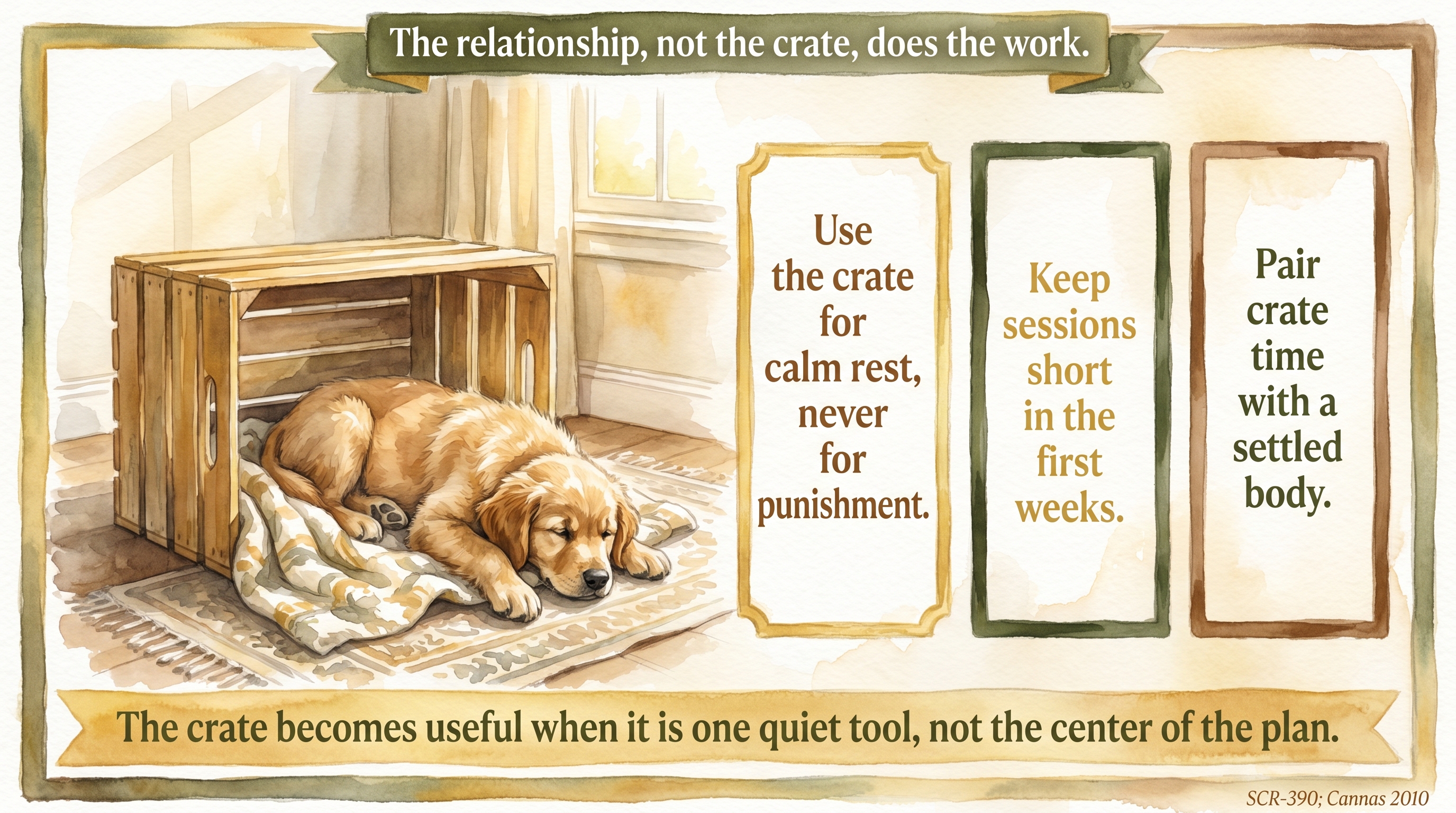
The crate becomes useful when it is one quiet tool, not the center of the plan.
Key Takeaways
- JB does not require or ban the crate. It asks whether the crate is serving calm, safety, and sleep in the first week.
- A crate beside the caregiver can work well as a nighttime rest tool, while a crate used mainly to override distress runs against the soft-landing logic.
- The broad crate debate is messier than internet certainty suggests, which is why the evidence around cry-it-out style use remains ambiguous.
- The crate is a tool, not a theology, and the best first-week setup is the one that protects regulation instead of sacrificing it.
The Evidence
This entry uses documented claim-level tags beyond the dedicated EvidenceBlocks below. These claims should remain tied to the entry Sources and SCR references during the next evidence-chain authoring pass.
This entry uses mixed-evidence claim-level tags beyond the dedicated EvidenceBlocks below. These tags mark claims that combine documented findings with observed practice, heuristic application, or unresolved gaps.
- JB first-week practicefamily-raised puppies
A crate can be a useful rest and sleep tool in the first week when it sits near the caregiver and functions as part of a calm transition setup rather than as a warehouse for distress.
- Cross-industry evidence boundarydomestic dogs
The literature does not support a simple universal claim that cry-it-out crate protocols are either clearly harmless or clearly devastating in all ordinary family puppies, which requires rhetorical caution around absolutes.
No direct canine research located for this specific topic. Current understanding relies on related research, clinical observation, and cross-species inference.
SCR References
Sources
- Topal, J., Miklosi, A., Csanyi, V., and Doka, A. (1998). Attachment behavior in dogs: A new application of Ainsworth's Strange Situation Test. Journal of Comparative Psychology, 112(3), 219-229. https://doi.org/10.1037/0735-7036.112.3.219
- Horn, L., Huber, L., and Range, F. (2013). The importance of the secure base effect for domestic dogs. PLoS ONE, 8(1), e65296. https://doi.org/10.1371/journal.pone.0065296
- Dale, F. C., Burn, C. C., Murray, J., & Casey, R. (2024). Canine separation-related behaviour at six months of age: Dog, owner and early-life risk factors identified using the 'Generation Pup' longitudinal study. Animal Welfare, 33, e60, 1-16. https://doi.org/10.1017/awf.2024.56
- Thielke, L. E., & Udell, M. A. R. (2019). Evaluating cognitive and behavioral outcomes in conjunction with the secure base effect for dogs in shelter and foster environments. Animals, 9(11), 932. https://doi.org/10.3390/ani9110932
- Adams, G. J., & Johnson, K. G. (1993). Sleep-wake cycles and other night-time behaviours of the domestic dog (Canis familiaris). Applied Animal Behaviour Science, 36(2-3), 233-248.
- Kis, A., Szakadat, S., Kovacs, E., Gacsi, M., Simor, P., Gombos, F., Topal, J., Miklosi, A., & Bodizs, R. (2014). Development of a non-invasive polysomnography technique for dogs (Canis familiaris). Physiology & Behavior, 130, 149-156.
- Kis, A., Szakadat, S., Gacsi, M., Kovacs, E., Simor, P., Torok, C., Gombos, F., Bodizs, R., & Topal, J. (2017). The interrelated effect of sleep and learning in dogs (Canis familiaris); an EEG and behavioural study. Scientific Reports, 7, 41873.
- Reicher, V., Bunford, N., Kis, A., Carreiro, C., Csibra, B., Kratz, L., et al. (2021). Developmental features of sleep electrophysiology in family dogs. Scientific Reports, 11, 22760. https://doi.org/10.1038/s41598-021-02117-1