Structured Leadership
Compound evidence detail3 SCRs / 7 parts
- Documentedthe human attachment evidence base together with the canine-direct secure-base findings (Topal 1998, Horn 2013) and Schoberl-documented physiological effects of secure caregiving in dogs
- Heuristicthe full attachment-theory apparatus transfer to canine relationships, including internal working models and attachment-classification systems
- Documentedthe Baumrind authoritative-parenting literature in human child development
- Documentedthe canine correlational evidence linking dog-directed caregiving styles to attachment, attention, sociability, and problem-solving outcomes (van Herwijnen 2018/2020, Brubaker and Udell 2023)
- Heuristicthe JB inference that one specific caregiving style experimentally produces the best long-term developmental outcomes in dogs
- Documentedthe wolf-side scientific record on the dominance model - Schenkel 1947 captive-pack methodology limitations, Mech 1999 wild-pack family-unit field data, and the AVSAB 2008 position statement against dominance-based training
- Heuristicthe JB application transferring the wolf family-unit framing to the dog-human relational architecture, an interpretive bridge that Mech's wolf data does not directly test in training contexts
Structured Leadership is the third pillar of Just Behaving: compassionate, firm parental guidance that provides both safety and structure. It means clear boundaries, calm authority, and predictable expectations. Mixed Evidence It does not mean intimidation, dominance rituals, or turning the relationship into a contest for rank.
For Families
Structured Leadership is the part of the framework that is most easily misread. It is not dominance. It is not training the dog to obey commands. It is closer to authoritative parenting in human developmental psychology - the parent who is warm and responsive and also clear about what the household expects.
In Baumrind's developmental research on human caregiving styles, permissive parenting was associated with elevated rates of childhood anxiety; harsh or hostile parenting was associated with elevated rates of childhood fear-based avoidance and behavioral shutdown. The Just Behaving framework infers analogous patterns in dogs raised under permissive or harsh leadership. The inference is biologically plausible and supported directionally by canine welfare research on aversive training methods (Ziv 2017; Vieira de Castro et al. 2020). The full causal mapping from caregiving style to canine developmental outcome has not been controlled-tested in dogs in the way it has been in humans, and the inference is held at Heuristic confidence. A dog raised under structured leadership has a parent figure who is calm, predictable, and consistent - the secure base research literature calls this the foundation for confident exploration.
What this looks like in practice is parent, not playmate. The household has a calm rhythm. Boundaries are held without drama. Affection is generous and not contingent on performance. The dog learns the household by watching how the household runs, not by being told what to do.
What It Means
The word leadership causes problems because most people hear it through the dog-training industry's vocabulary. They picture alpha rolls, sharp corrections, dominance hierarchies, or a human trying to "be the boss." That is not what Just Behaving means. JB is using leadership in the parental sense: the adult organizes the environment, regulates the tone, defines the boundaries, and gives the young a stable world in which development can happen.
The word structured is what does the real work here. Puppies do not need a louder human. They need a more predictable one. The caregiver who is calm on Monday, chaotic on Tuesday, permissive in the morning, and strict at night does not create security. That caregiver creates a moving target. By contrast, a home with stable rules, stable energy, and stable responses gives the puppy something its nervous system can actually use.
This is why Structured Leadership sits at the center of the pillar system. Mentorship needs an adult worth watching. Prevention needs a human willing to define and hold standards. Calmness needs someone who can keep the emotional floor low when novelty, frustration, or excitement show up. Indirect Correction only works safely when it comes from a trusted figure inside an already stable relationship. Structured Leadership is the relational architecture that lets the other pillars land.
Attachment science gives the clearest developmental language for this. Bowlby and Ainsworth described the caregiver as both a secure base and a safe haven. The young organism uses that caregiver in two directions at once: as the stable point from which it can move outward into exploration, and as the place it returns when strain, fear, or uncertainty rise. Dogs show documented secure-base effects with their owners. That does not mean every detail of human attachment theory transfers cleanly to dogs, but it does mean the broad developmental picture is not guesswork.
Parenting-style research sharpens the point. In human development, the best outcomes repeatedly cluster around the authoritative style: high warmth and high structure. Documented In Baumrindian taxonomy, high structure without warmth maps to authoritarian control. High warmth without structure maps to permissiveness. Low warmth and low structure are categorized as neglect. JB's claim is not that dogs are furry children. JB's claim is that the most useful parenting analogy is the adult who is both responsive and boundaried. In dogs, the evidence base is narrower and more correlational, but the direction is increasingly consistent: owner caregiving style is associated with differences in attachment, attention, sociability, and treatment outcome. Heuristic
That distinction matters because modern pet culture pushes people toward the wrong quadrant. Many owners are warm but structurally weak. They love the puppy, soothe the puppy, celebrate the puppy, and negotiate with the puppy. They also let rules move, match the puppy's energy, and confuse affection with leadership. The result is not freedom. The result is instability. A puppy can feel emotionally attended to and still remain developmentally under-parented.
Structured Leadership also differs sharply from dominance-based "leadership." The dominance model most often cited in pet-dog culture was built on captive, unrelated wolves housed in artificial groupings. Field work later showed that wild wolf packs are family units, with parental roles rather than the mythologized battle-for-rank model popularized in training culture. That matters because JB is not reviving alpha theory with softer language. It is explicitly rejecting that framework. The relevant model is parent to offspring, not dominant to subordinate.
This is where affective neuroscience becomes useful. Mammalian attachment and caregiving are not sentimental add-ons to development. They are built into the emotional architecture of social species. Panksepp's CARE and PANIC/GRIEF systems help explain why proximity, responsiveness, separation, and reunion matter so much in early life. A puppy is not simply learning rules. It is learning what kind of world it lives in, what kind of adult it can orient toward, and whether that adult is a source of steadiness or agitation.
Predictability is not just emotionally comforting. It is developmentally formative. Maier and Seligman's revised controllability framework argues that passivity is the default under adversity and that organisms must learn control through environments that are legible and dependable. Documented That matters for JB because "structure" is not cosmetic. Stable routines, stable limits, and stable consequences teach the young animal that the world has continuity. The exact neural implementation of JB's household model has not been tested in puppies, but the underlying controllability science is strong enough to support the principle.
The bond itself is not abstract either. Dog-human attachment and affiliation are measurable in physiology and behavior. Mutual gaze and affiliative interaction can participate in an oxytocin-mediated loop in at least some dog-owner dyads. Documented Owner personality and attachment quality also influence canine stress flexibility and behavioral treatment outcomes. In plain language: the person matters. Structure matters. The relationship matters. Method alone is not the whole story.
Once that is understood, the practical definition becomes simple. Structured Leadership means the human is the adult in the room. The human sets the emotional tone. The human decides what behaviors belong in the household. The human responds warmly, but not weakly. The human allows exploration, but not anarchy. The human comforts without collapsing into indulgence. The human protects the puppy from panic, but also protects the puppy from the long-term consequences of living without boundaries.
This is why JB says "parent, not playmate." Play can exist inside Structured Leadership. Warmth can exist inside Structured Leadership. Deep affection can exist inside Structured Leadership. What cannot happen is role confusion. The puppy should not be left to set the social terms of the relationship. The adult should.
Why It Matters for Your Dog
When a puppy experiences its people as calm, predictable, and consistently in charge, several things become easier at once. Mixed Evidence Exploration becomes safer because the puppy has a stable reference point. Recovery from stress becomes faster because there is somewhere reliable to orient. Boundary testing becomes less dramatic because the rules are already known. And correction becomes lighter because the relationship itself is carrying much of the information.
Structured Leadership means compassionate, firm parental guidance. The puppy gets both freedom and containment: room to explore, plus a stable adult who defines the shape of the world.
What Structured Leadership looks like:
- The same rules apply on good days, bad days, busy days, and tired days.
- The puppy is greeted calmly, not turned into an event.
- The adult notices distress quickly and responds, but does not reward chaos with more chaos.
- Boundaries are communicated early and quietly, before the puppy rehearses the unwanted pattern fifty times.
- Warmth is steady. It is not withheld to prove authority, and it is not used to buy compliance.
What Structured Leadership does not look like:
- Alpha rolls, scruffing, intimidation, or making the relationship adversarial.
- Treating excitement as connection and constant stimulation as engagement.
- Letting the puppy negotiate every household standard.
- Switching between permissive indulgence and frustrated crackdowns.
- Confusing a peer bond with a developmental bond.
The biggest practical consequence is maturity. A puppy that is always handled as a peer tends to remain socially juvenile for longer than it needs to. A puppy that is handled as a young member of a functioning social group has a clearer route upward. JB's language for this is simple: the adult should be pulling the puppy toward calm competence, not climbing down into puppy energy and living there.
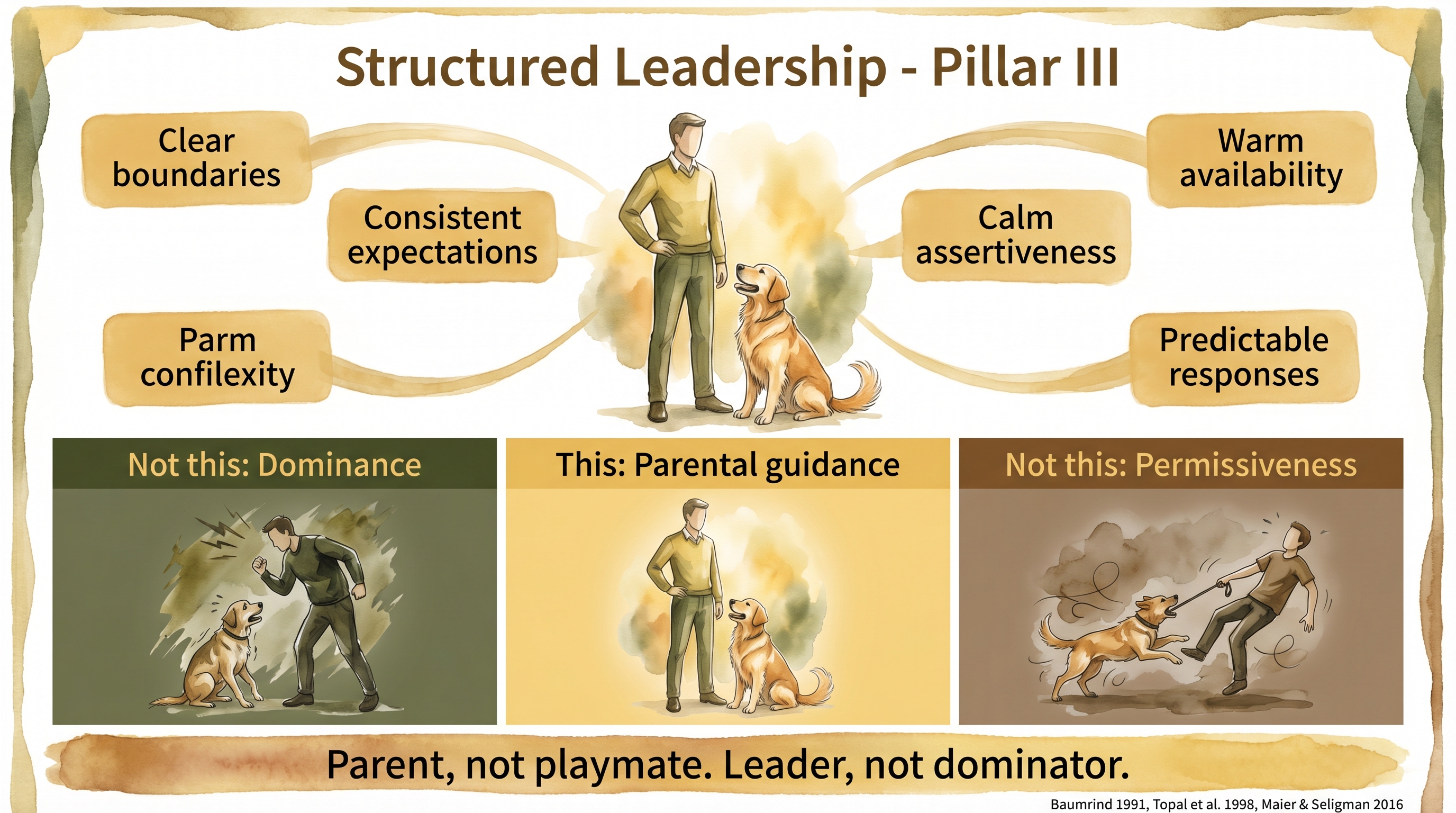
Parent, not playmate. Leader, not dominator. Compassionate, firm, predictable guidance.
Key Takeaways
- Structured Leadership means being the calm, predictable adult in your puppy's life, not dominating or being a peer.
- Clear boundaries, consistent routines, and steady emotional presence teach your puppy that the world makes sense and is safe.
- Warmth and structure belong together: affection without boundaries becomes indulgence, and structure without warmth becomes harshness.
- Your puppy learns how to handle challenge and stress by watching how you handle it, so staying regulated matters as much as the rules themselves.
The Evidence
This entry uses mixed-evidence claim-level tags beyond the dedicated EvidenceBlocks below. These tags mark claims that combine documented findings with observed practice, heuristic application, or unresolved gaps.
- Topal et al. (1998)domestic dogs
Adapted the Strange Situation Protocol for dogs and found attachment-like behavior toward owners, including proximity seeking and distress modulation. - Horn et al. (2013)domestic dogs
Confirmed a secure-base effect in dogs: the owner's presence changed exploration and task engagement in a novel setting. - Nagasawa et al. (2015)domestic dogs and humans
Documented a dog-human mutual gaze and oxytocin loop in some dyads, supporting measurable affiliative physiology rather than metaphorical bond language. - Powell et al. (2021)domestic dogs
Owner personality and owner-dog attachment were associated with behavioral treatment outcomes after consultation.
- Bowlby (1969)humans
Established attachment theory and the secure-base function of the caregiver in development. - Ainsworth et al. (1978)humans
Operationalized secure base, safe haven, and caregiver sensitivity through the Strange Situation framework. - Baumrind (1966, 1991)humans
Authoritative parenting, defined by warmth plus structure, is consistently linked to the strongest developmental outcomes in children. - Maier and Seligman (2016)multiple mammals
Reframed helplessness research around learned controllability: predictable environments build the conditions for resilient response rather than passivity. - Mech (1999) and AVSAB (2008)wolves and domestic dogs
Wild packs are family units rather than the popularized alpha hierarchy model, and veterinary behavior guidance cautions against dominance-based training applications.
- JB synthesisdomestic dogs and humans
Structured Leadership maps best to a warm-and-boundaried parental model. The exact full transfer from human parenting science to dog raising remains an interpretive framework rather than a controlled intervention literature. - JB synthesisdomestic dogs
The claim that predictability in daily household structure builds coping capacity in puppies is consistent with controllability science, attachment science, and owner-effect findings, but has not been tested as a standalone JB protocol.
- Evidence gapdomestic dogs
There is no direct randomized trial comparing puppies raised in a JB-style structured home against puppies raised in a permissive or excitement-driven home with long-term developmental follow-up. - Evidence gapdomestic dogs
The field has not yet isolated which specific parts of structured caregiving - consistency, warmth, routine, owner emotional stability, or all of the above - do the most developmental work.
SCR References
Sources
- Ainsworth, M. D. S., Blehar, M. C., Waters, E., & Wall, S. (1978). Patterns of attachment: A psychological study of the strange situation. Erlbaum.
- Baumrind, D. (1966). Effects of authoritative parental control on child behavior. Child Development, 37(4), 887-907.
- Baumrind, D. (1991). The influence of parenting style on adolescent competence and substance use. Journal of Early Adolescence, 11(1), 56-95.
- Bowlby, J. (1969). Attachment and loss. Vol. 1: Attachment. Basic Books.
- Horn, L., Huber, L., & Range, F. (2013). The importance of the secure base effect for domestic dogs. PLoS ONE, 8(1), e65296.
- Maier, S. F., & Seligman, M. E. P. (2016). Learned helplessness at fifty: Insights from neuroscience. Psychological Review, 123(4), 349-367.
- Mech, L. D. (1999). Alpha status, dominance, and division of labor in wolf packs. Canadian Journal of Zoology, 77(8), 1196-1203.
- Nagasawa, M., Mitsui, S., En, S., Ohtani, N., Ohta, M., Sakuma, Y., Onaka, T., Mogi, K., & Kikusui, T. (2015). Oxytocin-gaze positive loop and the coevolution of human-dog bonds. Science, 348(6232), 333-336.
- Powell, L., Stefanovski, D., Siracusa, C., & Serpell, J. A. (2021). Owner personality, owner-dog attachment, and canine demographics influence treatment outcomes in canine behavioral medicine cases. Frontiers in Veterinary Science, 7, 630931. https://doi.org/10.3389/fvets.2020.630931
- Vieira de Castro, A. C., Fuchs, D., Morello, G. M., Pastur, S., de Sousa, L., & Olsson, I. A. S. (2020). Does training method matter? Evidence for the negative impact of aversive-based methods on companion dog welfare. PLoS ONE, 15(12), e0225023. https://doi.org/10.1371/journal.pone.0225023
- Topal, J., Miklosi, A., Csanyi, V., & Doka, A. (1998). Attachment behavior in dogs (Canis familiaris): A new application of Ainsworth's Strange Situation Test. Journal of Comparative Psychology, 112(3), 219-229. https://doi.org/10.1037/0735-7036.112.3.219
- Ziv, G. (2017). The effects of using aversive training methods in dogs: A review. Journal of Veterinary Behavior, 19, 50-60.