Mentorship
The process by which puppies learn appropriate behaviors through structured, calm interactions modeled by adult dogs and humans. Mixed Evidence Mentorship emphasizes observation and subtle guidance over commands and treats - the "math professor" (thoughtful, patient guidance) rather than the "gym coach" (high-energy, command-driven drilling).
For Families
Mentorship is the simplest and most consequential idea in raising a dog. The puppy is watching you the same way a young mammal watches an older one - to figure out what kind of animal it should become. That is not a metaphor. It is the developmental mechanism Goldens evolved to use.
What this means in practice is that what you do matters more than what you say. The calm adult dog in the corner of the room is teaching the puppy more about how to be a dog than any training session ever could. The calm adult human in the corner of the room is teaching the puppy more about how to be a household member than any cue or command ever could.
The Just Behaving framework calls this the math professor model rather than the gym coach model. The math professor explains. The gym coach yells. Puppies learn from the explanation, not the volume.
What It Means
In mammalian species with extended parental investment, teaching by example is widely documented. Chimpanzee mothers sit beside a nut-cracking stone for years before a youngster picks up the skill. Meerkat adults bring progressively more challenging prey to juveniles. Elephant matriarchs lead calves along migration routes walked for generations. Across the species best studied for parental teaching, the pattern is consistent: the young watch, the adults model, learning flows upward from young to adult. Drilling young with repetitive commands and contingent food rewards is not a feature of how these species teach.
Modern domestic dogs participate in this pattern to a degree that is observable in program contexts but has not been directly studied in controlled comparison. Mixed Evidence The Just Behaving framework treats canine teaching-by-example as a working hypothesis grounded in cross-species mammalian observation and direct program observation; the hypothesis is held at Heuristic confidence at the canine-application level pending direct controlled study. A well-mannered adult dog does not get on the floor and match the puppy's energy. It does not become a puppy with the puppy. Over time, the puppy learns by watching. The adult demonstrates. The puppy absorbs. This is the math professor: calm, patient, present, available for observation - not the gym coach blowing a whistle and running drills.
The Just Behaving Dual Mentorship Model combines calm adult dog mentors with human parental guidance. The adult dogs demonstrate the behavioral standards of the household. The humans provide the structure, safety, and gentle leadership the puppy needs during the transition from breeder to family. Homes without adult dogs succeed through human mentorship alone - the human becomes the primary model of calm, structured behavior. Observed-JB The principle remains the same: what the puppy's environment models is what the puppy becomes.
This is also where Signal Precision enters the picture. Adult dogs deploy social signals - a play bow, a grooming invitation, tolerance at a food resource, a spatial correction - with surgical precision. Mixed Evidence These signals carry information precisely because they are rare, contextual, and specific. The mentor communicates through precision, not volume.
Why It Matters for Your Dog
Mentorship is the delivery mechanism for every other Pillar. The adult models Calmness. The adult demonstrates the boundaries of Structured Leadership. Prevention operates through what the mentor chooses not to model - no excitement-based play, no encouragement of behaviors that will later need correction. Mixed Evidence And when correction is needed, the mentor delivers it the way adult dogs do: briefly, calmly, proportionally.
Puppies learn through observation and subtle guidance modeled by calm adult dogs and humans. The "math professor" - thoughtful, patient guidance - not the "gym coach." Learning flows upward: young watching adult.
What Mentorship looks like:
- A puppy watching an adult dog settle calmly when a visitor arrives - and over days, beginning to mirror that response
- A human carrying a puppy calmly, moving through the house in a settled way, letting the puppy observe the rhythms of the household
- An adult dog ignoring a puppy's play solicitations - not engaging, not correcting, just being an adult - and the puppy learning that not every invitation is accepted
What Mentorship does not look like:
- Getting on the floor to match the puppy's energy level. You are not a puppy. You are the adult the puppy is supposed to be learning from.
- Running through command drills with treats. That is training. Mentorship is environmental - the puppy absorbs it by living in it.
- Ignoring the puppy. "Less is more" means restraint in initiation, not absence. When the puppy comes to you, you respond - calmly, warmly. This is sensitive responsiveness.
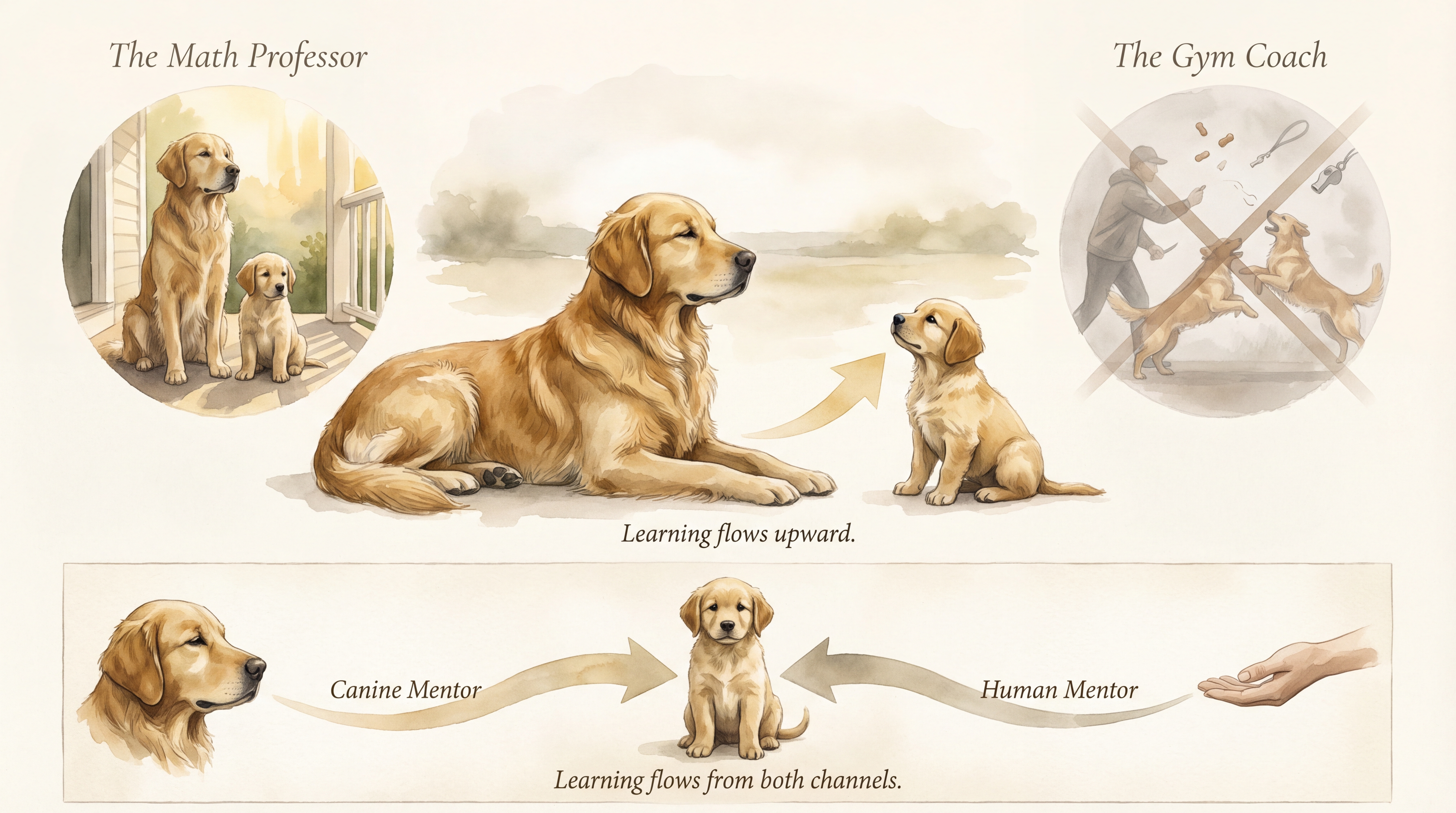
The Dual Mentorship Model: learning flows upward through targeted observation of human structure and adult dog modeling.
Key Takeaways
- Puppies learn most effectively by watching calm adult dogs and humans, not through commands and treats.
- Adult dog mentors demonstrate behavioral standards through precise, rare social signals - the real teaching happens through observation.
- The Dual Mentorship Model combines calm adult dogs with human parental guidance, creating a safe framework where learning flows naturally upward.
- Mentorship is the delivery mechanism for all five pillars - every other pillar works through what the mentor chooses to model.
The Evidence
This entry uses observed claim-level tags beyond the dedicated EvidenceBlocks below. These tags mark JB program observation or practice-derived claims that need dedicated EvidenceBlock coverage in a later content pass.
This entry uses mixed-evidence claim-level tags beyond the dedicated EvidenceBlocks below. These tags mark claims that combine documented findings with observed practice, heuristic application, or unresolved gaps.
- Fugazza, C. et al. (2018)domestic dogs
Scientific Reports. Demonstrated that puppies as young as 8 weeks can acquire novel behaviors through social learning from conspecifics. Three demonstrator conditions (mother, unfamiliar adult dog, human) - both conspecific and human demonstrator groups significantly outperformed no-demonstration controls. - Fugazza, C. & Miklósi, Á. (2015)domestic dogs
Applied Animal Behaviour Science. Direct comparison showing social learning (Do As I Do) is faster than shaping/clicker training for object-related tasks (P = 0.001). The advantage is robust for object-related actions; evidence for body movements is mixed. - Huber, L. et al. (2018, 2020, 2022)domestic dogs
Documented overimitation in dogs - dogs copy demonstrated actions even when simpler alternatives are available. Suggests a deeper fidelity to social modeling than simple efficiency would predict, consistent with development built on close observation of adult behavior. - Lugosi, C. A. et al. (2024)domestic dogs
BMC Biology. Cooperative breeds (including Golden Retrievers) learn better from human demonstrators; independent breeds learn better from conspecific demonstrators. Directly supports the Dual Mentorship Model - GRs are predisposed to learn from both channels.
- Bandura, A. (1961-65)humans
Social learning theory - organisms learn complex behaviors through observation without direct reinforcement. Modeling is a primary learning pathway across social species. - Cross-species convergencechimpanzees, dolphins, meerkats, elephants
Nut-cracking transmission, foraging pedagogy, graduated prey introduction, and matriarchal knowledge transfer all confirm mentorship through modeling as a conserved developmental strategy in highly social mammals (SCR-032).
The Dual Mentorship Model (adult dog mentors + human parental guidance) is JB's interpretive framework based on documented social learning capacity. Homes without adult dogs succeed through human mentorship alone - this is observational program data, not a controlled comparison.
Direct neural evidence for mirror neuron systems in dogs remains limited - behavioral evidence is suggestive, but no single-cell neural recording has been published for canines. Formal comparative studies of modeling-raised versus operant-trained dogs for complex behavioral repertoires are scarce.
SCR References
Sources
- Bandura, A. (1965). Influence of models' reinforcement contingencies on the acquisition of imitative responses. Journal of Personality and Social Psychology, 1(6), 589-595.
- Fugazza, C. et al. (2018). Social learning from conspecifics and humans in dog puppies. Scientific Reports, 8, 9257.
- Fugazza, C. & Miklósi, Á. (2015). Social learning in dog training: the effectiveness of the Do as I do method compared to shaping/clicker training. Applied Animal Behaviour Science, 171, 146-151.
- Huber, L. et al. (2018). Would dogs copy irrelevant actions from their human caregiver? Learning and Behavior, 46(4), 387-397.
- Huber, L. et al. (2020). Selective overimitation in dogs. Learning & Behavior, 48, 113-123.
- Lugosi, C. A., Udvarhelyi-Toth, K. M., Dobos, P., & Pongracz, P. (2024). Independent, but still observant: Dog breeds selected for functional independence learn better from a conspecific demonstrator than cooperative breeds in a detour task. BMC Biology.