Calmness
Compound evidence detail2 SCRs / 4 parts
- Documentedthe canine methylation pattern reported by Awalt 2024 for NR3C1 and OXTR in dogs with measured early-life history
- Heuristicthe JB extrapolation that ordinary calm raising produces durable epigenetic advantages in dogs beyond preventing adverse environments
- Documentedthe cross-species behavioral principle that parasympathetic-dominant autonomic states support social engagement, with direct canine HRV evidence (Berg 2026, Wormald 2017, Koskela 2024)
- Ambiguousthe polyvagal-theory-specific neuroanatomical mechanism, with the Grossman 2026 critique and Porges 2026 rebuttal active in current literature
The deliberate cultivation of serene environments and emotionally regulated interactions as the default state of the household. Calmness is not lethargy, suppression, or behavioral inhibition. It is attentive, engaged emotional stability - parasympathetic tone as the target baseline. Just Behaving builds the calm floor first. Mixed Evidence Everything else follows from there.
For Families
Calmness is the baseline state Just Behaving asks families to build first. Not lethargy. Not a tired dog. The kind of calm a healthy adult dog rests in when nothing in particular is happening - engaged with the household, attentive to what matters, and not running on the edge of excitement.
Most pet dogs do not have this baseline. The industry standard is to start with an excited puppy and try to train down to calm later. Just Behaving inverts that. The calm baseline gets built first, in the breeder environment, and the family's job is to continue it rather than rebuild it.
What this looks like at home is unglamorous. The household tone is calm. Greetings are calm. Mealtimes are calm. Excitement still happens, but it is the exception, not the operating mode. The calm dog is not a dull dog. The calm dog is the dog who has the bandwidth to be present.
What It Means
There is a cultural myth that an excited dog is a happy dog. That the puppy bouncing off the walls is expressing joy. That the dog who cannot settle at a restaurant or screams in the car is just "being a dog." Just Behaving challenges this directly. Chronic excitement is not happiness. It is a nervous system that never learned to regulate. And the cost of that dysregulation is real - physiologically, behaviorally, and developmentally.
The canine autonomic nervous system consists of two primary branches. The sympathetic branch drives the "activate" response - increased heart rate, mobilized glucose, heightened alertness, the physiological signature of arousal. The parasympathetic branch, operating primarily through the vagus nerve, drives the "recover and regulate" response - lowered heart rate, digestive function, the physiological signature of calm engagement. <EvidenceBadge type="documented" inline /> These two branches are not opponents. They are partners. The question is not whether one fires, but how efficiently the system moves between states and how reliably it returns to a regulated baseline.
Heart rate variability (HRV) - the beat-to-beat variation in heart rate - has been empirically validated as a noninvasive index of autonomic modulation in dogs. <EvidenceBadge type="documented" inline /> Higher HRV generally reflects stronger parasympathetic (vagal) influence, indicating a system that can flexibly respond to demands and recover efficiently. Lower HRV reflects sympathetic dominance - a system locked in activation mode. Reduced HRV in pet dogs is associated with anxiety-related behavioral problems (Wormald et al., 2017). ``
Data from the AI-COLLAR study reported a median resting heart rate of 57.9 beats per minute for Golden Retrievers in that dataset, lower than the general canine population median in the same study. As a single-study population statistic, this finding is consistent with but does not on its own establish a breed-level disposition. The interpretation that Golden Retriever biology and the Just Behaving framework align on the calmness baseline is held at heuristic confidence.
The Arousal Question
The Arousal Question comes down to sequence. Just Behaving builds the calm floor first. From that foundation, natural arousal - play, exploration, novel situations, environmental challenges - occurs on its own, because arousal is a natural state. The dog does not need to be taught arousal tolerance. It needs a regulated baseline to return to.
The industry inverts this sequence: it starts in excitement and then tries to train the dog back down to calm. Mixed Evidence A dog living in chronic excitement has nowhere to come down to.
The Window of Tolerance - the capacity to move through arousal states and return to baseline - develops naturally when the baseline exists. A Just Behaving dog runs along a beach, fetches balls from the water, digs in the sand - and then settles calmly for lunch without being told. Mixed Evidence That is not suppression. That is regulation. And the distinction matters.
A landmark 2015 study tested this directly. Bray, MacLean, and Hare compared 106 assistance dogs (bred and trained for low baseline arousal) with 30 pet dogs on an inhibitory control task, manipulating arousal through human vocal tones. The results split cleanly along baseline arousal lines. The assistance dogs, starting from a regulated calm baseline, actually improved their performance when humans eagerly encouraged them - the added stimulation moved them upward toward the optimal peak. The pet dogs, already starting at higher baseline arousal, showed significant cognitive impairment when arousal was increased. `` (SCR-047)
This is not "calm is always better." It is something more precise: optimal arousal depends on where the dog starts. For dogs already operating from a high-arousal baseline - which describes the vast majority of household pets - additional excitement degrades cognitive performance. Mixed Evidence For dogs operating from a calm, well-regulated baseline, moderate stimulation can enhance performance. Build the calm floor first. A dog raised in a regulated, low-arousal environment has room on the curve. When life provides stimulation, the dog can absorb it and still think clearly.
The Cost of Chronic Dysregulation
The consequences of chronic arousal are not abstract. Classic chronic stress experiments document that social and spatial restriction produces chronic stress physiology and immunological responses in dogs (Beerda et al., 1999). Modern immunology work confirms that dogs subjected to different durations of chronic environmental stress show measurable differences in T-lymphocyte subset distribution, expansion capacity, and apoptosis (Kulka et al., 2026). Chronic stress modulates the immune system at the cellular and molecular level. In dogs. Directly measured (SCR-045).
The consequences extend to the heart. In studies of client-owned dogs with diagnosed chronic anxiety and hyper-arousal, echocardiographic findings have included elevated fractional shortening and higher left atrial-to-aortic root ratios, consistent with early atrial remodeling from sustained sympathetic activation. The study population is dogs already presenting clinical anxiety. Whether comparable effects occur from ordinary household arousal routines has not been directly tested, and the extension from clinical anxiety populations to household-arousal contexts is held at heuristic confidence. At the population level, fear and anxiety traits in pet dogs are associated with health and lifespan differences. ``
Chronic environmental stress also accelerates telomere shortening in dogs (Dutra et al., 2025). However, the canine evidence documents effects of chronic environmental deprivation and institutional stress - kenneling, shelter conditions - not household arousal levels. The specific link between household excitability and lifespan reduction has not been tested. (SCR-015)
Calmness Enables Everything Else
Calmness enables Mentorship. A dysregulated puppy cannot observe, process, or learn from modeling. The parasympathetic state is a prerequisite for the social learning that Mentorship depends on. When the nervous system is calm, social information can be processed and modeling can be absorbed. When the nervous system is sympathetic-dominant - aroused, reactive, flooded - the brain is in survival mode and learning shuts down.
Calmness supports Prevention. A calm environment has fewer triggers and fewer opportunities for unwanted behaviors to form. Calmness sets the emotional context within which Indirect Correction can function as communication rather than punishment. The entire system runs on a calm foundation. Without it, nothing else works.
Why It Matters for Your Dog
Always bring peace, never bring chaos. Never bring excitement to a puppy, only calm. This is the core maxim. Your stress is your dog's stress. Your calm is your dog's calm. This is not a metaphor - it is measurable biology. Sundman et al. (2019) documented long-term cortisol synchronization between owners and dogs, with owner personality as the primary driver. `` (SCR-012). The direction of information flow is predominantly human-to-dog: dog personality traits have comparatively little effect on owner cortisol, but owner personality predicts dog cortisol (SCR-105).
Dogs do not even need to see your stress for it to affect them. Wilson et al. (2022) demonstrated that dogs can discriminate human baseline versus stress odor samples. Parr-Cortes et al. (2024) extended this finding: exposure to stressed-person odor actually impaired cognitive flexibility and learning in dogs. (SCR-058, SCR-107). Your anxiety becomes your dog's anxiety - through multiple sensory pathways simultaneously.
What Calmness looks like:
- A household where the default energy is settled. The humans are calm. The existing dogs are calm. The puppy enters a world where calm is the ambient baseline.
- Carrying a puppy quietly, cradling it against your body. Touch when the puppy is calm, not when it is frantic.
- A dog that can move through arousal - running, playing, exploring - and return to a settled state on its own, without being told to "settle" or "place."
- The human not importing excitement. No high-pitched greetings at the door. No wrestling on the floor as a bonding activity. No baby talk as a default communication mode.
- Structured Companionship as the primary bonding modality: quiet exploration together, calm walking, settled co-existence.
What Calmness does not look like:
- A flat-lined, inhibited dog that never plays. Calmness is a baseline, not a ceiling. Natural arousal is celebrated. Human-initiated chaos is not.
- Never allowing the dog to experience challenge or novelty. Calibrated challenge within a calm framework builds resilience. Overprotection undermines development just as surely as overstimulation (SCR-037).
- Punishing excitement. If the dog is naturally aroused - playing with another dog, encountering something novel - that is not a problem. The problem is when the human creates the arousal and then tries to manage it.
- Emotional flooding from the human. Emotional Reciprocity means the dog absorbs what the human projects. A human who brings anxiety, excitement, or emotional volatility into every interaction is not cultivating calm - no matter how quiet the house is.
The type of physical interaction matters. Slow stroking is associated with calming effects. But activating touch - scratching and patting - is associated with cortisol increases in dogs. `` (SCR-044). High-energy physical contact drives sympathetic arousal. The intent is not what matters. The physiology is what matters. A person vigorously roughhousing with a dog may believe they are bonding. The dog's endocrine system is registering stress.
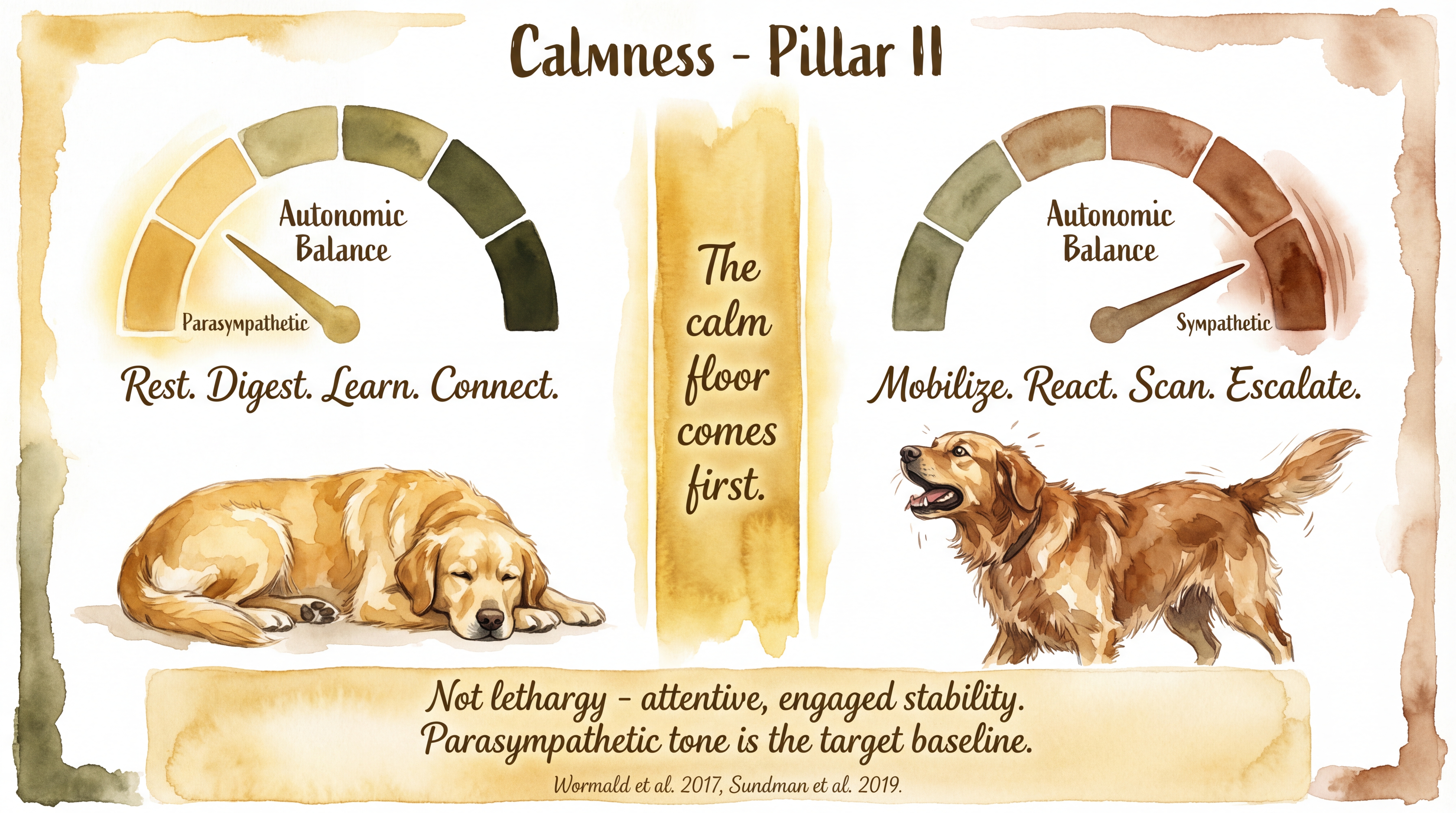
The calm floor comes first - not lethargy, but attentive, engaged stability as the default state.
Key Takeaways
- Calmness is parasympathetic-dominant stability - not lethargy but attentive, engaged presence. It is the prerequisite for learning, social processing, and emotional flexibility.
- The calm floor comes first. JB builds baseline calm and lets the window of tolerance expand upward. The industry starts in excitement and tries to train down.
- Owner stress synchronizes directly to dog cortisol over months. Your regulated state is not a nice idea - it is measurable biology shaping your dog's nervous system.
- Touch type matters physiologically. Slow stroking activates calming pathways. Activating touch - patting, scratching, roughhousing - drives cortisol up regardless of intent.
The Evidence
This entry uses documented claim-level tags beyond the dedicated EvidenceBlocks below. These claims should remain tied to the entry Sources and SCR references during the next evidence-chain authoring pass.
This entry uses mixed-evidence claim-level tags beyond the dedicated EvidenceBlocks below. These tags mark claims that combine documented findings with observed practice, heuristic application, or unresolved gaps.
No published study directly tests the specific claims or protocols described in this entry within a controlled canine trial.
SCR References
Sources
- Beerda, B., Schilder, M. B. H., van Hooff, J. A. R. A. M., de Vries, H. W., & Mol, J. A. (1999). Chronic stress in dogs subjected to social and spatial restriction. Physiology & Behavior, 66(2), 243-254.
- Bray, E. E., MacLean, E. L., & Hare, B. (2015). Increasing arousal enhances inhibitory control in calm but not excitable dogs. Animal Cognition, 18(6), 1317-1329.
- Dutra, L. et al. (2025). Telomere tales: Exploring the impact of stress, sociality, and exercise on dogs' cellular aging. Frontiers in Veterinary Science.
- Handlin, L. et al. (2011). Short-term interaction between dogs and their owners. Anthrozoös, 24(3), 301-315.
- Handlin, L. et al. (2012). Associations between the psychological characteristics of the human-dog relationship and oxytocin and cortisol levels. Anthrozoös, 25(2), 215-228.
- Hennessy, M. B., Kaiser, S., & Sachser, N. (2009). Social buffering of the stress response. Frontiers in Neuroendocrinology, 30(4), 470-482.
- Kulka, A. et al. (2026). Duration-dependent immunomodulation by chronic environmental stress in dogs. Veterinary Immunology and Immunopathology.
- Parr-Cortes, F. et al. (2024). Human stress odor affects dog cognitive performance. Scientific Reports.
- Sundman, A. S. et al. (2019). Long-term stress levels are synchronized in dogs and their owners. Scientific Reports, 9, 7391.
- Thayer, J. F., & Lane, R. D. (2000). A model of neurovisceral integration in emotion regulation and dysregulation. Journal of Affective Disorders, 61(3), 201-216.
- Wilson, C. et al. (2022). Dogs can discriminate between human baseline and stress conditions. PLOS ONE, 17(9), e0274143.
- Wormald, D., Lawrence, A. J., Carter, G., & Fisher, A. D. (2017). Reduced heart rate variability in pet dogs affected by anxiety-related behaviour problems. Physiology & Behavior, 168, 122-127. https://doi.org/10.1016/j.physbeh.2016.11.003