Introducing the Puppy to Cats and Other Household Pets
Cats and smaller household pets should not be introduced under the assumption that the puppy will simply be "curious" and figure it out. The first week teaches patterns very fast, and one of the most damaging patterns a family can accidentally normalize is low-level chase. JB's rule is simple: the resident animal's safety and calm come first, the puppy's access is restricted until predictability exists, and the introduction is measured in seconds and repeated over days rather than forced into a single dramatic meeting. Observed-JB
What It Means
The household story about cats and puppies is often far too casual.
Families say: the puppy just wants to play, the cat will teach the puppy, and they need to get used to each other.
Sometimes that optimism works because the cat is bold, the puppy is soft, and the humans are more structured than they realize.
But many chronic cat-dog problems begin under the innocent sentence "they're just getting to know each other." Observed-JB
What is actually happening is rehearsal: the puppy notices movement, the puppy rushes, the cat flees, the chase feels interesting, the humans laugh or merely tolerate it, and the pattern repeats.
At that point the problem is no longer the first meeting. The problem is the family accidentally teaching the puppy that cats are moving targets.
The Cat Is the Social Authority
JB treats the resident cat as the ranking authority in its own space until proven otherwise. Observed-JB
That means the environment must preserve the cat's control over distance. The cat should always have: elevated escape routes, a room or zone the puppy cannot access, the ability to leave the interaction immediately, and no requirement to "accept" the puppy on human schedule.
This is one of the clearest differences between soft landing and crash landing in a multi-species home.
A soft landing says: the cat's calm is part of the household calm and therefore the cat's exit rights are non-negotiable.
A crash landing says: the puppy lives here now, the cat needs to adapt, and let's put them together and see what happens.
That second script creates the exact kind of background stress families later struggle to undo. Observed-JB
The First Meeting Should Be Tiny
For most homes, the first meeting should be extremely brief: puppy on leash, held, or behind a pen boundary, cat free to leave, one glance or a few seconds of shared space, and then separation.
That brevity often feels underwhelming to people, which is one reason they overdo it. Humans want the meeting to be meaningful. The animals usually need it to be tolerable.
The first meeting should answer only one question: Can the two animals perceive each other without the household becoming emotionally flooded?
If yes, that is enough for day one.
Why Forced Contact Is a Mistake
Families often physically carry the puppy toward the cat or bring the cat toward the puppy "so they can sniff."
This ignores the actual social needs of both animals.
The cat's needs: distance, choice, vertical escape, and the right to refuse.
The puppy's needs: low arousal, clear boundary, and no reinforcement for lunging or chasing.
Forced contact deprives both animals of the conditions most likely to produce a stable relationship later.
The Hundred Small Chases Matter More Than the First Meeting
The single most important JB point on this page is not about the first meeting itself.
It is about the next hundred moments.
Most long-term cat-dog conflict is not created by one dramatic fight. It is created by a family allowing: one quick hallway chase, one bounce toward the litter box, one playful pounce at the stairs, and one excited follow when the cat runs.
Then another.
Then another.
Humans do not always intervene because each event seems too small to matter.
JB sees those events differently. Observed-JB Each uncorrected or unprevented chase is a rehearsal. Each rehearsal makes the next one easier.
That is why this page belongs in the transition category. The first week is the perfect time to decide that chase is not part of the puppy's social vocabulary here.
Birds, Small Mammals, and Reptiles
The same principle becomes even stricter with prey-sized animals.
If the home contains: birds, rabbits, guinea pigs, hamsters, and reptiles.
then introductions are not social in the ordinary sense at all. They are exposure-management questions.
The puppy should not have free access.
The enclosure should not become stimulation.
The family should not assume curiosity is harmless simply because the puppy is young. Small-animal households require tighter prevention from day one because the cost of an error is much higher.
What a Crash Landing Looks Like Here
The crash-landing version usually sounds familiar: the cat is cornered in a room with the puppy, the puppy is allowed to trot after the cat because "he's just playing", the family laughs at the chase because it is not yet intense, the cat starts avoiding common spaces, and the puppy begins scanning for the cat's movement.
At that point, both animals are learning the wrong things.
The puppy learns: movement is exciting, following is fun, and the cat is an activation cue.
The cat learns: the puppy is invasive, common areas are unsafe, and the humans do not control proximity well.
That is a crash landing, even if nobody ever had a dramatic fight.
Prevention Is the Whole Logic
JB's prevention language fits this page almost perfectly.
The family should not allow the puppy to begin a behavior pattern it will later have to unteach under emotional load. Chasing a cat is exactly that kind of pattern. It can become: thrilling for the puppy, stressful for the cat, and hard for the humans to interrupt cleanly later.
So the correct first-week standard is not "correct it after it happens several times."
It is "arrange the house so it does not become a pattern in the first place."
Why It Matters for Your Dog
A multi-species household can become beautifully ordinary, but it almost never becomes beautifully ordinary by accident.
It becomes ordinary because the humans build it that way: barriers where needed, elevated cat pathways, short exposures, chase never normalized, and puppy calm protected.
The family should not let low-level chase become part of the puppy's normal repertoire. In a multi-species home, prevention is kinder than correction because the cost of rehearsal is paid by every animal in the house.
This page matters because it helps families tell the truth about "play." A puppy chasing a fleeing cat may look playful to humans because it is not yet aggressive. But the cat does not experience that moment as a theory about play. The cat experiences pressure, loss of control, and threat to personal space.
That is why the first week is so important. If the puppy learns early that cats are to be noticed and then left alone, the whole household benefits. If the puppy learns that cats are an energy source, the house starts building chronic stress for both species.
The soft landing version is not anti-contact. It is pro-sequence. Safety first. Calm second. Relationship later.
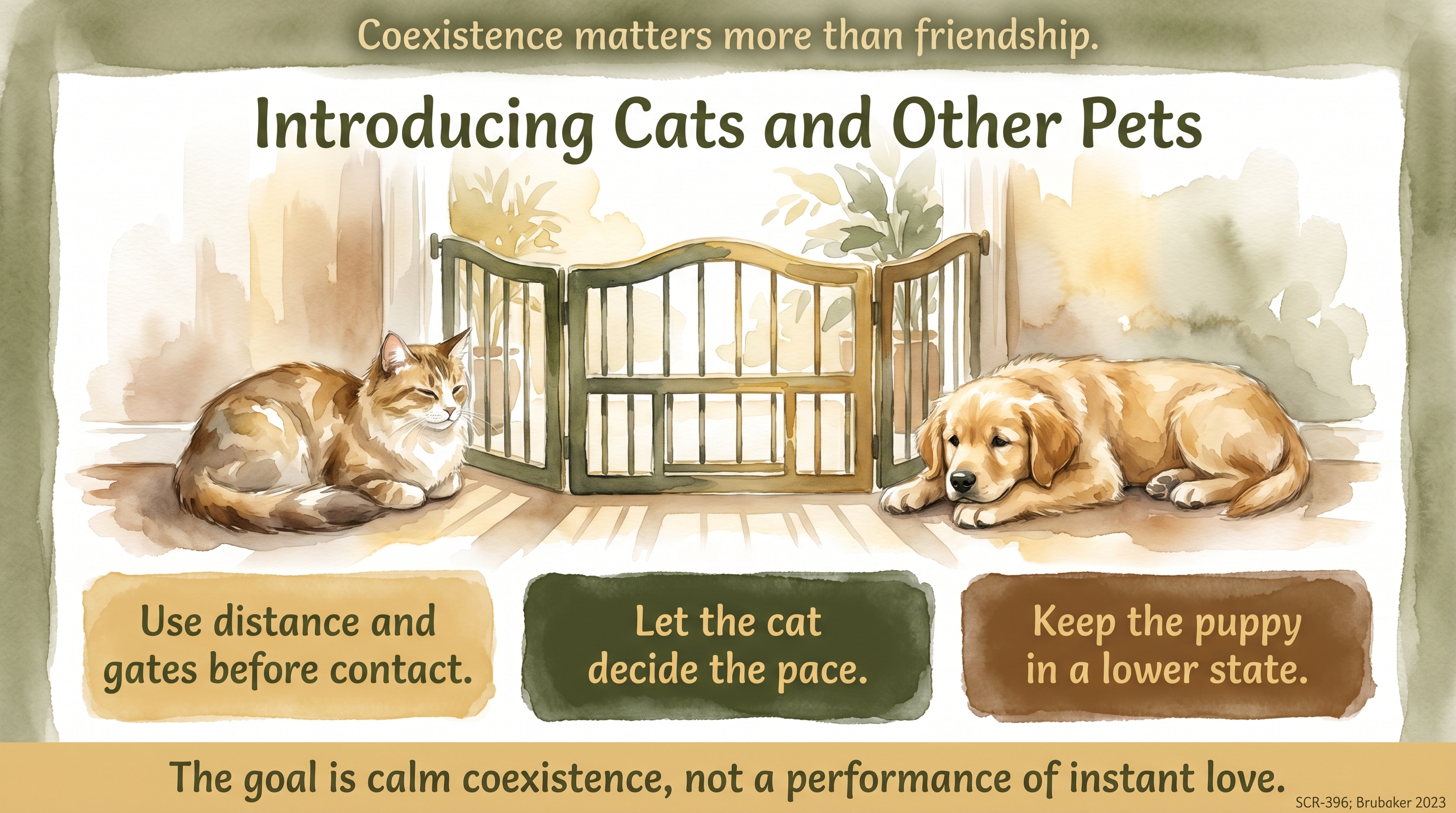
The goal is calm coexistence, not a performance of instant love.
Key Takeaways
- In a multi-species home, the resident animal's safety and calm come first and should determine the structure of the introduction.
- The most important prevention target is not the first meeting itself but the first hundred small chases a family might otherwise allow.
- A crash landing happens when cats or smaller pets are treated as something the puppy should freely investigate before the puppy has any calm floor around them.
- Short, controlled exposures with clear escape rights for the resident animal build a better long-term relationship than forced contact does.
The Evidence
- Brubaker & Udell (2023); van Herwijnen et al. (2018, 2020); de Assis et al. (2025)domestic dogs
Human responses, tolerance patterns, and environmental arrangement shape what behaviors become established rather than merely reacting to pre-existing dog tendencies.
- JB household-transition practicepuppies, cats, and smaller household animals
Short, controlled first exposures combined with strong environmental management prevent chase rehearsal and produce steadier long-term multi-species adjustment than open access and repeated low-level pursuit.
No published study directly tests the specific Just Behaving guidance on introducing cats and other pets. This entry relies on broader canine evidence, breeder observation, and practical synthesis.
SCR References
Sources
- Brubaker, L., & Udell, M. A. R. (2023). Does pet parenting style predict the social and problem-solving behavior of pet dogs (Canis lupus familiaris)? Animal Cognition, 26(1), 345-356. https://doi.org/10.1007/s10071-022-01694-6
- van Herwijnen, I. R., van der Borg, J. A. M., Naguib, M., & Beerda, B. (2018). The existence of parenting styles in the owner-dog relationship. PLOS ONE, 13(2), e0193471. https://doi.org/10.1371/journal.pone.0193471
- van Herwijnen, I. R., van der Borg, J. A. M., Naguib, M., & Beerda, B. (2020). Dog-directed parenting styles predict verbal and leash guidance in dog owners and owner-directed attention in dogs. Applied Animal Behaviour Science, 232, 105131. https://doi.org/10.1016/j.applanim.2020.105131
- de Assis, L. S., Georgetti, B., Burman, O. H. P., Pike, T. W., & Mills, D. S. (2025). Development of a dog owner caregiving style scale (Lincoln Owner Caregiving Questionnaire, LOCQ) and its relationship with behaviour problems in dogs. Applied Animal Behaviour Science, 287, 106628. https://doi.org/10.1016/j.applanim.2025.106628