Canine Adolescence
Compound evidence detail1 SCR / 3 parts
- Documentedthe Baumrind authoritative-parenting literature in human child development
- Documentedthe canine correlational evidence linking dog-directed caregiving styles to attachment, attention, sociability, and problem-solving outcomes (van Herwijnen 2018/2020, Brubaker and Udell 2023)
- Heuristicthe JB inference that one specific caregiving style experimentally produces the best long-term developmental outcomes in dogs
Canine adolescence is the period when many families suddenly feel as though the puppy they knew has disappeared. The dog seems less responsive, more selective, more emotionally uneven, and more interested in testing familiar boundaries. That experience is not just folklore. Dogs do show a documented adolescent-sensitive period, and the conflict behavior is directed especially at the primary caregiver. Documented
What It Means
One of the most useful adolescence findings in the JB knowledge base comes from Asher and colleagues. In guide-dog populations, dogs around eight months were roughly twice as likely to ignore sit commands from their caregiver than they had been at five months, while remaining more responsive to an unfamiliar person. That matters because it makes a very practical point: the regression is not just "the dog forgot everything." It is relationship-specific development.
This parallels what many parents experience with human adolescents. The young organism is not suddenly incapable of behavior. The issue is that the caregiver relationship is where developmental friction appears first. The familiar adult becomes the place where testing, pushing, and selective noncompliance surface.
That does not mean dogs become rebellious in a moral sense. JB treats adolescence as developmental reorganization, not character failure. The dog is older, stronger, more socially confident, and less automatically dependent. The old simplicity of puppyhood is gone, but full adult steadiness is not there yet. Families often interpret that middle phase as defiance because the outward behavior feels personal. Observed-JB
Attachment quality appears to matter here too. In Asher's work, less secure attachment patterns were associated with more pronounced adolescent conflict behavior. Documented That does not prove that one parenting style determines the entire adolescent trajectory. It does suggest that relationship organization changes how the phase expresses itself.
This is why JB treats Structured Leadership as especially important during adolescence rather than less important. Many families make the opposite move. They get tired, the dog looks bigger, and the temptation is to loosen the structure, let more things slide, or fall into a peer relationship because the dog seems "grown." But adolescence is precisely when the cost of inconsistent leadership becomes more visible.
The developmental logic is straightforward. During early puppyhood, some gaps in structure are buffered by dependence. During adolescence, the dog has more physical power, more initiative, and more willingness to test whether previously stable rules really are stable. If the answer turns out to be "not really," the household starts negotiating with a stronger and more practiced dog.
Owner state matters here as well. Research linking owner psychological profile and attachment variables to canine HPA-axis flexibility reinforces a broader JB point: the adult's regulation is part of the dog's experience of the developmental period. Documented A dysregulated adult tends to amplify the friction phase rather than containing it.
This is one reason adolescence often feels like a referendum on the first months. Families are not starting from zero, but they are discovering what their earlier consistency did or did not build. A dog raised inside calm, predictable structure may still test boundaries, but the testing lands inside an already coherent system. A dog raised in inconsistency may find adolescence the perfect time to expose every weak seam in the environment.
The goal during adolescence is not to escalate into bigger force. It is to remain unmistakably adult. The boundaries stay. The tone stays low. The routines stay recognizable. The relationship remains warm, but the role does not collapse into playmate energy just because the dog is larger and more socially assertive.
This is also why JB resists panic language about teenage dogs. Adolescence is real, but it is not evidence that the dog is broken. It is evidence that development has entered a new phase and the adult must keep acting like an adult through it.
There is also an emotional trap here for families. The dog may look more mature physically, but behavioral maturity is uneven. Owners often grant social freedoms on the basis of size alone, then feel betrayed when the dog uses those freedoms badly. JB's answer is simple: do not confuse a taller body with a finished nervous system.
Another trap is personalization. Adolescence can feel disrespectful because the caregiver-specific pattern is so obvious. But once families understand that caregiver-directed conflict is part of the documented picture, the behavior becomes easier to interpret correctly. Documented The dog is not filing a philosophical objection to structure. The dog is moving through a stage in which the known adult relationship becomes the developmental pressure point.
Why It Matters for Your Dog
Families often surrender dogs, seek intensive training help, or start using harsher methods right around the age when adolescence becomes visible. That makes the stage doubly important: it is developmentally normal and practically high-risk.
Adolescence is the phase where your earlier structure either starts paying dividends or reveals its gaps. The answer is not more drama. It is steadier adulthood.
What canine adolescence often looks like:
- the dog ignores familiar cues from the primary caregiver more than before
- boundaries that seemed settled suddenly get tested
- emotional recovery may become bumpier for a period
- the dog appears more interested in independence and less automatically deferential
What families should not conclude too quickly:
- that the dog is stubborn by nature
- that the relationship has failed
- that harsher control is now required
- that rules should be loosened because the dog is "basically grown"
What helps most:
- stable routines
- consistent boundaries
- lower emotional reactivity from the humans
- keeping the relationship warm but adult
What usually makes it worse:
- loosening the rules because the dog is bigger now
- taking the regression personally
- adding more force because the dog feels offensive
- sliding from parent-role into peer-role during the exact stage when guidance is most needed
Adolescence is often the clearest demonstration that structure was never about convenience. It was about preparing for the moment when the puppy stops making it easy for you. Documented
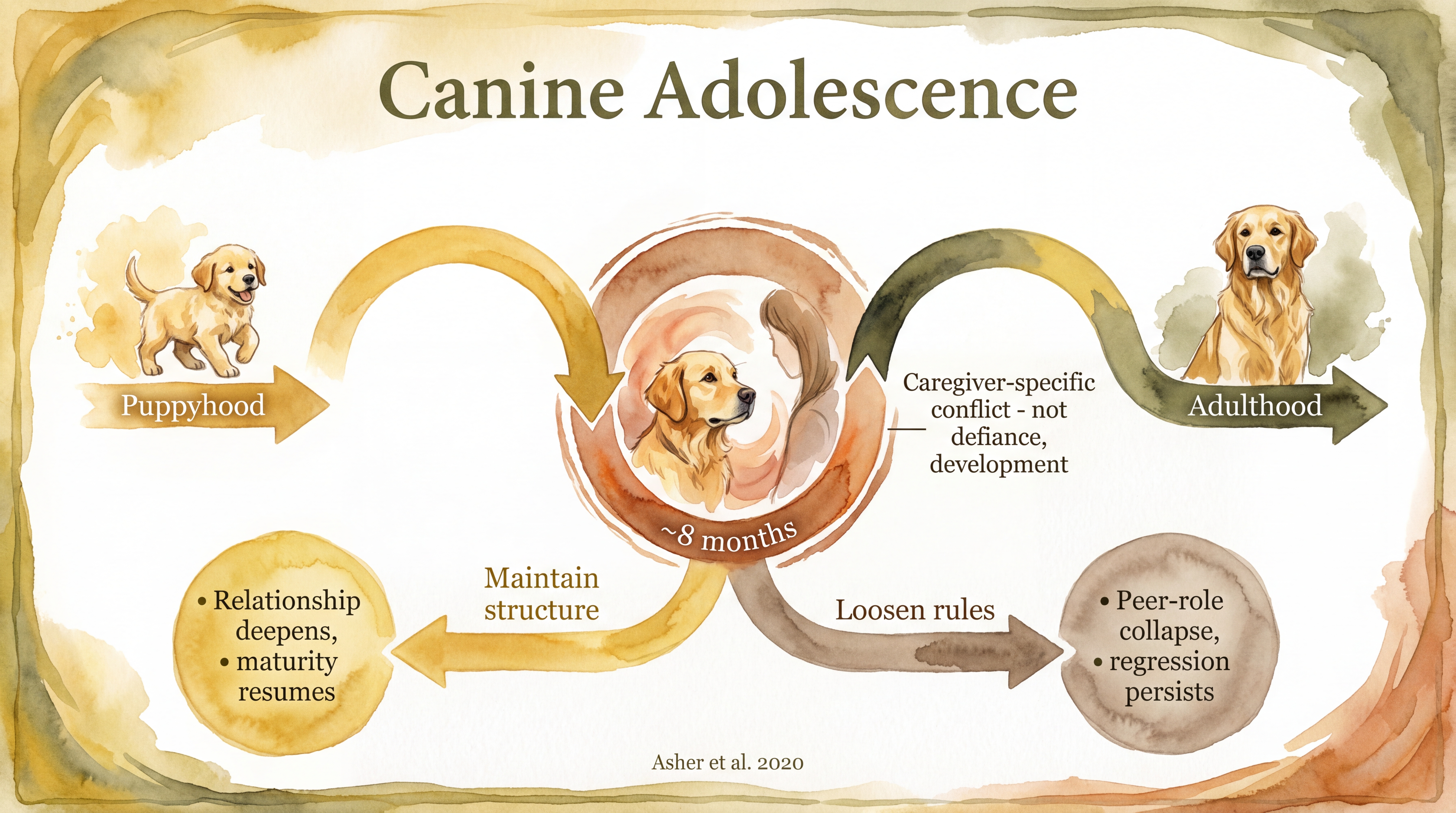
Adolescence is a developmental phase, not a character flaw - maintaining structure through the dip is what matters.
Key Takeaways
- Adolescence is not failure or defiance - it is a documented developmental phase where teenage dogs test boundaries with their primary caregiver more than with strangers.
- The exact moment many families want to loosen structure is the moment the dog needs it most, because a stronger dog with more initiative will find every weak seam.
- Your earlier consistency either shows up as a solid foundation the dog tests within, or as an open invitation to negotiate every rule the dog now has the strength to challenge.
- Stay calm and stay in the parent role during adolescence - the relationship and boundaries that matter should stay the same even as the dog gets physically larger and more socially confident.
The Evidence
This entry uses observed claim-level tags beyond the dedicated EvidenceBlocks below. These tags mark JB program observation or practice-derived claims that need dedicated EvidenceBlock coverage in a later content pass.
- Asher et al. (2020)domestic dogs
Documented an adolescent-sensitive period around eight months with caregiver-specific conflict behavior and links to attachment quality. - Schoberl et al. (2017)domestic dogs and humans
Owner personality and insecure attachment variables predicted lower canine HPA-axis flexibility, relevant to how adolescence is experienced in the relationship.
- Baumrind (1991)humans
Authoritative warmth plus structure remains the strongest developmental combination during periods of increasing adolescent autonomy.
- JB synthesisdomestic dogs
JB's claim is that adolescence is where families most need to maintain the parent role and avoid collapsing into playmate dynamics. This is a practical synthesis built from documented adolescence and attachment findings. - JB synthesisdomestic dogs
The specific lesson that adolescence reveals the quality of earlier structure is a reasoned developmental inference rather than a directly tested outcome statement.
No published study directly tests the specific claims or protocols described in this entry within a controlled canine trial.
SCR References
Sources
- Asher, L., England, G. C. W., Sommerville, R., & Harvey, N. D. (2020). Teenage dogs? Evidence for adolescent-phase conflict behaviour and an association between attachment to humans and pubertal timing in the domestic dog. Biology Letters, 16(5), 20200097.
- Baumrind, D. (1991). The influence of parenting style on adolescent competence and substance use. Journal of Early Adolescence, 11(1), 56-95.
- Schoberl, I., Wedl, M., Bauer, B., Day, J., Mostl, E., & Kotrschal,
- Asher, L., England, G. C. W., Sommerville, R., and Harvey, N. D. (2020). Teenage dogs? Evidence for adolescent-phase conflict behaviour and an association between attachment to humans and pubertal timing in the domestic dog. Biology Letters, 16(5), 20200097. DOI: 10.1098/rsbl.2020.0097.
- Schoberl, I., Wedl, M., Beetz, A., and Kotrschal, K. (2017). Psychobiological factors affecting cortisol variability in human-dog dyads. PLOS ONE, 12(2), e0170707. DOI: 10.1371/journal.pone.0170707.