The Socialization Window: Mechanism and Implications
The socialization window is the developmental period in which early experience has unusually high leverage over later behavior. The best-supported canine summary is still roughly three to fourteen weeks, with the important caveat that the window closes gradually, varies by breed, and is better understood as a sensitive period than as a literal all-or-nothing switch. Documented
What It Means
This page is the mechanism companion to the broader socialization-period page.
That page focuses on what happens developmentally. This page focuses on why this period matters more than later periods.
Historical framing
The classic starting point is Scott and Fuller, reinforced by Freedman and colleagues. Their work showed that delayed social experience carries a cost that later experience does not fully erase. That is the core reason the socialization window is treated differently from later training or later rehabilitation.
Modern reviews have refined the language without removing the underlying point: "sensitive period" is better than "critical period," the boundaries are real but gradual, later improvement remains possible, and later improvement is not equally easy or equally cheap.
That last sentence is the essence of the window.
A window is about differential cost
One way to misunderstand the socialization window is to imagine it as a mystical door. That creates two predictable mistakes: people panic and flood the puppy with intensity, and people assume that once the window closes, change is impossible. Documented
Neither is supported.
The better picture is economic rather than mystical. Experience in this period is developmentally cheaper. It generalizes more easily, gets built into the puppy's ordinary expectations more readily, and requires less compensatory work later.
Later learning still matters. It just matters under different conditions.
What "closing" actually means
The closing of the window is best treated as a shift in learning conditions, not the disappearance of learning capacity.
The puppy gradually becomes more cautious about novelty; less automatically approach-oriented; more capable of defensive or avoidant learning; and less likely to absorb unfamiliar things as effortlessly ordinary. Documented
This is why the literature increasingly talks about a gradual change in balance between approach and wariness rather than a hard developmental cutoff on one exact day.
Morrow and colleagues are important here because they showed breed-dependent variation in fear-related avoidance onset. That confirms a closing process that is real but not identical across all dogs. It also reinforces an important Golden Retriever boundary: the specific breeds in that study were not Golden Retrievers, so the general principle is documented while exact Golden timing remains less settled. Documented
Sensitive, not absolute
The reason "sensitive period" is the better term is that later remediation remains possible.
Dogs can improve after a poor start. Rescue dogs can form secure bonds. Fearful dogs can become safe and more functional. Rehomed dogs can stabilize in later environments.
What the window changes is not whether later change can happen. It changes how much work is required, how incomplete the outcome may remain, and how much accumulated avoidance or fear has to be worked around.
Mechanism without pseudo-precision
This is where the neuroscience needs careful wording.
The developmental picture supports a broad high-plasticity story. The puppy brain is changing rapidly. Myelination is active. The socialization window overlaps a dense period of postnatal maturation.
But the SCR explicitly blocks a stronger jump: we do not have a dog-specific pruning calendar that maps one exact developmental week to one exact social milestone. That means the common explanation "the puppy brain prunes away unused social circuits at week X" is stronger than the evidence supports.
What we can say responsibly is that synaptic pruning is a real developmental mechanism across mammals; that pruning-related machinery is confirmed in dogs; that rapid postnatal maturation provides biological context for the window; and that dog-specific behavioral pruning timelines remain unmapped.
That still gives the window a strong mechanistic foundation. It just avoids pretending the mechanism has been fully timed and labeled in puppies.
Why quality matters more than the checklist
Once the window is understood as developmental tuning rather than event collection, the limits of checklist-style socialization become obvious.
A puppy can technically encounter men with hats; children; car rides; vacuum noise; tile floors; and visitors.
and still leave the period with poor developmental lessons if those experiences were too intense, too frequent, too abrupt, or poorly scaffolded.
That is why "more exposure" is not identical to "better socialization." The question is not only whether the puppy saw the thing. The question is what the puppy learned about the thing.
The rehoming-age question inside the window
The socialization window also helps explain why debates about eight weeks versus twelve weeks so often go nowhere. The calendar age matters. The quality of experience during that age often matters more.
An extra month in a poor environment is not automatically protective. An extra month in a calm, socially rich, developmentally appropriate environment can be very valuable. Early placement into a noisy, inconsistent, overstimulating home can undermine the second half of the window. Early placement into a well-run, ordinary, predictable family environment can also provide exactly the kinds of human-world exposures the puppy now needs.
That is why the strongest scientific conclusion is not "later is always better" or "earlier is always better." The stronger conclusion is that the window shifts the importance of developmental quality upward. Calendar age without environmental quality is not enough.
Why later change costs more
Later change often has to work against learning that is already established. Observed-JB That is true behaviorally even when the original learning is not visible in a simple way.
The window matters because earlier ordinary successful experience helps install broad default expectations before avoidance or chronic overarousal become well rehearsed. After that, change often depends less on simple acquisition and more on careful management, desensitization, counterconditioning, or relearning under emotional load.
This is also why the window fits so naturally with prevention logic. The strongest careful version of that claim is not "prevention has been proven to prune away exact future bad behaviors in dogs." The strongest careful version is that early life offers a uniquely efficient opportunity to bias development before defensive and maladaptive patterns become more expensive to reverse.
Why It Matters for Your Dog
The socialization window matters because many of the puppy's first lasting assumptions are being built here: whether novelty is usually manageable, whether humans are safe and legible, whether handling predicts calm or conflict, and whether the environment feels navigable or threatening.
Those are not trivial details. They are the background settings of later behavior.
The go-home overlap
For many pet dogs, the socialization window overlaps with rehoming.
That means the new family is not beginning after the window. It is stepping into it.
This overlap is why transition quality matters so much. The family is helping define the second half of the window, not only responding to the finished output of the first half.
The soft-landing idea fits the socialization window because the dog often arrives in the family home while still highly plastic. Calm continuity helps the puppy absorb "ordinary life is manageable" more reliably than excitement-heavy novelty.
Why later rehabilitation is still worth doing
A scientifically serious account of the window should never be fatalistic.
Poor early life is a risk factor, not a sentence. Dogs can improve dramatically after the socialization window. The point of the window is not to tell people change is impossible later. The point is to explain why early developmental support is disproportionately valuable and why later rehabilitation can be slower, narrower, or more fragile.
Limits and open questions
The evidence is strongest for the existence and importance of the window. It is weaker for the exact canine neural events that "close" it; breed-specific Golden Retriever timing; one universal optimal socialization recipe; and simplistic later-is-always-better or earlier-is-always-better placement rules independent of environment quality.
The literature also does not support turning the window into a stimulus-collection contest. That move is common in practice culture, but it is not the strongest reading of the science.
It also does not support using the window as an excuse for panic. One of the most common distortions of sensitive-period science is adult urgency that becomes environmental urgency. When the humans are frantic, over-scheduling, chasing exposures, and reacting to every missed stimulus as if damage is occurring in real time, the dog is not benefiting from better developmental understanding. The dog is being asked to absorb adult anxiety as part of the developmental environment.
How this connects to the rest of the wiki
This page is paired with socialization-period, which covers the developmental phase itself. This page focuses more tightly on why the window matters and what it does and does not say about plasticity.
The first-fear-period page explains the late-window vulnerability that often overlaps with rehoming and changes what good socialization looks like in the second half of the period. Observed-JB
For the mechanism background, synaptic-pruning-in-dogs explains what is and is not currently established about pruning machinery and behavioral timing in the developing canine brain.
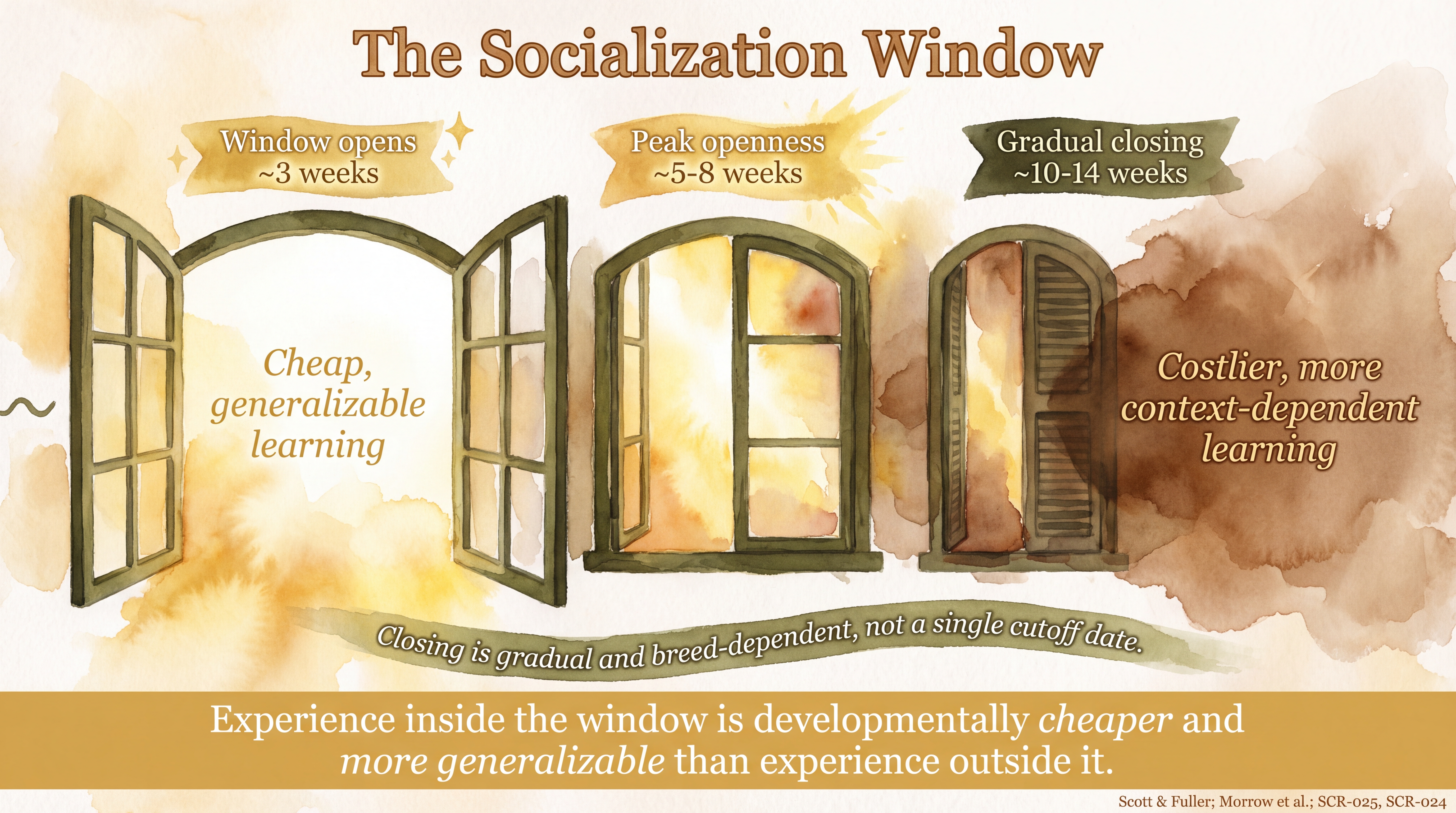
Experience inside the window is developmentally cheaper and more generalizable than experience outside it.
Key Takeaways
- The socialization window is a real sensitive period in which early experience carries unusually high developmental leverage.
- It is best understood as a shift in learning conditions, not as a literal door that closes on one exact day.
- Quality of experience matters at least as much as the calendar checklist of exposures.
- Later rehabilitation remains possible, but the window explains why early support is disproportionately valuable.
- Mechanism talk should stay at the level of broad postnatal maturation and confirmed pruning machinery, not detailed canine pruning timetables.
The Evidence
This entry uses observed claim-level tags beyond the dedicated EvidenceBlocks below. These tags mark JB program observation or practice-derived claims that need dedicated EvidenceBlock coverage in a later content pass.
- Scott, J. P. & Fuller, J. L. (1965)domestic dogs
Established the foundational developmental framework in which delayed early human contact produced persistent later social differences, anchoring the canine sensitive-period concept. - Freedman, D. G., King, J. A., & Elliot, O. (1961)domestic dogs
Experimental work showed that puppies isolated from human contact during the early weeks displayed lasting avoidance, providing the original evidence for a bounded early developmental window. - Morrow, M. et al. (2015)domestic dogs
Showed breed-dependent differences in fear-related avoidance onset, supporting a real but gradual closing of the window with variation across breeds. Goldens were not in this study, so exact Golden timing remains a separate question. - Howell, T. J. et al. (2015)domestic dogs
Review work supported the idea that the socialization window closes gradually rather than through a single universal cutoff.
- Gross, B. et al. (2010)domestic dogs
Provided direct canine MRI evidence of rapid postnatal brain maturation across the same general age corridor as the socialization window, supporting biological plausibility for differential plasticity without specifying a behavioral pruning calendar. - Developmental neurobiology synthesismultiple mammals
Sensitive periods across mammals reflect a combination of high plasticity and changing fear and exploratory systems rather than a single switch event.
- SCR-043 boundarydomestic dogs
Synaptic pruning machinery is confirmed in dogs, but a dog-specific behavioral pruning calendar tied to the socialization window has not been established and should not be presented as settled. - Canine developmental boundarydomestic dogs
The window itself is well supported, but precise neural events that mark its closing in dogs remain incompletely mapped, and breed-specific Golden Retriever timing is not yet directly studied.
No direct canine research located for this specific topic. Current understanding relies on related research, clinical observation, and cross-species inference.
SCR References
Sources
- Freedman, D. G., King, J. A., & Elliot, O. (1961). Critical period in the social development of dogs. Science, 133(3457), 1016-1017.
- Gross, B., Garcia-Tapia, D., Riedesel, E., Ellinwood, N. M., & Jens, J. K. (2010). Normal canine brain maturation at magnetic resonance imaging. Veterinary Radiology & Ultrasound, 51(4), 361-373.
- Howell, T. J., King, T., & Bennett, P. C. (2015). Puppy parties and beyond: The role of early age socialization practices on adult dog behavior. Veterinary Medicine: Research and Reports, 6, 143-153.
- Morrow, M., Ottobre, J. S., Ottobre, A. C., Neville, P., St-Pierre, N., Dreschel, N. A., & Pate, J. L. (2015). Breed-dependent differences in the onset of fear-related avoidance behavior in puppies. Journal of Veterinary Behavior, 10(4), 286-294. https://doi.org/10.1016/j.jveb.2015.03.002