Consistency and Boundary Setting
Compound evidence detail2 SCRs / 5 parts
- Documentedthe human attachment evidence base together with the canine-direct secure-base findings (Topal 1998, Horn 2013) and Schoberl-documented physiological effects of secure caregiving in dogs
- Heuristicthe full attachment-theory apparatus transfer to canine relationships, including internal working models and attachment-classification systems
- Documentedthe Baumrind authoritative-parenting literature in human child development
- Documentedthe canine correlational evidence linking dog-directed caregiving styles to attachment, attention, sociability, and problem-solving outcomes (van Herwijnen 2018/2020, Brubaker and Udell 2023)
- Heuristicthe JB inference that one specific caregiving style experimentally produces the best long-term developmental outcomes in dogs
Consistency and boundary setting are the daily operating system of Structured Leadership. If leadership is the adult role, consistency is how that role becomes real. Rules that change with mood are not rules from the dog's point of view. Heuristic They are weather.
What It Means
Consistency means the same rule applies across time, across people, and across contexts unless there is a deliberate reason to change it. Boundary setting means the adult defines what belongs in the household and communicates that definition clearly enough that the dog does not have to keep guessing.
The developmental value of this is larger than convenience. Consistent caregiving supports attachment security, predictable environments support controllability, and warm-plus-structured care is the strongest pattern in the parenting literature. Heuristic JB's point is that these ideas stop being abstract the moment the family decides whether "off the couch" really means off the couch every day or only when company is over.
Inconsistency teaches the dog something whether the family intends it or not. It teaches that persistence may work, that the rule depends on the person's mood, or that different humans occupy different social realities. Heuristic None of those lessons help the dog settle.
Boundary setting is also different from argument. Good boundaries are not negotiated endlessly. They are communicated through stable adult action. The adult notices the behavior early, interrupts or redirects it if needed, and keeps the tone low. Heuristic The point is not to overpower the dog. The point is to remove ambiguity.
This is why boundary setting must be a whole-household activity. One permissive family member can destabilize a system the others are trying to build because the dog experiences households as integrated environments, not as separate philosophical departments. Heuristic If one person means yes and another means no, the dog does not learn a clear standard. The dog learns a social strategy.
Consistency also protects warmth. Many owners fear that boundaries will make them seem cold. In practice, unclear boundaries often damage warmth more because they generate repeated friction. When the rules are stable, there is less need for emotional escalation. The household becomes calmer because less social energy is spent renegotiating the same issue.
That is why JB frames consistency as kindness through clarity. The puppy gets to live in a world that can be read. The adult no longer needs to surprise the dog with sudden enforcement because the shape of the world is already there.
This is also why boundary-setting should happen early rather than after the dog has practiced a pattern for months. Early boundaries are usually quieter boundaries. Late boundaries often feel harsher because the dog has already built expectation around the old access.
Boundaries also work best when they are meaningful. Families do not need fifteen complicated rules to look serious. They need a few standards that genuinely matter and are worth defending every time. That makes the system easier for both humans and dogs to carry.
Why It Matters for Your Dog
When boundaries are clear and consistent, the dog can stop investing energy in testing whether the environment has changed. That does not eliminate all experimentation, especially during adolescence, but it narrows the space in which confusion grows.
Consistency is how structure becomes believable. If the boundary only exists when the adult feels like enforcing it, the dog is not living in structure. The dog is living in improvisation.
What consistency looks like:
- the same answer from every adult
- the same greeting standard every day
- the same boundary on furniture, food, doors, and personal space
- the same low-drama response to predictable testing
Common failure modes:
- "just this once"
- relaxing standards because the dog has been good lately
- different people using different rules
- turning boundary setting into emotional argument
What helps families actually do this well:
- decide the core household rules in advance
- make sure every adult uses the same language and the same response style
- keep the number of non-negotiables small enough to enforce well
- return to baseline quickly after a correction or interruption
The practical payoff is usually peace. The dog settles faster, the family feels less resentful, and everyday life stops feeling like a referendum on every small choice.
That is the quiet genius of consistency. It lowers the emotional cost of leadership. Once the boundary is real, the adult no longer has to perform conviction every hour. The structure itself begins to do part of the work.
In that sense, boundaries are not just about stopping behavior. Heuristic They are about making the household more coherent. A coherent household is easier for the dog to live in and easier for the humans to maintain.
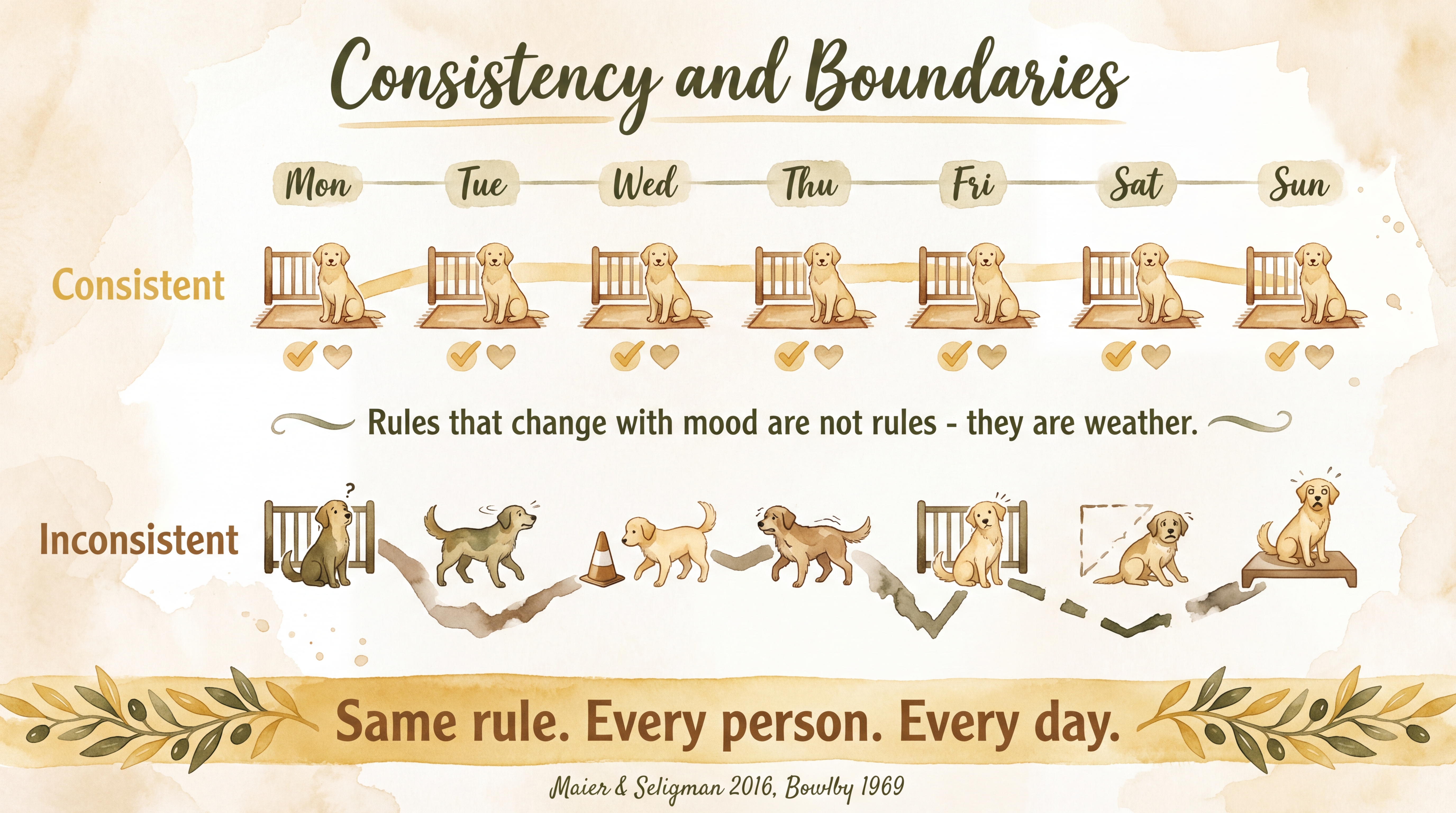
Rules that change with mood are not rules from the dog's perspective - they are weather.
Key Takeaways
- The same rule should apply every day, from every person, unless you have a deliberate reason to change it - inconsistency teaches the dog that boundaries are weather, not structure.
- Set a few meaningful non-negotiables that actually matter to you, then enforce them quietly and consistently - the point is clarity, not performance.
- Whole-family agreement matters more than perfection; one permissive family member can undo what everyone else is building because the dog experiences the home as one system.
- When rules are clear and stable, the dog stops wasting energy testing whether things have changed and can settle into the actual household reality.
The Evidence
- Bowlby (1969)humans
Attachment security grows from predictable, sensitively responsive caregiving rather than erratic availability. - Baumrind (1991)humans
Warmth plus stable structure supports stronger developmental outcomes than either harsh control or permissiveness. - Maier and Seligman (2016)multiple mammals
Predictable environments help organisms learn controllability rather than defaulting to passivity under uncertainty.
- Panksepp (1998)multiple mammals
Caregiving and attachment systems are biologically central to development, making the quality and reliability of adult guidance highly consequential.
- JB synthesisdomestic dogs
The claim that inconsistent rules teach dogs that boundaries are negotiable is a practical developmental inference rather than a standalone experimental result from a JB protocol. - JB synthesisdomestic dogs
Whole-family consistency is treated as essential because the dog experiences the home as one social environment, not a set of independent rule systems. - JB synthesisdomestic dogs
The recommendation to set only a few meaningful non-negotiables and enforce them quietly is a practical implementation principle derived from JB family work rather than a formal published intervention trial.
No published study directly tests the specific claims or protocols described in this entry within a controlled canine trial.
SCR References
Sources
- Baumrind, D. (1991). The influence of parenting style on adolescent competence and substance use. Journal of Early Adolescence, 11(1), 56-95.
- Bowlby, J. (1969). Attachment and loss. Vol. 1: Attachment. Basic Books.
- Maier, S. F., & Seligman, M. E. P. (2016). Learned helplessness at fifty: Insights from neuroscience. Psychological Review, 123(4), 349-367.
- Maier, S. F., and Seligman, M. E. P. (2016). Learned helplessness at fifty: Insights from neuroscience. Psychological Review, 123(4), 349-367. DOI: 10.1037/rev0000033.
- Panksepp, J. (1998). Affective Neuroscience: The Foundations of Human and Animal Emotions. Oxford University Press.