Attachment Theory in Dogs
Compound evidence detail2 SCRs / 5 parts
- Documentedthe human attachment evidence base together with the canine-direct secure-base findings (Topal 1998, Horn 2013) and Schoberl-documented physiological effects of secure caregiving in dogs
- Heuristicthe full attachment-theory apparatus transfer to canine relationships, including internal working models and attachment-classification systems
- Documentedthe Baumrind authoritative-parenting literature in human child development
- Documentedthe canine correlational evidence linking dog-directed caregiving styles to attachment, attention, sociability, and problem-solving outcomes (van Herwijnen 2018/2020, Brubaker and Udell 2023)
- Heuristicthe JB inference that one specific caregiving style experimentally produces the best long-term developmental outcomes in dogs
Attachment theory gives Just Behaving one of its most useful scientific bridges, but it also requires discipline. Documented Dogs do form documented attachment bonds with humans. What remains more limited is the full transfer of the human attachment framework, especially when people start talking about detailed classifications, internal working models, or causation claims the dog literature has not fully tested.
What It Means
At its simplest, attachment theory asks a developmental question: when a young social organism is under stress, uncertainty, or separation, what role does the caregiver play? Bowlby's answer was that the caregiver is not just emotionally important. The caregiver is behaviorally organizing. Proximity seeking, distress on separation, emotional recovery on reunion, safe-haven use, and secure-base exploration all flow from that relationship.
That language maps onto the dog-human bond better than many people realize. Dogs do not simply cohabit with humans. They orient toward them, use them socially, and regulate around them. In the Strange Situation adapted for dogs, owners affect behavior in ways that look far closer to attachment dynamics than to generic familiarity. Documented
That said, there are several layers to the theory, and they should not be blurred together.
The first layer is the safest: dogs form attachment bonds, and secure-base effects are documented. That claim is strong.
The second layer is more bounded: caregiving quality appears to affect canine stress physiology and behavior. Securely attached dogs show lower stress reactivity in some paradigms, and dog-directed parenting-style research suggests owner relational style is associated with attachment-related and problem-solving outcomes. Documented That claim is increasingly supported.
The third layer is where restraint matters most: whether the full human attachment apparatus transfers cleanly to dogs. This includes detailed classifications, internal working models, and broad developmental causal stories borrowed wholesale from human psychology. That larger transfer remains partly heuristic.
This is exactly the kind of distinction JB tries to preserve. It would be easy to say, "Dogs are just like children, therefore human attachment science applies directly." That would be rhetorically convenient and scientifically sloppy. Dogs are not human infants. Their social ecology, developmental timetable, sensory world, and communicative repertoire differ. But it would be equally sloppy to ignore the convergence entirely. The dog-human bond is not a blank slate. It has real attachment-like structure.
So what does attachment theory contribute to JB in a disciplined way?
First, it legitimizes the idea that the relationship itself is part of development, not just the delivery route for training techniques. A puppy is learning from the human's emotional stability, availability, predictability, and boundary-setting style. The relationship is not background. It is active developmental input.
Second, it helps explain why calm, consistent parental behavior matters more than constant social performance. Secure attachment is not built by theatrical affection. It is built by a combination of responsiveness and reliability. The caregiver notices, responds, protects, and steadies. That is very different from becoming the puppy's entertainer or emotional equal.
Third, it gives JB a way to talk about both closeness and structure without falling into opposites. Some dog cultures talk as though affection makes boundaries unnecessary. Others talk as though boundaries require emotional distance. Attachment theory points toward a middle path. The secure caregiver is both warm and organizing.
In dogs, that middle path seems especially important because owner variables matter. Research now suggests that owner personality and attachment quality influence outcomes independently of the technique being used. In other words, two people can apply similar instructions and still get different results because the relationship itself is not the same.
This is also why attachment theory belongs inside Structured Leadership rather than standing apart from it. JB is not using attachment language to argue for endless comforting, permissiveness, or over-management. Heuristic It is using attachment language to describe the kind of adult presence that produces confidence: available, predictable, boundaried, and calm.
The puppy who experiences that kind of adult often shows the pattern attachment theory would predict. The puppy checks back. The puppy uses proximity strategically. The puppy recovers more efficiently after stress. The puppy explores without becoming emotionally untethered. What the puppy does not need is a human who is unpredictable, theatrically emotional, or socially peer-like.
This is also where the transfer boundary becomes important again. In human research, attachment classifications carry a dense literature. Documented In dogs, classification efforts exist, but the field has not mapped caregiving styles, developmental trajectories, and classification stability with anything like the depth of human infant research. So JB can responsibly say:
- dogs form attachment bonds
- dogs show secure-base effects
- caregiving quality matters
- secure, responsive relationships likely support better regulation
JB should be more careful when saying:
- this dog is the canine equivalent of a specific human attachment category
- this exact attachment pathway causes this later behavior
- the full human theoretical architecture has been validated in dogs
That distinction protects the useful insight without overselling the science.
Why It Matters for Your Dog
For families, attachment theory changes the practical question from "How do I get the puppy to comply?" to "What kind of caregiver am I becoming in the puppy's nervous system?" Heuristic That is a different standard. It asks whether the human is stable enough to be used as a point of orientation.
Attachment theory matters at JB because the puppy is not just learning commands. The puppy is learning whether the adult is reliable enough to organize exploration, stress recovery, and emotional safety.
Signs of a secure pattern:
- The puppy seeks the owner under stress, then settles more quickly there.
- The puppy can move away to investigate and return without spiraling.
- The owner is a source of information, not just stimulation.
- Boundaries do not weaken the bond because the bond is not based on indulgence.
What secure attachment does not mean:
- the puppy never feels frustration
- the puppy is never asked to wait
- the owner prevents all novelty or challenge
- the relationship becomes a constant reassurance ritual
Healthy attachment supports independence properly understood. The puppy can move outward because it trusts the adult underneath the movement.
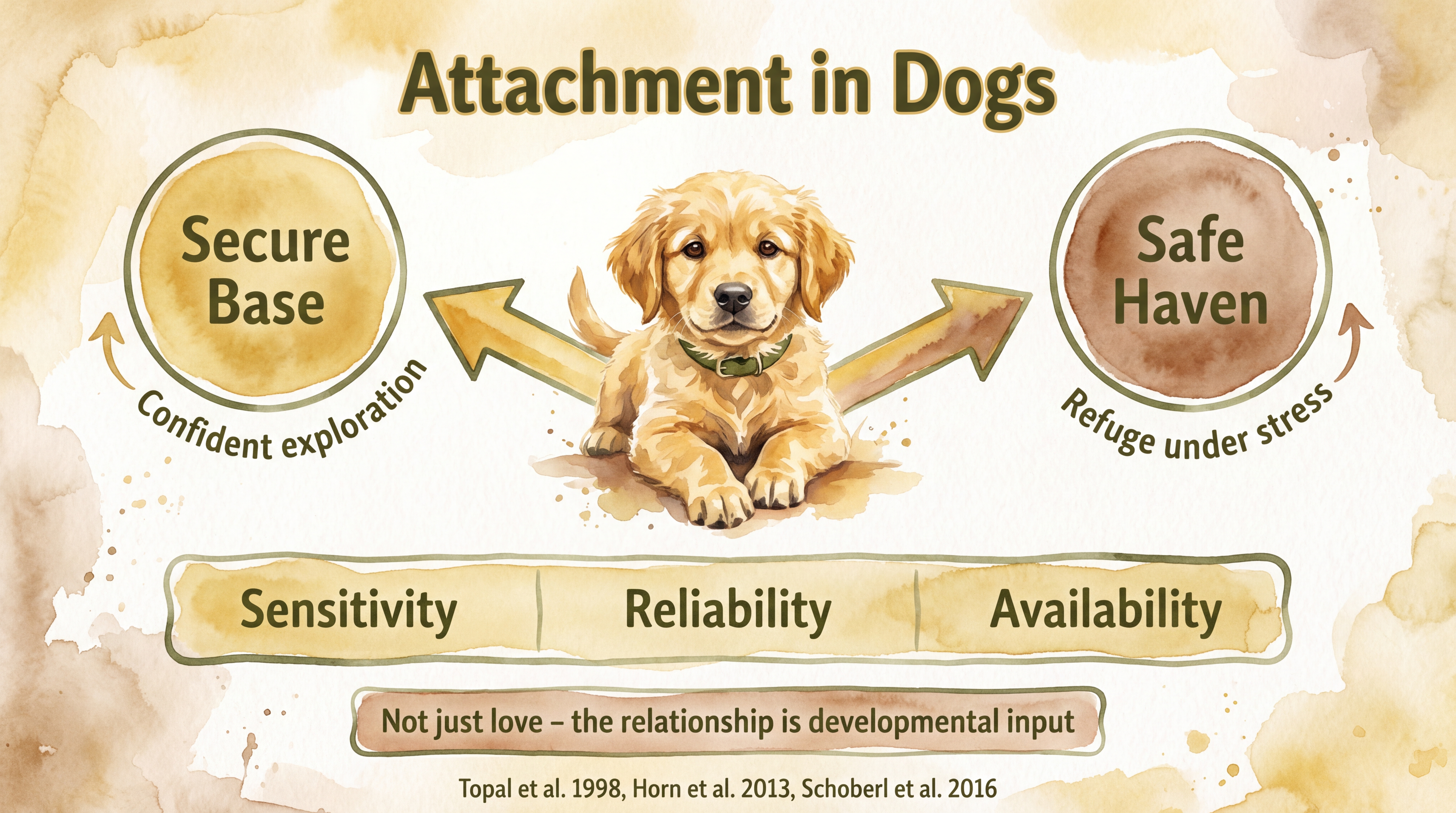
The two functions of attachment: a base for confident exploration and a haven under stress.
Key Takeaways
- Dogs form real attachment bonds with their owners, and research shows owners change how puppies explore and handle stress.
- Your job is not to be perfect - it is to be predictable and responsive enough that your puppy trusts you as a steady presence.
- What matters is whether your puppy can use you as a reference point during uncertainty, not whether they match every detail of human attachment theory.
- Owner personality and relational style matter just as much as the rules you set, so staying calm and consistent is part of the method itself.
The Evidence
- Topal et al. (1998)domestic dogs
The adapted Strange Situation showed that dogs behave toward owners in attachment-relevant ways, not merely as toward any familiar person. - Horn et al. (2013)domestic dogs
Owner presence altered exploration and task persistence, supporting a documented secure-base effect in dogs. - Schoberl et al. (2016)domestic dogs and humans
Attachment security in dogs was associated with lower cortisol reactivity under standardized stress. - Powell et al. (2021)domestic dogs
Owner personality and owner-dog attachment were associated with treatment outcomes after behavioral consultation, highlighting the importance of the relational variable.
- Bowlby (1969)humans
Established the caregiver as the attachment figure around which exploration, proximity seeking, and stress recovery are organized. - Ainsworth et al. (1978)humans
Developed the operational attachment framework that later informed canine Strange Situation adaptations.
- JB synthesisdomestic dogs and humans
The broad claim that secure, predictable, sensitively responsive caregiving supports healthier development in dogs is well aligned with current evidence. The full transfer of attachment categories and internal working models from humans to dogs remains incomplete. - JB synthesisdomestic dogs
Mapping Structured Leadership directly onto secure attachment predictors is a useful framework for practice, but the field has not formally validated the entire JB model as an attachment intervention.
No published study directly tests the specific claims or protocols described in this entry within a controlled canine trial.
SCR References
Sources
- Ainsworth, M. D. S., Blehar, M. C., Waters, E., & Wall, S. (1978). Patterns of attachment: A psychological study of the strange situation. Erlbaum.
- Bowlby, J. (1969). Attachment and loss. Vol. 1: Attachment. Basic Books.
- Horn, L., Huber, L., & Range, F. (2013). The importance of the secure base effect for domestic dogs. PLoS ONE, 8(1), e65296.
- Powell, L., Stefanovski, D., Siracusa, C., & Serpell, J. A. (2021). Owner personality, owner-dog attachment, and canine demographics influence treatment outcomes in canine behavioral medicine cases. Frontiers in Veterinary Science, 7, 630931. https://doi.org/10.3389/fvets.2020.630931
- Schoberl, I., Beetz, A., Solomon, J., Gee, N., Kotrschal, K., & Wedl, M. (2016). Social factors influencing cortisol modulation in dogs during a strange situation procedure. Journal of Veterinary Behavior, 11, 77-85.
- Topal, J., Miklosi, A., Csanyi, V., & Doka, A. (1998). Attachment behavior in dogs (Canis familiaris): A new application of Ainsworth's Strange Situation Test. Journal of Comparative Psychology, 112(3), 219-229. https://doi.org/10.1037/0735-7036.112.3.219