Adolescent Sleep and Rest
The adolescent dog does not sleep like a young puppy. That is obvious in daily life and supported in the literature. Rest still matters deeply, but the pattern changes. The long chain of short puppy naps begins to give way to fewer, longer blocks, more stable overnight sleep, and a more adult-like rhythm of wakefulness and recovery.
Families often notice the change and draw the wrong conclusion. Observed-JB The dog needs fewer naps, so the dog must not need protected rest anymore. That is where adolescence quietly goes off the rails in many homes.
What It Means
What Actually Changes
The dog-specific sleep literature makes two things clear.
First, developmental sleep physiology changes across the first year and beyond. Observed-JB REM proportion and other electrophysiological features shift as the dog matures. The adolescent nervous system is not simply running puppy sleep forever.
Second, the common public hour estimates are less precise than people think. Peer-reviewed home data often reports lower total sleep than the popular numbers repeated in casual dog advice. That does not mean dogs suddenly need less downtime than households have been told. It means measurement is messy and stimulation often interferes with how much rest dogs actually achieve.
In practice, the adolescent often looks like a dog who can stay awake longer, stay engaged longer, and rest in longer blocks once settled.
Why Protection Still Matters
The dog may self-regulate rest better than a young puppy. It still does not regulate perfectly.
An adolescent allowed to run its own energy budget in a stimulating household will often stay awake too long, tip upward in arousal, and then behave in ways the family reads as obstinate or overexcited. The dog looks older, so the adults stop pulling it back toward rest. The overtired adolescent then starts living in a more activated baseline.
JB treats that as a household-management problem rather than as a personality problem in the dog. Observed-JB
Rest is still an active practice. It is just not the same nap schedule the family used in the transition.
What JB Adjusts
The first adjustment is interval length. Instead of frequent puppy shutdowns, the adolescent often needs longer stretches of ordinary life followed by longer protected down time.
The second adjustment is expectation. The dog may not fall asleep instantly every time it is guided to a quiet space. That is fine. Rest is more than unconsciousness. Quiet low-arousal downtime still matters.
The third adjustment is environmental honesty. If the house is noisy, fast, and stimulating all day, the dog may never truly settle even if it technically has access to a bed.
The calm bedroom principle still matters here. The quiet space, the readable routine, and the assumption that rest is part of healthy life all continue into adolescence.
The Common Mistake
The biggest mistake is to answer adolescent wakefulness with more activity every time. The dog is up, so it must need more exercise. The dog is restless, so it must need more novelty. The dog is moving, so the family keeps it moving. Sometimes the dog does need a well-timed walk or better daytime structure. Often the dog needs the adults to recognize that heightened wakefulness does not equal better regulation. More activity is not always the right antidote to activation.
The adolescent who looks like it has outgrown rest often needs protection from overstimulation more than ever. Calmness remains a pillar because nervous systems do not mature well in constant noise.
Why Sleep Still Belongs in the Adolescence Conversation
People sometimes treat sleep as a puppy issue and behavior as an adolescent issue. Observed-JB The two should not be separated so neatly.
A less-rested adolescent is often a more reactive adolescent.
A more fragmented sleeper may recover more slowly.
A dog living in a chronically stimulating environment may get enough apparent downtime to satisfy the humans while still not achieving enough quality restoration.
This is one reason JB keeps household rhythm at the center of raising. Rest is not a side program. It is part of the environment that shapes how every other behavior shows up.
What Families Can Look For
The useful questions are simple: Is the dog getting obvious quiet blocks each day? Does the dog wake refreshed or edgy? Is evening behavior worse when the day had too much stimulation? Has the family mistaken reduced puppy sleep for adult-level self-management? Those answers tell the truth better than rigid hour counting.
Why It Matters for Your Dog
The adolescent does not need to be treated like a newborn puppy. It also does not need to be treated like a fully finished adult.
That middle understanding is the goal.
The dog sleeps differently now. The household should adapt. But the family should not drop the larger principle that made the first months work so well: rest is biologically active and behaviorally protective. A dog who sleeps and recovers well is usually easier to live with, easier to guide, and easier to keep in a calm baseline.
Rest remains one of the simplest ways a family can help the adolescent nervous system mature without turning every rough edge into a training problem.
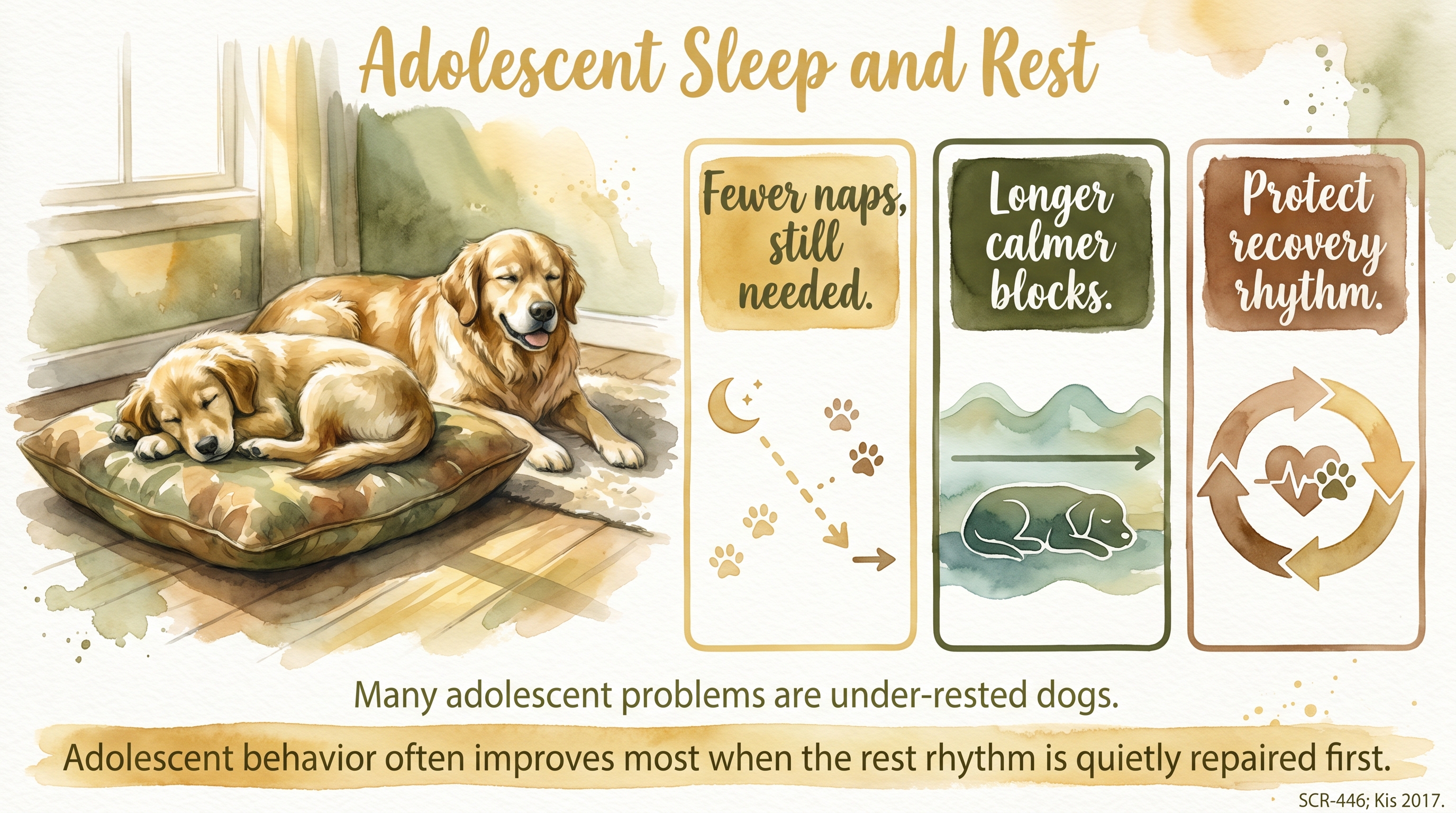
Adolescent behavior often improves most when the rest rhythm is quietly repaired first.
Key Takeaways
- Adolescent dogs sleep differently from young puppies, but they still need deliberate rest protection.
- Fewer naps do not mean the dog has outgrown the biological need for quiet recovery.
- JB adjusts rest rhythm in adolescence by using longer blocks and calmer environmental management, not by giving up on rest.
- Many behavior problems that look adolescent are made worse by under-protected rest and overstimulation.
The Evidence
- Reicher et al. (2021)domestic dogs
Sleep electrophysiology changes across development, including changes in REM and developmental EEG patterns through adolescence. - Kinsman et al. (2020)domestic dogs
Owner-reported sleep patterns change across the first year, with younger dogs showing more daytime sleep than older juveniles.
- JB breeder observationGolden Retrievers
Adolescents often need fewer but longer rest periods and become more difficult when families assume they no longer need protected downtime. - JB household practicefamily dogs
Quiet spaces and a legible rest rhythm continue to support settling well past the early puppy stage.
- JB synthesisfamily-dog households
The right practical response to adolescent sleep change is to adjust the rhythm rather than abandon deliberate rest protection.
No published study directly tests the practical implications of adolescent sleep and rest for domestic dog raising programs. The application to household dog raising remains an interpretive synthesis rather than a directly tested intervention finding.
SCR References
Sources
- Kinsman, R., Owczarczak-Garstecka, S., Casey, R., Knowles, T., Tasker, S., Woodward, J., Da Costa, R., & Murray, J. (2020). Sleep duration and behaviours: A descriptive analysis of a cohort of dogs up to 12 months of age. Animals, 10(7), 1172. https://doi.org/10.3390/ani10071172
- Kis, A., Szakadat, S., Gacsi, M., Kovacs, E., Simor, P., Torok, C., Gombos, F., Bodizs, R., & Topal, J. (2017). The interrelated effect of sleep and learning in dogs (Canis familiaris): An EEG and behavioural study. Scientific Reports, 7, 41873. https://doi.org/10.1038/srep41873
- Reicher, V., Kis, A., Simor, P., Bodizs, R., Gacsi, M., & Topal, J. (2021). Developmental features of sleep electrophysiology in family dogs. Scientific Reports, 11, 22760. https://doi.org/10.1038/s41598-021-02117-1
- Schork, I. G., Manzo, I. A., De Oliveira, M. R. B., da Costa, F. V., Palme, R., Young, R. J., & de Azevedo, C. S. (2022). How environmental conditions affect sleep? An investigation in domestic dogs (Canis lupus familiaris). Behavioural Processes, 199, Article 104662. https://doi.org/10.1016/j.beproc.2022.104662
- Just Behaving program observation disclosure. (2026). Boundary: this internal observation is limited to JB-raised Golden Retrievers whose families continued the JB framework after placement; cohort size, time window, and counting rule are deferred in this revision. Treat as program observation supporting adolescent rest-protection outcomes, not as published external evidence.