The Adolescent Chewer
The adolescent chewer is a different creature from the teething puppy. By this stage the adult teeth are in place, but the urge to use the mouth often intensifies rather than disappears. The dog has more jaw strength, more persistence, more environmental curiosity, and less hesitation about experimenting on larger objects. That is why household damage often peaks later than families expect.
JB does not read this as bad character. It reads it as normal canine behavior passing through a more powerful body. Observed-JB
What It Means
Why Chewing Often Increases
By adolescence, chewing is doing different work than it did in early puppyhood. The dog is not mainly relieving baby-tooth discomfort. It is using the mouth for sensory exploration, jaw engagement, settling, and self-occupation.
A larger dog can now carry bigger objects, apply more pressure, persist longer before giving up, and choose household items that were previously ignored. Observed-JB
That means ordinary management that was barely sufficient in puppyhood may stop being sufficient now.
The JB Position
Chewing is not a behavior to suppress out of existence. It is a behavior to route.
The family provides appropriate outlets.
The family keeps valuable objects unavailable.
The family interrupts wrong-object chewing calmly and redirects without drama.
The family does not wait for repeated destruction before changing the setup.
That last point is the Prevention pillar again. A dog does not need to prove that the coffee table is interesting eight times before the humans decide the environment should help.
What Appropriate Outlet Means
Appropriate chew outlet is not a single universal item. It depends on dog size, chewing style, supervision needs, and safety considerations. The useful principle is matching the chew to the dog rather than treating every chew as interchangeable.
The dog should have legal things to mouth.
Those things should be easy to access.
The humans should not act shocked that the dog uses the mouth if the house contains no good options and many tempting bad ones.
How JB Corrects It
JB uses the same social vocabulary here that it uses elsewhere. Body block if needed, provide calm verbal interruption if needed, take the object quietly, redirect to a legitimate chew, and disengage from the scene instead of turning it into a performance.
The point is not to frighten the dog away from the mouth. The point is to clarify where the mouth belongs.
What Punishment Often Does Wrong
Families who punish chewing hard often think they are teaching a clear lesson. What they often teach is a different one: chewing near humans is risky, so do it farther away or more secretly.
That is why punishment can reduce visible chewing without reducing chewing drive. The dog still needs the behavior. Observed-JB It just learns to hide it better.
JB would rather make the right behavior easy and the wrong behavior unavailable. Observed-JB
Why Rest and Exercise Still Matter
The adolescent chewer is also easier to live with when the larger life is well managed. A rested dog, a dog with calmer movement, and a dog with an intelligible daily rhythm usually chews more appropriately than a dog living in chronic activation.
That does not mean chewing is caused only by boredom or stress. It means the whole system influences how strongly the chewing phase shows up.
Why It Matters for Your Dog
Chewing is one of the easiest ways for families to become adversarial with an adolescent. It damages real objects, costs real money, and often happens when the humans feel they have already worked hard that day.
That is why it helps to have the frame ready beforehand.
The dog is not betraying the household. The dog is being a bigger, stronger, more persistent young dog. Good management usually solves far more of this phase than anger does.
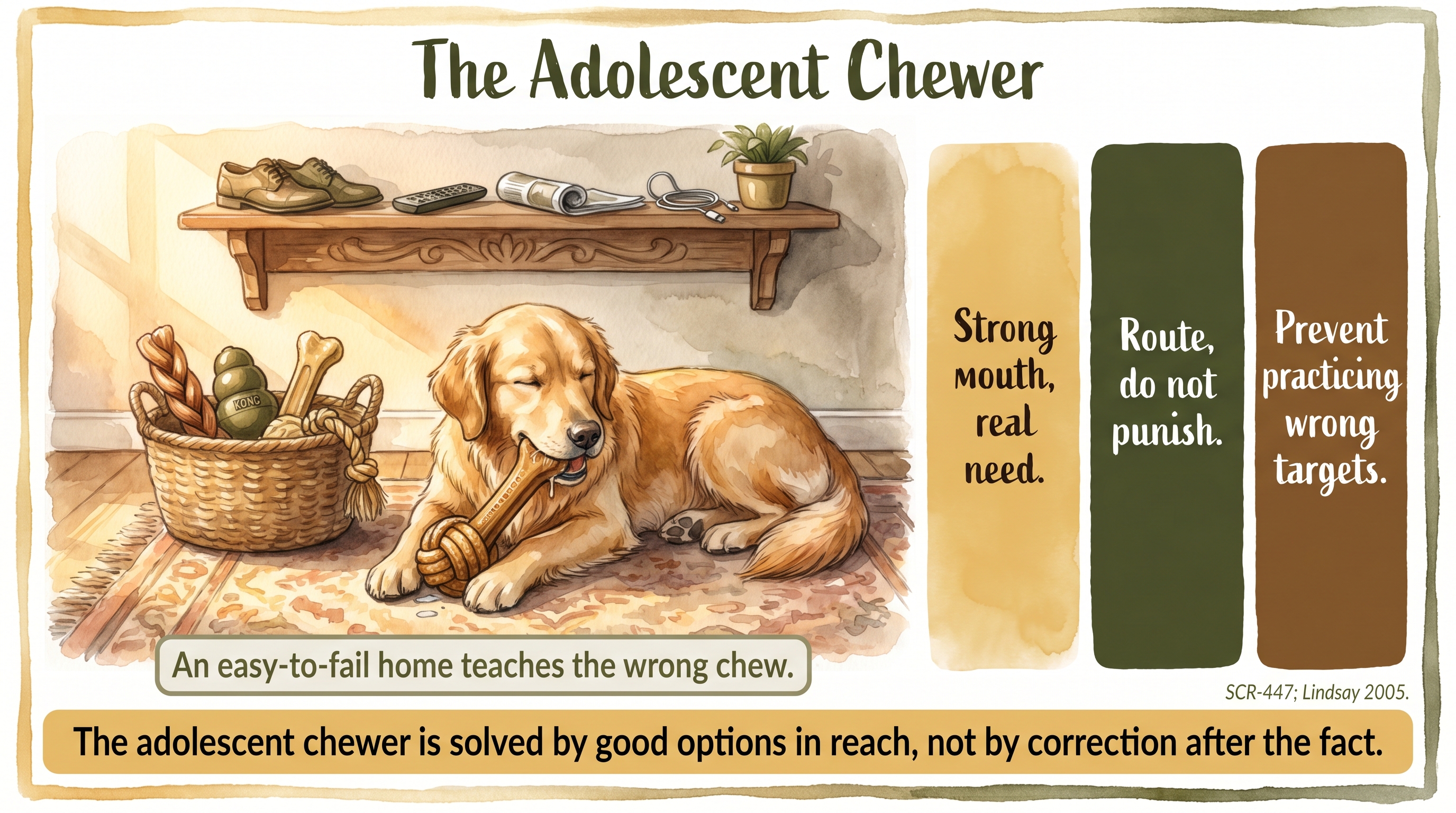
The adolescent chewer is solved by good options in reach, not by correction after the fact.
Key Takeaways
- The adolescent chewer is not the same as the teething puppy. The mouth is stronger and the experimentation is bigger.
- JB treats chewing as a routing problem, not a moral problem.
- Prevention, outlet, and calm redirection usually work better than punishment.
- If the environment stays easy to fail in, the dog will keep practicing the wrong version of the behavior.
The Evidence
- JB breeder observationGolden Retrievers
Chewing often intensifies in adolescence as mouth strength, persistence, and environmental experimentation increase. - JB household practicefamily dogs
Damage falls fastest when access is managed and legal chew outlets are obvious and plentiful.
- canine development literaturedomestic dogs
Behavior changes across adolescence reflect broader developmental shifts rather than simple adult-level stability.
- JB synthesisfamily-dog households
The cleanest way through the chewing phase is to route the behavior toward legal outlets and prevent wrong-object rehearsal rather than trying to punish mouth use itself.
No published study directly tests the practical implications of the adolescent chewer for domestic dog raising programs. The application to household dog raising remains an interpretive synthesis rather than a directly tested intervention finding.
SCR References
Sources
- Creevy, K. E., Grady, J., Little, S. E., Moore, G. E., Strickler, B. G., Thompson, S., & Webb, J. A. (2019). 2019 AAHA canine life stage guidelines. Journal of the American Animal Hospital Association, 55(6), 267-290. https://doi.org/10.5326/JAAHA-MS-6999
- Wells, D. L. (2004). A review of environmental enrichment for kennelled dogs, Canis familiaris. Applied Animal Behaviour Science, 85(3-4), 307-317. https://doi.org/10.1016/j.applanim.2003.11.005
- Re-sharpened by Queue1-DecisionTree: Iinuma, M., Yoshida, S., & Funakoshi, M. (1991). Development of masticatory muscles and oral behavior from suckling to chewing in dogs. Comparative Biochemistry and Physiology A, 100(4), 789-794. https://doi.org/10.1016/0300-9629(91)90293-l. This documents early canine oral and masticatory development, but does not verify adolescent household chewing-management protocols. SCR-447 remains an [Observed] JB-practice claim.