Adolescent Reactivity and Calm Exposure
Many dogs who looked socially easy in late puppyhood begin to show more visible trigger sensitivity during adolescence. The family first notices it on leash. Barking at another dog. Fixating on a runner. stiffening at a stranger. vocalizing at movement that used to pass without drama. This can feel sudden, but it is usually the result of several things landing together: the adolescent baseline shift, a more reactive arousal system, and the dogs growing history with specific triggers. Observed-JB
JB does not reduce all adolescent reactivity to a single cause. Some of it is developmental turbulence. Some of it is learning. Some of it is temperament. Some of it is genetics. The practical question is not whether a perfect explanation can be found. The practical question is how the family should handle the dog standing in front of them.
What It Means
Why Reactivity Often Emerges Now
Adolescence is a stage of altered salience. The world grabs the dog more strongly than it did months earlier. That change alone makes it easier for triggers to become loaded.
A dog that used to notice another dog and move on may now notice, orient harder, stay on the stimulus longer, and tip into vocal or leash behavior. Observed-JB A dog that used to pass strangers neutrally may now read them through a more charged nervous system. The leash can magnify all of it because it restricts motion and adds handler tension to the dogs body.
The important thing is not to make the trigger bigger than it is. Many adolescent dogs are not globally aggressive. They are more arousable and less smooth in the presence of specific stimuli.
What JB Means by Calm Exposure
Calm exposure is not flooding. It is not avoidance forever either.
It means working at the dogs actual threshold. Close enough that the dog notices the trigger. Far enough that the dog can remain under it.
That threshold matters because learning changes when arousal is too high. Observed-JB A dog barking, lunging, and spinning is no longer having a quiet information-gathering experience. It is rehearsing alarm.
The family goal is to set up exposures where the dog can look, process, stay with the handler, and move on without going fully over threshold. Sometimes that means much more distance than the owner expected. That is fine. Distance is not failure. Distance is the price of usable nervous-system state.
Calm exposure works because Calmness is not an afterthought. It is the condition that makes the dogs brain available for a different experience of the trigger.
The Practical Tools
In JB households, the most useful tools are usually plain ones: the quiet walk, more distance, better route choice, a long line or sensible leash management, fewer crowded environments for a while, and more low-arousal practice at home so the baseline is lower everywhere else. Observed-JB
The parasympathetic walk belongs here because it changes the whole frame. The walk is no longer an exposure gauntlet or a fitness test. It becomes a place where the dog learns to move through the world at a more regulated tempo.
That does not mean the dog will never react. It means the family is no longer donating extra arousal to every trigger encounter.
What JB Does Not Do
JB does not recommend meeting adolescent reactivity with aversive suppression and calling the quieter surface success. Dogs corrected hard around triggers often look more controlled in the moment while carrying the same or greater internal load underneath. The welfare literature around aversive methods is part of why JB refuses to confuse silence with resolution.
JB also does not tell families to disappear from the world until adulthood. Total avoidance can turn the dogs life into a shrinking circle and can make ordinary re-entry harder later. The answer is thoughtful exposure, not dramatic isolation.
When the Family Needs Help
Adolescent reactivity is common. Escalating and generalizing reactivity deserves support.
If the trigger list is getting longer, the distance needed is growing, or the dog is beginning to look unsafe or deeply distressed, the family should not keep treating the situation as routine adolescence. Calm exposure is a strong first principle. It is not the only principle. Some dogs need a more structured behavior plan, medical assessment, or specialist guidance.
What matters is that help is sought before the reactivity becomes the dogs main way of meeting the world.
Why It Matters for Your Dog
Reactivity is one of the places where adolescence can push families out of their philosophy fastest. People become embarrassed, afraid, and eager for anything that works immediately. That emotional pressure is understandable. It is also when bad methods get marketed most successfully.
JB tries to keep the family steady enough to choose the cleaner path: lower the baseline, increase distance, work under threshold, do not confuse suppression with resolution, and get help when the pattern is clearly growing. That is not a glamorous plan. It is a defensible one.
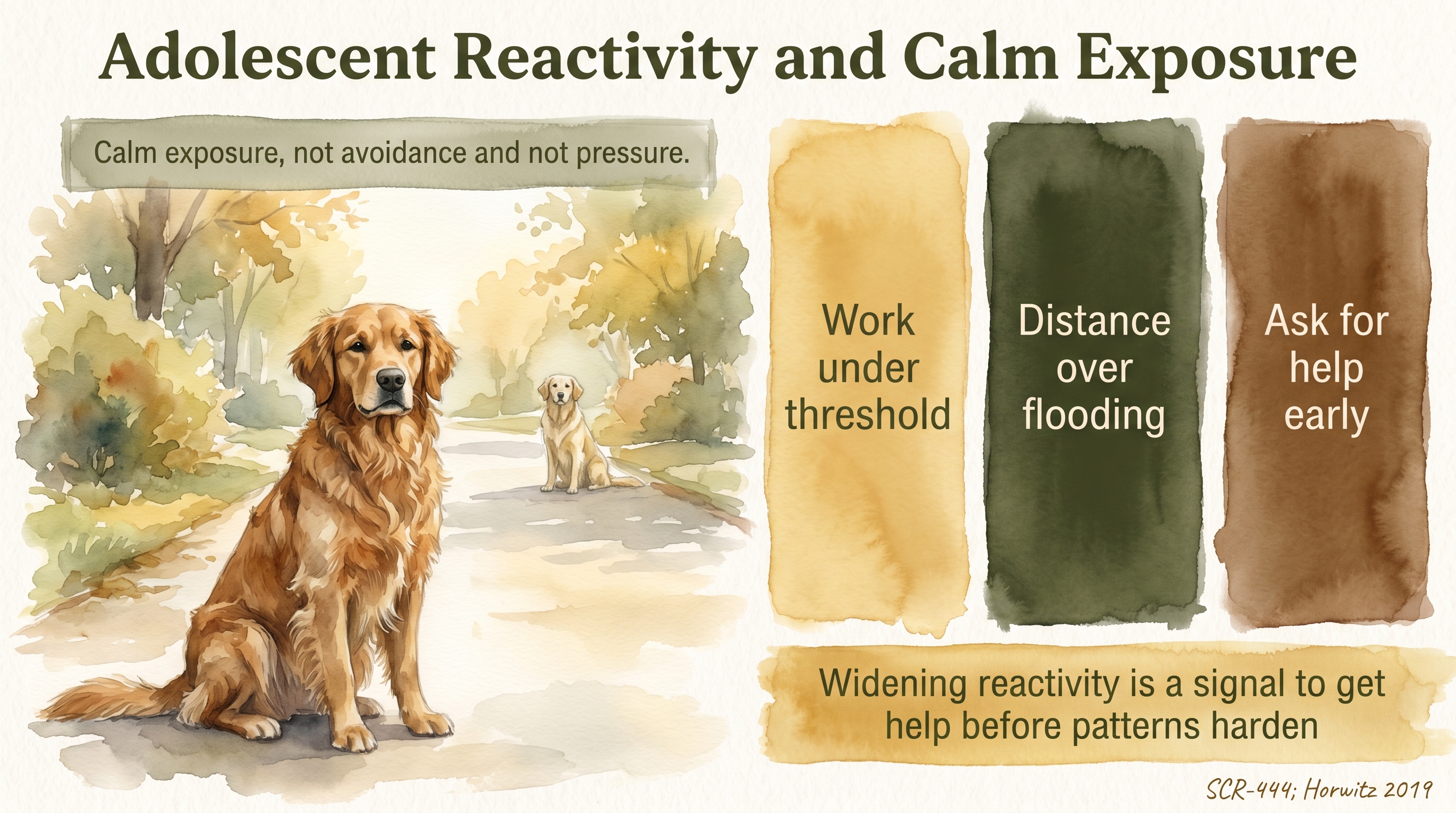
Widening reactivity is a signal to get help before patterns harden.
Key Takeaways
- Adolescent reactivity often reflects a developmental shift in arousal and salience rather than a single new personality trait.
- Calm exposure means working under threshold, not flooding the dog and not hiding from the world forever.
- JB prefers distance, route choice, quiet walks, and lower baseline arousal over harsh trigger corrections.
- If reactivity is widening or intensifying, the family should seek help before it becomes the dogs dominant social pattern.
The Evidence
- Yerkes-Dodson framing applied to dogsdomestic dogs
Performance and regulation deteriorate when arousal exceeds the dogs usable range, which is highly relevant for trigger work. - stress physiology literaturedomestic dogs
Higher sympathetic load changes how dogs process novelty, challenge, and environmental triggers.
- JB breeder observationGolden Retrievers
Trigger sensitivity and leash reactivity often become more visible during adolescence even in dogs that appeared socially easy in late puppyhood. - JB household practicefamily dogs
Calm exposure at threshold distance, combined with lower baseline household arousal, tends to produce cleaner progress than reactive correction.
- aversive welfare literaturedomestic dogs
Aversive interventions may suppress visible behavior while leaving fear, stress, or negative emotional association unresolved.
No published study directly tests the practical implications of adolescent reactivity and calm exposure for domestic dog raising programs. The application to household dog raising remains an interpretive synthesis rather than a directly tested intervention finding.
SCR References
Sources
- Asher, L., England, G. C. W., Sommerville, R., & Harvey, N. D. (2020). Teenage dogs? Evidence for adolescent-phase conflict behaviour and an association between attachment to humans and pubertal timing in the domestic dog. Biology Letters, 16(5), 20200097. https://doi.org/10.1098/rsbl.2020.0097
- Ziv, G. (2017). The effects of using aversive training methods in dogs: A review. Journal of Veterinary Behavior, 19, 50-60. https://doi.org/10.1016/j.jveb.2017.02.004
- Vieira de Castro, A. C., Fuchs, D., Morello, G. M., Pastur, S., de Sousa, L., & Olsson, I. A. S. (2020). Does training method matter? Evidence for the negative impact of aversive-based methods on companion dog welfare. PLoS ONE, 15(12), e0225023. https://doi.org/10.1371/journal.pone.0225023
- Hiby, E. F., Rooney, N. J., & Bradshaw, J. W. S. (2004). Dog training methods: Their use, effectiveness and interaction with behaviour and welfare. Animal Welfare, 13(1), 63-69. https://doi.org/10.1017/S0962728600026683
- Beerda, B., Schilder, M. B. H., van Hooff, J. A. R. A. M., de Vries, H. W., & Mol, J. A. (1998). Behavioural, saliva cortisol and heart rate responses to different types of stimuli in dogs. Applied Animal Behaviour Science, 58(3-4), 365-381. https://doi.org/10.1016/S0168-1591(97)00145-7
- Affenzeller, N., Palme, R., & Zulch, H. (2017). Playful activity post-learning improves training performance in Labrador Retriever dogs. Physiology & Behavior, 168, 62-73. https://doi.org/10.1016/j.physbeh.2016.10.014