When to Get Professional Support in Adolescence
Most adolescent dogs can be held well by the family, the breeders guidance, good daily rhythm, and the ordinary JB vocabulary. Observed-JB Some cannot, or at least not without more help than the household can reasonably provide on its own.
That is not a failure of the philosophy. It is part of the philosophy.
JB does not promise that every adolescent challenge resolves through patience alone. Observed-JB It promises a clean way to notice when the challenge has outgrown ordinary household management.
What It Means
The Signs That Matter Most
Families should consider outside support when they are seeing any of the following: reactivity spreading quickly to new triggers, aggression that is approaching or crossing bite-threshold intensity, fear responses that are not settling with calmer handling and time, resource guarding that is growing rather than shrinking, separation-related distress that is becoming severe, or abrupt behavioral change that feels qualitatively different from normal adolescence.
The key phrase there is growing rather than shrinking. Adolescence can be noisy without being dangerous. What deserves help is the pattern that is consolidating in the wrong direction.
The JB Support Pathway
JB generally thinks in tiers. First call: the breeder. Second call: the dogs veterinarian. Third tier: a qualified behavior professional, ideally someone aligned with humane, non-aversive work and with enough skill to handle real cases rather than only easy training scenarios. Observed-JB
Where medical contribution is possible, the veterinarian matters early, not late. Sudden behavioral change, pain-related change, endocrine change, and significant deterioration should not all be treated as pure training questions.
What JB Does Not Recommend
JB does not recommend sending an adolescent into aversive board-and-train systems, remote-collar programs, or force-heavy behavior packages simply because the problem is serious and the family feels scared. Observed-JB
That sort of moment is when bad options look most attractive. The dog looks harder. The family is exhausted. The trainer promises fast control. But fast quiet is not the same thing as safer long-term behavioral health.
The welfare and punishment literature matters here. Suppression can change what the family sees without changing what the dog is carrying.
Why Asking for Help Is Not a Contradiction
Some people hear a philosophy built on calmness and mentorship and assume that needing a specialist means the philosophy failed. JB sees it differently. The philosophy includes discernment. It includes escalation when escalation is warranted. It includes not pretending that all dogs have the same threshold for developmental turbulence.
The same distinction JB makes inside the home applies to outside help. Families should choose support that keeps the dog in a communicative, relational frame rather than support that depends on fear or coercive suppression.
Why Timing Matters
Behavioral patterns are easier to change when they are not yet the dogs normal answer to the world. Families who seek help early are not overreacting. They are often preserving options.
Waiting until the dog has months of successful reactivity, guarding, or fear rehearsal behind it usually makes every future intervention harder. Early support is prevention in another form.
Why It Matters for Your Dog
The warmest thing a family can do is not always to keep handling the problem alone. Sometimes the warmest thing is to recognize that the dog needs more skill, more structure, or more medical assessment than the household currently has.
A good referral does not replace the family. It strengthens the familys ability to keep being the secure base.
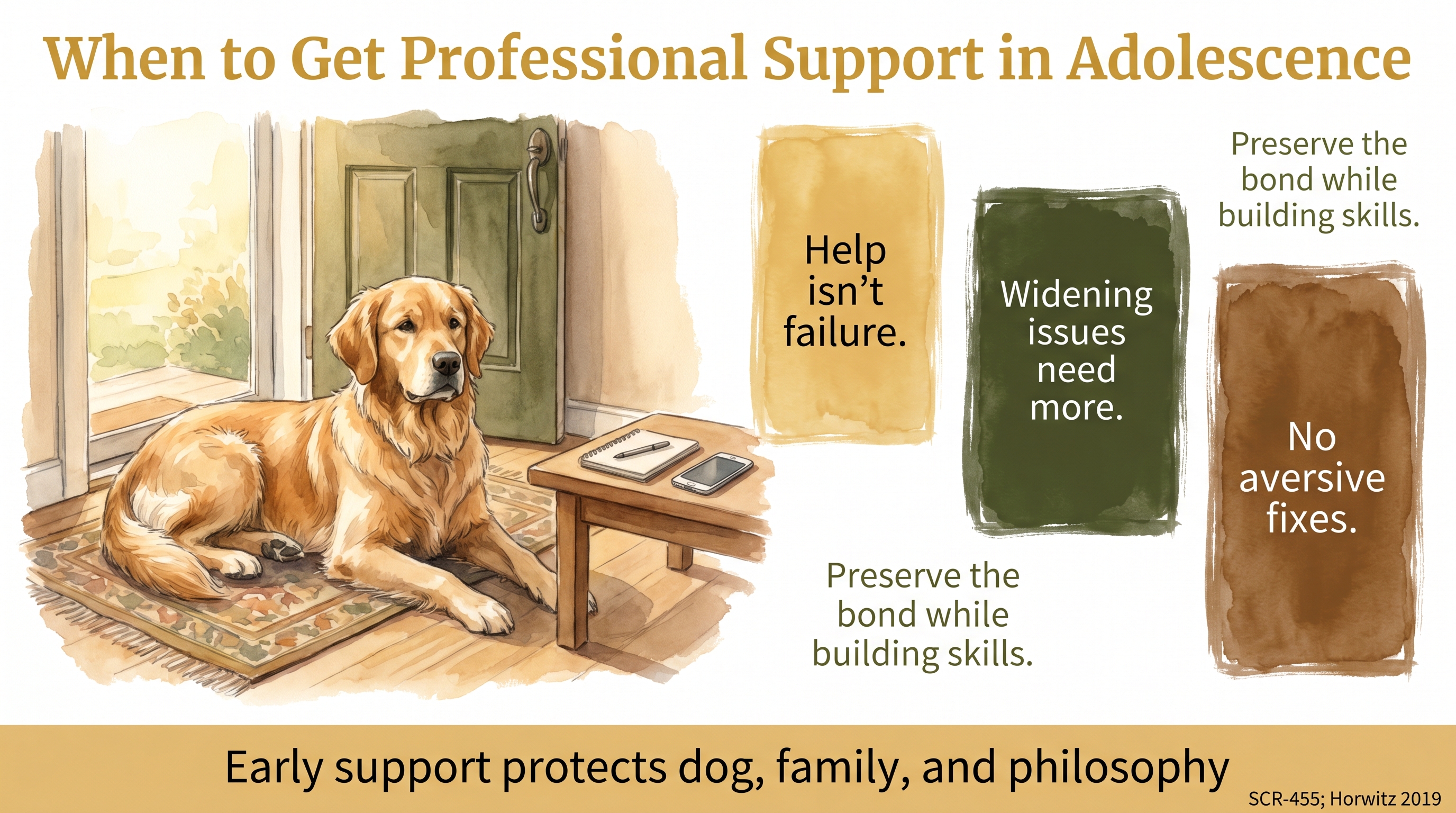
Asking for support early protects the dog, the family, and the philosophy all at once.
Key Takeaways
- Needing help in adolescence is not a failure of the philosophy.
- The strongest reasons to seek support are widening reactivity, significant aggression, severe fear, intensifying guarding, or abrupt major change.
- JB does not recommend aversive quick-fix systems simply because the case is serious.
- Good support preserves the relationship while giving the family more skill and clearer options.
The Evidence
- JB breeder observationGolden Retrievers
Most adolescent issues remain manageable in the home, but widening reactivity, severe fear, aggression, and growing guarding patterns are red flags rather than ordinary noise.
- punishment-in-learning literaturedomestic dogs and animals
Punishment can suppress behavior without changing underlying emotional drivers and can introduce additional welfare costs. - aversive welfare literaturedomestic dogs
Aversive methods are associated with fear, stress, and welfare risks that should remain visible during referral decisions.
- JB synthesisfamily dogs
The cleanest support pathway is breeder, veterinarian, then qualified humane behavior help when the pattern is beyond ordinary household handling.
No published study directly tests the practical implications of when to get professional support in adolescence for domestic dog raising programs. The application to household dog raising remains an interpretive synthesis rather than a directly tested intervention finding.
SCR References
Sources
- Hiby, E. F., Rooney, N. J., & Bradshaw, J. W. S. (2004). Dog training methods: Their use, effectiveness and interaction with behaviour and welfare. Animal Welfare, 13(1), 63-69. https://doi.org/10.1017/S0962728600026683
- Ziv, G. (2017). The effects of using aversive training methods in dogs: A review. Journal of Veterinary Behavior, 19, 50-60. https://doi.org/10.1016/j.jveb.2017.02.004
- Vieira de Castro, A. C., Fuchs, D., Morello, G. M., Pastur, S., de Sousa, L., & Olsson, I. A. S. (2020). Does training method matter? Evidence for the negative impact of aversive-based methods on companion dog welfare. PLoS ONE, 15(12), e0225023. https://doi.org/10.1371/journal.pone.0225023
- Boundary approved by Queue1-DecisionTree: existing Hiby (2004), Ziv (2017), Vieira de Castro (2020), and AVSAB-related humane-training materials support the aversive-method and humane-support boundary. No single primary-source threshold set was located for when adolescent cases require professional support. SCR-455 remains an [Observed] JB-practice claim pending a dedicated professional-support source review.
- Just Behaving program observation disclosure. (2026). Boundary: this internal observation is limited to JB-raised Golden Retrievers whose families continued the JB framework after placement; cohort size, time window, and counting rule are deferred in this revision. Treat as program observation supporting when adolescent cases require professional help, not as published external evidence.