Adolescent Socialization: The Limits of the Window
Adolescent socialization is often where families become most confused by the word socialization itself. The early puppy window made the term feel urgent and expansive. Expose the puppy. Introduce the puppy. Build familiarity while the world is easy to absorb. By adolescence, that same word can tempt people into the wrong project. They start trying to recreate the primary window with an older dog whose nervous system no longer works that way.
JB prefers a cleaner distinction: by adolescence, the main work is no longer primary socialization. Observed-JB It is maintenance, expansion, and patient realism.
What It Means
What the Window Means
The classic socialization literature gives the strongest weight to the early window. Documented That is the period when broad categories of people, places, sounds, and life patterns are easiest to absorb as normal. Later learning absolutely still happens. The point is not that learning stops. The point is that the conditions have changed.
An adolescent can still form new associations.
An adolescent can still become more comfortable.
An adolescent can still generalize from repeated calm experience.
What is less defensible is the idea that a late adolescent can simply be rushed through a backlog of novelty and come out as though the earlier window had been used fully.
What JB Means by Maintenance
Maintenance means keeping the world open without making exposure frantic. The adolescent still needs quiet walks in different locations, calm contact with ordinary public life, occasional well-chosen encounters with trusted adult dogs, and low-drama exposure to the kinds of people and settings that will matter in adulthood. But the tone changes. The family is no longer checking off novelty for novelty's sake. It is preserving or gently extending the dog's ability to move through real life without overload.
The Catch-Up Mistake
Families often realize during adolescence that there are things the dog does not handle beautifully. Observed-JB Maybe it is city noise, men in hats, busy sidewalks, or unfamiliar dogs in close quarters. At that moment, panic can turn socialization into a campaign: dog park, busy pet store, weekend crowd, large group class, and repeated high-stimulation outings because the dog needs more exposure.
This usually mistakes quantity for usefulness. A dog over threshold in a chaotic setting is not receiving the kind of calm, layered information that changes long-term comfort. It is just enduring a lot.
The JB Alternative
JB keeps exposure quiet enough that the dog can still regulate. Distance is allowed, duration is adjusted, crowded contexts are not used just because they are available, and novelty is introduced at a tempo the dog can digest.
The question is always the same: can the dog remain in a state where this experience can be processed as ordinary life instead of as an emotional event?
Social exposure without regulation is not the same as socialization. JB treats calmness as the condition that makes later exposure useful rather than overwhelming.
The Honest Limit
Some categories missed during the early window may always require more patient handling later.
A dog not exposed to a certain surface, social type, or environmental pattern early may still improve substantially in adolescence. Observed-JB It may simply not do so with the ease the family wishes it had.
That is not failure. It is development with history.
This is one reason JB resists marketing language that implies perfect rehabilitation of every missed experience by simply trying harder. The dog deserves a truthful plan, not a fantasy.
Why It Matters for Your Dog
Adolescent socialization matters because adult life is still ahead. The family should not stop showing the dog the world. But it should stop imagining that more is automatically better.
The goal is not maximum stimulation. The goal is a dog who can live in the real world with quiet competence. That goal is served by calm repetition, thoughtful environments, and realistic expectations about what early windows did and did not establish.
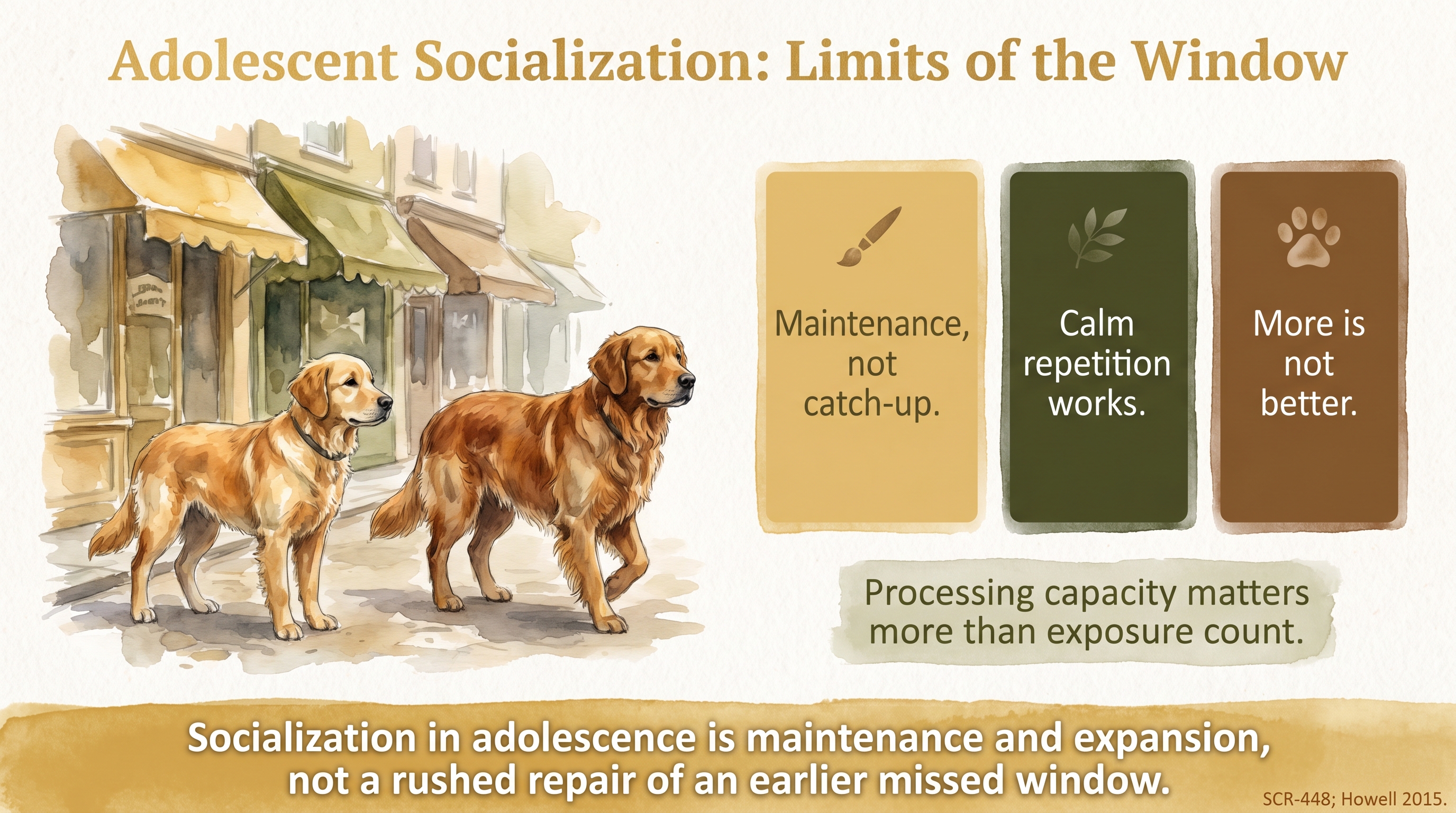
Socialization in adolescence is maintenance and expansion, not a rushed repair of an earlier missed window.
Key Takeaways
- By adolescence, the main socialization work is maintenance and expansion, not recreating the early puppy window.
- More exposure is not always better if the dog is too aroused to process it well.
- JB favors calm real-world repetition over catch-up chaos.
- Missed early experiences can often be improved later, but usually with less ease and more patience than families expect.
The Evidence
- Scott and Fuller tradition and later synthesisdomestic dogs
The primary socialization window carries the strongest documented influence on broad familiarity and reduced fear toward novelty.
- JB breeder observationGolden Retrievers
Adolescence is best used to maintain and gently expand real-world comfort rather than to recreate the primary puppy window under high pressure. - JB household practicefamily dogs
Calm public exposure and well-chosen low-stimulation outings generally help more than busy social scenes when the adolescent is already uncertain.
- JB synthesisfamily dogs
The right adolescent socialization strategy is realistic exposure at digestible intensity, especially when the early window left gaps.
No published study directly tests the practical implications of adolescent socialization: the limits of the window for domestic dog raising programs. The application to household dog raising remains an interpretive synthesis rather than a directly tested intervention finding.
SCR References
Sources
- Scott, J. P., & Fuller, J. L. (1965). Genetics and the social behavior of the dog. University of Chicago Press.
- Howell, T. J., King, T., & Bennett, P. C. (2015). Puppy parties and beyond: The role of early age socialization practices on adult dog behavior. Veterinary Medicine: Research and Reports, 6, 143-153. https://doi.org/10.2147/VMRR.S62081
- Asher, L., England, G. C. W., Sommerville, R., & Harvey, N. D. (2020). Teenage dogs? Evidence for adolescent-phase conflict behaviour and an association between attachment to humans and pubertal timing in the domestic dog. Biology Letters, 16(5), 20200097. https://doi.org/10.1098/rsbl.2020.0097
- Asher, L., England, G. C. W., Sommerville, R., & Harvey, N. D. (2020). Teenage dogs? Evidence for adolescent-phase conflict behaviour and an association between attachment to humans and pubertal timing in the domestic dog. Biology Letters, 16(5), 20200097. https://doi.org/10.1098/rsbl.2020.0097
- Serpell, J. A., & Duffy, D. L. (2016). Aspects of juvenile and adolescent environment predict aggression and fear in 12-month-old guide dogs. Frontiers in Veterinary Science, 3, 49. https://doi.org/10.3389/fvets.2016.00049