Adolescent Recall and the Mentorship Response
If there is one complaint that makes families feel adolescence personally, it is recall. The dog that felt naturally available at five months stops feeling naturally available at eight. The dog still knows your voice. The dog still understands the situation. The difference is that the environment has become more compelling than it used to be, and the dogs response threshold is no longer operating on puppy settings.
This matters because recall is emotionally loaded. Families do not experience it as a subtle developmental change. They experience it as a moment of being ignored.
JB asks for a slower interpretation. Observed-JB Adolescent recall weakness is real. It is also one of the most understandable outcomes of this developmental stage.
What It Means
Why Recall Changes
The underlying principle is simple: adolescence redistributes attention. Scent becomes more rewarding, distance becomes more interesting, other dogs matter more, and movement matters more. The dog is not less bonded. It is more environmentally engaged.
That is why the guide-dog adolescence work is so useful here. It shows that a temporary drop in responsiveness to the primary carer is part of the documented canine adolescent picture. Documented Recall is one of the first places a family feels that drop because recall asks the dog to turn away from the worlds pull and back toward the relationship.
In late puppyhood that turn may happen easily. In adolescence it may happen later, less consistently, or not at all in environments that have become too rewarding.
The Industry Reflex
Most recall advice gets more intense the moment recall gets thinner: use better rewards, raise the value, drill harder, correct harder, use remote pressure, and enroll in a recall intensive. Observed-JB
Some of these approaches can create surface reliability. JB is not pretending otherwise. The deeper question is what kind of recall is being built and at what cost to the relationship during a developmentally unstable period.
JB does not want families gambling with off-leash exposure while trying to out-condition adolescence in real time.
The JB Response
The first JB move is management.
If recall is no longer reliable, the dog gets less off-leash freedom in environments where failure is dangerous or self-reinforcing. That is not defeat. It is maturity from the human side.
The second move is the long line. The long line is not a punishment tool. It is a safety and honesty tool. It allows the dog to move, sniff, and explore while keeping the family from rehearsing failed recalls.
The third move is simplified practice. Recall can still be used in low-stimulation settings where the family is not asking the adolescent to fight the entire environment at once. The point is not to prove the dog wrong. It is to keep the relationship channel warm and readable.
The mentorship response to weak adolescent recall is not to take the lapse as insult. It is to recognize that the dogs internal reward map has shifted and to protect both the relationship and the dogs safety while that map matures again.
What JB Will Not Promise
This is important enough to say plainly: JB should never promise that love alone produces perfect off-leash return.
Relationship matters deeply. Attachment matters. Observed-JB Calmness matters. But adolescence also involves wildlife, moving objects, competing dogs, distance, hormones, and individual variation. Families still have legal responsibilities and safety responsibilities. A philosophically elegant recall view becomes dangerous if it turns into magical thinking.
That is why JB keeps the management side visible. A dog can be loved and still need a leash.
What Families Usually See When They Handle This Well
When recall weakens and the family responds calmly, several good things happen. First, the dog stops practicing large, exciting failures. Second, the human stops making recall a resentful confrontation. Third, the relationship stays intact because the adolescent is not being treated like a moral offender every time the environment wins. Fourth, recall often rebuilds later on firmer ground. The dog that comes back after adolescence is often less impulsively available than the puppy, but more deeply settled when mature.
That long-arc perspective is important. Puppy recall can look wonderful because the puppies world is still small. Adult recall has to survive a much larger world. Adolescence is the bridge between the two.
The Main Mistakes
The first mistake is testing recall in conditions where the family already knows it is failing. The second is escalating emotionally every time the dog hesitates. The third is giving the dog too much freedom out of nostalgia for the earlier puppy stage. The fourth is confusing management with training failure. Using a leash, long line, fenced area, or quieter setting is not a confession that the relationship does not work. It is how good relationships protect young dogs from their own unfinished stage.
Why It Matters for Your Dog
Recall is not only about coming when called. It is about what the dog learns the human voice means during a difficult developmental stretch.
If the voice becomes loaded with frustration, pressure, or repeated failure, the relationship pays for it.
If the voice remains legible, calm, and attached to sensible management, the dog comes through adolescence still reading the family as a stable center rather than as a source of conflict.
That is the JB goal. Not theatrical adolescent obedience. A recall relationship that survives the phase and strengthens after it.
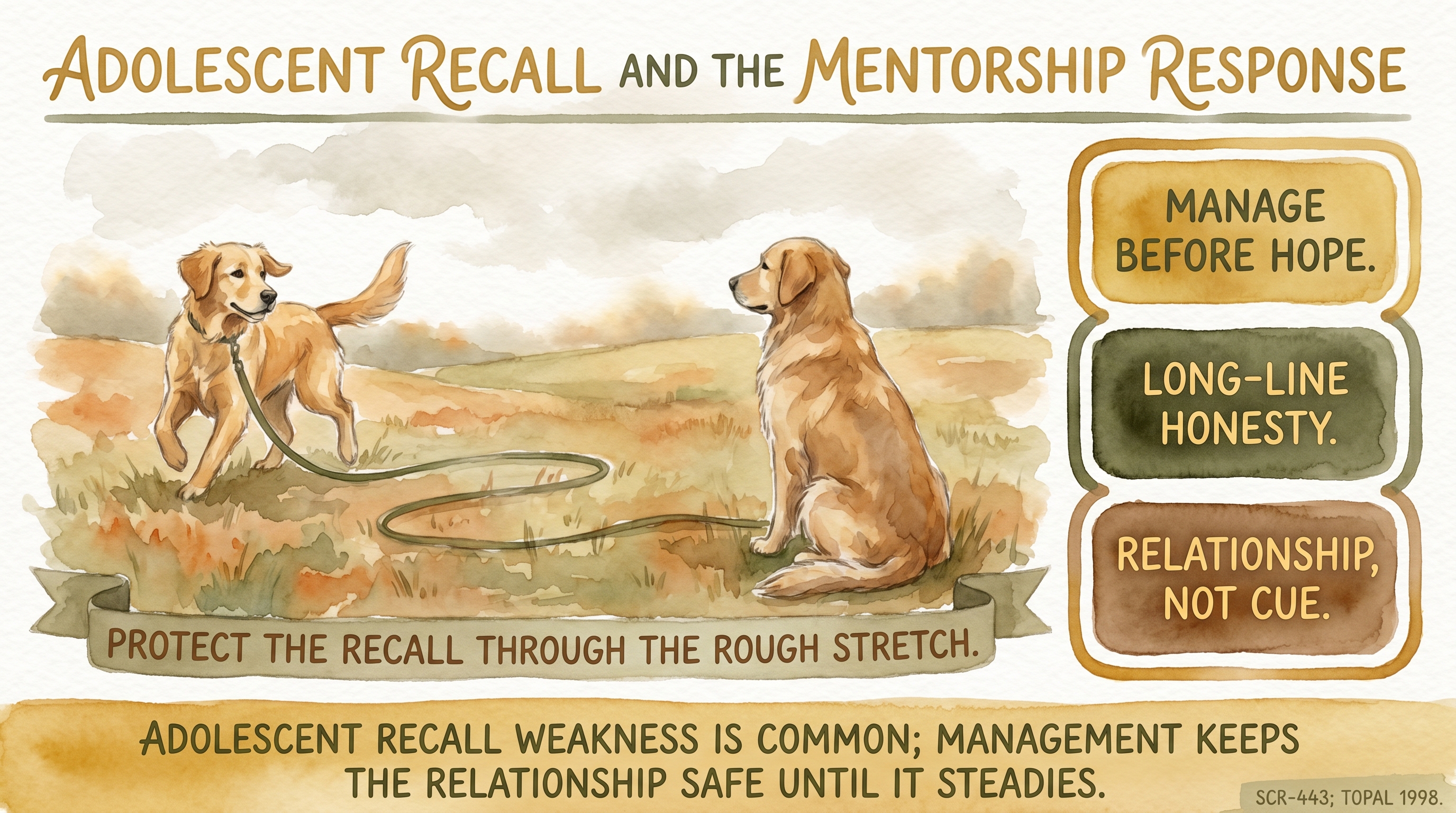
Adolescent recall weakness is common; management keeps the relationship safe until it steadies.
Key Takeaways
- Adolescent recall weakness is common and developmentally understandable, not proof that the relationship failed.
- JB responds by managing first: less risky freedom, more long-line honesty, and calmer low-stimulation practice.
- Families should not promise themselves that bond alone makes adolescence safe off leash in every context.
- The goal is a recall relationship that survives adolescence intact and strengthens as the dog matures.
The Evidence
- Asher et al. (2020)domestic dogs
Adolescent dogs showed a temporary reduction in responsiveness and trainability toward their primary carer, supporting the developmental explanation for thinner recall during this phase.
- JB breeder observationGolden Retrievers
Recall often becomes less reliable during adolescence even in dogs with strong earlier partnership, especially when the environment becomes more rewarding. - JB family practicefamily-raised Goldens
Reducing freedom, using a long line, and keeping recall emotionally clean tends to protect both safety and relationship through the adolescent phase.
- JB synthesisfamily dogs
The recall that re-forms after adolescence is often stronger because it is built in a dog whose relationship to the environment is no longer running on puppy settings.
No published study directly tests the practical implications of adolescent recall and the mentorship response for domestic dog raising programs. The application to household dog raising remains an interpretive synthesis rather than a directly tested intervention finding.
SCR References
Sources
- Asher, L., England, G. C. W., Sommerville, R., & Harvey, N. D. (2020). Teenage dogs? Evidence for adolescent-phase conflict behaviour and an association between attachment to humans and pubertal timing in the domestic dog. Biology Letters, 16(5), 20200097. https://doi.org/10.1098/rsbl.2020.0097
- Hiby, E. F., Rooney, N. J., & Bradshaw, J. W. S. (2004). Dog training methods: Their use, effectiveness and interaction with behaviour and welfare. Animal Welfare, 13(1), 63-69. https://doi.org/10.1017/S0962728600026683
- Bouton, M. E., & Todd, T. P. (2014). A fundamental role for context in instrumental learning and extinction. Behavioural Processes, 104, 13-19. https://doi.org/10.1016/j.beproc.2014.02.012
- Just Behaving program observation disclosure. (2026). Boundary: this internal observation is limited to JB-raised Golden Retrievers whose families continued the JB framework after placement; cohort size, time window, and counting rule are deferred in this revision. Treat as program observation supporting the mentorship-response approach to adolescent recall, not as published external evidence.