Golden Retriever Health: An Overview
Compound evidence detail1 SCR / 2 parts
- Ambiguousany single percentage figure presented as a universal Golden Retriever cancer constant without naming the population, study design, or referral basis
- Documentedthe necropsy and referral cohort findings themselves; cancer as a leading cause of death in Golden Retrievers with honest sourcing and explicit dataset attribution
Golden Retriever health is a subject that needs two things at the same time: honesty and proportion. The honest part is that Goldens carry a well documented burden of cancer, orthopedic disease, cardiac screening concerns, ocular disease, allergic skin and ear disease, and broader population-genetic narrowing. The proportional part is that this does not mean every Golden is fragile, doomed, or unhealthy. It means the breed has known risk architecture, and good families deserve to understand it clearly. Mixed Evidence
What It Means
The modern Golden Retriever is one of the most beloved family breeds in the world, but popularity has a cost when it interacts with a closed studbook and repeated use of the same influential bloodlines. Large census numbers can create the illusion of abundance while the effective breeding population stays much smaller than it appears. That structural narrowing does not create one single disease. It changes the probability landscape across many diseases at once.
For families, the practical question is not "Is this breed healthy or unhealthy?" The practical question is "What health problems are common enough, serious enough, and well documented enough that I should understand them before I bring a puppy home?" Documented That is the function of this subcategory.
The broad answer is cancer is the dominant mortality story in the breed, especially in middle-aged and older adults; hip and elbow dysplasia remain important orthopedic concerns despite decades of screening; subvalvular aortic stenosis remains the most important inherited cardiac condition in the breed; Golden-specific ocular risk cannot be reduced to DNA panels alone; some inherited conditions, such as ichthyosis, are common enough that genetic management must balance disease prevention with diversity preservation; and allergies, recurrent otitis externa, and chronic skin disease are extremely common quality-of-life issues even when they are not the most dramatic diseases in the breed.
That mix matters because families often imagine breed health only in terms of catastrophic disease. Observed-JB In reality, Golden Retriever health has both high-severity problems and high-frequency, lower-severity problems. A family may never face hemangiosarcoma, but many will face recurrent ear disease, chronic itch, orthopedic management, or later-life cancer surveillance.
The Main Health Burdens
Cancer
Cancer is the center of gravity in Golden Retriever health discussion for good reason. Across multiple large datasets, Goldens are consistently described as a cancer-predisposed breed, and neoplasia is the leading cause of death. The famous "60 to 65 percent" figure comes from specific referral and necropsy populations, not from a single perfect breed-wide census, so it must be stated with care. But the core point survives that caveat: cancer is not a rare outlier in this breed. It is the dominant long-term health burden.
The four cancers families hear about most are hemangiosarcoma, lymphoma, mast cell tumors, and osteosarcoma. They do not behave the same way. Hemangiosarcoma is often catastrophic and sudden. Lymphoma is often diagnosed from enlarged lymph nodes and may respond meaningfully to treatment for a period of time. Mast cell tumors vary widely by grade and site. Osteosarcoma is a painful, aggressive bone cancer that often presents first as unexplained lameness.
Orthopedic disease
Hip dysplasia and elbow dysplasia are not cosmetic screening issues. They are developmental joint diseases that can shape comfort, mobility, activity tolerance, and long-term arthritis risk. Hip screening has improved over time, but the breed is not free of risk, and voluntary registries can understate real prevalence because abnormal dogs are less likely to be submitted. Elbow disease is often quieter in public discussion than hip disease, but for individual dogs it can be just as consequential.
Cardiac disease
For Goldens, the key inherited cardiac concern is subvalvular aortic stenosis, often shortened to SAS. The screening lesson here is as important as the disease itself: a stethoscope exam alone is not enough for responsible breeding decisions. Specialist echocardiography with Doppler is the defensible method. That distinction matters because many families hear "heart checked" and assume all screening methods are equivalent. They are not.
Eyes, skin, and quality-of-life disease
Ocular health in Goldens includes both DNA-testable problems and problems that remain clinical-screening problems rather than panel-test problems. Annual ophthalmologic exams still matter because late-onset and incompletely mapped conditions, especially Golden Retriever Pigmentary Uveitis, are not ruled out by being "clear" on a DNA panel.
Skin and ear disease sit in a different part of the burden map. They are usually not the conditions that dominate mortality statistics, but they are among the conditions most likely to shape daily comfort and veterinary visits. Golden Retrievers are one of the classic floppy-eared, allergy-prone breeds. For many families, chronic itch, recurrent otitis, and skin barrier problems are more likely to become part of normal life than the rarer inherited diseases.
Why the Pattern Looks Like This
The breed's health picture is not explained by one gene, one decade, or one decision. It is the cumulative effect of population structure.
Golden Retrievers descend from a limited founder base. Over time, breed popularity, selection bottlenecks, and popular-sire effects concentrated some lines much more heavily than others. The result is that the true breeding population, measured genetically rather than emotionally, is smaller than the registration numbers imply.
That matters in three ways.
First, shallow pedigree COI is an imperfect measure of real genomic relatedness. Documented A dog can look acceptably outcrossed on paper while still carrying more homozygosity than the pedigree suggests.
Second, higher genomic inbreeding has documented effects inside the breed, including reduced fecundity. Documented That does not mean every individual high-COI dog is sick. It means inbreeding depression is not hypothetical. It is measurable.
Third, this is why diversity management matters even when a disease is DNA-testable. Removing every carrier of every recessive condition sounds clean but can worsen the bigger structural problem by shrinking the gene pool further. In many cases, carrier-to-clear breeding with planned selection of clear offspring is the more responsible strategy. Documented
Why It Matters for Your Dog
What Responsible Breeding Can and Cannot Do
Responsible breeding is not magic. It shifts probabilities. It does not abolish them.
A breeder can screen hips, elbows, eyes, and hearts using the best available methods; track family-level health and longevity, not only individual clearances at breeding age; manage recessive disease intelligently instead of panicking at carrier status; avoid pairing decisions that unnecessarily narrow diversity; and retire dogs and lines when concerning patterns become clear.
A breeder cannot promise a cancer-proof Golden Retriever; turn one normal cardiac exam into a lifetime guarantee; claim that health testing alone solves a population-genetics problem; and hide behind registry language that sounds reassuring but exceeds what the screening really proves.
For families, that means the right standard is not "find a breeder who guarantees everything." The right standard is "find a breeder who understands the actual problem set, screens rigorously, and speaks honestly about residual risk."
Why This Page Matters for Families
This overview exists because breed health information is often delivered in one of two bad forms.
One form is sales language, where every problem is softened into "we health test" and the structure of risk disappears. The other is doom language, where every Golden seems destined for early disease and grief.
Neither is useful.
The more accurate middle ground is that Goldens are wonderful family dogs with a real, evidence-based health burden that requires more seriousness than some breeds do. That seriousness is not pessimism. It is competence. Families who understand the health map make better decisions about breeder selection, screening questions, body condition, exercise, routine monitoring, and how they interpret changes as the dog ages. When the change is behavioral rather than obviously physical, Rule Out Physiology First explains why the veterinary workup still comes before behavioral interpretation.
When to See a Veterinarian
Families should not try to turn a broad health overview into self-diagnosis. What matters is recognizing the signs that move a dog from normal monitoring into professional evaluation.
Veterinary evaluation is warranted for unexplained weight loss, new lethargy, or loss of normal stamina, persistent or recurrent lameness, especially in a growing dog or an older dog with sudden pain, collapse, fainting, or unusual exercise intolerance, new or changing eye cloudiness, chronic tearing, squinting, or visible discomfort, recurrent ear odor, discharge, head shaking, or chronic skin itch, new urinary leakage, repeated house-soiling in a dog that seems to be trying, or excessive drinking and urination, and any rapidly growing lump, a lump that changes character, or an old lump that suddenly looks different.
Immediate or same-day evaluation is especially important for collapse, pale gums, severe breathing difficulty, abdominal distension, or neurologic changes.
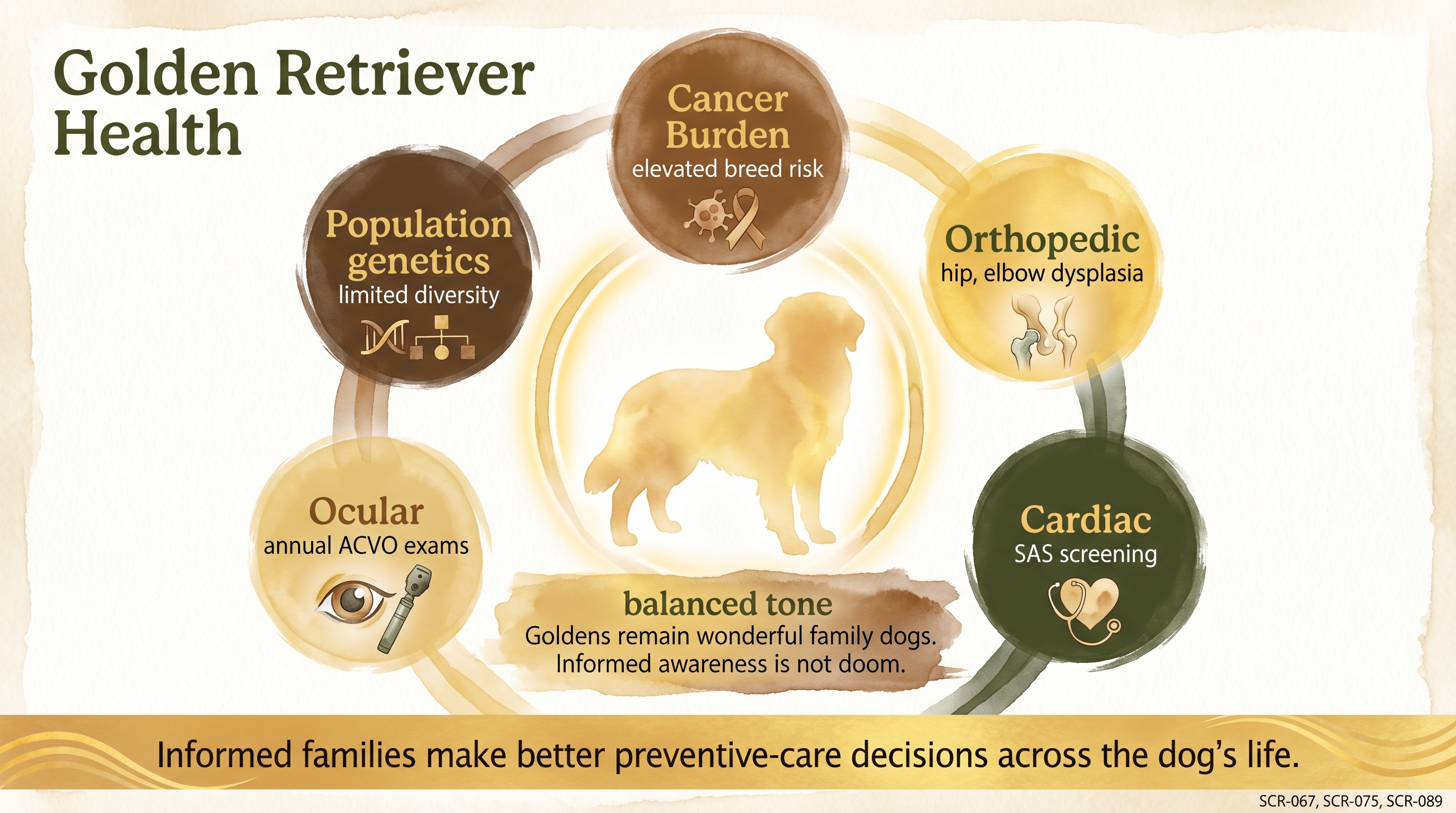
Informed families make better preventive-care decisions across the dog's life.
Key Takeaways
- Golden Retrievers have a real and well documented health burden, with cancer as the central long-term mortality issue.
- Orthopedic disease, SAS, ocular disease, and chronic allergic skin and ear disease are also major parts of the breed health picture.
- Population structure matters. Genetic narrowing and popular-sire effects help explain why the breed carries this pattern of risk.
- Responsible breeding reduces risk through screening, diversity management, and outcome tracking, but it cannot eliminate risk entirely.
The Evidence
This entry uses observed claim-level tags beyond the dedicated EvidenceBlocks below. These tags mark JB program observation or practice-derived claims that need dedicated EvidenceBlock coverage in a later content pass.
This entry uses mixed-evidence claim-level tags beyond the dedicated EvidenceBlocks below. These tags mark claims that combine documented findings with observed practice, heuristic application, or unresolved gaps.
- Fleming et al. (2011)Golden Retrievers
Necropsy-population work showed cancer dominating mortality in a large referral cohort, while also showing that age at death differs sharply between cancer and non-cancer deaths. - Bonnett et al. insurance dataGolden Retrievers
Swedish insured-dog data showed that most Goldens in that insured population survived to age 10, illustrating why different sampling frames produce different lifespan pictures. - Golden Retriever diversity studiesGolden Retrievers
Genomic and pedigree comparison work shows that shallow pedigree COI underestimates true genomic relatedness and that inbreeding-related effects are measurable inside the breed. - Cardiac, hip-elbow, and ocular screening literaturedogs and Golden Retrievers
The major Golden health domains are not speculative. Screening methodology and disease burden are well documented, even where exact prevalence varies by dataset.
- SCR-067 boundaryGolden Retrievers
The often repeated 60 to 65 percent cancer mortality figure is dataset-bounded and should not be written as a universal breed constant without naming the population studied. - SCR-068 boundaryGolden Retrievers
The nostalgic claim that Goldens commonly lived 16 to 17 years in the recent past is not supported by a verified breed-level longevity series. - Overview synthesis boundaryGolden Retrievers
The breed-health picture is strong at the domain level, but exact effect sizes and prevalence numbers change meaningfully depending on referral, survey, registry, and insurance frame.
No direct canine research located for this specific topic. Current understanding relies on related research, clinical observation, and cross-species inference.
SCR References
Sources
- Bonnett, B. N., Egenvall, A., Hedhammar, A., & Olson, P. (2005). Mortality in insured Swedish dogs.
- Chu, E. T., et al. (2019). Inbreeding and fecundity in Golden Retrievers.
- Fleming, J. M., et al. (2011). Mortality in North American dogs from a veterinary medical database, including Golden Retriever-specific necropsy analysis.
- Morris Animal Foundation. Golden Retriever Lifetime Study cohort profile and annual reports.
- Orthopedic Foundation for Animals. Golden Retriever orthopedic statistics a