Subvalvular Aortic Stenosis (SAS) in Golden Retrievers
Subvalvular aortic stenosis, usually shortened to SAS, is the most important inherited cardiac screening issue in Golden Retrievers. It matters not only because severe disease can cause major clinical problems, but because it is one of the clearest examples in breed health where methodology matters as much as diagnosis. A dog can be described as "heart checked" and still not have received the kind of screening that actually supports a responsible breeding decision. Documented
What It Means
What SAS Is
SAS is a narrowing below the aortic valve, in the left ventricular outflow tract. Fibrous or fibromuscular tissue partially obstructs the path blood normally takes as it leaves the left ventricle and enters the aorta.
That means the heart has to generate more force to move blood through a tighter opening. Over time, that pressure load can thicken the ventricular wall, alter normal cardiac mechanics, and increase the risk of arrhythmia, exercise intolerance, syncope, and in severe cases sudden death. Documented
The condition exists on a spectrum. Mild SAS can be clinically quiet. Moderate and severe SAS are much more consequential. This is one reason the public conversation becomes confusing. One person knows a Golden with a mild murmur that lived normally. Another knows a young dog that collapsed. Both experiences can be real because they sit at different points on the same severity curve.
Why Screening Is Harder Than Families Think
The stethoscope problem
Many people assume heart screening means someone listened to the dog and heard either a murmur or no murmur. That is not enough.
The current SCR is explicit: auscultation alone is not a reliable screening method for subaortic stenosis in puppies, and specialist echocardiographic evaluation with Doppler measurement is required for defensible breeding clearance decisions. A normal stethoscope exam does not rule out SAS.
This matters because some dogs with clinically relevant disease can be misclassified as normal on basic listening exams, while some dogs with innocent murmurs can sound abnormal without having true pathologic obstruction. Documented
What echocardiography adds
Doppler echocardiography measures blood-flow velocity through the outflow tract. That turns a vague cardiac impression into a quantitative physiologic assessment. It also allows structural interpretation of the heart, not just sound interpretation.
That does not mean echo turns uncertainty into perfection. There is still an equivocal zone. Stress state, age, exact cutoff choice, and examiner context all matter. Documented But it is still categorically stronger than auscultation alone for breeding and risk-stratification purposes.
What Families Should Understand About Severity
Mild SAS is not the same condition story as severe SAS.
Dogs with mild disease may remain clinically normal for long periods. Dogs with severe disease can show reduced stamina, syncope, progressive structural change, or sudden death. Documented Because the phenotype exists on a gradient, the question is not merely "does the dog have SAS?" The more useful question is "how much obstruction is present, and how is it behaving over time?"
This is also why a single simplistic velocity threshold should not be treated as the whole truth. The screening literature itself recognizes an equivocal zone and the importance of re-screening in some dogs.
Why It Matters for Your Dog
The Breeding Reality
SAS is one of the clearest places where breeders should be modest in their claims.
A responsible breeder can use specialist echocardiography rather than basic auscultation alone; re-screen over time instead of treating one early normal exam as a permanent truth; remove affected dogs from breeding; and track line-level patterns.
A responsible breeder cannot promise that a normal parental exam eliminates the risk in offspring; market a basic stethoscope exam as equivalent to cardiology clearance; and pretend the equivocal zone does not exist. Documented
For families, that means the right questions are concrete. Who performed the exam? Was it a board-certified cardiologist? Was Doppler echocardiography done? Was the dog re-screened as it matured?
The Other Heart Conversation Families Will Hear
Because this is a Golden Retriever heart page, families will also run into diet-associated DCM discussion. That is a different disease question from SAS.
The SCR currently supports two separate statements taurine-deficient, diet-associated dilated cardiomyopathy is documented in Golden Retrievers; and the blanket claim that grain-free diets cause DCM is an overstatement of the evidence.
Those statements can both be true at once. They do not change the central point of this page, which is that SAS remains the major inherited screening issue. They do matter because families often hear "Golden heart disease" and collapse several different problems into one. Observed-JB
When to See a Veterinarian
Veterinary evaluation is warranted for exercise intolerance or unexplained reduction in stamina, fainting, collapse, or near-collapse episodes, labored breathing, especially if new, persistent cough not explained by a respiratory cause, and marked fatigue after ordinary activity.
Same-day evaluation is appropriate for collapse, severe weakness, breathing difficulty, or blue or pale gums.
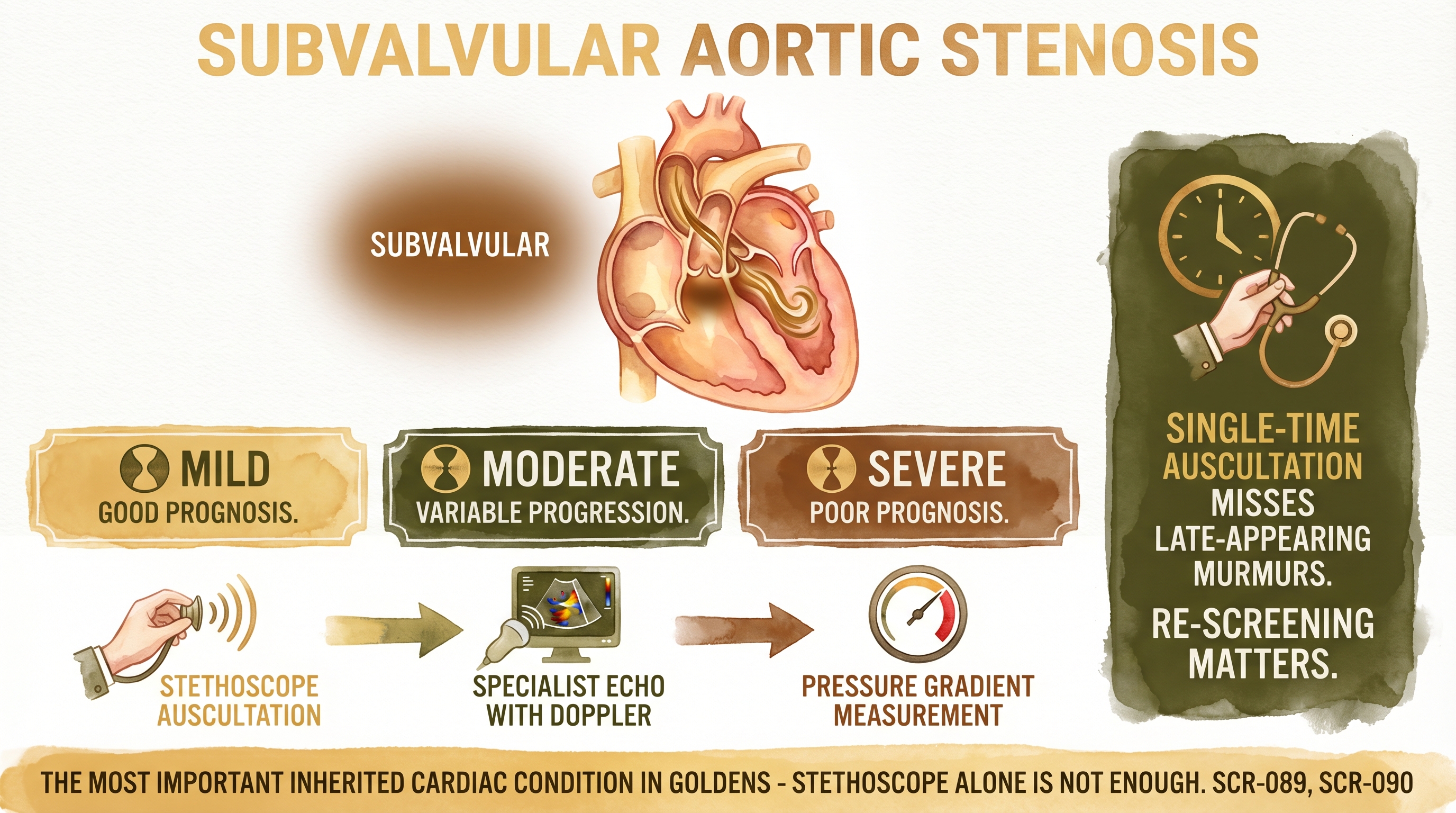
The most important inherited cardiac condition in Goldens - stethoscope alone is not enough.
Key Takeaways
- SAS is the most important inherited cardiac screening issue in Golden Retrievers.
- Auscultation alone is not a reliable breeding screen. Specialist echocardiography with Doppler is the current evidence-based standard.
- Disease severity exists on a spectrum, which is why re-screening and cautious interpretation matter.
- Families should treat SAS and diet-associated DCM as separate cardiac conversations, even though both matter in Golden Retrievers.
The Evidence
This entry uses observed claim-level tags beyond the dedicated EvidenceBlocks below. These tags mark JB program observation or practice-derived claims that need dedicated EvidenceBlock coverage in a later content pass.
- van Staveren et al. (2020)dogs
Agreement between general-practice and specialist murmur classification was very poor, showing why auscultation alone is not an adequate breeding screen. - Ontiveros and related SAS literaturedogs
Specialist echocardiography with Doppler remains the defensible method for identifying and grading outflow-tract disease relevant to breeding decisions. - Golden Retriever cardiac literatureGolden Retrievers
Golden-specific work confirms the breed relevance of SAS and the need for careful interpretation of screening values over time.
- SCR-061 boundarydogs
A normal stethoscope exam must not be marketed as equivalent to specialist echocardiographic clearance. - SCR-078 boundarydogs
Families should separate SAS from the broader and still unresolved grain-free or pulse-rich DCM debate rather than collapsing all Golden heart risk into one story.
No direct canine research located for this specific topic. Current understanding relies on related research, clinical observation, and cross-species inference.
SCR References
Sources
- Orthopedic Foundation for Animals. (n.d.). Cardiac disease. https://ofa.org/diseases/cardiac-disease/
- Orthopedic Foundation for Animals. (n.d.). Congenital cardiac database. https://ofa.org/diseases/cardiac-disease/congenital-cardiac-database/
- Stern, J. A., Meurs, K. M., Lehmkuhl, L. B., Bonagura, J. D., & DeFrancesco, T. C. (2012). Familial subvalvular aortic stenosis in Golden Retrievers: Inheritance and echocardiographic characterization. Journal of Veterinary Internal Medicine, 26(6), 1440-1445. https://doi.org/10.1111/j.1939-1676.2012.01007.x
- Ontiveros, E. S., Fousse, S. L., Crofton, A. E., Hodge, T. E., Gunther-Harrington, C. T., Visser, L. C., & Stern, J. A. (2019). Congenital cardiac outflow tract abnormalities in dogs: Prevalence and pattern of inheritance from 2008 to 2017. Frontiers in Veterinary Science, 6, 52. https://doi.org/10.3389/fvets.2019.00052
- van Staveren, M. D. B., & Szatmari, V. (2020). Detecting and recording cardiac murmurs in clinically healthy puppies in first opinion veterinary practice at the first health check. Acta Veterinaria Scandinavica, 62, 57. https://doi.org/10.1186/s13028-020-00535-1