Cancer Epidemiology in Golden Retrievers
Compound evidence detail1 SCR / 2 parts
- Ambiguousany single percentage figure presented as a universal Golden Retriever cancer constant without naming the population, study design, or referral basis
- Documentedthe necropsy and referral cohort findings themselves; cancer as a leading cause of death in Golden Retrievers with honest sourcing and explicit dataset attribution
Cancer is the single most important health topic in Golden Retrievers because it is the condition cluster most responsible for ending Golden lives. That does not mean every Golden gets cancer, and it does not mean every cancer diagnosis comes early in life. What it does mean is that cancer is not a niche concern in this breed. It is the central epidemiologic reality families should understand before they choose a puppy and throughout the dog's adult life. Mixed Evidence
What It Means
What Is Actually Documented
The first thing to get right is the number.
The widely repeated statement that "about 60 to 65 percent of Golden Retrievers die of cancer" is not fabricated, but it is often stripped from its methodological context. The strongest version of that number comes from referral and necropsy populations. Those populations are clinically rich and highly relevant, but they are not interchangeable with a perfect population-wide census of all Golden Retrievers. So the responsible phrasing is not "all Goldens have a fixed 65 percent cancer death rate." The responsible phrasing is "cancer dominates mortality in major Golden Retriever datasets, and the most famous 60 to 65 percent figure comes from specific referral and necropsy populations." Mixed Evidence
That boundary matters because some families hear the high-end number and conclude the breed is essentially doomed. Mixed Evidence Others hear that the number is dataset-bound and incorrectly conclude the problem is overstated. Both reactions miss the point. Even after the caveat, the burden remains striking. Goldens are consistently described as a cancer-predisposed breed, and cancer remains the leading cause of death across the major sources people cite.
The Four Cancers Families Need to Know
Hemangiosarcoma
Hemangiosarcoma is the hardest cancer in this breed to talk about because it is often sudden, violent, and devastating. It is a malignancy of blood vessel endothelial cells, most often arising in the spleen or right atrium of the heart. In Golden datasets, it is one of the defining cancers of the breed.
The clinical problem is that many dogs show no obvious warning signs until a tumor ruptures and bleeds internally. A dog may seem normal, then suddenly collapse, become weak, develop pale gums, or show a swollen abdomen. This is one reason cancer in Goldens can feel so cruel to families. Hemangiosarcoma is not only common enough to matter. It often presents late in the biologic course.
Lymphoma
Lymphoma is the second major cancer families should understand. It is cancer of lymphocytes and the lymphatic system, and in practice it is often discovered because families find enlarged, painless lymph nodes under the jaw, in front of the shoulders, or behind the knees.
One important Golden-specific theme is subtype distribution. Goldens appear overrepresented not only for lymphoma broadly but for more aggressive T-cell patterns relative to some other breeds. That does not mean every Golden with lymphoma has the same prognosis. It does mean the breed story is not just "more lymphoma." It is also "possibly a different lymphoma profile."
Mast cell tumors
Mast cell tumors are among the most variable cancers in dogs. They arise from mast cells, immune cells involved in inflammatory and allergic responses. In Goldens, they matter because they are common enough to sit inside the standard cancer conversation and because they can range from very manageable to very serious.
Some mast cell tumors look like benign skin lumps. Some swell and shrink. Some are low-grade and surgically curable. Others behave aggressively. For families, the practical consequence is simple: new skin lumps should not be treated casually in this breed.
Osteosarcoma
Osteosarcoma is the most common primary bone cancer in dogs. Goldens are not the most extreme osteosarcoma breed, but they are meaningfully represented in the disease burden of large-breed oncology. The classic presentation is persistent limb pain or lameness in an adult dog, often around the metaphyseal regions of long bones.
Unlike hip arthritis, osteosarcoma usually does not behave like a chronic, slowly obvious joint story. It often looks like a lameness that should have resolved and does not, or that rapidly worsens.
Why the Numbers Vary
Cancer epidemiology is not simple because the word "rate" can hide several different questions.
Are we asking what proportion of Golden deaths in a referral necropsy population were due to cancer?; what proportion of living dogs in a prospective cohort have reached a primary cancer endpoint so far?; what proportion of family-reported deaths in a survey were listed as cancer?; and what age distribution produced those deaths?.
Those are not the same question.
This is why the same breed can produce a 9.15-year median age of death in a referral-necropsy context and a 12-year-3-month median age in a UK family-survey context. Referral populations capture sicker dogs. Family surveys have recall and response bias. Insurance populations are age-truncated. Prospective cohorts are stronger for exposure tracking but still take years to mature.
The right lesson is not "ignore the numbers." The right lesson is "read the numbers through the study design." Documented
Why It Matters for Your Dog
What the Genetics Do and Do Not Explain
Cancer in Goldens is not a single-gene disease story. It is a polygenic, breed-structure, and biology story.
The clearest direct breed-genetic register entry currently in the SCR is for hemangiosarcoma: two chromosome 5 regions were identified that together account for about 20 percent of hemangiosarcoma risk in Golden Retrievers. That is a real and important finding. But it also means 80 percent of risk is not explained by those regions. This is not a near-total explanation. It is a meaningful partial one.
More broadly, the breed's narrowed gene pool likely concentrates susceptibility alleles and shapes immune surveillance, inflammatory biology, and cancer vulnerability. Documented But families should resist the simplistic leap from "inbreeding is bad" to "we can explain Golden cancer by one tidy COI rule." That stronger causal claim is not where the evidence stands today.
What the Golden Retriever Lifetime Study Changes
The Golden Retriever Lifetime Study matters because it moves the field away from retrospective reconstruction and toward prospective observation. More than 3,000 privately owned Goldens were enrolled, biological samples were banked, exposures were tracked, and cancer endpoints were pre-specified.
That does not mean every answer is already in hand. It means the breed now has the best chance it has ever had to separate signal from folklore. The study is especially important because it tracks hemangiosarcoma, lymphoma, high-grade mast cell tumors, and osteosarcoma as explicit endpoints. Documented Over time, that gives the field a much better shot at disentangling genetics, environment, diet, body condition, and other modifiers.
What Families Should Understand About Timing
One of the most emotionally distorting things about Golden cancer talk is the collapse of "common" into "early."
Cancer is common in this breed. That does not mean it usually strikes puppies or young adults. Many Golden cancers emerge later in life. The referral necropsy literature itself shows that dogs dying of cancer had older median ages than dogs dying of non-cancer causes. That does not make cancer less serious. It simply means the phrase "60 percent" should not be heard as "60 percent die young."
That distinction matters because families need a truthful picture, not a permanently panicked one.
When to See a Veterinarian
Veterinary evaluation is appropriate any time a Golden shows signs that could reflect cancer, but some signs are especially important not to ignore sudden weakness, collapse, pale gums, or a swollen abdomen; enlarged lymph nodes under the jaw, in front of the shoulders, or behind the knees; persistent lameness, especially if it worsens rather than improves; unexplained weight loss, decreased appetite, or reduced interest in normal activity; a lump that is new, growing, changing, or intermittently swelling; and non-healing wounds, chronic skin irritation that does not behave normally, or recurrent bleeding from a mass.
Same-day or emergency evaluation is warranted for collapse, severe weakness, pale gums, abdominal distension, or obvious respiratory distress.
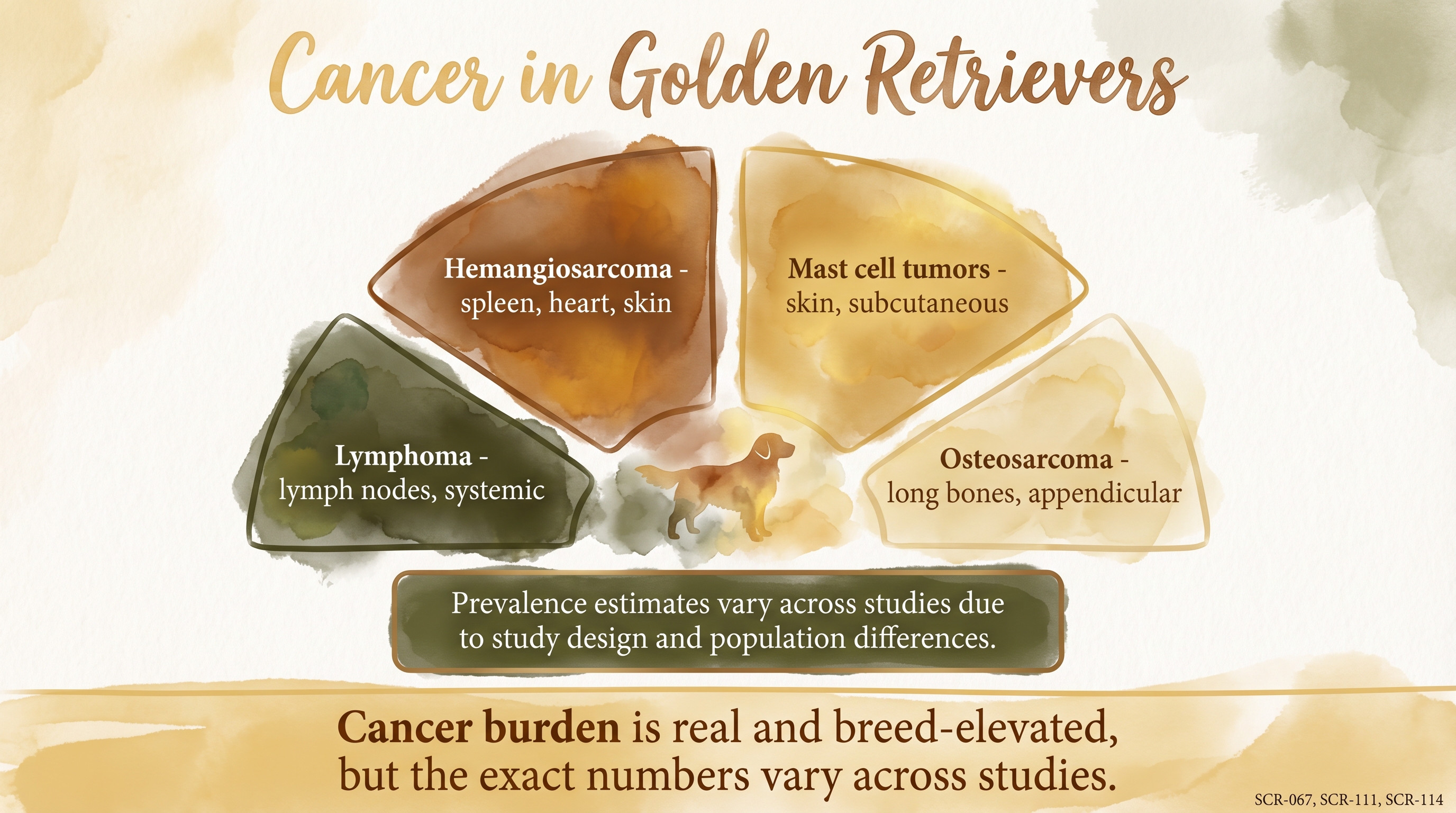
Cancer burden is real and breed-elevated, but exact prevalence numbers vary across studies.
Key Takeaways
- Cancer is the central health burden in Golden Retrievers and the leading cause of death across major Golden datasets.
- The four cancers families should know best are hemangiosarcoma, lymphoma, mast cell tumors, and osteosarcoma.
- The famous 60 to 65 percent figure is dataset-bounded, but the broader conclusion that Goldens are a cancer-predisposed breed remains strong.
- Prospective work such as the Golden Retriever Lifetime Study is critical because it can answer exposure and risk-factor questions that retrospective datasets cannot.
The Evidence
This entry uses mixed-evidence claim-level tags beyond the dedicated EvidenceBlocks below. These tags mark claims that combine documented findings with observed practice, heuristic application, or unresolved gaps.
- Fleming et al. (2011)Golden Retrievers
Large necropsy-population work documented cancer as the dominant cause of death in that referral cohort and defined the major cancer distribution inside the breed. - Golden Retriever Lifetime StudyGolden Retrievers
The prospective cohort was designed to track hemangiosarcoma, lymphoma, high-grade mast cell tumors, and osteosarcoma as major breed cancer endpoints. - Golden-specific cancer genetics literatureGolden Retrievers
Hemangiosarcoma GWAS work identified chromosome 5 regions associated with a meaningful fraction of breed risk, confirming that at least part of the vulnerability is traceable at the breed-genetic level.
- SCR-067 boundaryGolden Retrievers
The 60 to 65 percent figure is real as a dataset output, but it should not be written as a universal breed constant without the referral and necropsy context. - Study-design boundaryGolden Retrievers
Owner surveys, referral populations, insurance datasets, and prospective cohorts answer different epidemiologic questions and should not be treated as interchangeable.
No direct canine research located for this specific topic. Current understanding relies on related research, clinical observation, and cross-species inference.
SCR References
Sources
- Fleming, J. M., Creevy, K. E., & Promislow, D. E. L. (2011). Mortality in North American dogs from 1984 to 2004: An investigation into age-, size-, and breed-related causes of death. Journal of Veterinary Internal Medicine, 25(2), 187-198. https://doi.org/10.1111/j.1939-1676.2011.0695.x
- Guy, M. K., Page, R. L., Jensen, W. A., et al. (2015). The Golden Retriever Lifetime Study: Establishing an observational cohort study with translational relevance for human health. Philosophical Transactions of the Royal Society B, 370(1673), 20140230. https://doi.org/10.1098/rstb.2014.0230
- Simpson, M., Searfoss, E., Albright, S., Brown, D. E., Wolfe, B., Clark, N. K., McCann, S. E., Haworth, D., Guy, M., & Page, R. (2017). Population characteristics of Golden Retriever Lifetime Study enrollees. Canine Genetics and Epidemiology, 4, 14. https://doi.org/10.1186/s40575-017-0053-5
- Labadie, J. D., Elser, B. A., Brown, D. C., Searfoss, E. E., & Page, R. L. (2022). Cohort profile: The Golden Retriever Lifetime Study (GRLS). PLoS ONE, 17(6), e0269425. https://doi.org/10.1371/journal.pone.0269425
- Christensen, J., Johnson, K., Ettinger, S., Garrett, L., Gordon, I., Ireifej, S., Love, A., & Wisecup, M. (2026). 2026 AAHA oncology guidelines for dogs and cats. Journal of the American Animal Hospital Association, 62(1), 1-37. https://doi.org/10.5326/JAAHA-MS-7549
- McMillan, K. M., Bielke, L. R., Bettini, C. M., et al. (2024). Life tables of annual life expectancy and mortality for companion dogs in the United Kingdom. Scientific Reports, 14, 531. https://doi.org/10.1038/s41598-023-50458-w
- Labadie, J. D., Elser, B., Brown, D. C., Vogel, C., Armstrong, J., O'Brien, D. P., Krick, E., Schliekelman, P., Thamm, D. H., & Trepanier, L. A. (2022). Cancer mortality in a cohort of Golden Retrievers: A prospective study from the Golden Retriever Lifetime Study. PLOS ONE, 17(6), e0269425. https://doi.org/10.1371/journal.pone.0269425