Breeding for Temperament Over Conformation
This page closes the category with the actual breeding choice underneath the rest of the science, and it deserves a direct statement rather than a hedge because the choice is real and the choice has consequences. A breeder cannot maximize everything at once. Finite attention, finite breeding stock, and finite generations mean that pressure has to go somewhere first, and the places where pressure is applied first are the places where the population will move most clearly over time. Just Behaving places that pressure on temperament: low arousal, social stability, recoverability, and family livability. Health screening remains a non-negotiable filter that operates in parallel with temperament selection rather than as a competing priority. Conformation matters, because the dogs should remain recognizable Golden Retrievers rather than drifting away from the breed, but it is not allowed to outrank the quality of life the dog will create in the home. This priority order is what the rest of the breeding-and-genetics category has been building toward, and stating it explicitly is part of the honest communication families deserve when they are evaluating breeding programs. Observed-JB
What It Means
The two layers of the argument
The argument here has two layers, and keeping them separate is part of maintaining the slippage discipline that applies to everything in the knowledge base. The documented layer is population genetics. Temperament-relevant traits are heritable enough to respond to selection, which means repeated breeder choice can move a population mean over time in ways that are real and measurable even when individual outcomes remain variable. The science underlying this claim has been built up across the rest of the category, drawing on canine behavioral-genetics literature, cross-species evidence from the Belyaev fox experiment, and the foundational work of Scott and Fuller on breed differences under standardized rearing conditions. None of this is speculation; the heritability of temperament-relevant traits is as well established as the heritability of structural traits, and breeders who treat it as selectable are working with the biology rather than against it.
The observed layer is program philosophy. Just Behaving chooses to spend its primary selection pressure on the traits that determine what daily life with the dog actually feels like, because the program's purpose is producing family companions rather than specialized working dogs or competition specimens. Observed-JB This choice is not dictated by the science; the science only establishes that temperament selection is possible. The decision to prioritize temperament over other legitimate targets is a philosophical commitment specific to the kind of dog the program is trying to produce, and different breeding programs with different goals could legitimately make different choices within the same scientific framework.
The priority order
The combination of those two layers produces a clear order that the program follows consistently. Temperament comes first because it most directly determines whether the dog will be a good fit for ordinary family life across the dog's full lifespan. Observed-JB A dog with stable temperament can be comfortable in a range of households, can handle the ordinary stresses of family life without becoming reactive or shut down, and can maintain its livability even when the family's circumstances change over the years. Temperament selection is therefore the highest-leverage intervention a breeder can make for the families the program serves.
Health screening comes as a hard filter that operates in parallel with temperament selection, not as a competing priority that has to be traded off against it. A dog whose hips are not clear on OFA or PennHIP screening does not get bred, regardless of temperament quality, because producing puppies with predictable orthopedic problems would undermine the program's commitment to the families who will live with those puppies. A dog whose cardiac screening shows SAS murmur does not get bred, regardless of other qualities, because the stakes of congenital cardiac disease are too high to accept even for otherwise excellent dogs. Health screening operates as a threshold that breeding candidates must clear before other evaluation begins, and this threshold is non-negotiable even when it eliminates dogs the program would otherwise want to use.
Conformation comes third, to preserve breed identity without leading the program. Golden Retrievers should remain recognizably Golden Retrievers in their size, structure, coat, and general outline, because the breed is worth preserving and because breed identity is part of what families expect when they choose a Golden. But the program does not chase conformation ring success, does not weight aesthetic polish above functional soundness, and does not let appearance considerations override the two higher priorities when they come into conflict. A dog that would score well in a conformation ring but whose temperament is less stable than the program's standard will not be bred preferentially over a less showy dog with better temperament. Observed-JB
Not anti-conformation
This is not an anti-conformation position, and families evaluating the program should understand the distinction. Conformation matters because Golden Retrievers should remain recognizably Golden Retrievers, because structural soundness contributes to long-term quality of life, and because a certain level of attention to structural features is part of responsible breed stewardship. The program does not ignore conformation or treat it as irrelevant; it treats it as a real consideration that sits below temperament and health in the order of operations.
The position is that when tradeoffs have to be made, the tradeoff goes in favor of temperament and health over conformation, not the reverse. Over generations, this priority order produces dogs that look like Golden Retrievers (because the breed's conformation has not been abandoned) but whose primary selection has been for the traits that matter most for family life (because temperament and health were where the finite selection pressure went). If the dog is beautiful and difficult to live with, the program has selected for the wrong outcome, and no amount of aesthetic appeal will compensate for a temperament mismatch that makes the dog's daily life with the family harder than it should be.
Why this priority order is defensible
The defensibility of the priority order rests on a practical observation about what families actually experience over the dog's lifetime. A family lives with the dog's temperament every day for the dog's full life, from the first week after placement to the dog's last day. The family experiences the dog's conformation mostly as a visual impression and as a contributor to the dog's functional soundness, but the visual impression is a relatively small part of daily life with the dog compared to how the dog behaves, how the dog handles stress, how the dog relates to family members and visitors, and how the dog settles into the household rhythm. Observed-JB
If a breeding program is going to prioritize one dimension over another, the dimension that produces more of the dog's lived experience is the more consequential choice for the families the program serves. This reasoning does not prove that other priority orders are wrong for other purposes; a field-trial breeder selecting for working intensity is making a legitimate choice for a different purpose, and a conformation-ring breeder selecting for ring presence is making a legitimate choice for a different purpose. But for a program whose purpose is producing family companions, the temperament-first order is the one the program's purpose supports.
Why It Matters for Your Dog
Families often ask what they should look for in a breeder, and the question is legitimate because the answer is often harder to discern than the sales language breeders use would suggest. This page gives the shortest useful answer: ask what the breeder selects for first. That one answer often predicts more about life with the dog than any polished sales script, any collection of titles, or any set of professional photographs, because it reveals the structure of the program's decision-making rather than just the surface presentation.
If the first answer is color, with language about English Cream shades or specific coat tones leading the conversation, the program is telling you something about where its attention has gone and what it has optimized for. The dogs may still be lovely and the breeder may still be doing legitimate work in other areas, but color-first framing reveals a selection priority that places aesthetics ahead of the deeper considerations.
If the first answer is title culture, with conformation championships, field trial placements, or obedience competition wins leading the conversation, the program is telling you about a different set of priorities. These can be legitimate priorities for breeders producing dogs for those specific contexts, but they are not the same priorities as producing family companions, and the dogs from title-focused programs may not be the best fit for families whose needs are primarily about daily household life.
If the first answer is ring style, with emphasis on European lines, show presentation, or stylistic preferences in head shape and coat, the program is telling you about cosmetic priorities that may or may not align with what families actually experience in daily life with the dog.
If the first answer is temperament stability, family function, and the kind of dog the puppy is likely to become in ordinary life, the program is telling you something different. It is telling you that the primary selection pressure is going where it matters most for the families the program serves, and that the other considerations, while still present, are subordinated to the question of whether the dog will be a good fit for the life it will actually live.
For Just Behaving, the long-arc claim is not mystical or grandiose. If a breeder selects first for calm, socially steady, parentally present temperament across years and generations, the population shifts toward that center in ways that families can feel in their daily lives with the dogs. If the breeder treats temperament as an afterthought and selects mainly for other priorities, the population does not move nearly as cleanly in the temperament direction, and the dogs will reflect whatever the program actually optimized for rather than what the marketing language claimed.
That is why breeding and raising belong together in the Just Behaving framework, and why neither can substitute for the other. The breeder supplies the underlying architecture through generation-level selection on temperament. The family and early environment carry the architecture forward through developmentally appropriate experience during the transition and beyond. Neither piece alone produces the kind of dog the program is trying to create, and the two pieces together are what the Five Pillars approach is designed to support across the full arc from breeder environment to adult family dog. Observed-JB
What This Cannot Promise
Breeding for temperament does not mean every puppy will be identical, effortless, or immune to developmental challenge, and the program's communication with families should be clear about these limits even as it explains the priority order.
Temperament is still polygenic, which means that individual puppies within any litter will vary around the line average even when both parents represent the program's temperament target well. A breeder selecting for low arousal and social stability across generations will produce dogs that cluster more tightly around the desired temperament than dogs from a program selecting for different targets, but the within-litter variation does not disappear, and families should expect the puppies they bring home to show individual differences rather than being carbon copies of each other or of their parents.
Environment still matters, and a puppy raised in a chaotic household with inconsistent handling will not express the same temperament it would have expressed in a calmer household even when the underlying genetic starting point is the same. Breeding provides the architecture, but development carries the architecture forward, and the Scott and Fuller framework established decades ago still applies: heredity and environment are partners rather than competitors, and neither operates alone.
The transition to the home still matters, and the weeks and months after placement are when the breeder's work either gets carried forward smoothly or gets disrupted. A puppy from a strong temperament-focused program that moves into a household that does not understand the Five Pillars framework may not express the temperament the breeder selected for as cleanly as a puppy that moves into a household that does. This is part of why Just Behaving treats the transition as a central concern rather than treating placement as the end of the program's responsibility.
And even a strong population shift does not erase individual variation, which means that the program cannot promise that any specific puppy will meet any specific family expectation. The program can offer probabilistic claims about what its dogs tend to be like, based on years of consistent selection, but it cannot offer individual guarantees, and communication that implies otherwise would be dishonest.
So this page is not a guarantee page. It is a priority page. It explains what the breeder is aiming at when tradeoffs have to be made, and it explains why that aim produces the kind of dog the program exists to produce.
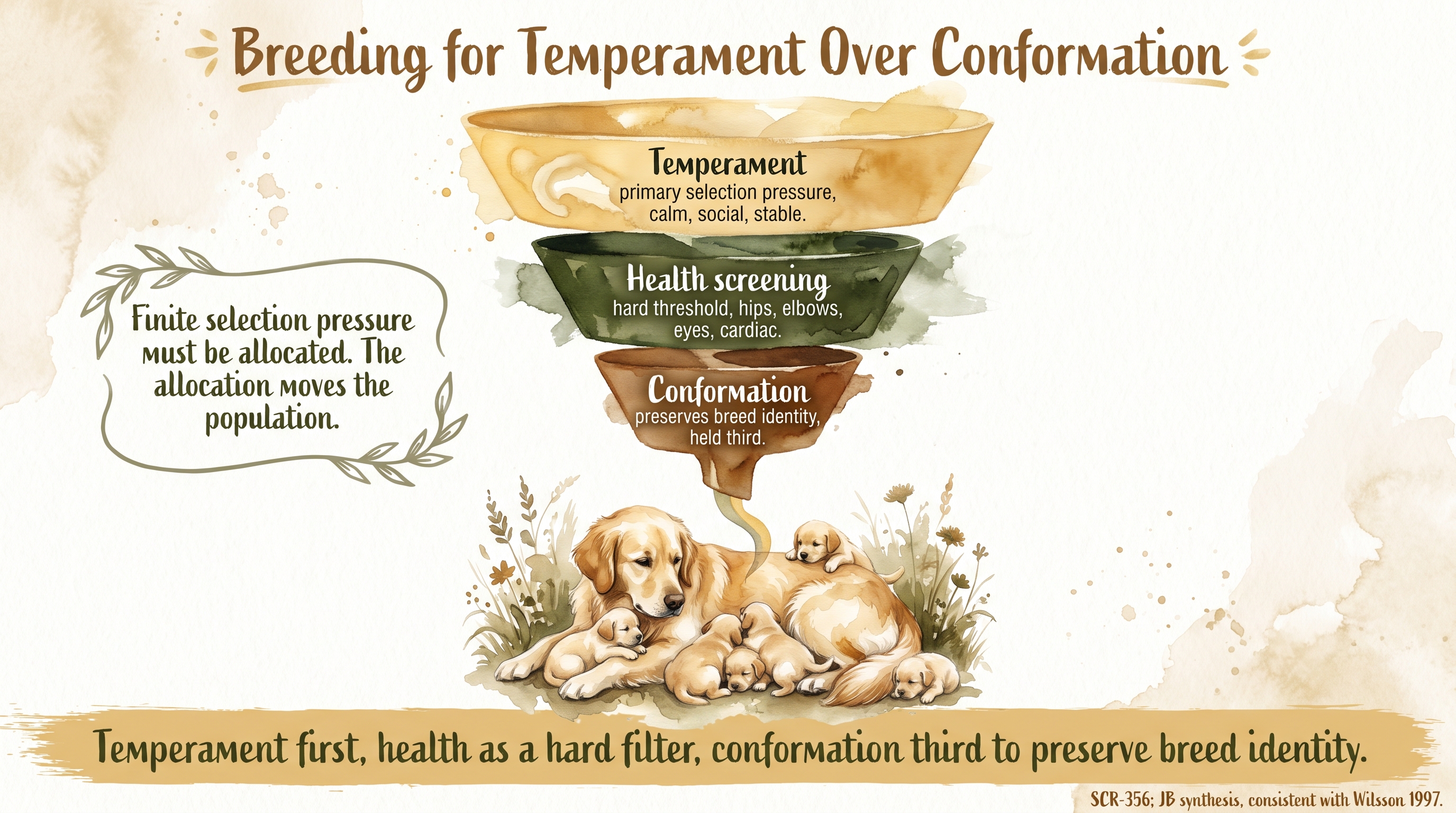
Temperament first, health as a hard filter, conformation third to preserve breed identity.
Key Takeaways
- A breeding program cannot place maximum pressure on every trait at once, so priority order matters and reveals what the program actually values.
- JB treats temperament as the primary target because it most strongly shapes everyday life with the dog across the full lifespan.
- Health screening remains non-negotiable, but it is a filter rather than the sole definition of quality, and it operates in parallel with temperament selection.
- Conformation matters only after the deeper questions of livability, stability, and breed health are addressed, and it never overrides them in tradeoff situations.
- The shortest useful question for families evaluating a breeder is what the program selects for first, because that answer reveals the structure beneath the sales language.
The Evidence
- Canine behavioral-genetics literaturedogs
Multiple temperament-relevant traits show measurable heritability, which means breeding programs can shift population tendencies through repeated phenotypic selection.
- JB breeding philosophy and program practiceGolden Retrievers
JB places temperament first, uses health screening as a hard filter, and treats conformation as secondary to the lived family experience the dog will create.
No randomized trials directly compare long-term outcomes in families who worked with temperament-focused breeders against families who worked with other selection priorities, measured on dimensions like family satisfaction, dog behavioral stability, and long-term placement success.
SCR References
Sources
- Wilsson E. & Sundgren P.E. (1997). The use of a behaviour test for the selection of dogs for service and breeding, I: Method of testing and evaluating test results in the adult dog, demands on different kinds of service dogs, sex and breed differences. Applied Animal Behaviour Science, 53(4), 279-295. doi:10.1016/S0168-1591(96)01174-4
- Wilsson E. & Sundgren P.E. (1998). Behaviour test for eight-week old puppies - heritabilities of tested behaviour traits and its correspondence to later behaviour. Applied Animal Behaviour Science, 58(1-2), 151-162. doi:10.1016/S0168-1591(97)00093-2
- Goddard M.E. & Beilharz R.G. (1983). Genetics of traits which determine the suitability of dogs as guide-dogs for the blind. Applied Animal Ethology, 9(4), 299-315. doi:10.1016/0304-3762(83)90010-X
- Foyer P., Bjällerhag N., Wilsson E., & Jensen P. (2014). Behaviour and experiences of dogs during the first year of life predict the outcome in a later temperament test. Applied Animal Behaviour Science, 155, 93-100. doi:10.1016/j.applanim.2014.03.006
- Bray E.E., Sammel M.D., Cheney D.L., Serpell J.A., Seyfarth R.M., Marshall-Pescini S., & Parker K.J. (2017). Effects of maternal investment, temperament, and cognition on guide dog success. Proceedings of the National Academy of Sciences, 114(34), 9128-9133. doi:10.1073/pnas.1704303114
- Bray E.E., Levy K.M., Kennedy B.S., Duffy D.L., Serpell J.A., & MacLean E.L. (2019). Predictive Models of Assistance Dog Training Outcomes Using the Canine Behavioral Assessment and Research Questionnaire and a Standardized Temperament Evaluation. Frontiers in Veterinary Science, 6, 49. doi:10.3389/fvets.2019.00049
- Duffy D.L. & Serpell J.A. (2012). Predictive validity of a method for evaluating temperament in young guide and service dogs. Applied Animal Behaviour Science, 138(1-2), 99-109. doi:10.1016/j.applanim.2012.02.011
- Strandberg E., Nilsson K., & Svartberg K. (2025). Genetic parameters of personality traits in dogs based on behavioral assessment and questionnaire information. Applied Animal Behaviour Science, 286, 106619. doi:10.1016/j.applanim.2025.106619