Hip Dysplasia in Golden Retrievers
Hip dysplasia in Golden Retrievers is not a myth, a breeder-marketing talking point, or a simple outcome of "too much exercise." It is a developmental orthopedic disease in which the hip joint does not maintain stable, healthy congruity during growth, allowing laxity, abnormal force distribution, and eventually degenerative change. The genetics matter. The environment matters. The screening method matters. And the public conversation often flattens all three. Documented
What It Means
Puppies are not born with arthritic hips. The problem develops during growth.
The core upstream issue is passive hip laxity. When the femoral head does not remain tightly seated in the acetabulum, the joint experiences abnormal loading. That altered mechanics drives cartilage wear, subchondral stress, inflammation, and later osteoarthritis. Documented In other words, arthritis is often the downstream consequence. Laxity is the earlier and more informative risk variable.
That distinction explains why hip dysplasia has two different public faces. One face is the older dog with stiffness, pain rising after rest, or reduced willingness to jump. The other face is the breeder screening conversation, where the question is whether the joints show the kind of stability that predicts lower lifetime risk before the dog is ever bred.
How Common Is It
The answer depends on what population is being measured.
OFA-based figures for Goldens are often quoted around the high teens to roughly 20 percent. Those numbers are real within the submitted registry population. But OFA submission is voluntary, and families are more likely to submit radiographs when the hips look acceptable. That means registry prevalence is not the same as true breed prevalence.
This is one of the places where families need methodological literacy. A breeder saying "only 20 percent" and a critic saying "the true number is much higher" may both be partially right, because they may be talking about two different denominator problems. Estimated
The better conclusion is not to fight over one magic prevalence number. It is to recognize that Goldens remain a dysplasia-relevant breed, that selection can improve the population over time, and that even excellent parental clearances reduce risk rather than eliminate it.
Why Screening Methodology Matters
OFA style hip-extended radiographs
The traditional extended ventrodorsal view is valuable for seeing conformation and established degenerative change, but it has a well known limitation. The positioning can seat the femoral head more deeply into the socket and partially mask the very laxity we most care about when predicting future osteoarthritis risk.
That does not make OFA useless. It makes OFA a different tool from a distraction-based method.
PennHIP and distraction views
PennHIP-type stress radiography was built around a more specific question: how much passive displacement can the joint show when the masking effect of the extended position is removed? The answer is turned into a distraction index, a measurement more directly tied to laxity.
The current SCR anchor is clear here: passive hip laxity measured on stress or distraction radiography is a stronger predictor of later osteoarthritis risk than the standard hip-extended view alone.
For families, the practical takeaway is simple. If a breeder uses only one style of hip screening, you need to understand what that method can and cannot tell you. If a breeder uses both a standard registry view and a distraction-based assessment, that is a stronger attempt to characterize the joint honestly.
Genetics and Environment Are Both Real
Hip dysplasia is polygenic. There is no single hip-dysplasia gene to eliminate. Selection works over generations because many small inherited effects are being nudged in a better direction, not because one mutation is being removed once and for all.
At the same time, environment changes expression.
The three most important practical modifiers families can control are body condition; growth rate and diet composition; and impact pattern during development. Documented
Body condition matters because extra weight increases mechanical load on a vulnerable joint. Growth rate and diet matter because excessive caloric intake and excess calcium in large-breed puppyhood can worsen developmental orthopedic expression. Documented Activity matters because immature joints tolerate varied, moderate movement better than repetitive high-impact loading.
This is why the right message is not "exercise causes hip dysplasia." That is too blunt to be useful. The better message is "genetics creates vulnerability, and growth management changes how hard that vulnerability is pushed."
Why It Matters for Your Dog
What Responsible Breeders Do
A responsible breeder does not treat hip screening as a box-checking ritual.
The meaningful practices are screening breeding stock with a defensible method; reading the result as probability, not guarantee; tracking offspring outcomes over time; paying attention to family patterns rather than one isolated clearance; and pairing joint screening with body-condition, nutrition, and exercise guidance for the puppy's growth phase.
This is also where honesty matters. Two parents with normal hips can still produce a dysplastic puppy. That does not mean screening failed. It means screening reduces risk in a polygenic disease rather than converting uncertainty into certainty.
What Families Can Control
Families do not control genotype, but they do control expression pressure.
Keeping a Golden Retriever puppy lean is one of the most important long-term orthopedic decisions a family can make. Lean body condition has documented lifespan and chronic-disease benefits broadly, and from an orthopedic standpoint it reduces the daily mechanical burden on vulnerable joints. Documented
Feeding a large-breed puppy diet matters too. The point is not brand tribalism. The point is controlled energy density and appropriate mineral balance. Excess calcium during large-breed development can create partly irreversible skeletal consequences.
Exercise should be regular but sensible. Free movement, walking, swimming, and normal play are good. Repetitive impact, forced running on hard surfaces, and high-volume jumping work are not.
When to See a Veterinarian
Veterinary evaluation is appropriate when a Golden Retriever shows persistent rear-limb lameness, difficulty rising, stiffness after rest, or reduced willingness to jump or climb, bunny-hopping gait during running, pain or reluctance during hip extension, and loss of muscle mass over the hips or hindquarters.
Same-day evaluation is reasonable when lameness is suddenly severe, the dog will not bear weight, or the pain is dramatic enough that normal movement stops.
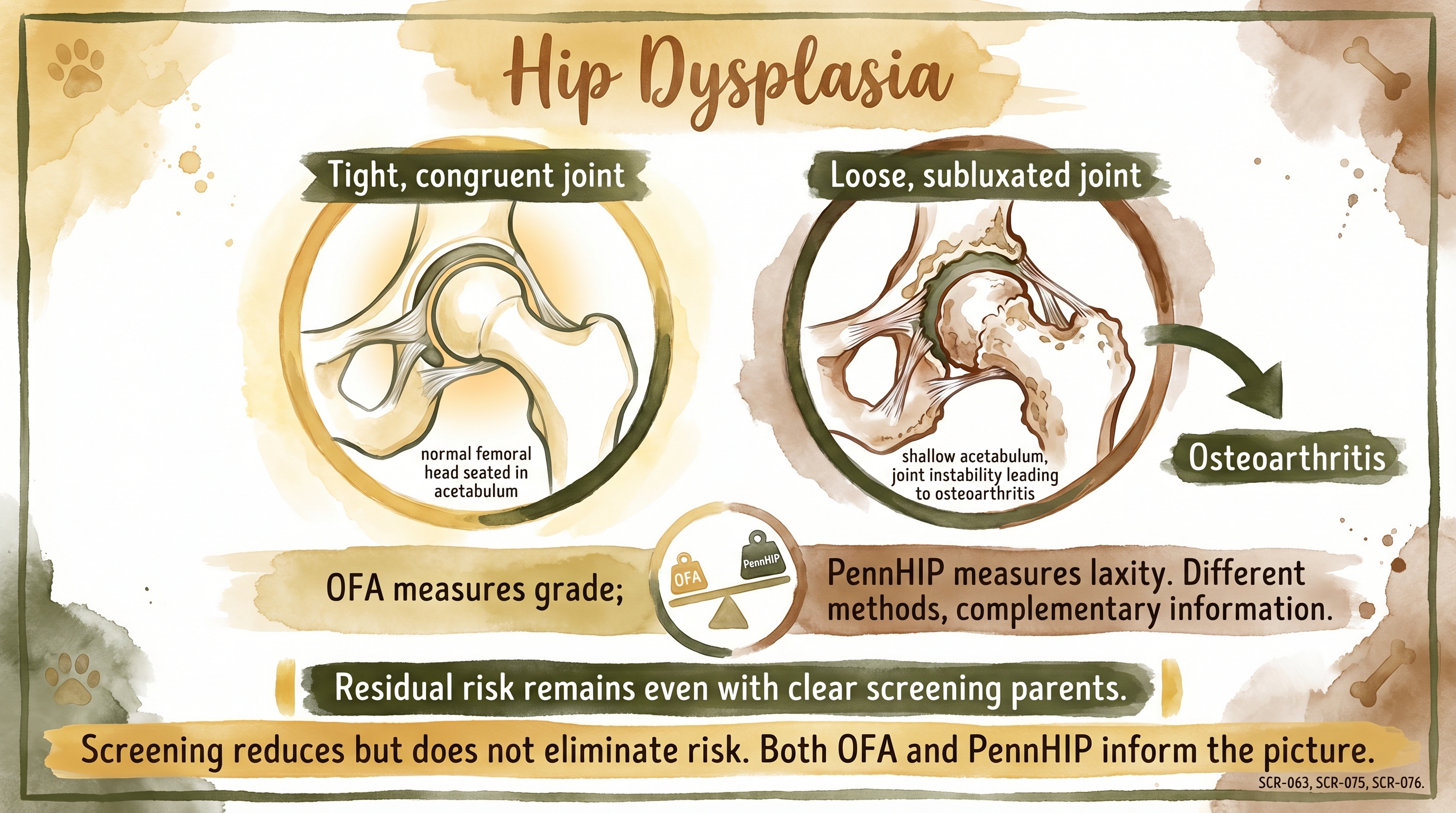
Screening reduces but does not eliminate risk - both OFA and PennHIP inform the picture.
Key Takeaways
- Hip dysplasia is fundamentally a developmental joint-stability problem, with osteoarthritis often arriving later as the downstream consequence.
- OFA and PennHIP do not ask exactly the same question. Distraction-based methods are stronger for detecting passive laxity.
- Normal parental clearances reduce risk but do not guarantee a dysplasia-free puppy.
- Keeping a Golden puppy lean, feeding an appropriate large-breed diet, and avoiding repetitive impact during growth are practical ways families can lower expression pressure on vulnerable joints.
The Evidence
This entry uses estimated claim-level tags beyond the dedicated EvidenceBlocks below. These tags mark approximate ranges or timing claims that should remain bounded by the cited sources.
- Smith and PennHIP literaturedogs
Stress and distraction radiography isolate passive laxity more directly than the standard extended view and better predict later osteoarthritis risk. - Hip-elbow screening synthesisdogs
Registry-style radiographs are useful, but screening method and age at measurement materially change what is being detected. - Large-breed nutrition literaturedogs
Excess calcium during large-breed puppyhood can create partly irreversible orthopedic harm, showing that developmental management influences phenotype expression. - Kealy and related body-condition workdogs
Lean body condition delays chronic disease and reduces orthopedic burden over time.
- domestic dogs
No published study directly compares the most effective long-term management paths for hip dysplasia in golden retrievers in dogs across breeds and ordinary home settings.
SCR References
Sources
- Smith, G. K., Biery, D. N., & Gregor, T. P. (1990). New concepts of coxofemoral joint stability and the development of a clinical stress-radiographic method for quantitating hip joint laxity in the dog. Journal of the American Veterinary Medical Association, 196(1), 59-70. PMID: 2295555.
- Smith, G. K., Mayhew, P. D., Kapatkin, A. S., McKelvie, P. J., Shofer, F. S., & Gregor, T. P. (2001). Evaluation of risk factors for degenerative joint disease associated with hip dysplasia in German Shepherd Dogs, Golden Retrievers, Labrador Retrievers, and Rottweilers. Journal of the American Veterinary Medical Association, 219(12), 1719-1724. https://doi.org/10.2460/javma.2001.219.1719
- Runge, J. J., Kelly, S. P., Gregor, T. P., Kotwal, S., & Smith, G. K. (2010). Distraction index as a risk factor for osteoarthritis associated with hip dysplasia in four large dog breeds. Journal of Small Animal Practice, 51(5), 264-269. https://doi.org/10.1111/j.1748-5827.2010.00937.x
- Kealy, R. D., Olsson, S. E., Monti, K. L., Lawler, D. F., Biery, D. N., Helms, R. W., Lust, G., & Smith, G. K. (1992). Effects of limited food consumption on the incidence of hip dysplasia in growing dogs. Journal of the American Veterinary Medical Association, 201(6), 857-863. PMID: 1399793.
- Kealy, R. D., Lawler, D. F., Ballam, J. M., Mantz, S. L., Biery, D. N., Greeley, E. H., Lust, G., Segre, M., Smith, G. K., & Stowe, H. D. (2002). Effects of diet restriction on life span and age-related changes in dogs. Journal of the American Veterinary Medical Association, 220(9), 1315-1320. https://doi.org/10.2460/javma.2002.220.1315
- Schoenmakers, I., Hazewinkel, H. A. W., Voorhout, G., Carlson, C. S., & Richardson, D. (2000). Effect of diets with different calcium and phosphorus contents on the skeletal development and blood chemistry of growing Great Danes. Veterinary Record, 147(23), 652-660. PMID: 11131552.
- Hedhammar, A., Wu, F. M., Krook, L., Schryver, H. F., de Lahunta, A., Whalen, J. P., Kallfelz, F. A., Nunez, E. A., Hintz, H. F., Sheffy, B. E., & Ryan, G. D. (1974). Overnutrition and skeletal disease: An experimental study in growing Great Dane dogs. Cornell Veterinarian, 64(Suppl. 5), 1-160. PMID: 4826273.