Size and Conformation Genetics in Dogs
Body size is one of the best-mapped complex traits in dogs, and the success of that mapping is one of the reasons domestic dogs have become an unusually powerful model system for understanding how genetic variation produces morphological variation in mammals generally. A relatively small number of loci can explain a large share of the dramatic size differences between breeds, with IGF1 as the classic major-effect example that has become a textbook case for how a small number of variants can produce enormous phenotypic differences. Inside a single breed, however, size and conformation behave more like quantitative traits with many contributing loci: measurable, heritable, selectable, and still variable enough that no one puppy can be read perfectly from pedigree shorthand alone. Understanding both scales (the between-breed dramatic effects and the within-breed quantitative variation) is part of thinking clearly about what conformation selection can and cannot accomplish. Documented
What It Means
The surprisingly compressed genetics of dog body size
Dogs show an unusually compressed map of body-size genetics compared with many species, and that compression is part of what makes canine morphology such an interesting subject for geneticists. Documented Between-breed size differences can be enormous (a Chihuahua and a Great Dane differ by roughly two orders of magnitude in body weight), and some of the loci responsible for those differences are well described. The IGF1 locus, which encodes insulin-like growth factor 1 and has well-understood effects on growth during development, carries variants that contribute substantially to the small-versus-large size divide across breeds, with small breeds tending to share specific IGF1 haplotypes that distinguish them from larger breeds.
Beyond IGF1, additional loci including GHR, SMAD2, STC2, and others have been identified as contributors to between-breed size variation. The cumulative effect is that a modest number of loci explain a large share of the dramatic size range seen across the domestic dog species, and this genetic architecture is different from what might be expected if size were influenced by hundreds of small-effect variants none of which dominated the picture. The dog-specific situation appears to reflect the intense selective pressure humans applied to size during breed formation, which concentrated the variation at a smaller set of high-effect loci than would typically accumulate under natural selection.
That does not make conformation simple, and it does not mean the between-breed picture translates directly into within-breed predictions. The loci that distinguish Chihuahuas from Great Danes are not necessarily the same loci that distinguish a larger Golden Retriever from a smaller one, and the within-breed variation is likely to involve a much more polygenic architecture with smaller effect sizes at each contributing locus. Documented
Conformation as a composite phenotype
Conformation is broader than weight or height alone, and any useful discussion of structural breeding has to respect that breadth. Conformation includes overall frame size (how big the dog's skeleton is in three dimensions), bone and substance (the thickness and density of the skeleton relative to the frame), proportion (how the different body regions relate to each other, for example the ratio of body length to leg length), angulation (how the joints articulate and how the limbs are set relative to the body), topline (the shape of the back and spine from withers to croup), and movement mechanics (how efficiently the dog carries itself during locomotion).
These traits are heritable and responsive to selection, and breeders can move them over generations when they select consistently for desired features. But they are not one-gene switches, and they are not readable from a single DNA test. They are composite phenotypes built from many developmental inputs, and the full picture of a dog's conformation only emerges as the dog matures through the growth period and into adulthood.
This is part of why evaluating breeding candidates on conformation requires either extensive expertise (for breeders who can read structure in younger dogs) or patience (for waiting until the dog's structure has fully developed before making breeding decisions). Some structural features that matter for long-term soundness do not become fully visible until the dog is two or three years old, and breeders who are rushing to breed younger dogs are making decisions with incomplete structural information.
The within-breed spread in Goldens
Golden Retrievers provide a useful example of how within-breed conformation variation actually looks in practice. The breed sits in the mid-to-large range, with adult males typically weighing in the 65 to 75 pound range and females somewhat smaller, though individual variation extends meaningfully beyond those midpoints. Estimated But within the breed there is still visible structural variation that experienced Golden families can recognize.
Some lines trend larger and heavier in frame, producing dogs with substantial bone, broader chests, and heavier overall presence. Some lines trend more moderate and athletic, producing dogs with lighter bone, more rangy proportions, and what many observers would call a more functional outline for the work the breed was originally developed to do. Some populations carry secondary selection for ring aesthetics, with emphasis on features that judging traditions reward such as coat presentation, head shape, and overall visual impression. Others preserve more field-oriented functional moderation, with emphasis on the structural features that support sustained working ability rather than on the aesthetic polish that ring competition rewards.
None of these directions is inherently wrong, and each reflects legitimate priorities on the part of the breeders pursuing them. But the different directions produce visibly different dogs at the far ends of the within-breed spectrum, and families who have seen Goldens only at one end of the range may be surprised when they encounter dogs from the other end.
Why structure is never isolated from function
That within-breed spread matters because structure is never isolated from function for very long, and the connection between the two is where the breeding decisions actually have consequences. Selection for more bone, more length, more substance, or a more stylized outline may also alter load distribution, gait efficiency, and joint stress in ways that are not immediately obvious from looking at the static dog but become apparent over years of movement and aging.
A dog with heavier bone than its muscle mass can efficiently support may experience greater joint loading than a more balanced dog, and that loading can contribute to arthritis and mobility loss later in life. Documented A dog with unusual proportions (unusually long body, unusually short legs, unusually angled hindquarters) may move less efficiently than a more moderately built dog, and the inefficiency compounds over the thousands of miles a normally active dog walks across its lifetime. A dog with a topline that slopes too steeply or too little may develop back problems that a more moderate topline would have avoided.
These connections are not always simple, and dogs at the extremes of any trait can sometimes remain functional throughout their lives. But the population-level pattern is that moderate, balanced, well-integrated structure tends to support better long-term function than heavily stylized structure, and that pattern is one of the reasons functional breed standards exist even in breeds that compete primarily in conformation rings.
The appearance-only selection risk
One of the most important lessons from conformation genetics is that heavy selection for appearance can pull correlated traits along with it in ways that were not part of the original breeding intent. If a judging tradition rewards a particular head shape, and breeders select for that head shape, they may also be selecting (inadvertently) for whatever other traits are genetically correlated with it, some of which may affect health. Documented If a judging tradition rewards heavier coat, and breeders select for it, they may also be selecting for whatever traits correlate with heavier coat architecture. The genome does not always let breeders move one trait without affecting others, and long-term appearance-only selection has produced documented health problems in a number of breeds where the correlated traits turned out to include real welfare concerns.
The lesson for Golden Retriever breeding is not that conformation selection is wrong, but that it should be pursued as part of an integrated framework that attends to function, health, and temperament alongside appearance. A breeder who asks "does this look right?" before asking "does this move well?" and "will this stay sound?" is prioritizing the wrong question first, even if they are asking the right question eventually.
Why It Matters for Your Dog
What This Cannot Predict
Size and conformation genetics can describe population tendencies and can explain why certain lines tend to produce larger or smaller dogs with particular structural features. They cannot tell you exactly how one individual Golden will mature in frame, movement, or orthopedic resilience, because the polygenic architecture within the breed leaves meaningful individual variation around any line-level tendency.
That rule matters because people often slide from "this line tends to run larger" into "this puppy will definitely mature as the bigger, stronger, sounder dog," and the slide is a category error. Tendencies are probabilistic, and individual outcomes vary around them in both directions. A puppy from a line that tends larger can mature smaller than expected, and a puppy from a line that tends smaller can mature larger than expected, even within the normal range of variation the line produces.
The stronger statement about conformation genetics is only probabilistic. Quantitative traits shift distributions over generations under selection pressure. They do not eliminate individual variation within the selected population, and any honest conformation prediction for a specific puppy has to acknowledge the uncertainty that remains even under the best breeding programs.
Families feel conformation every day even if they do not use the word, and the effects of structure on daily life are often more significant than families expect before they have owned the dog long enough to see them play out. Structure affects how the dog moves through its daily activities, how much physical stress the joints absorb during routine exercise, how easy the dog is to keep lean and athletic as it ages, how well the dog ages into later-life mobility when the accumulated effects of years of movement start to matter, and how comfortable the dog seems in its own body across the ordinary activities of family life.
A structurally sound Golden Retriever can often remain active and comfortable well into its senior years, while a structurally compromised dog may begin showing mobility limitations earlier and require more aggressive management to stay comfortable. These differences are not visible in a two-month-old puppy, and families rarely evaluate conformation explicitly when choosing a breeder. But they are experiencing the consequences of the breeder's conformation choices throughout the dog's life, whether they recognize the source of those consequences or not.
This is why appearance-only breeding is a long-arc risk even when individual dogs from appearance-focused programs look lovely at placement age. If a breeder rewards what looks impressive in the conformation ring or in puppy photos without asking what moves efficiently, what ages well, and what stays comfortable, the program can slowly drag health-relevant structure in the wrong direction over generations. The effect may not be visible in any single litter, but the cumulative drift across multiple generations can produce meaningful problems that later breeders struggle to reverse.
For JB, conformation matters because breed identity matters and because structural soundness is part of the biological foundation that lets the raising philosophy work. A dog with good structure can move, play, and rest comfortably, and a dog with compromised structure cannot, and the Five Pillars are easier to apply to a dog whose body is supporting rather than undermining its behavioral development. But conformation lives below temperament and health in the order of operations. Breed identity should be preserved, because the program is producing Golden Retrievers rather than generic mid-sized dogs. It should not become the main target if that target starts pulling against soundness or daily livability, and the program's willingness to value moderate, balanced, functional structure over stylistic extremes is part of the integrated approach the philosophy requires.
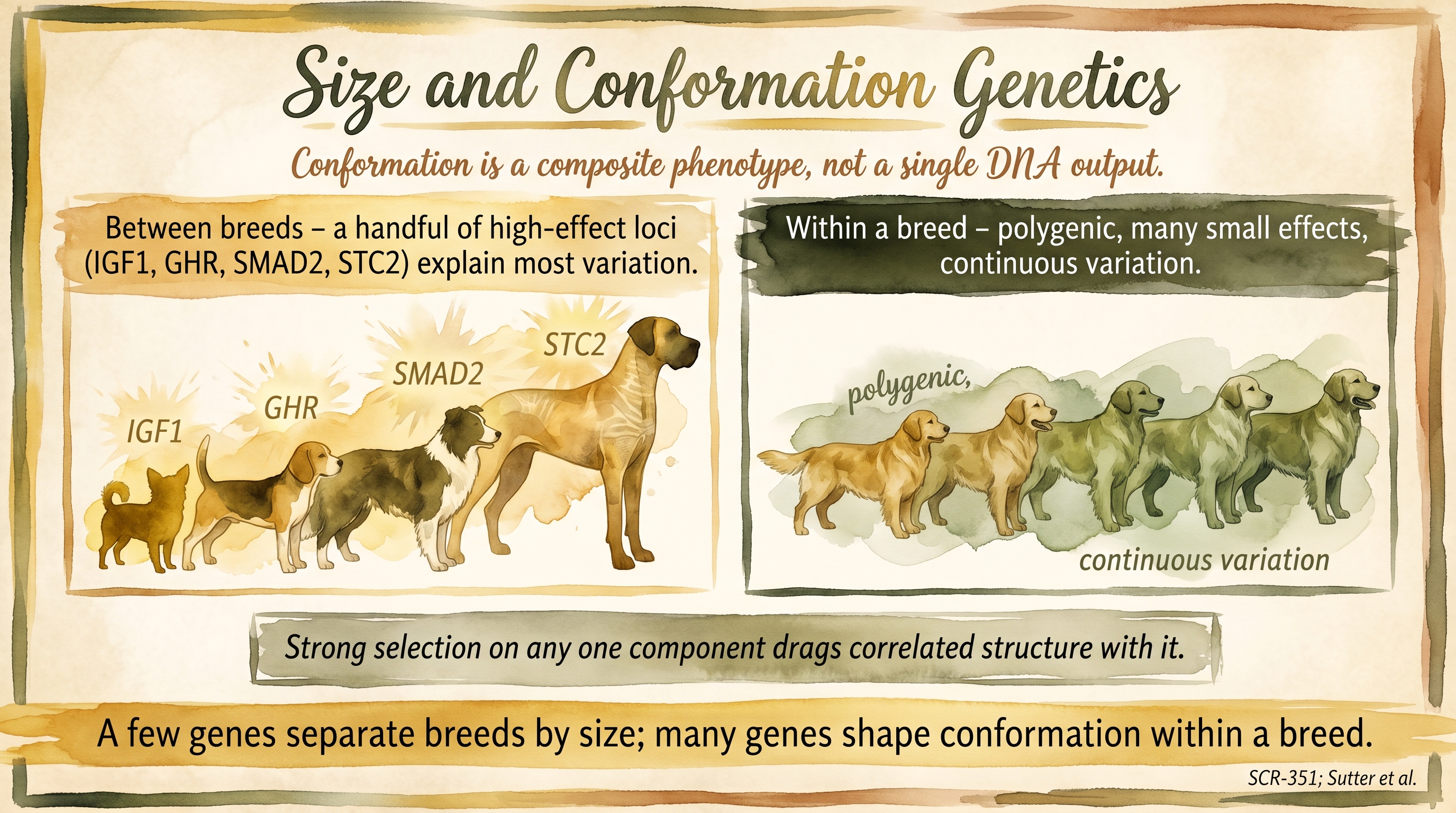
A few genes separate breeds by size; many genes shape conformation within a breed.
Key Takeaways
- Body size in dogs is strongly heritable and unusually well mapped genetically, with IGF1 as a classic major-effect locus.
- Inside a breed, size and conformation are still quantitative traits with real but non-deterministic variation.
- Golden Retrievers show within-breed structural variation shaped by different secondary selection pressures.
- Appearance-only selection can gradually pull health-relevant structure in the wrong direction, which is why conformation should stay subordinate to function and health.
- Structural soundness supports daily livability and long-term aging in ways that families feel throughout the dog's life.
The Evidence
This entry uses estimated claim-level tags beyond the dedicated EvidenceBlocks below. These tags mark approximate ranges or timing claims that should remain bounded by the cited sources.
- Sutter et al. and later canine morphology studiesdogs
IGF1 and several additional loci explain substantial portions of body-size variation across dog breeds, making size one of the most genetically tractable canine quantitative traits. - Canine conformation genetics synthesisdogs
Morphology inside breeds remains polygenic and selection-responsive, with structure reflecting many loci and developmental tradeoffs rather than one simple predictor.
- Golden Retriever population-health synthesisGolden Retrievers
Selection on body style and conformation can pull correlated health outcomes along with it, which is why conformation decisions should be interpreted as functional decisions as well as aesthetic ones.
No published study has directly measured the health and longevity consequences of within-breed conformation variation in Golden Retrievers specifically, as opposed to between-breed comparisons or brachycephalic studies.
SCR References
Sources
Sources pending: a dedicated source doc for this topic is queued for the next research cycle. The entry's factual claims draw on the broader JB Knowledgebase synthesis; peer-reviewed citations will be added when the source doc is built. This note will be replaced during the next audit pass.