Genetic Diversity in Golden Retrievers
Genetic diversity in Golden Retrievers matters because the breed's biggest health problems are not only about whether one dog passed one test on one day. They are also about what happens when a closed population stays popular for a long time and repeatedly leans on a relatively narrow set of bloodlines. The visible population can be large while the effective genetic population remains much smaller. Documented
What It Means
What the Term Actually Means
When breeders and families talk about diversity, they often mean pedigree variety. Observed-JB That is only part of the story.
Real diversity questions include how much true genomic variation is still present in the breed, how accurately pedigree COI reflects that genomic reality, whether the same influential dogs dominate too much of the modern population, and whether recessive disease management is being done in a way that preserves or destroys the remaining diversity. Documented
This is why diversity is not an abstract breeder hobby. It is one of the structural background conditions under which cancer burden, fertility, and disease frequency unfold.
Why Pedigree COI Is Not Enough
The first major register point here is that shallow pedigree COI underestimates Golden Retriever genomic inbreeding. In practical terms, a dog can look acceptably outcrossed on paper while still carrying more homozygosity than the pedigree number suggests. Documented
That does not make pedigree COI useless. It makes it a rough tool rather than a precision instrument.
For families, the practical lesson is that a breeder quoting a low short-generation COI should not be taken as offering a genetic safety guarantee. The number may still be useful. It is just not the whole picture.
Popular Sire Effects and Effective Population Size
One of the main ways purebred populations lose resilience is not by becoming tiny on paper. It is by letting a relatively small number of males shape too much of the next generation.
This is the popular-sire problem. A very successful or fashionable male contributes an outsized fraction of the gene pool. His visible strengths spread quickly, but so do the less obvious liabilities he carries. Over time, the population looks large while its functional diversity narrows.
Goldens are especially vulnerable to this pattern because they are so popular. Popularity does not protect diversity by itself. In some cases it accelerates the concentration problem.
What the Breed-Level Consequences Look Like
The current SCR already anchors one direct within-breed consequence: higher genomic inbreeding in Golden Retrievers is associated with reduced female fecundity, including smaller litter size. That is important because it reminds us that inbreeding depression is not just a theoretical warning imported from conservation biology. It is measurable inside the breed itself.
The harder and more public question is cancer. Families reasonably ask whether inbreeding explains Golden cancer. The careful answer is that the breed's narrowed population structure is clearly relevant, but the causal story is not simple enough to turn into one tidy COI threshold rule. Diversity is part of the risk architecture. It is not the entire explanation for every tumor that appears.
Why It Matters for Your Dog
Why Carrier Management Matters
The third major SCR anchor is one of the most practical in the whole health category: for recessive disease alleles, breeding carrier dogs to clear mates avoids producing affected puppies without needlessly shrinking genetic diversity.
This matters because "remove all carriers" sounds responsible until you apply it to a breed where some disease alleles are common enough that blunt exclusion would narrow the gene pool further and worsen the bigger structural problem. Documented
In Goldens, the responsible move is usually not purity language. It is precision language know what the dog carries; know what the mate carries; avoid affected puppies; and keep one eye on the next generation and on the wider population.
That is why a diversity-aware breeder may sometimes make a genetically responsible carrier-to-clear breeding that sounds less tidy to a novice than a breeder who simply says "all of ours are clear."
What Families Should Ask
Good diversity questions are often more revealing than families expect.
Ask How do you think about COI, and what kind of COI are you measuring?; Are you tracking line-level health and longevity, not only individual clearances?; How do you handle recessive carriers?; and Are you trying to preserve diversity, or are you talking as if every mutation should be eliminated immediately?.
The breeder does not need to sound like a population geneticist. But they should sound like someone who understands that diversity is part of health, not separate from it.
Why This Page Matters for the Rest of the Subcategory
Genetic diversity is the structural page in this subcategory. Cancer epidemiology, inherited disease management, lifespan trends, and screening policy all make more sense when viewed against the background of a narrowed gene pool. Documented
It is also the page that explains why good breeding is not just a list of tests. Testing tells you what one dog is carrying now. Diversity management tells you what kind of population you are building over time.
When to See a Veterinarian
Genetic diversity itself is not a symptom, so this is less a crisis-recognition page than some others in the category. But veterinary or specialist consultation is appropriate when a family or breeder is trying to interpret a DNA-test result that sounds alarming without context; repeated health patterns inside a family line; fertility or litter-size problems that may reflect broader breeding-structure concerns; and chronic skin, eye, orthopedic, or cancer patterns that raise questions about line-level risk.
For prospective families, the immediate practical move is usually not "go to the vet" but "ask better breeder questions before you commit."
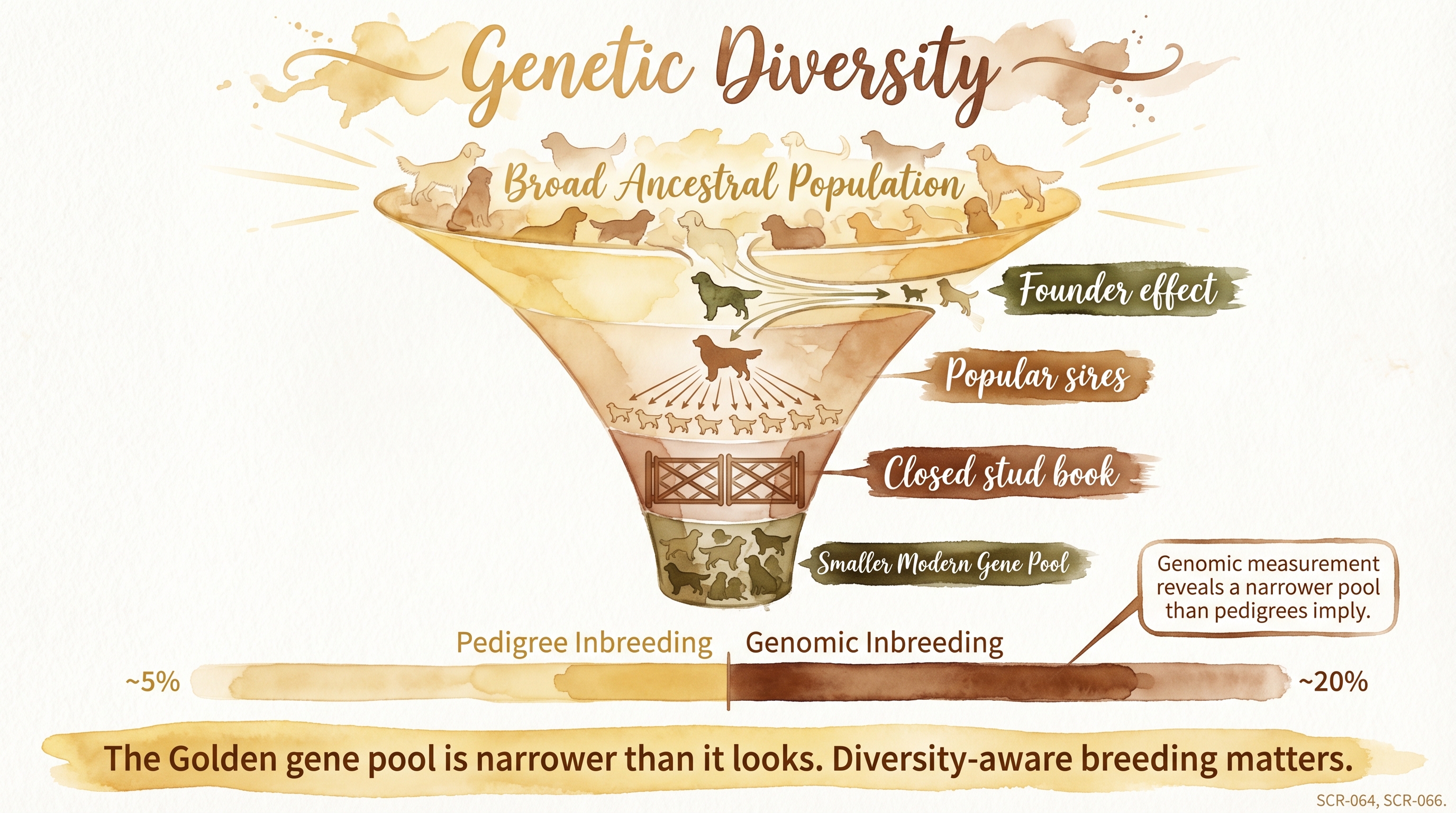
The Golden gene pool is narrower than it looks - diversity-aware breeding matters.
Key Takeaways
- Golden Retriever diversity is narrower than raw registration numbers suggest because effective population size and popular-sire effects matter more than census size alone.
- Pedigree COI is useful but imprecise. It can underestimate true genomic inbreeding.
- Higher genomic inbreeding in Goldens has measurable consequences, including reduced female fecundity.
- Responsible breeding protects diversity by using carrier-to-clear strategies rather than indiscriminate carrier exclusion.
The Evidence
This entry uses observed claim-level tags beyond the dedicated EvidenceBlocks below. These tags mark JB program observation or practice-derived claims that need dedicated EvidenceBlock coverage in a later content pass.
- Golden diversity comparison studiesGolden Retrievers
Shallow pedigree COI correlates only imperfectly with true genomic inbreeding in the breed, so paper COI should not be treated as a precise stand-in for actual genetic relatedness. - Chu et al. and related workGolden Retrievers
Higher genomic inbreeding is associated with reduced female fecundity inside the breed, showing that diversity loss has measurable biological consequences. - Canine population-genetics consensusdogs
Carrier-to-clear breeding is the rational way to prevent affected puppies while preserving population diversity for recessive conditions.
- domestic dogs
No published study directly quantifies how current breeding and management decisions will change genetic diversity in golden retrievers across the full Golden Retriever population over multiple generations.
SCR References
Sources
- Chu, E. T., et al. (2019). Inbreeding depression causes reduced fecundity in Golden Retrievers. Mammalian Genome, 30(7), 236-243.
- Kampmann, B., et al. (2020). Genetic heterogeneity and diversity of North American Golden Retrievers using a low-density STR marker panel. PLoS One, 14(2), e0212171.
- Calboli, F. C., et al. (2008). Population structure and inbreeding trends in the Purebred dog. Journal of Heredity, 99(1), 6-13.