The Golden Retriever Lifetime Study
Compound evidence detail1 SCR / 2 parts
- Ambiguousany single percentage figure presented as a universal Golden Retriever cancer constant without naming the population, study design, or referral basis
- Documentedthe necropsy and referral cohort findings themselves; cancer as a leading cause of death in Golden Retrievers with honest sourcing and explicit dataset attribution
The Golden Retriever Lifetime Study is the most important breed-specific health research project ever launched for Golden Retrievers. It follows thousands of privately owned dogs over time, collecting standardized veterinary data, biospecimens, lifestyle information, and cancer outcomes in a way retrospective surveys cannot. That design matters because Golden health conversations are often driven by emotionally powerful numbers pulled from necropsy series, referral hospitals, or family memories. The lifetime study was built to do something harder and more useful: watch the story unfold prospectively. Documented
What It Means
What the Study Actually Is
The Morris Animal Foundation enrolled more than 3,000 purebred Golden Retrievers from the United States and began following them longitudinally through life. Each dog entered the study young and apparently healthy. Documented Researchers then collected annual veterinary examinations; blood, urine, fecal, hair, and nail samples; diet and environmental exposure histories; reproductive status and medication data; and diagnoses, cause-of-death information, and tissue samples when available.
That structure is what separates the study from the usual breed-health conversation. Documented A retrospective survey asks families to remember what happened. A necropsy series describes dogs who reached a referral center and then died. A prospective cohort follows dogs before the disease appears, which makes it much stronger for identifying risk factors.
Why Golden Retrievers Were Chosen
Goldens were not chosen because they are the only breed with serious health problems. They were chosen because they sit at the intersection of three useful research realities. Documented
First, they are common enough to enroll at scale.
Second, their cancer burden is large enough that meaningful numbers of outcome events were likely to occur during follow-up.
Third, the breed has a relatively coherent type and culture, which helps standardize recruitment, veterinary participation, and family reporting.
In practical terms, Goldens offered a rare opportunity: a large single-breed cohort with enough disease burden to study cancer, longevity, and environmental exposures prospectively rather than guessing backward after the fact. Documented
The Four Main Cancers Under Study
The project was designed with four major Golden cancer outcomes in view hemangiosarcoma; lymphoma; high-grade mast cell tumors; and osteosarcoma.
These are not random selections. They are the diagnoses that shape the emotional and epidemiological center of gravity in Golden Retriever health. Hemangiosarcoma is the most devastating for its suddenness. Lymphoma is common enough that many Golden families encounter it directly. Mast cell tumors are frequent and clinically variable. Osteosarcoma carries both pain and a serious metastatic burden.
The study does not magically solve those diseases. Documented What it offers is a better chance to ask careful questions about them. Which exposures come before diagnosis? Which blood markers shift earliest? Which households, diets, or line structures associate with altered risk? Those are the kinds of questions prospective cohorts are built to answer.
What the Study Can Do Better Than Surveys
The lifetime study improves on older health surveys in several ways. Documented
It reduces recall problems
Families still report information, but they are not being asked to reconstruct ten years of health history from memory at the end of a dog's life.
It captures pre-disease samples
This is one of the most valuable features in the entire project. If a dog later develops lymphoma or hemangiosarcoma, researchers may already have blood and other samples banked from years before diagnosis. That makes biomarker and exposure work much more credible.
It follows healthy dogs too
Referral datasets overrepresent serious disease because they are built from sick dogs who reach advanced care. A cohort follows the healthy dogs, the mildly affected dogs, and the severely affected dogs together, which gives a truer denominator.
It supports nested future studies
A well-designed cohort becomes a research platform. Documented Questions that were not fully imaginable at the time of enrollment can often be studied later if samples and follow-up data were collected well.
What the Study Cannot Do
The Golden Retriever Lifetime Study is powerful, but it is not all-powerful.
It is not a randomized trial. Families choose environments, foods, supplements, vaccines, flea-and-tick products, spay or neuter timing, and activity patterns. That means many later associations can suggest risk architecture without proving strict causation.
It is also not perfectly representative of every Golden Retriever in every context. Enrolled families are unusually engaged, veterinary follow-up is structured, and participation itself may select for households that differ from the breed population at large.
Most importantly, the study does not erase the need for careful rhetoric. Documented A single study finding, especially from an observational cohort, should not instantly become breeder folklore. It needs replication, context, and discipline.
Why It Matters for Your Dog
What It Has Already Clarified
Even before the full lifespan arc is complete, the study has already helped stabilize the public conversation in at least three ways. Documented
First, it reinforces that cancer is not a marginal issue in Goldens. That point was already visible in surveys and necropsy series, but the lifetime study confirms that a serious cancer burden belongs at the center of breed-health discussion.
Second, it has strengthened the case that breed health must be discussed as population structure plus environment, not as one-gene storytelling. Goldens carry known inherited risk architecture, but lived exposures matter too.
Third, it has normalized the idea that the right health questions are longitudinal. Health is not only whether a dog passed a screen at age two. It is what happens at eight, ten, and twelve.
Why Breeders Should Care
For breeders, the lifetime study matters less as a source of slogans and more as a model of what responsible thinking looks like.
A serious breeder should already be doing a small-scale version of the same logic track dogs across lifespan; record cause of death when known; monitor cancer pattern by line; care about longevity, not only early clearances; and avoid making certainty claims the data cannot support.
The study does not tell one breeder exactly which pairing to make next spring. What it does is make it impossible to defend the old shallow model where breeders stop thinking about health once hips, elbows, eyes, and heart are done.
Why Families Should Care
For families, the study provides something emotionally important: a better standard of honesty.
Golden Retriever health does not need spin. It needs clear thinking. The lifetime study supports a middle path between two bad extremes denial, where breed lovers talk as though cancer is just bad luck that happens occasionally; and sensationalism, where every Golden is spoken about as if tragedy is already scheduled.
The study reinforces a calmer truth. Goldens are a high-risk breed for certain major diseases, especially cancer. They are also a breed with enough love, enough numbers, and enough scientific attention that those risks can be studied rigorously rather than mythologized.
How to Read Study Findings Responsibly
When families or breeders see a new Golden lifetime study result, the right questions are what exactly was measured; was the finding an association or a causal test; how large was the effect; was it replicated elsewhere; and does the rhetoric being used exceed the actual study design.
That last question matters most. The Just Behaving standard is that evidence strength governs rhetoric. A prospective cohort can support stronger language than anecdote, but not unlimited language.
When to See a Veterinarian
The lifetime study is a research framework, not a clinical tool. Families should see a veterinarian for the actual signs the study is trying to understand, including new or changing lumps; unexplained weight loss; persistent lameness; repeated vomiting or diarrhea; drinking or urinating much more than normal; and collapse, pale gums, or sudden weakness.
The study helps explain population risk. Your veterinarian helps interpret the dog in front of you.
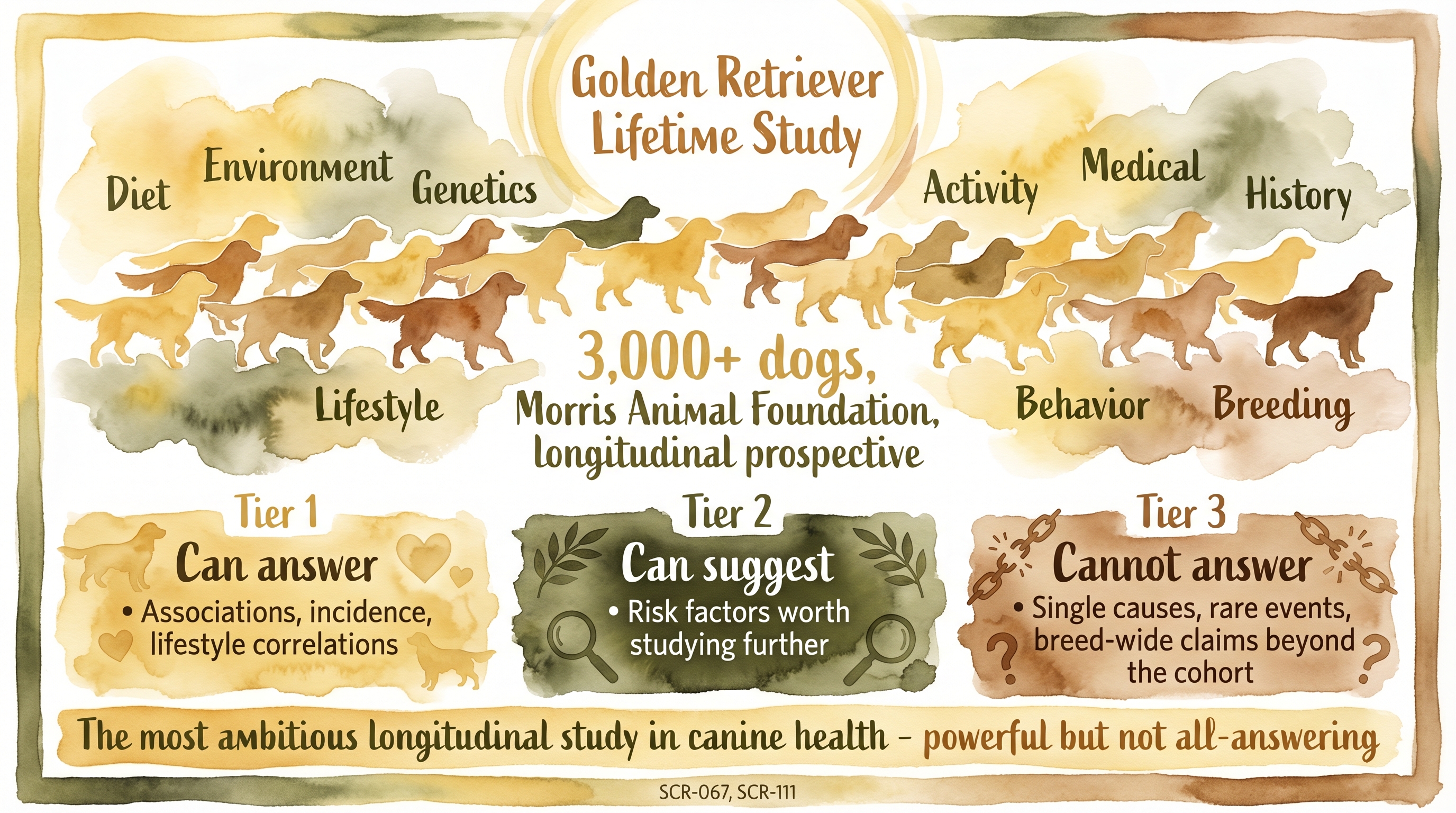
The most ambitious longitudinal study in canine health - powerful but not all-answering.
Key Takeaways
- The Golden Retriever Lifetime Study is the strongest single prospective research platform ever built for Golden Retriever health.
- Its biggest value is not one headline result. It is the ability to follow healthy dogs over time and connect pre-disease samples to later outcomes.
- The study strengthens cancer and longevity discussions, but it does not convert every association into proof of causation.
- Breeders and families should use the study as a model for disciplined, lifespan-oriented health thinking rather than slogan-driven interpretation.
The Evidence
- Morris Animal Foundation cohort design papersGolden Retrievers
The study prospectively enrolled more than 3,000 healthy young Golden Retrievers and follows them through life with standardized sample collection and veterinary reporting. - Golden epidemiology sourcesGolden Retrievers
The cohort was built around the breed's substantial burden of hemangiosarcoma, lymphoma, mast cell tumors, and osteosarcoma. - Prospective cohort methodologygeneral
Longitudinal cohorts are stronger than retrospective surveys for exposure timing, denominator integrity, and pre-disease sample banking.
- Observational-cohort limitationgeneral
Associations emerging from the cohort can be extremely informative without automatically proving direct causation. - SCR-067 boundaryGolden Retrievers
Even strong cancer-burden findings still require care when translating referral or selected datasets into breed-wide population rhetoric.
No direct canine research located for this specific topic. Current understanding relies on related research, clinical observation, and cross-species inference.
SCR References
Sources
- Guy, M. K., Page, R. L., Jensen, W. A., et al. (2015). The Golden Retriever Lifetime Study: Establishing an observational cohort study with translational relevance for human health. Philosophical Transactions of the Royal Society B, 370(1673), 20140230. https://doi.org/10.1098/rstb.2014.0230
- Simpson, M., Searfoss, E., Albright, S., Brown, D. E., Wolfe, B., Clark, N. K., McCann, S. E., Haworth, D., Guy, M., & Page, R. (2017). Population characteristics of Golden Retriever Lifetime Study enrollees. Canine Genetics and Epidemiology, 4, 14. https://doi.org/10.1186/s40575-017-0053-5
- Labadie, J. D., Elser, B. A., Brown, D. C., Searfoss, E. E., & Page, R. L. (2022). Cohort profile: The Golden Retriever Lifetime Study (GRLS). PLoS ONE, 17(6), e0269425. https://doi.org/10.1371/journal.pone.0269425
- Morris Animal Foundation. (n.d.). Golden Retriever Lifetime Study. https://www.morrisanimalfoundation.org/golden-retriever-lifetime-study
- Guy, M. K., Page, R. L., Jensen, W. A., Olson, P. N., Haworth, J. D., Searfoss, E. E., & Brown, D. E. (2015). The Golden Retriever Lifetime Study: Establishing an observational cohort study with translational relevance for human health. Philosophical Transactions of the Royal Society B, 370(1673), 20140230. https://doi.org/10.1098/rstb.2014.0230
- Simpson, M., Albright, S., Wolfe, B., Searfoss, E., Street, K., Diehl, K., & Page, R. (2017). Age at gonadectomy and risk of overweight or obesity in a cohort of Golden Retrievers. PLOS ONE, 12(7), e0180461. https://doi.org/10.1371/journal.pone.0180461