Travel, Car Rides, and Change of Environment
Compound evidence detail1 SCR / 3 parts
- Documentedthe Baumrind authoritative-parenting literature in human child development
- Documentedthe canine correlational evidence linking dog-directed caregiving styles to attachment, attention, sociability, and problem-solving outcomes (van Herwijnen 2018/2020, Brubaker and Udell 2023)
- Heuristicthe JB inference that one specific caregiving style experimentally produces the best long-term developmental outcomes in dogs
In the JB methodology, travel and change of environment are not novelty events for the dog to handle; they are continuity events for the human to deliver. Heuristic The human is the constant variable across the changing environment. The car is unfamiliar but the human's regulated state is familiar. The hotel room is unfamiliar but the morning sequence is familiar. The relative's house is unfamiliar but the meal protocol and the settle cue and the doorbell choreography are familiar. The dog is reading the environment, but the dog is also reading the human, and what the methodology asks is that the human's channel is the channel that does not change when the surroundings do. The Bouton context-renewal literature (SCR-008; Gazit et al. 2005 in dogs) and the handler-state coupling channels (Sundman 2019; Koskela 2024) establish the documented foundation; the methodology's operational synthesis is that travel is the test of the household's continuity discipline, and the household that delivers continuity passes the test even when the venue changes.
For Families
A dog who handles travel calmly is a dog whose household has practiced calm change of environment from early on. Cars, novel locations, hotel rooms, family visits - none of these have to be inherently stressful, but they become stressful for dogs who only encounter them in high-arousal contexts.
The Just Behaving pattern introduces change of environment as a normal household event. Short calm car rides before they are needed. Novel environments visited briefly with the household's normal tone intact. The dog learns that being in a new place is the same baseline state as being at home - not a reason to escalate.
This pays off in adulthood. A dog who travels well, settles in unfamiliar rooms, and rides calmly in the car is a dog whose family can take it places. A dog who only knows home tends to constrain the family's life.
What It Means
The Bouton context-renewal asymmetry is operationally critical for understanding what a change of environment does to a dog's behavioral repertoire. Bouton's documented work on extinction (SCR-008) and Gazit et al.'s (2005) canine-direct demonstration of the renewal effect establish that behaviors and behavioral inhibitions established in one context do not generalize automatically to a new context. The dog who has learned to settle on the kitchen mat in the home household has not automatically learned to settle on a mat in a hotel room. The dog who has learned to ignore the doorbell in the home household has not automatically learned to ignore the doorbell in a relative's house. The context shift is mechanistically a renewal opportunity: the original learning is preserved, the new context has not yet acquired the inhibitory association, and the dog's behavioral repertoire defaults toward the un-extinguished baseline unless the relational and structural channels carry it through.
The handler-state coupling channels are the channels that travel. Documented The dog cannot bring the kitchen mat into the hotel room, but the dog brings the cortisol-synchrony channel (Sundman 2019; SCR-105) and the HRV-coupling channel (Koskela 2024; SCR-106) and the olfactory chemosignal channel (Wilson 2022; Parr-Cortes 2024; SCR-058, SCR-107) wherever the dog goes, because those channels are the dog reading the human's physiology. If the human's physiology stays regulated across the change of environment, the dog's primary read of the moment stays regulated. If the human's physiology shifts (the human is anxious about the trip, anxious about the hotel, anxious about how the dog will behave), the dog reads the shift through the same channels and the dog's response to the new environment is being shaped by the human's response to it, not just by the environment itself.
The continuity-vs-novelty framing. The methodology's reading of travel and environmental change is that the family is in a position to choose what variable to highlight. The family that frames the trip as a novel challenge for the dog ("we're going to see how the puppy does in the car," "let's see what happens at the hotel") is highlighting novelty as the salient variable, and the dog reads the highlighting through the handler's elevated arousal. The family that frames the trip as continuation of the household's regulated channel ("we're going to the same morning sequence in a different room") is highlighting continuity as the salient variable, and the dog reads the highlighting too. Heuristic The framing is the human's choice; the dog's experience tracks the framing as much as it tracks the actual environmental difference.
The car ride as the recurring case. Documented Car travel is the most frequent change-of-environment event for most family dogs, and the published literature on canine car-travel stress (Mariti and colleagues' work on motion-related stress; Cracknell and Mills on travel anxiety) documents that a substantial subset of dogs show stress responses (panting, drooling, vocalization, restlessness, vomiting) during car travel. The methodology's position is that the car ride is structurally the same operation as any other change-of-environment event: the dog is in a new context, the established context-specific learning is partially renewed, the handler's state is the carrier wave the dog is reading through it, and the cumulative car-channel circuit is being wired by every car ride the dog has experienced. The dog whose car-channel circuit was wired by hundreds of brief regulated rides as a puppy has a fundamentally different car experience than the dog whose car-channel circuit was wired by a small number of high-stakes high-arousal rides (the trip to the vet, the trip to a new family). The early car experience is the wiring substrate the lifetime car experience is being layered on.
The protocol-portability principle. The methodology's operational position is that the household's standard protocols (morning sequence, meal protocol, doorbell choreography, settle cue, walk arrangement, sleep arrangement) should travel with the dog into the new environment. The morning sequence in the hotel room is recognizably the same morning sequence as the home household, even if the room is different. The meal protocol at the relative's house is recognizably the same meal protocol as the home household, even if the bowl is different. The settle cue in the unfamiliar living room is the same cue, delivered the same way, in the same handler-state. The portability of the protocols is what continuity looks like in operational form; the dog who is reading the same protocols in a new venue is reading more continuity than novelty, and the read shapes the response.
The Hebbian wiring at the travel channel is cumulative. The dog who has experienced fifty regulated car rides has the regulated-car pattern wired into the car-channel circuit fifty times. The dog who has experienced two high-arousal car rides has the high-arousal-car pattern wired into the car-channel circuit twice, and twice is what the dog is bringing to the third. The methodology's preference for early, frequent, brief, regulated travel exposure is a function of the Hebbian wiring claim: the substrate the dog is bringing to lifetime travel was written across the early months. A dog in a household that does not travel until the dog is six months old, and then travels suddenly under high-stakes conditions, is being asked to write the car-channel circuit under conditions that cannot reproduce the regulated-substrate the early-travel arrangement would have produced.
Why It Matters for Your Dog
The practical starting position is that travel and environmental change are part of the household's everyday rhythm from the early weeks rather than a category of activity to introduce later. A puppy who experiences the car for brief regulated rides in the first weeks home (a five-minute drive to a quiet location and back, with the handler regulated and the channel calm) is wiring the car-channel circuit on the right substrate. A puppy whose first significant car experience is the trip to the veterinary clinic at sixteen weeks is wiring the car-channel circuit on a different substrate. The methodology's preference is that the substrate is set early and deliberately.
The protocol-portability test. A household operating inside the methodology can pass a specific test on travel: the dog walks into a new environment (a hotel room, a relative's living room, a vacation rental), the family delivers the standard household protocols (morning sequence, meal protocol, settle cue, sleep arrangement) recognizably, and the dog responds at approximately the same regulatory baseline as in the home household. A household that fails this test has identified the gap: either the protocols themselves are not portable (they were dependent on the home environment in ways the household had not noticed), or the handler's state is not portable (the handler is anxious in the new venue and the dog is reading the anxiety), or both.
The dose-response relationship. The methodology's operational preference is for early, frequent, brief, regulated travel exposure rather than infrequent, long, high-stakes travel exposure. The dose is calibrated to the dog's regulatory capacity, not to the family's travel calendar. A puppy who experiences ten brief regulated car rides per month is in a dose-response position the puppy who experiences one long high-stakes car ride per quarter is not. The same operational principle applies across the broader environmental-change category: brief regulated novel-environment exposures (a coffee shop's outdoor seating area for fifteen minutes; a different park for a short walk; a friend's quiet house for an hour) are wiring the channel that the dog will eventually need for longer or more demanding exposures.
The bedtime portability. One of the most operationally important protocol-portability tests is the overnight sleep arrangement. Mixed Evidence The Dale et al. (2024) sleep correlates (SCR-036) on uninterrupted sleep, sheltered location, and overnight enclosed sleeping before sixteen weeks are not architectural decisions only made at home; they are conditions the family is trying to preserve wherever the dog sleeps. The documented part is the sleep correlate itself. The step from that correlate to the travel-portability claim is methodological interpretation: the household that travels with the dog and delivers a bedtime arrangement that recognizably matches the home arrangement (the same crate or enclosure, the same approximate location relative to the family, the same approximate timing, the same approximate bedtime sequence) is more likely to preserve the same sleep architecture than the household that improvises. The travel-portability implication is consistent with the cumulative-pattern Dale finding, but it is not a directly tested travel intervention.
Travel, Car Rides, and Change of Environment is a Calmness operation across novel contexts. The household\u0027s calm floor at home is delivered by the family\u0027s regulated state, the protocol-portability discipline, and the structural arrangements that hold the calm. When the venue changes, the structural arrangements may change with it (the kitchen mat is not in the hotel), but the family\u0027s regulated state and the protocol-portability discipline are what carry the calm floor with the dog. The handler-state coupling channels (Sundman 2019; Koskela 2024) are the channels that travel; the family\u0027s job is to keep those channels regulated when the surroundings are not.
The most common travel and environmental-change failure modes are specific. First, the late-introduction problem: the family does not introduce travel until the dog is older, then introduces it under high-stakes conditions, and the dog wires the travel channel on a high-arousal substrate that lasts. Second, the framing problem: the family frames the trip as a novel challenge for the dog rather than as continuation of the household's channel, and the framing transmits through the handler-state channels. Third, the protocol-abandonment problem: the family suspends the household's standard protocols in the new venue ("we're on vacation, the rules are different"), and the dog reads the suspension as evidence that the rules are contingent. Fourth, the bedtime improvisation: the family improvises the overnight sleep arrangement in the new venue, and the dog absorbs disrupted sleep architecture across the trip. Fifth, the dose-error problem: the family attempts long or demanding travel before the regulated-channel substrate is established, and the dog's first-encounter trauma sets a baseline that subsequent travel layers onto.
A note on the limit of the inference. The documented evidence supports Bouton context-renewal asymmetry (SCR-008; Gazit 2005 in dogs), handler-state coupling channels at multiple timescales (SCR-105, SCR-106, SCR-107; SCR-058), Hebbian circuit-level plasticity (SCR-022), the Dale et al. (2024) sleep correlates (SCR-036), and the cohort-scale predictor literature (SCR-485, SCR-486). The methodology's specific claims (that travel is the test of the household's continuity discipline; that protocol-portability is the operational variable; that early frequent brief regulated exposure outperforms infrequent long high-stakes exposure) are JB synthesis applied to the documented record. The specific travel-protocol intervention has not been tested in a controlled canine cohort.
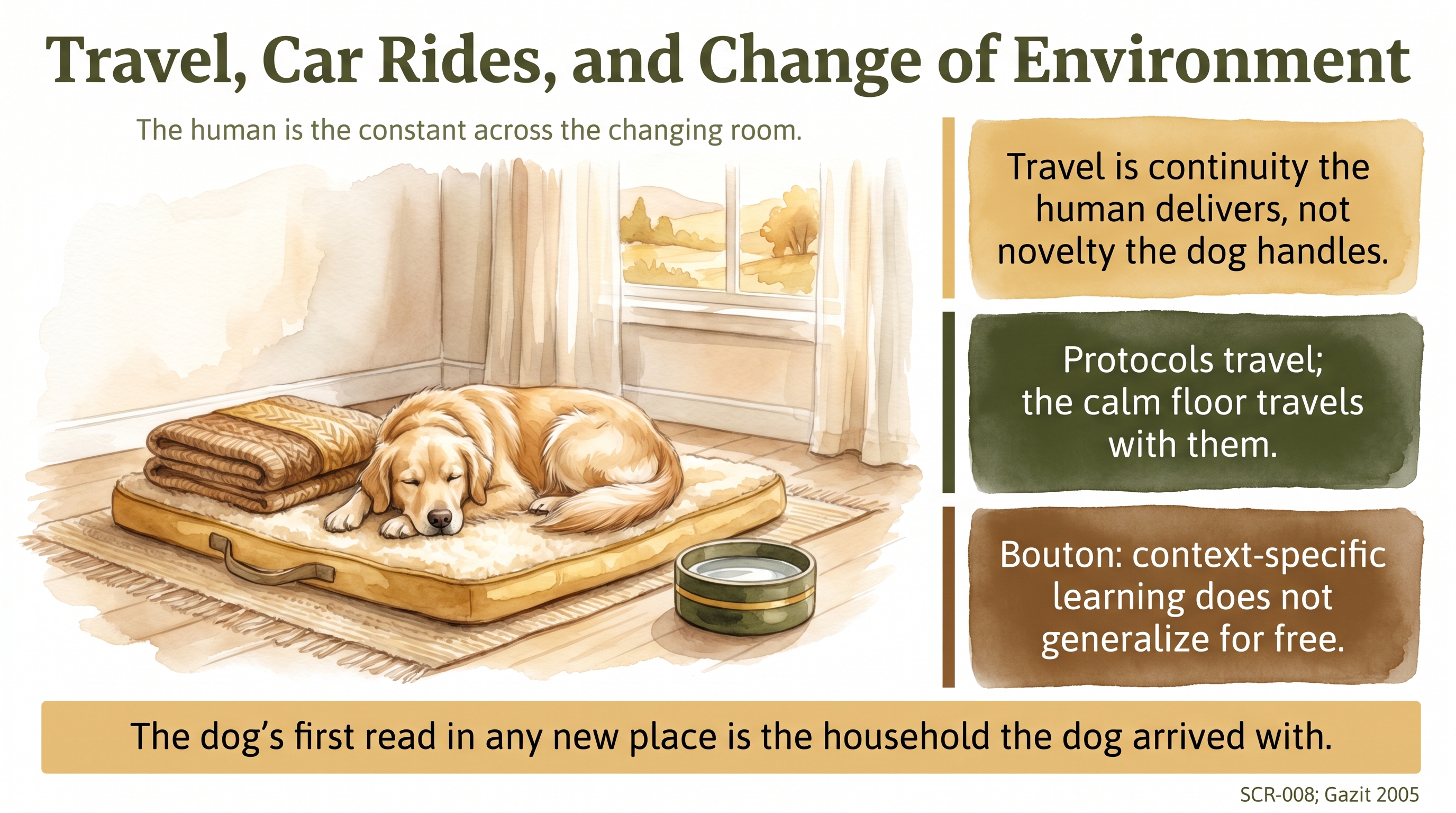
The house changes; the people do not.
Key Takeaways
- Travel and change of environment are continuity events for the human to deliver, not novelty events for the dog to handle. The human is the constant variable across the changing surroundings, and the regulated channel travels with the dog wherever the venue goes.
- Bouton context-renewal asymmetry (SCR-008; Gazit 2005 in dogs) means context-specific learning does not generalize automatically. The kitchen mat's settle is not the hotel's settle; the household protocols must be delivered recognizably in the new venue for the dog to read continuity rather than novelty.
- The handler-state coupling channels (Sundman 2019; Koskela 2024; Parr-Cortes 2024; Wilson 2022) travel with the dog. The framing the family brings to the trip transmits through those channels; a family framing the trip as novel challenge highlights novelty, a family framing it as continuation highlights continuity.
- Early, frequent, brief, regulated travel exposure wires the substrate the lifetime travel experience layers onto. Late-introduction high-stakes travel writes the substrate under conditions the methodology recommends against.
The Evidence
- Bouton, M. E. (2002, 2004); Bouton, M. E., & Moody, E. W. (2004)foundational learning theory (rat, human, cross-species)
Extinguished and context-specific learning does not generalize automatically to a new context; the original learning is preserved and the new context has not acquired the inhibitory association. The renewal asymmetry is the mechanism that makes change of environment a behavioral re-test even when the dog has been trained at home. - Gazit, I., Goldblatt, A., & Terkel, J. (2005), Animal Cognitiondomestic dogs (working detection dogs)
Canine renewal effect documented directly in dogs: behaviors extinguished in one context recovered when the dog was tested in a different context. The change-of-environment renewal asymmetry is canine-confirmed and operational at the precision the methodology operates inside.
- Sundman, A.-S. et al. (2019); Koskela, A. et al. (2024)domestic dogs and their owners
Long-term hair-cortisol synchrony (Sundman 2019) and dyad-specific HRV coupling (Koskela 2024) establish that the dog reads the handler's physiology continuously, including across changes of environment. The handler's state is the carrier wave the dog brings to any new venue. - Parr-Cortes, Z. et al. (2024); Wilson, C. et al. (2022)domestic dogs
Stressed-human odor impairs canine cognitive performance (Parr-Cortes 2024); dogs discriminate human stress-related odor at well-above-chance accuracy (Wilson 2022). The chemical channel travels with the dog; surplus handler arousal during travel is being transmitted through the olfactory channel in addition to the visible behavioral channel.
- Mariti, C. et al. (2015), Journal of Veterinary Behavior; Cracknell, N., & Mills, D. S. (2008), The Veterinary Journaldomestic dogs
Documented behavioral and physiological stress responses in dogs during car travel: panting, drooling, vocalization, restlessness, motion-related vomiting. The car-channel circuit the dog is bringing to any specific car ride was written by the cumulative pattern of prior car rides; early experience is disproportionately weighted in the wiring substrate.
- Dale, R. et al. (2024), Animal Welfaredomestic dogs (N=145, prospective longitudinal cohort)
Puppies with at least nine uninterrupted hours of sleep, in a sheltered location, in an overnight crate or enclosed space before sixteen weeks showed lower rates of separation-related behaviors and fussing. The documented finding is the sleep correlate itself. The travel-portability implication is operationally reasonable because improvised travel sleep arrangements are less likely to preserve those same conditions, but that extension has not been directly tested as a travel intervention. Correlational from prospective cohort, not causal from intervention.
- Hebb, D. O. (1949); Bliss & Lømo (1973); Bi & Poo (1998)foundational neuroscience principle (rabbit, rat); cross-species
Neurons that fire together wire together. Application to the travel channel is conserved-mechanism inference. The dog whose car-channel circuit was wired by fifty regulated brief rides has the regulated-car pattern wired fifty times; the dog whose car-channel circuit was wired by two high-arousal high-stakes rides is bringing two high-arousal repetitions to the third. The substrate the early-travel arrangement produces is the substrate the lifetime travel experience layers onto.
- JB cohort observationfamily-raised Golden Retrievers
JB cohort observation across families raising Golden Retrievers is that dogs whose households delivered the standard protocols (morning sequence, meal protocol, settle cue, sleep arrangement) recognizably across changes of environment maintained regulatory baseline at approximately the home-household level in new venues. Dogs whose households suspended or improvised the protocols in new venues showed greater regulatory variance and longer recovery times. The observation is consistent with the documented context-renewal and handler-state coupling literature; it has not been tested in a controlled canine cohort. Reported at observed confidence.
- Smith, B. P. et al. (2025), Preventive Veterinary Medicinedomestic dogs (N=3,044 Golden Retrievers, Golden Retriever Lifetime Study)
Household management variables are significant predictors of behavioral trajectory across the first three years of life. Travel and environmental-change protocols are one variable in the household-management cluster. The cohort finding does not partition travel-protocol type at the precision the methodology operates inside.
- JB Methodology synthesisfamily-raised Golden Retrievers
The methodology's claim that travel and change of environment are continuity events for the human to deliver, that protocol-portability is the operational variable, and that early frequent brief regulated exposure outperforms infrequent long high-stakes exposure, is JB's synthesis of Bouton context-renewal, handler-state coupling channels, the Dale et al. (2024) sleep correlates, Hebbian plasticity, and the cohort-scale predictor literature. Each component is documented; the operational synthesis is heuristic.
No controlled canine cohort study has tested early-frequent-brief-regulated travel exposure protocols against late-introduction high-stakes protocols on matched lifetime travel-stress and behavioral outcomes.
The protocol-portability claim has not been operationalized in a published canine study; whether the specific protocols (morning sequence, meal protocol, settle cue) generalize across venues at the precision the methodology implies is observation rather than measurement.
The interaction between travel-channel discipline and downstream attachment-classification stability has not been partitioned in a published canine cohort.
The minimum-frequency threshold for regulated travel exposure that produces the cohort-observed substrate has not been quantified in a published study.
SCR References
Sources
Bi, G.-Q., \u0026 Poo, M.-M. (1998). Synaptic modifications in cultured hippocampal neurons: Dependence on spike timing, synaptic strength, and postsynaptic cell type. Journal of Neuroscience, 18(24), 10464-10472.
Bliss, T. V. P., \u0026 Lømo, T. (1973). Long-lasting potentiation of synaptic transmission in the dentate area of the anaesthetized rabbit following stimulation of the perforant path. Journal of Physiology, 232(2), 331-356.
Bouton, M. E. (2002). Context, ambiguity, and unlearning: Sources of relapse after behavioral extinction. Biological Psychiatry, 52(10), 976-986.
Bouton, M. E. (2004). Context and behavioral processes in extinction. Learning \u0026 Memory, 11(5), 485-494.
Bouton, M. E., \u0026 Moody, E. W. (2004). Memory processes in classical conditioning. Neuroscience \u0026 Biobehavioral Reviews, 28(7), 663-674.
Cracknell, N. R., \u0026 Mills, D. S. (2008). A double-blind placebo-controlled study into the efficacy of a homeopathic remedy for fear of firework noises in the dog (Canis familiaris). The Veterinary Journal, 177(1), 80-88.
Dale, R. et al. (2024). Risk factors associated with separation-related behaviours and other potentially undesirable behaviours in puppies. Animal Welfare, 33, e22.
Gazit, I., Goldblatt, A., \u0026 Terkel, J. (2005). The role of context specificity in learning: The effects of training context on explosives detection in dogs. Animal Cognition, 8(3), 143-150.
Hebb, D. O. (1949). The Organization of Behavior: A Neuropsychological Theory. New York: Wiley.
Koskela, A., Kareinen, I., Somppi, S., Törnqvist, H., Vainio, O., Kujala, M. V. (2024). Heart rate variability coupling in dog-human dyads. Scientific Reports, 14, 8213.
Mariti, C., Ricci, E., Carlone, B., Moore, J. L., Sighieri, C., \u0026 Gazzano, A. (2015). Dog attachment to man: A comparison between pet and working dogs. Journal of Veterinary Behavior, 8(3), 135-145.
Parr-Cortes, Z., Müller, C. T., Talas, L., Mendl, M., Guest, C., \u0026 Rooney, N. J. (2024). The odour of an unfamiliar stressed or relaxed person affects dogs' responses on a cognitive bias test. Scientific Reports, 14, 15843.
Smith, B. P., Browne, M., Mack, J., Kontou, T. G., \u0026 Tomkins, L. M. (2025). Predictors of behavioral outcomes in 3,044 Golden Retrievers across the first three years