Continuity: Continue, Don't Start
In JB, Continuity is the operating principle that the puppy arriving in a family home at eight to ten weeks is not starting something new. The puppy already knows how to live in a structured social group, has been doing so since birth, and arrives carrying a working social grammar developed during the most consequential developmental window canine biology recognizes. Heuristic The component findings, that early social experience produces durable behavioral patterns, that rehoming spikes canine cortisol, and that habit automation accelerates fastest during the earliest repetitions of a new context, are documented at the levels stated below. The convergent operational claim, that the family's job at intake and across the whole life of the dog is conservation of working structure rather than reinvention from scratch, is JB's synthesis of that science.
What It Means
An eight-to-ten-week-old puppy raised in the JB program has been living in a structured social environment since birth. It has experienced calm adult presence, predictable rhythm, calm correction from its mother, social learning from littermates, graduated independence, and the pattern of a day organized around rest and regulated interaction. Scott and Fuller's multi-breed studies (1965) and Serpell and Jagoe's synthesis (1995) established that early social experience during the canine sensitive period produces durable behavioral patterns and that conditioning during that window is not easily changed in later years (SCR-354). Documented The breeder's environment is not a preparation for real life. It is a social education delivered in the first weeks of existence, during exactly the developmental window when those experiences have the most lasting impact.
What most families do when the puppy arrives is inadvertently crash this structure. They respond to the puppy's first night distress by escalating their own behavior. They introduce high levels of stimulation precisely when the puppy's nervous system is most reactive to novelty. They replace the predictable rhythm of the breeder environment with the rhythms of their family's somewhat chaotic daily life. They intend kindness and produce disorganization. The puppy's nervous system, which was operating on an established social grammar, encounters a new household that communicates no legible grammar at all. This is the crash landing.
The transition is physiologically real. Van der Laan and colleagues (2022) and the broader rehoming and shelter cortisol literature documented that moving dogs into novel kennel, shelter, or rehoming contexts produces sharp cortisol increases, and that stable, quiet home environments reduce cortisol and increase restful behavior over days to weeks (SCR-060). Documented The documented evidence comes primarily from shelter-to-home and kennel transitions; direct breeder-to-family puppy rehoming cortisol trials comparing JB's specific reception protocol against a high-energy abrupt transition do not exist. The principle that transition stress is real and that stable environments help is documented; the specific JB Soft Landing protocol is the family-side application of that principle, well-grounded but not directly tested as an intervention package. The puppy-health source document adds the cumulative-stressors framing: transport, environmental novelty, schedule rupture, sleep loss, diet change, and social change are physiologically additive in puppies, each compounding the HPA-axis burden.
The JB Soft Landing is the family-side response to this biology. Rather than treating the transition as an occasion for maximal welcome, the methodology treats it as an occasion for maximal continuity. Quiet. Calm. Structured. Minimal overwhelming stimulation. The message, communicated through the household's behavior rather than through words, is the one the JB program summarizes in a single sentence: take the puppy home, and pretend like it has been there. The sentence is philosophically dense. It contains the entire Soft Landing principle and extends it forward, not just for the first day, but for the first weeks, across the socialization window, and as a disposition that never fully ends, because a household that maintains continuity of structure across the dog's whole life is never asking the dog to reorganize its understanding of what is expected.
The continuity principle also reaches forward to organize how the methodology relates to the rest of the dog's life. A new home, a new family member, the loss of an adult dog from a multi-dog household, a move, a significant change in schedule, in each case the question is the same: what is already established, and how does the family carry it through this change rather than treating the change as a reset? Design and routine can be adapted. The core social grammar, calm, structured, parental, predictable, should not be abandoned for the sake of novelty.
The transition window is also a high-leverage period for the family's own habit formation, not only the puppy's. Lally and colleagues (2010), tracking 96 participants in human behavioral habit formation, found that behaviors automated at a median of approximately 66 days, with a range of 18 to 254 days, and that the earliest repetitions in a new context carried disproportionate weight in setting the eventual automated pattern (SCR-101). Documented The human application is documented; the dog-owner context application is interpretive. Translated into JB terms: the family's behavior in the first weeks of the puppy's arrival is being automated as surely as the puppy's responses are. Continuity is not passivity. It is active conservation of what works, established during the period when both sides of the relationship are most plastic to the patterns being laid down.
The synthesis JB takes from these findings is operational: the right framing of the puppy's arrival is not "start something" but "continue something already underway." Heuristic Each component, sensitive-period imprinting, transition cortisol, and the early-repetition weighting of human habit formation, is independently documented at the level stated. The convergent operational claim that the family's most important first-week work is conservation rather than initiation is well-supported synthesis rather than a directly demonstrated controlled comparison.
Why It Matters for Your Dog
The Soft Landing is the most visible application of the principle. The first night, the first week, and the first month organize themselves around continuity rather than welcome. The household keeps its tone calm because the puppy's nervous system is operating in the same calm register the breeder environment established. The family resists the temptation to invite friends and extended family to meet the puppy in the first days, not because socialization is unimportant, but because the puppy's nervous system is currently doing the work of carrying its existing social grammar across a major physiological transition. Adding novelty during that window competes with the work the puppy is already doing.
The Lally finding sharpens the practical stakes. The family that builds a calm, structured, mentorship-rich rhythm during the first weeks is not only making the puppy comfortable. They are wiring their own behavioral defaults during the period of highest plasticity for owner habit formation. The family that allows chaos during the first weeks because the puppy is small and forgiving is wiring a different set of defaults that the household will be operating from when the puppy is no longer small and no longer forgiving. The transition window is the family's window too.
Continuity is the operating-principle expression of the Calmness pillar applied across the transition and across the lifespan. The pillar names the floor: parasympathetic baseline, regulated interaction, attentive stability rather than lethargy. The principle names the time horizon. The floor is not built fresh in the family home and then maintained. It is received from the breeder environment, kept intact through the transition, and carried forward across whatever the dog's life later asks of it. The other four pillars carry mentorship, structured leadership, prevention, and indirect correction. Continuity organizes the relational arc those four operate inside.
For families considering the JB program, the principle reframes what they are buying. They are not buying a blank-slate puppy to be raised from zero. They are buying a puppy whose first weeks have been organized around exactly the social grammar the methodology asks them to maintain. The work the family is asked to do at intake is not to start the puppy's social education. It is to continue an education already in progress. That reframing changes the daily question from "what should I be teaching my puppy today?" to "what is already working that I should not interrupt?"
The principle does not eliminate the family's work; it organizes it. The puppy still needs the household's parental relationship to develop, still needs the household's daily rhythm to become the dog's daily rhythm, still needs to learn the specific structure of this particular family's life. What changes is the orientation: the family is the second teacher in a relay, not the first teacher in a vacuum. The first teacher delivered the grammar. The family's job is to keep speaking it.
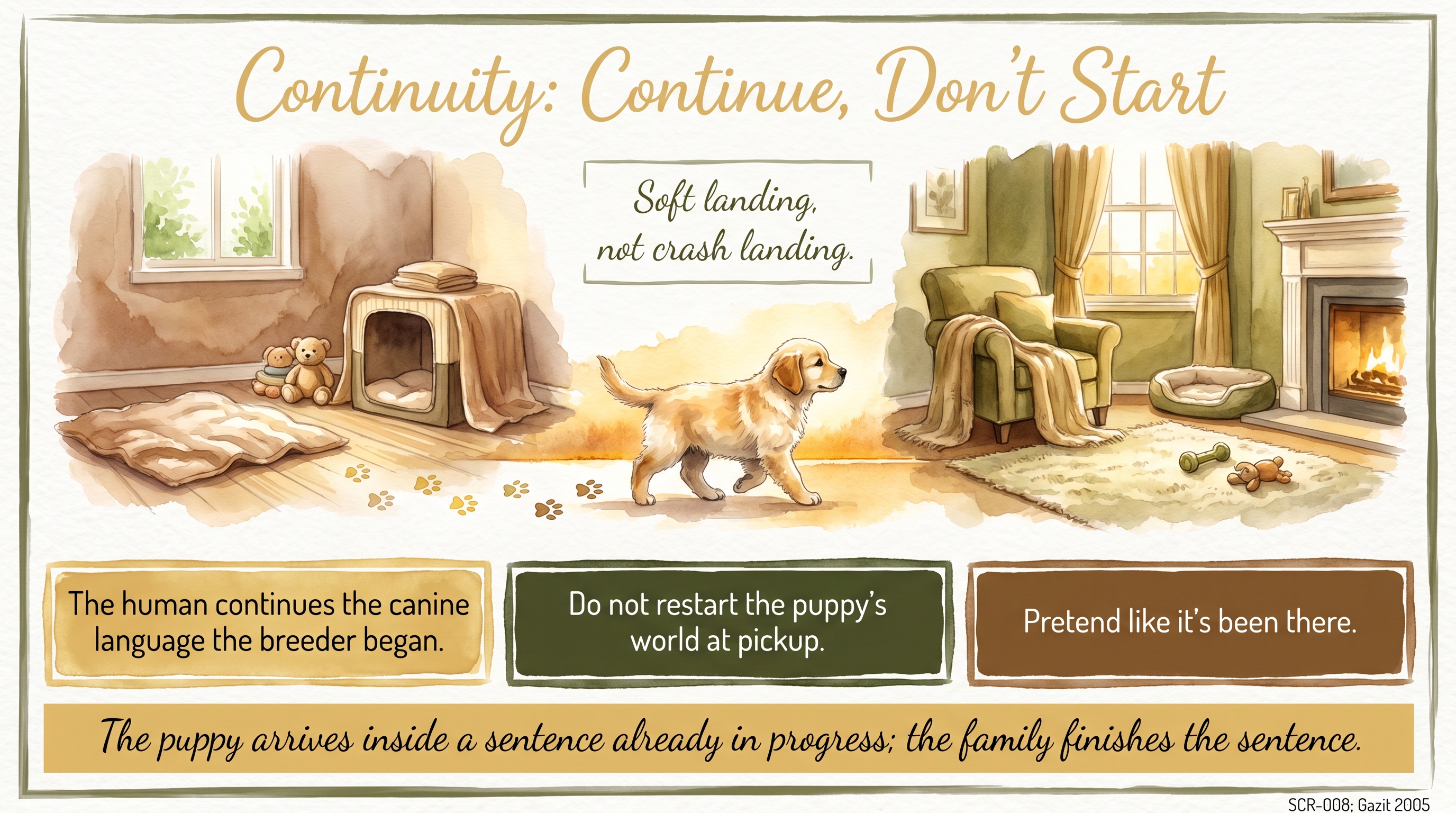
Pretend like it has been there.
Key Takeaways
- The puppy arriving from the JB program is not starting something. It is continuing a social grammar developed since birth during the canine sensitive period (Scott and Fuller 1965; Serpell and Jagoe 1995). The family's first job is conservation of working structure, not reinvention from scratch.
- Transition stress is documented. Rehoming and shelter contexts produce sharp cortisol increases; stable, quiet home environments reduce cortisol over days to weeks (SCR-060). The JB Soft Landing is the family-side application of that principle. The principle is documented; the specific protocol as a tested intervention package is not.
- The transition window is the family's window too. Lally and colleagues (2010) showed that early repetitions in a new context carry disproportionate weight in human habit formation. The patterns the household establishes in the first weeks are being automated as surely as the puppy's responses are.
- The principle reaches across the whole life of the dog. New homes, new family members, schedule changes, and household transitions are all governed by the same question: what is already established, and how does the family carry it through this change rather than treating the change as a reset?
The Evidence
- Scott, J. P. & Fuller, J. L. (1965); Serpell, J. & Jagoe, J. A. (1995)domestic dog
Scott and Fuller's multi-breed studies established canine behavioral genetics as a field by demonstrating heritable breed differences under standardized conditions and clarifying the developmental importance of early social experience. Serpell and Jagoe noted that conditioning during the canine sensitive period is not easily changed in later years and that early experience sets a general pattern of responses to the major influences the puppy encounters later. The puppy arriving at eight to ten weeks has already received the most consequential developmental input of its early life.
- van der Laan, J. E. et al. (2022), Scientific Reports; Gunter, L. M. et al. (2026), PeerJdomestic dog (shelter and adoption transition contexts)
Hair cortisol changes across shelter and adoption transitions document sharp increases on intake into novel environments, with reductions over days to weeks in stable home contexts. The puppy-health literature adds that transport, environmental novelty, schedule rupture, sleep loss, diet change, and social change are physiologically cumulative stressors in puppies, each compounding HPA-axis burden. The documented evidence comes primarily from shelter-to-home and kennel-to-home contexts; direct breeder-to-family puppy rehoming cortisol trials comparing JB's specific reception protocol against a high-energy abrupt transition do not exist.
- Gross, B. et al. (2010), Veterinary Radiology & Ultrasounddomestic dogs (N=17, longitudinal 1-36 weeks)
Longitudinal MRI and histology correlation documented progressive postnatal myelination, with the canine brain approaching adult-like appearance by approximately 16 weeks and continued white-matter maturation extending well beyond. The breeder-to-family transition occurs squarely inside this active myelination window. The link between repetition of a specific behavior and insulation of its specific underlying circuit has not been mapped directly in dogs; the documented finding is the maturation timeline. Continuity protects the work the puppy's nervous system is already doing during this period rather than asking it to reorganize.
- Lally, P., van Jaarsveld, C. H. M., Potts, H. W. W., & Wardle, J. (2010), European Journal of Social Psychologyhumans (N=96 participants tracking new daily behaviors)
Behaviors automated at a median of approximately 66 days, with a range of 18 to 254 days. Complex behaviors took significantly longer than simple ones. The earliest repetitions of a new behavior in a new context carry disproportionate weight in setting the eventual automated pattern. The human-research finding is documented; application to dog-owner habit formation is interpretive analogy. The 66-day figure is informative as median; the 18-254 day range is as important as the median.
- JB Methodology synthesisfamily-raised Golden Retrievers
The convergent operational claim that the family's first-week work is conservation of an existing social grammar rather than initiation from zero is JB's synthesis of canine sensitive-period research, transition-cortisol evidence, the active myelination window, and the human habit-formation literature on early-repetition weighting. Each component is documented at the level stated. The integrated framing of the puppy's arrival as continuation rather than start is well-supported synthesis rather than a directly demonstrated controlled comparison. The Soft Landing protocol as a specific intervention package has not been clinically validated against alternatives.
No randomized trial has compared the JB Soft Landing reception protocol against a higher-energy welcome protocol on puppy cortisol, behavioral, or relational outcomes in the breeder-to-family transition window. The principle that transition stress is real and that stable environments help is documented; the specific protocol as an intervention package is family-side application.
The Lally et al. (2010) early-repetition weighting in human habit formation has not been directly replicated in dog-owner contexts. The application to family habit formation during the puppy's arrival window is interpretive analogy from a documented human finding.
Long-term outcome data on dogs raised under continuous structured-companionship grammar across major life transitions (move, household composition change, loss of an adult dog) versus dogs whose households treat each transition as a reset has not been collected. The principle's lifespan claim rests on the same component evidence as the intake claim, extended by the same synthesis logic.
SCR References
Sources
Gross, B., Garcia-Tapia, D., Riedesel, E., Ellinwood, N. M., \u0026 Jens, J. K. (2010). Normal canine brain maturation at magnetic resonance imaging. Veterinary Radiology \u0026 Ultrasound, 51(4), 361-373.
Gunter, L. M., Feuerbacher, E. N., Gilchrist, R. J., \u0026 Wynne, C. D. L. (2026). Cortisol and behavioral adaptation in foster versus shelter contexts in dogs. PeerJ (per SCR-060 source registry).
Lally, P., van Jaarsveld, C. H. M., Potts, H. W. W., \u0026 Wardle, J. (2010). How are habits formed: Modelling habit formation in the real world. European Journal of Social Psychology, 40(6), 998-1009.
Scott, J. P., \u0026 Fuller, J. L. (1965). Genetics and the Social Behavior of the Dog. University of Chicago Press.
Serpell, J., \u0026 Jagoe, J. A. (1995). Early experience and the development of behaviour. In J. Serpell (Ed.), The Domestic Dog: Its Evolution, Behaviour and Interactions with People (pp. 79-102). Cambridge University Press.
van der Laan, J. E., Vinke, C. M., \u0026 Arndt, S. S. (2022). Hair cortisol concentration in shelter dogs as a measure of chronic stress: An assessment across the rehoming process. Scientific Reports, 12, 5117.