Household Rhythm and Structure
In the JB methodology, the dog does not experience a day. The dog experiences a week, a season, and a year, and the household's whole-week rhythm is the architecture the dog actually lives inside. Heuristic The Shape of the Day operating principle names the daily grammar (pattern, sequence, rhythm); Household Rhythm and Structure names the scale above it: what the week looks like from the dog's point of view, what the weekend-weekday variance costs or contributes, how the household's seasonal shifts shape the dog's year. The predictability of rhythm is a regulatory variable. The documented findings on long-term dog-owner cortisol synchrony (Sundman 2019; SCR-105), canine circadian and sleep architecture (Kis et al. 2014, 2017; Bódizs et al. 2020; SCR-042), and owner-managed household variables as behavioral-outcome predictors (SCR-485; SCR-486) converge on the claim that the whole-week rhythm is upstream of much of what families interpret as daily behavioral variability. The convergent household-rhythm claim has not been tested as a direct intervention.
For Families
Dogs do not need rigid schedules. They need predictable patterns. The difference matters. A rigid schedule says meals are at 7:00 and 5:00 sharp. A predictable pattern says meals happen in the morning and evening at roughly the times they always do. The dog reads the second one as security; the first one creates anxiety the day it slips.
The Just Behaving household has rhythm rather than schedule. There is a morning shape, a midday shape, an evening shape. Walks happen, meals happen, rest happens, in a pattern the dog can predict without being able to set a clock by it. The dog knows the household well enough to anticipate, but is not made anxious by minor variations.
The payoff is a dog who lives easily inside the family's actual life rather than one whose nervous system is held hostage by clock time.
What It Means
The operating position is that rhythm and routine are not rigidity. Rigidity is the inability to handle deviation; rhythm is a repeated pattern that carries the dog through the normal week in a regulated state and absorbs deviation without dysregulating the whole. The methodology's preference is for what can be called a durable rhythm: the week has a recognizable shape (waking, morning, midday, afternoon, evening, overnight, repeated across days with tolerable variation); the dog's position in the rhythm is consistent (resting places, feeding times, walk times, quiet periods); and the shape bends under specific events (a guest, a trip, a holiday) without breaking. The durable rhythm is the operational form of Calmness at the week scale.
The weekday-weekend problem. In households where the rhythm varies substantially across the week, the dog is effectively living in two households: the weekday household (structured, paced, with adult humans on work schedules) and the weekend household (unstructured, variable, with extended social events, trips, and human attention patterns that differ from weekdays). Observed-JB The methodology's observation is that dogs raised in two-household rhythms show more dysregulation at the transitions (Sunday-evening-into-Monday, Friday-evening-into-Saturday) than dogs raised in rhythms where the weekday-weekend variance is smaller. The observation is consistent with the documented handler-state coupling literature (Sundman 2019; Koskela 2024): the household state shifts at the week boundaries transmit to the dog. The claim is reported at observed confidence; it has not been tested in a controlled household cohort.
Circadian architecture is canine-documented. Canine sleep-wake cycles have diurnal structure; morning HPA-axis activation is documented (Haverbeke 2008 in working contexts; Bryan 2013 hair-cortisol validation of canine baseline measurement); non-REM and REM sleep stages with associated learning-consolidation effects are documented directly in dogs (Kis et al. 2014, 2017; Bódizs et al. 2020; Iotchev et al. 2020; SCR-042). Documented The precise peak-timing curve for canine waking cortisol relies on the broader mammalian diurnal pattern rather than on a canine-direct intensive time-series measurement; the general architecture is canine-documented. The implication for household rhythm is that the dog's physiology has an inherent temporal structure, and household rhythms that align with that structure (morning activation window, midday rest, afternoon activity, evening wind-down, overnight sleep) are aligning with the biology. Rhythms that fight the biology produce chronic dysregulation costs.
The long-term cortisol channel. Sundman et al. (2019) demonstrated that long-term hair-cortisol concentrations are synchronized between dogs and their owners across months, with the owner's profile appearing to drive the dog's more strongly than the reverse (SCR-105). Documented The owner profile is not a snapshot; it is the cumulative expression of the household's rhythm and the owner's daily-to-weekly pattern of stress, recovery, and regulation. The dog's chronic endocrine state is being set, over months, by the household's rhythm as lived. A household that runs a chronically overloaded weekly rhythm is writing that overload into the dog's physiology. A household that runs a durable weekly rhythm is writing stability.
Hebbian plasticity at the week scale. The dog that has been in a household for a year has experienced the weekly rhythm approximately fifty-two times. The sensory-motor sequences associated with Monday morning, with Wednesday evening, with Saturday afternoon have each been repeated approximately fifty-two times in the specific household configuration the family has created. Each repetition has strengthened the circuit (SCR-022). The mechanism is cross-species foundational neuroscience; the application to week-scale pattern learning is conserved-mechanism inference. The dog's response to Monday morning is not a new response; it is the expression of fifty-two previous Monday mornings wired into the dog's daily-expectation architecture.
The Dale et al. (2024) sleep correlates apply here too. Nine uninterrupted hours, sheltered location, overnight enclosed sleeping before sixteen weeks (SCR-036) are not one-time architectural decisions; they are weekly-repeated conditions, and their protective association with reduced separation-related behaviors and fussing is itself a week-scale finding. Documented A household that delivers the sleep correlates on weekdays and disrupts them on weekends (late bedtimes, shifted sleeping locations, variable overnight arrangements) is not delivering the correlates. The finding is about the cumulative pattern, not about any specific night.
Why It Matters for Your Dog
The practical starting position is that the family can read its own rhythm at the week scale by writing it down. A seven-day log of waking times, feeding times, walk times, rest windows, and overnight sleep arrangements across both weekdays and weekend produces an instrument the family can use to see what the dog is experiencing. Most households, doing this for the first time, are surprised by the variance between weekdays and weekends. The exercise is not a judgment; it is a diagnostic. The variance is the data.
The practical durability test. A durable rhythm is not an inflexible rhythm. The question is not whether the family can keep every variable constant; the question is whether the rhythm's core structure (waking time within a reasonable window; feeding times within a reasonable window; the distribution of activity, rest, and sleep across the day; the overnight arrangement) can be maintained across the normal variation of the household's week. A rhythm that breaks under a Saturday brunch is brittle; a rhythm that bends and recovers is durable. The methodology's preference is durability, not rigidity.
The weekday-weekend rhythm-minimization principle. For families raising a Golden Retriever puppy, the methodology's preference is that the weekday-weekend rhythm variance is kept smaller than the household would otherwise prefer, at least through the first six months. The puppy whose weekend is shaped substantially like the weekday is a puppy who is receiving approximately fifty-two repetitions of a single rhythm over the first year rather than a hundred-and-four repetitions of two rhythms with transitions between them. The cumulative consolidation gain from the single rhythm is one of the reasons the methodology recommends early-rhythm convergence. As the dog matures, the rhythm can accommodate more variance; as the puppy is being built, the rhythm-minimization produces outcomes the family will benefit from for the dog's lifetime.
The seasonal and annual scale. Household rhythm operates at longer scales than the week. The household that experiences substantially different summer and winter rhythms (outdoor activity, daylight patterns, travel) is presenting the dog with a seasonal architecture. The dog who has experienced three summers and three winters in a stable household has been through six seasonal transitions in rhythm. The methodology's position is that the seasonal transitions themselves are teachable; a family that marks the transition with a conscious adjustment period, rather than with an abrupt rhythm shift, produces a dog whose seasonal regulation is smoother. The claim is consistent with general circadian-adjustment literature rather than tested directly in a canine seasonal-rhythm study.
Household rhythm and structure is a Calmness operation at the week scale. Calmness at the moment-to-moment scale is the handler\u0027s state; Calmness at the daily scale is the Shape of the Day; Calmness at the week scale is the rhythm of the household\u0027s life. The Sundman et al. (2019) finding that owner profile drives dog cortisol synchrony across months (SCR-105) is the week-scale Calmness finding. The household\u0027s chronic rhythm is the chronic handler-state the dog is coupled to. A durable, regulated weekly rhythm is a chronic regulated handler-state; the dog\u0027s chronic physiology reflects the rhythm as lived.
The most common household-rhythm failure modes are specific. First, the weekday-weekend bifurcation: the weekday household is structured around work schedules and the weekend household is structured around social events, and the dog is experiencing two households a week. Second, the calendar-driven variance: the rhythm is dictated by whatever is on the calendar rather than by the underlying architecture of the dog's biological needs. Birthdays, dinner parties, and travel schedules are treated as the primary variables and the dog's rhythm bends around them. Third, the unconsidered rhythm: the household has not written down the week, and the family cannot articulate what the rhythm is. The rhythm exists, but nobody is consciously authoring it. Fourth, the perfectionist rhythm: the family has constructed a rhythm so precise that any deviation is experienced as failure, and the household is living under the tyranny of the rhythm rather than being supported by it. The methodology's preference is durability, not precision.
A note on the limit of the inference. The documented evidence supports long-term dog-owner cortisol synchrony (SCR-105; Sundman 2019), HRV coupling (SCR-106; Koskela 2024), canine sleep architecture (SCR-042; Kis et al., Bódizs et al., Iotchev et al.), the Dale et al. (2024) sleep correlates (SCR-036), Hebbian circuit-level plasticity (SCR-022), and owner-managed variables as behavioral-outcome predictors (SCR-485; SCR-486). The convergent claim that the whole-week rhythm is the architecture the dog actually lives inside, and that weekday-weekend variance is a specific regulatory cost, is JB's synthesis of those documented channels. The specific household-rhythm intervention has not been tested at the precision the methodology's operational guidance implies.
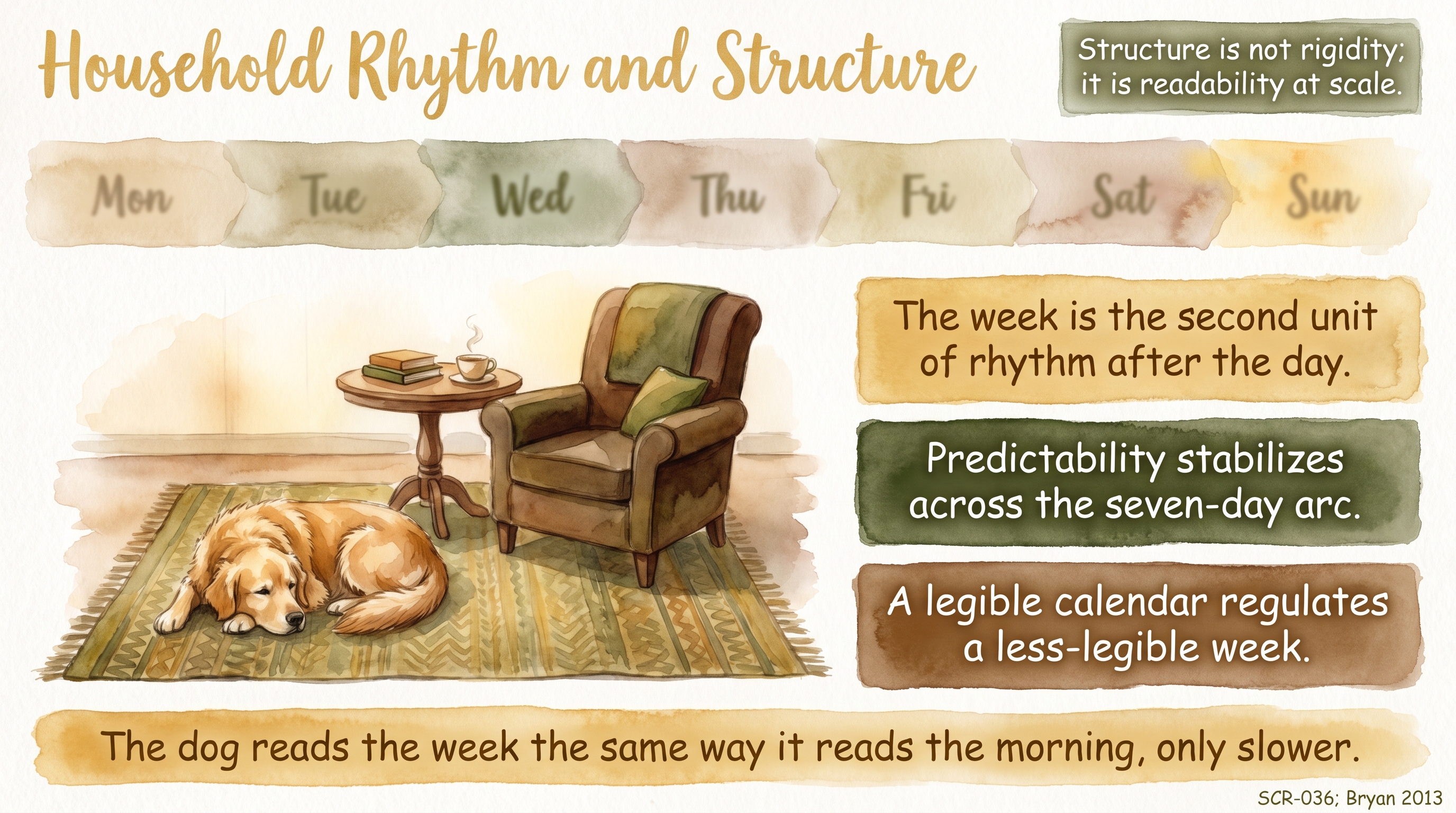
The dog lives inside a week, not a day.
Key Takeaways
- The dog does not experience a day; the dog experiences a week. Household rhythm is the architecture inside which daily grammar nests. The whole-week rhythm is the architecture the dog is actually living inside, and its predictability is a regulatory variable.
- Long-term dog-owner cortisol synchrony (Sundman 2019; SCR-105) runs at the month scale; the owner profile appears to drive the dog's cortisol more strongly than the reverse. The household's chronic rhythm is the chronic handler-state the dog's chronic endocrine state reflects.
- Weekday-weekend rhythm variance is a specific regulatory cost. Dogs raised in two-household rhythms (structured weekday, unstructured weekend) show more dysregulation at transitions. Methodology observation consistent with the documented handler-state coupling literature; not tested in a controlled household cohort.
- Durability, not rigidity. A durable rhythm has a recognizable shape that bends under specific events and recovers; a rigid rhythm breaks under deviation. The practical test is whether the rhythm's core structure can be maintained across the normal variation of the household's week.
The Evidence
- Sundman, A.-S. et al. (2019), Scientific Reportsdomestic dogs (N=58 dog-owner dyads; border collies and Shetland sheepdogs)
Hair-cortisol concentrations synchronized between dogs and their owners across months. Owner personality traits accounted for more variance in the dog's cortisol than the dog's own traits. The household's chronic rhythm is one of the variables through which owner profile is expressed. The dog's chronic endocrine state reflects the rhythm as lived. - Koskela, A. et al. (2024), Scientific Reportsdomestic dogs and their owners
Heart-rate-variability coupling is dyad-specific. The real-time coupling is the moment-to-moment expression; the long-term rhythm is the chronic expression. Together they establish that dog-human coupling operates at multiple timescales.
- Kis, A. et al. (2014, 2017); Bódizs, R. et al. (2020); Iotchev, I. B. et al. (2020)domestic dogs
Canine polysomnography has documented mammalian polyphasic sleep architecture with distinct non-REM and REM stages in dogs, sleep spindles associated with learning outcomes, and homeostatic regulation of sleep. The dog's physiology has an inherent temporal structure; household rhythms aligning with that structure support regulation. - Haverbeke, A. et al. (2008), Applied Animal Behaviour Science; Bryan, H. M. et al. (2013), JAALASdomestic dogs (military working dogs; hair cortisol methodology validation)
Canine morning HPA-axis activation is documented in working-dog cortisol responses (Haverbeke 2008) and validated through hair-cortisol methodology for baseline measurement (Bryan 2013). The morning activation window is the canine expression of the broader mammalian diurnal pattern; household rhythms aligning the morning window with the dog's physiology support regulation.
- Dale, R. et al. (2024), Animal Welfaredomestic dogs (N=145, prospective longitudinal cohort)
Puppies with at least nine uninterrupted hours of sleep, in a sheltered location, in an overnight crate or enclosed space before sixteen weeks showed lower rates of separation-related behaviors and fussing (fussing was about six times more common among puppies without these arrangements). The finding is a cumulative-pattern finding: the correlates are weekly-repeated conditions, and weekend disruptions of the conditions are not delivering the correlates. Correlational from prospective cohort, not causal from intervention.
- Hebb, D. O. (1949); Bliss & Lømo (1973); Bi & Poo (1998)foundational neuroscience principle (rabbit, rat); cross-species
Neurons that fire together wire together. Application to canine week-scale pattern learning is conserved-mechanism inference. The dog that has been in a household for a year has experienced the weekly rhythm approximately fifty-two times; the sensory-motor sequences associated with specific days and specific times have been repeated fifty-two times in the household's specific configuration. The dog's response to Monday morning is the output of fifty-two Monday-morning repetitions.
- Smith, B. P. et al. (2025), Preventive Veterinary Medicinedomestic dogs (N=3,044 Golden Retrievers, Golden Retriever Lifetime Study)
Household management variables identified as significant predictors of behavioral trajectory across the first three years of life. Household rhythm is one of the variables in the cluster. The cohort finding is cross-sectional with longitudinal tracking; direct intervention on household rhythm has not been tested. - Dale, R. et al. (2024); Dodman, N. H. et al. (2018); Powell, L. et al. (2021); Bouma, E. M. C. et al. (2024)domestic dogs (multiple cohorts)
Convergent evidence that owner-managed variables predict canine behavioral outcomes. The stronger ranking claim (owner variables as the primary determinant) is well-supported synthesis but not definitively established across all contexts (per SCR-486 ceiling).
- JB cohort observationfamily-raised Golden Retrievers
JB cohort observation across families raising Golden Retrievers is that dogs raised in two-household rhythms (structured weekday, unstructured weekend) show more dysregulation at the weekday-weekend transitions. The observation is consistent with documented handler-state coupling at multiple timescales but has not been tested in a controlled household cohort. Reported at observed confidence.
- JB Methodology synthesisfamily-raised Golden Retrievers
The convergent claim that the whole-week rhythm is the architecture the dog lives inside, and that rhythm predictability is a regulatory variable, is JB's synthesis of long-term dog-owner cortisol synchrony, canine circadian and sleep architecture, Dale et al. (2024) cumulative-pattern correlates, Hebbian week-scale pattern learning, and owner-managed household variables as behavioral-outcome predictors. Each component is documented. The specific household-rhythm intervention claim has not been directly tested.
No controlled canine cohort study has directly tested whether deliberately reducing weekday-weekend rhythm variance produces the behavioral outcomes the convergent findings predict.
The precise peak-timing curve for canine waking cortisol is inherited from the broader mammalian diurnal pattern; intensive canine time-series measurement at human-equivalent precision has not been published.
Seasonal-rhythm adjustment studies in canine populations are not yet available; the seasonal-transition claim is consistent with the general circadian-adjustment literature but not directly tested in dogs.
The interaction between household rhythm and specific behavioral outcomes (reactivity, settle latency, separation-related behavior) has not been partitioned by rhythm variance in a published canine cohort.
SCR References
Sources
Bi, G.-Q., \u0026 Poo, M.-M. (1998). Synaptic modifications in cultured hippocampal neurons: Dependence on spike timing, synaptic strength, and postsynaptic cell type. Journal of Neuroscience, 18(24), 10464-10472.
Bliss, T. V. P., \u0026 Lømo, T. (1973). Long-lasting potentiation of synaptic transmission in the dentate area of the anaesthetized rabbit following stimulation of the perforant path. Journal of Physiology, 232(2), 331-356.
Bódizs, R., Kis, A., Gácsi, M., \u0026 Topál, J. (2020). Sleep in the dog: Comparative, behavioral and translational relevance. Sleep Medicine Reviews, 51, 101283.
Bouma, E. M. C., Reijgwart, M. L., \u0026 Dijkstra, A. (2024). Dog-directed parenting styles and intergenerational patterns in dog-owner dyads. Animals, 14(3).
Bryan, H. M., Adams, A. G., Invik, R. M., Wynne-Edwards, K. E., \u0026 Smits, J. E. G. (2013). Hair as a meaningful measure of baseline cortisol levels over time in dogs. Journal of the American Association for Laboratory Animal Science, 52(2), 189-196.
Dale, R. et al. (2024). Risk factors associated with separation-related behaviours and other potentially undesirable behaviours in puppies. Animal Welfare, 33, e22.
Dodman, N. H., Brown, D. C., \u0026 Serpell, J. A. (2018). Associations between owner personality and psychological status and the prevalence of canine behavior problems. PLOS ONE, 13(2), e0192846.
Haverbeke, A., Diederich, C., Depiereux, E., \u0026 Giffroy, J. M. (2008). Cortisol and behavioral responses of working dogs to environmental challenges. Applied Animal Behaviour Science, 115(3-4), 204-213.
Hebb, D. O. (1949). The Organization of Behavior: A Neuropsychological Theory. New York: Wiley.
Iotchev, I. B., Kis, A., Bódizs, R., van Luijtelaar, G., \u0026 Kubinyi, E. (2020). Sleep spindles in dogs are associated with learning performance. Scientific Reports, 10, 20196.
Kis, A., Szakadát, S., Kovács, E., Gácsi, M., Simor, P., Gombos, F., Topál, J., Miklósi, Á., \u0026 Bódizs, R. (2014). Development of a non-invasive polysomnography technique for dogs (Canis familiaris). PLOS ONE, 9(4), e93883.
Kis, A., Szakadát, S., Gácsi, M., Kovács, E., Simor, P., Török, C., Gombos, F., Bódizs, R., \u0026 Topál, J. (2017). The interrelated effect of sleep and learning in dogs (Canis familiaris); an EEG and behavioural study. Scientific Reports, 7, 41873.
Koskela, A., Kareinen, I., Somppi, S., Törnqvist, H., Vainio, O., Kujala, M. V. (2024). Heart rate variability coupling in dog-human dyads. Scientific Reports, 14, 8213.
Powell, L., Chia, D., McGreevy, P., Podberscek, A. L., Edwards, K. M., Neilly, B., Guastella, A. J., Lee, V., \u0026 Stamatakis, E. (2021). Expectations for dog ownership: Perceived physical, mental and psychosocial health consequences. PLOS ONE, 16(7), e0230770.
Smith, B. P., Browne, M., Mack, J., Kontou, T. G., \u0026 Tomkins, L. M. (2025). Predictors of behavioral outcomes in 3,044 Golden Retrievers across the first three years of life. Preventive Veterinary Medicine, 234, 106101.
Sundman, A.-S., Van Poucke, E., Svensson Holm, A.-C., Faresjö, Å., Theodorsson, E., Jensen, P., \u0026 Roth, L. S. V. (2019). Long-term stress levels are synchronized in dogs and their owners. Scientific Reports, 9, 7391.