The Calm Floor Principle
Compound evidence detail1 SCR / 2 parts
- Documentedthe cross-species behavioral principle that parasympathetic-dominant autonomic states support social engagement, with direct canine HRV evidence (Berg 2026, Wormald 2017, Koskela 2024)
- Ambiguousthe polyvagal-theory-specific neuroanatomical mechanism, with the Grossman 2026 critique and Porges 2026 rebuttal active in current literature
In JB, The Calm Floor Principle is the operating decision to build a parasympathetic baseline before expanding a dog's window of tolerance, rather than starting in excitement and asking the dog to regulate downward later. Mixed Evidence It is what the Calmness pillar looks like once it stops being a value the family endorses and starts being the sequence in which a household actually develops a calm Golden Retriever.
For Families
The calm floor is the household's resting tone. When nothing in particular is happening - no doorbell, no meal, no walk being prepared - the household feels calm to the dog. The dog rests, observes, and stays in a regulated state without effort.
Most households accidentally build the opposite. The default tone is mildly elevated, the dog is mildly aroused, and excitement spills into every household event because the floor was never calm to begin with. Excitement at the door, excitement at meals, excitement at walks - each one feels normal, but the dog is operating well above the regulated baseline most of the day.
Just Behaving asks families to build the calm floor first and let the exciting moments be exceptions to it, not extensions of it. A calm floor takes weeks of unglamorous consistency to build. Once it is there, almost everything else gets easier.
What It Means
The autonomic nervous system runs along a spectrum. At one end, sympathetic dominance: alert, activated, metabolically expensive, primed for action. At the other end, parasympathetic dominance: calm, regenerative, socially available, biologically inexpensive to sustain. Documented Heart rate variability, the millisecond-scale variation between heartbeats, is a validated index of where on that spectrum an organism is operating. High variability indicates strong parasympathetic tone. Low variability indicates sympathetic dominance, and in dogs is associated with anxiety-related behavior problems (Wormald et al., 2017). Documented
The calm floor is the parasympathetic baseline a dog operates from between events. It is not sedation. It is not a dog suppressed into stillness or drilled into passivity. It is an attentive, engaged, socially available dog whose nervous system is not burning unnecessary fuel maintaining anticipatory arousal. From that floor, a dog develops what clinicians and developmentalists call a window of tolerance: the range of arousal the dog can move through and return from without losing behavioral regulation. The window expands by use. A dog that has a calm baseline and then encounters a new dog at the park, a sudden noise, or a busy veterinary lobby has somewhere to come back to. A dog that has no baseline has only escalation.
The Calm Floor Principle is the JB family's decision about which side of that architecture to build first. The conventional sequence builds the ceiling and then tries to install the floor. Greetings are exuberant. Play is frenetic. The first weeks in a new home are dense with stimulation, novelty, and high-energy human attention. Arousal is treated as enthusiasm to be encouraged rather than as a physiological state to be regulated. At some point the family discovers the dog cannot settle, cannot handle the doorbell, cannot pass another dog on a walk, and they hire a trainer to teach the dog to perform calm in a specific high-arousal moment. The dog is being asked to regulate down from a floor that was never built. Mixed Evidence
The empirical signature of this asymmetry is direct. Bray, MacLean, and Hare (2015) studied 106 assistance dogs and 30 pet dogs on an inhibitory-control detour task, manipulating arousal through vocal tone and movement. Assistance dogs, who operate at a low baseline by selection and training, performed better when arousal was elevated, moving upward toward optimal performance on the Yerkes-Dodson curve. Pet dogs, already operating at higher baseline arousal, showed significant cognitive impairment when arousal was added: more frequent task failures, diminished impulse control. Documented The effect was not about the dogs' underlying intelligence. It was about where each group started on the curve. The pet dogs were already near the top before the session began; there was nowhere to go but over. The assistance dogs had room to move up because they had been built from a quieter baseline. The arousal effect on cognition is U-shaped and baseline-dependent, which is exactly why the floor has to come first.
For Golden Retrievers specifically, Chetboul et al. (2025) documented a useful starting condition. Across breeds measured in their natural home environments, Golden Retrievers showed a median resting heart rate of 57.9 beats per minute, statistically significantly lower than the general canine population median. Documented Lower resting heart rate is a direct indicator of strong parasympathetic tone. The breed arrives biologically inclined toward parasympathetic operation. This is a population-level predisposition, not an individual guarantee, but it means a JB family is working with a cardiovascular architecture that was prepared to cooperate. Mixed Evidence A household that begins in chaos and tries to train its way back to calm is fighting both the dog and the breed.
The JB-specific framing of this as a methodological principle, rather than as a descriptive note about how some calm dogs end up calm, is interpretive. Mixed Evidence The autonomic science is documented. The breed cardiovascular data is documented. The Yerkes-Dodson asymmetry in dogs is documented. The argument that families should therefore organize the first weeks of a puppy's home life around deliberate parasympathetic anchoring is JB's synthesis of these findings, well-supported by mechanism but not directly demonstrated in a controlled trial that compared a JB-style calm-first first month against a conventional high-energy first month in breeder-to-family Golden Retriever placements. The mechanism is firm. The household-scale prescription is the program's reading of what the mechanism implies.
Why It Matters for Your Dog
The principle reshapes what the first month with a JB puppy looks like, and it reshapes it in a direction most families do not intuitively expect. The first month is quieter than the family imagined it would be.
Fewer visitors. Less rough physical play. Less of the loud, exclamatory style of attention that human families reach for when they are excited and want the puppy to share the feeling. More structured companionship: the puppy present, the family present, the household ordinary, nothing dramatic required of either side. Gunter and colleagues (2026) found that dogs in a 7-day quiet foster environment showed cortisol reductions roughly twice as large as those in 2-night stays, with wearable sensors confirming more time in restful states. Documented The shelter context is not directly the same as a breeder-to-family transition, but the physiology generalizes: a quiet, stable, predictable environment functions as a parasympathetic anchor. Stable, quiet home environments reduce cortisol and increase restful behavior over days to weeks (van der Laan et al., 2022; Gunter et al., 2026). Documented
Calm in this method is not the ceiling. The window of tolerance does expand, and it should. A dog raised on a parasympathetic foundation develops room on the arousal curve that an overexcited dog never had. That dog can attend a busy park, meet new dogs, navigate a veterinary office, walk into a new house, and return to baseline without falling apart. The expansion is healthy and necessary. The principle simply insists on the order of construction. Floor first, ceiling later. A ceiling without a floor is not a window of tolerance; it is a permanent state of activation with periodic crashes.
This is also why calm-first raising does not produce a dull dog. Mixed Evidence Families sometimes worry that quieting the early environment will deprive the puppy of stimulation needed for development. The Yerkes-Dodson evidence cuts the other way. The dogs in Bray's sample who could absorb arousal and convert it into cognitive performance were the ones operating from a calm baseline. The dogs who collapsed under added arousal were the ones whose baselines were already too high. Building the floor protects the puppy's future capacity to handle the world. It does not subtract from it. The tax falls on the household, which has to resist the cultural pull toward greeting a puppy with the volume and intensity Americans reserve for new babies and birthday parties. The puppy benefits.
The Calm Floor Principle is the operational form of the Calmness pillar. The pillar names parasympathetic tone as the JB target baseline. The principle tells the family the order of construction: build the floor first, let the window of tolerance expand from there, do not invert the sequence. The pillar is the value; the principle is the sequence the family follows to make the value real.
The role of the family in this is not passive. The quiet, stable environment the calm floor requires does not appear by itself; it is the cumulative result of the choices a household makes about volume, pace, and intensity in the first weeks. Less exclamatory greeting. Less rough physical play. Less of the loud, celebratory style of attention many families reach for when something exciting arrives. The puppy receives the quieter version of belonging as the correct signal almost immediately. The household feels it as restraint at first and then, within weeks, as the actual texture of life with the dog. The deeper question of how the family's own state shapes the puppy's physiology is taken up in The Human Is the Primary Variable; for the calm floor itself, what matters operationally is that the environment the family builds is the floor.
For Golden Retrievers, the principle is leveraged by genetics and undermined by culture. Mixed Evidence The breed's cardiovascular predisposition toward parasympathetic operation is a genuine head start. The cultural expectation, that a Golden Retriever is supposed to be an exuberantly happy, perpetually excited family companion, is a genuine obstacle. Families who absorb the cultural expectation and meet the puppy with that energy are building the ceiling first by accident. Families who quiet the household and let the puppy find a baseline are working with the breed instead of against it. The dog that emerges from the second approach is not less joyful than the dog from the first. The joy simply lives on top of a regulated nervous system rather than instead of one.
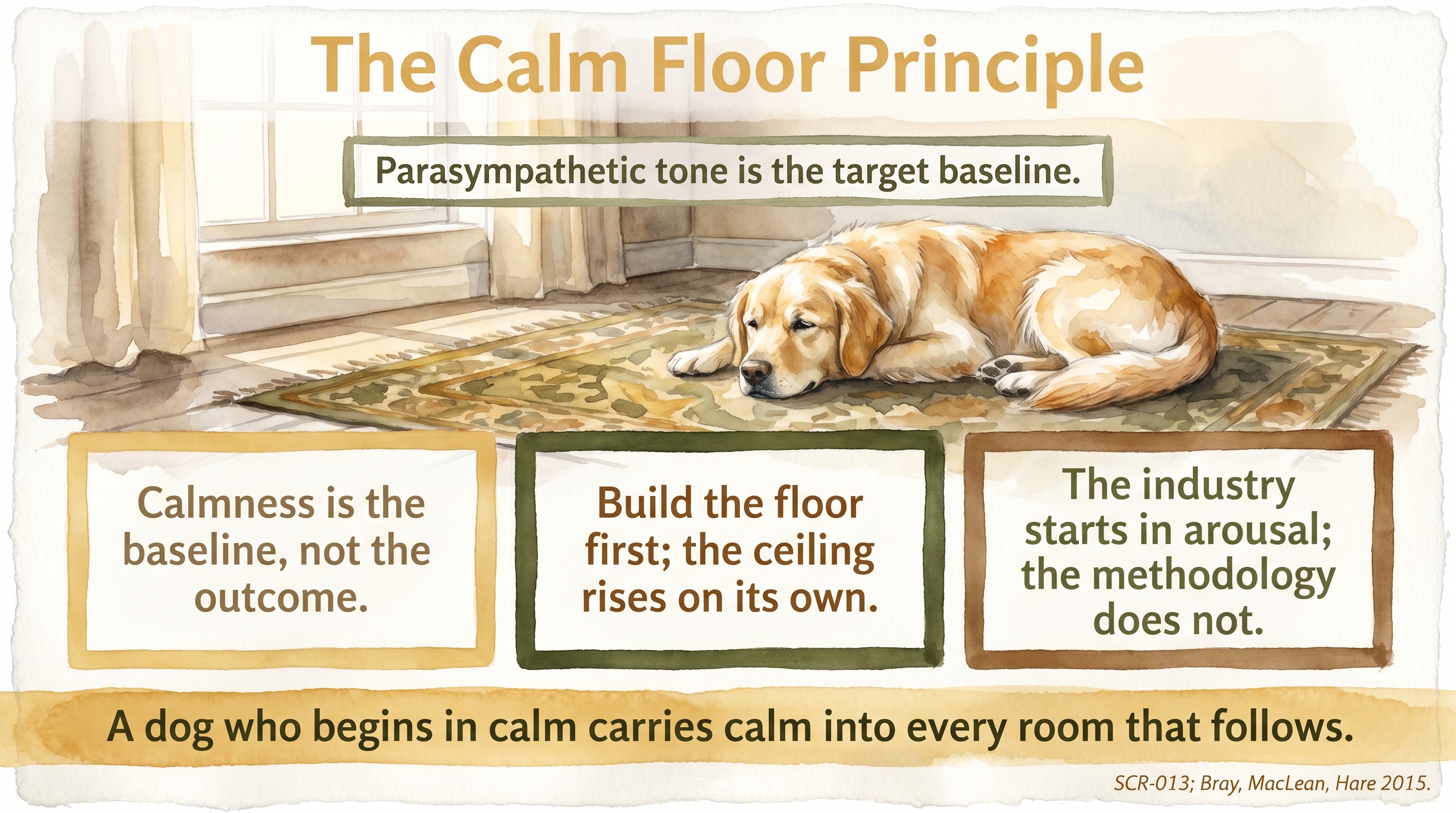
Build the floor first; the ceiling takes care of itself.
Key Takeaways
- The calm floor is the parasympathetic baseline a dog operates from between events: not sedation, but an attentive, socially available state in which the nervous system is not burning fuel on anticipatory arousal.
- The window of tolerance expands from a calm floor; it does not develop in dogs whose baseline is already at the top of the arousal curve.
- Bray, MacLean, and Hare (2015) showed that arousal helps calm dogs and impairs already-excitable dogs, which is why the order of construction matters: build the floor first, let the ceiling rise.
- For JB families, this means the first month is quieter than expected, with less rough play, fewer visitors, and more structured companionship; the breed's cardiovascular predisposition cooperates with this approach when the household does not fight it.
The Evidence
This entry uses mixed-evidence claim-level tags beyond the dedicated EvidenceBlocks below. These tags mark claims that combine documented findings with observed practice, heuristic application, or unresolved gaps.
- Wormald, D., Lawrence, A. J., Carter, G., & Fisher, A. D. (2017)domestic dogs
Reduced heart rate variability documented in dogs with anxiety-related behavior problems, supporting HRV as a validated physiological index of autonomic balance and as a marker linking parasympathetic tone to behavioral regulation. - Thayer, J. F. & Lane, R. D. (2000) and follow-on workhumans (cross-species behavioral principle)
Parasympathetic-dominant autonomic states support social engagement, emotion regulation, and learning capacity. The behavioral principle is independently established across multiple frameworks; canine application is documented through HRV-behavior research.
- Bray, E. E., MacLean, E. L., & Hare, B. (2015)domestic dogs (106 assistance dogs, 30 pet dogs)
On an inhibitory-control detour task with arousal manipulated by vocal tone and movement, calm-baseline assistance dogs improved with elevated arousal while higher-baseline pet dogs showed significant cognitive impairment with the same manipulation. The effect is temperament-dependent: arousal helps dogs operating below the optimal Yerkes-Dodson zone and impairs dogs operating above it.
- Chetboul, V. et al. (2025)domestic dogs (multiple breeds, home environment)
Median resting heart rate in Golden Retrievers measured at 57.9 beats per minute, statistically significantly lower than the general canine population median. Lower resting heart rate is a direct physiological indicator of strong parasympathetic tone. The finding is a population-level predisposition, not an individual guarantee.
- Gunter, L. M. et al. (2026)domestic dogs (shelter and foster contexts)
Dogs placed in 7-day quiet foster environments showed cortisol reductions roughly twice as large as those placed in 2-night stays, with wearable sensors confirming more time in restful behavioral states. The shelter context generalizes to the principle that environmental stability and quiet reliably support parasympathetic recovery. - van der Laan, J. E. et al. (2022)domestic dogs
Hair cortisol changes across shelter and adoption transitions documented stable home environments as physiologically supportive of stress recovery over a multi-week timescale.
- JB Methodology synthesisfamily-raised Golden Retrievers
The argument that families should organize the first weeks of a puppy's home life around deliberate parasympathetic anchoring, building the floor before allowing the window of tolerance to expand, is JB's synthesis of canine autonomic science, the Yerkes-Dodson asymmetry, breed cardiovascular data, and quiet-environment cortisol research. The mechanisms are documented; the household-scale prescription is the program's interpretation of what the mechanism implies.
No published study directly compares a JB-style calm-first first month against a conventional high-energy first month in breeder-to-family Golden Retriever placements.
The dose-response curve for environmental quiet during the puppy transition window has not been quantified outside shelter and foster contexts.
The interaction between owner autonomic state and puppy parasympathetic baseline development in the first thirty days is biologically plausible but directly untested.
SCR References
Sources
Bray, E. E., MacLean, E. L., & Hare, B. (2015). Increasing arousal enhances inhibitory control in calm but not excitable dogs. Animal Cognition, 18(6), 1317-1329.
Chetboul, V., Foulex, P., Gouni, V., Trehiou-Sechi, E., Pouchelon, J. L., & Lefebvre, H. P. (2025). Resting heart rate reference values across breeds in dogs measured in the home environment. Journal of Veterinary Internal Medicine (advance publication).
Gunter, L. M., Feuerbacher, E. N., Gilchrist, R. J., & Wynne, C. D. L. (2026). Cortisol and behavioral adaptation in foster versus shelter contexts in domestic dogs. PeerJ, 14, e16842.
van der Laan, J. E., Vinke, C. M., van der Borg, J. A. M., & Arndt, S. S. (2022). Hair cortisol concentration as a measure of chronic stress in domestic dogs across shelter and adoption transitions. Scientific Reports, 12, 18445.
Wormald, D., Lawrence, A. J., Carter, G., & Fisher, A. D. (2017). Reduced heart rate variability in pet dogs affected by anxiety-related behav