The Human Is the Primary Variable
Compound evidence detail1 SCR / 3 parts
- Documentedthe Baumrind authoritative-parenting literature in human child development
- Documentedthe canine correlational evidence linking dog-directed caregiving styles to attachment, attention, sociability, and problem-solving outcomes (van Herwijnen 2018/2020, Brubaker and Udell 2023)
- Heuristicthe JB inference that one specific caregiving style experimentally produces the best long-term developmental outcomes in dogs
In JB, The Human Is the Primary Variable is the operating principle that treats the household human as the working primary lever the family adjusts, with the dog's behavior and physiological state interpreted as substantially downstream of the family's state, consistency, and habits. Heuristic It is the principle that distinguishes a dog-raising methodology from a dog-training one. A training approach centers the dog as the subject to be modified. JB centers the human as the variable the family works on, in the working understanding that household consistency and calm tend to account for more of the dog's day-to-day behavior than equivalent effort spent on the dog directly. The ranking that gives the principle its name is JB's synthesis, not a settled empirical comparison; the next section unpacks what is documented and what is interpretive.
For Families
The most important variable in how a dog turns out is not the dog's breed, the dog's trainer, or the dog's litter. It is the household the dog lives in. Specifically, it is how regulated the people in the household are.
Dogs are mammals with extraordinary sensitivity to human emotional state. They read tone, body posture, breathing rhythm, and household tension better than humans read each other. A calm household produces a calm dog more reliably than any training protocol can. A dysregulated household produces a dysregulated dog regardless of breed quality, training method, or owner intention.
This is not a comfortable observation. It puts the responsibility on the family rather than the dog. But it is also the most actionable thing the framework offers. Working on your own regulation, your own household tone, and your own consistency is the highest-leverage intervention available.
What It Means
The behavioral evidence that human factors significantly influence canine outcomes is robust. Documented The interpretive ranking, that the human is the primary modifiable variable, is JB's synthesis of that evidence rather than a single settled empirical finding (Owner Variables Are Highly Important but Not Yet Proven the Primary Predictor, SCR-486). Heuristic The entry has to be read at both levels at once. The component findings are documented. The ranking that turns them into an operating principle is interpretive, well-supported but not directly proven by a head-to-head comparison ranking owner state against breed, genetics, diagnosis, or formal training method.
What the documented evidence does establish, with unusual density for canine science, is that owner-to-dog transmission operates through at least four measurable physiological channels.
The first channel is long-term cortisol coupling. Sundman and colleagues (2019) measured hair cortisol concentration, a marker of integrated stress exposure over weeks and months, in 58 dog-owner pairs across two seasonal time points. Human hair cortisol significantly predicted dog hair cortisol at both time points. Documented Activity collars confirmed that shared physical activity and training frequency did not explain the synchronization. What did predict it was the human's personality, particularly Neuroticism, Conscientiousness, and Openness on the Big Five inventory. Dog personality did not significantly affect owner cortisol. The coupling was asymmetric: it flows predominantly from human to dog (SCR-105). Documented Höglin and colleagues (2021) documented the breed boundary on this finding: the synchronization appears in breeds selected for close human cooperation and not in ancient or solitary hunting breeds. Golden Retrievers fall squarely inside the synchronizing population. The temporal scale of this finding is what makes it remarkable. Hair cortisol is not a momentary effect of an anxious human walking into the room. It is the human's baseline physiological state writing itself into the dog's physiology over a multi-month integration window.
The second channel is autonomic co-modulation. Koskela and colleagues (2024) measured heart rate variability in dog-owner pairs during free-behaving baseline periods. Dog and owner HRV correlated within true dyads but not when dogs were paired with random unfamiliar humans. Documented The coupling is dyad-specific and relationship-dependent (SCR-106), not a generic response to any human in the room. The science does not yet have a complete causal account of the mechanism, but the pattern is consistent with a household in which the family's autonomic state is not simply observed by the dog but, over time, becomes part of the dog's autonomic baseline.
The third channel is olfactory. Wilson and colleagues (2022) demonstrated that dogs can discriminate human breath and sweat samples taken under baseline versus psychological stress conditions, well above chance under controlled experimental conditions. Documented Parr-Cortes and colleagues (2024) extended that detection finding into functional consequence: exposure to stress odor from an unfamiliar person shifted dogs' cognitive flexibility and learning performance on a cognitive bias task (SCR-058). Documented Both studies used unfamiliar persons; the chronic effect of familiar-owner stress odor inside a household is biologically plausible but directly untested. The mechanism is documented; the household magnitude is inference. The entry holds that line.
The fourth channel is the affiliative neurochemistry of contact. Nagasawa and colleagues (2015) described an oxytocin-gaze positive loop in which dog gaze triggers owner oxytocin, which produces affiliative calm behavior in the owner, which triggers dog oxytocin, which increases dog gazing (SCR-042). Documented The loop was domestication-specific in their sample: an identical paradigm conducted with hand-raised, extensively socialized wolves did not activate the cascade, though the sample size was statistically modest. Critically, the loop is maintained by calm, quiet, slow-stroking interaction styles and is suppressed by activating touch and rapid commanding interaction. Handlin and colleagues (2011, 2012) documented that activating touch (scratching, patting) drove cortisol rather than oxytocin at the 15-minute mark (SCR-044). Documented The same hand on the same dog produces different endocrine outcomes depending on the style of contact. The human is not just a presence in the room; the human is the variable controlling which physiological cascade is running.
These four channels do not prove that the human is the single ranking determinant of canine behavior. They establish that the human is a documented, measurable, multi-channel upstream variable, operating on temporal scales from minutes (touch and odor) to weeks and months (hair cortisol). Mixed Evidence The JB synthesis takes that documented multi-channel transmission and treats the human, in practice, as the most consequential modifiable lever the family has access to. Breed is fixed. Early developmental history is fixed once the puppy arrives. Veterinary diagnoses are largely fixed. The human's consistency, calm, response style, and habits are the part of the system the family can actually adjust.
The dog-directed caregiving-style literature converges on the same direction. Dog-directed caregiving styles are now operationalized and associated with measurable differences in canine attachment, attention, sociability, and problem-solving (van Herwijnen et al. 2018, 2020; Brubaker and Udell 2023; Bouma et al. 2024) (SCR-019). Documented Authoritative caregiving, the combination of warmth and structure, is associated with the most securely attached and most persistent dogs in problem-solving tasks. Authoritarian or permissive caregiving is associated with weaker attachment and lower persistence. The boundary the JB-aligned literature holds carefully is that these are association findings, not interventional ones. No published trial has shown that therapeutically converting an authoritarian owner into an authoritative one experimentally produces a more securely attached dog. The directional evidence is strong; the causal demonstration in dogs is not yet complete.
Dodman, Brown, and Serpell (2018) added population-scale weight to the picture in a study of 1,564 owner-dog pairs. Lower owner agreeableness, conscientiousness, extraversion, and emotional stability predicted higher canine behavior problem scores across multiple domains (SCR-485). Documented Critically, training method accounted for only a small portion of the link between owner personality and dog behavior outcomes. The influence operated primarily through thousands of unstructured micro-interactions across daily life, not through formal training sessions. This is consistent with the JB synthesis at the principle level: most of what the dog absorbs from the household happens between the training moments, not during them.
Why It Matters for Your Dog
The implication for a JB family is direct and somewhat counterintuitive. Improving the dog's behavior is not primarily a project the family does to the dog. It is, to a meaningful and measurable extent, a project the family does on themselves. The dog's consistency, calm, and behavioral regulation are coupled to the family's consistency, calm, and behavioral regulation. The four documented transmission channels mean the family's state is not invisible to the dog; it is integrated by the dog over multiple physiological pathways and multiple time scales.
What this looks like operationally is unglamorous. The first thirty seconds after walking through the front door do more to shape the dog's arousal baseline than a training session does. The voice the family uses with each other in the kitchen contributes to the household autonomic environment the dog is integrating. The style of touch the family offers, calm and slow versus activating and brisk, determines which endocrine cascade runs. The consistency with which the family responds to the same situation today as they did yesterday is what allows the dog's nervous system to settle into prediction rather than vigilance.
Lally and colleagues (2010) established in human habit-formation research that median time to behavioral automaticity is roughly 66 days, with substantial variation, and that a single missed day does not meaningfully derail the trajectory. Mixed Evidence The application of human habit-formation timing to dog-owner behavioral change contexts is interpretive, not directly tested. The principle the JB family takes from it is that the household does not need to be perfect. It needs to trend toward consistency. The methodology is not an optimization exercise. It is a direction of travel.
The Human Is the Primary Variable is the operating principle that explains why all five Pillars are addressed to the family rather than to the dog. Calmness is built by the household. Structured Leadership is offered by the household. Mentorship is modeled by the household. Prevention is enacted by the household. Indirect Correction is delivered by the household. The dog absorbs the methodology by living inside it; the family produces the methodology by being it.
For Golden Retrievers specifically, this principle is leveraged by breed history. Golden Retrievers were selected for close cooperative work with humans, which is the exact phenotype Höglin and colleagues identified as the synchronizing population. Documented The breed's biology is unusually responsive to the human's state. That responsiveness is a gift and a tax. It is a gift in that a calm, consistent family has a dog whose physiology is meeting them halfway. It is a tax in that an inconsistent or chronically activated family has a dog whose physiology is also meeting them halfway, in the wrong direction. The breed amplifies whatever the household is broadcasting.
This is also why JB does not promise that buying a JB puppy delivers a calm dog independent of the family the puppy goes to. Mixed Evidence The puppy arrives biologically prepared, developmentally well-organized, and behaviorally ready to settle. The family is the variable that determines what happens next. The methodology is built around this fact, not in spite of it. JB's job is to deliver a puppy whose nervous system has been organized for cooperation. The family's job is to be the upstream variable the puppy was prepared to be coupled to.
The corollary inside the household is one of allocation. Most family efforts to improve a dog's behavior reach for techniques, classes, tools, or new equipment. The principle suggests that, for most families with a JB puppy, the highest-leverage move is upstream of the dog: a quieter household, a more consistent response to familiar situations, a more deliberate first thirty seconds at the front door, a slower style of touch, a less reactive voice. Those changes are unglamorous and they do not photograph well. They produce more of the dog the family wanted than the next training class does.
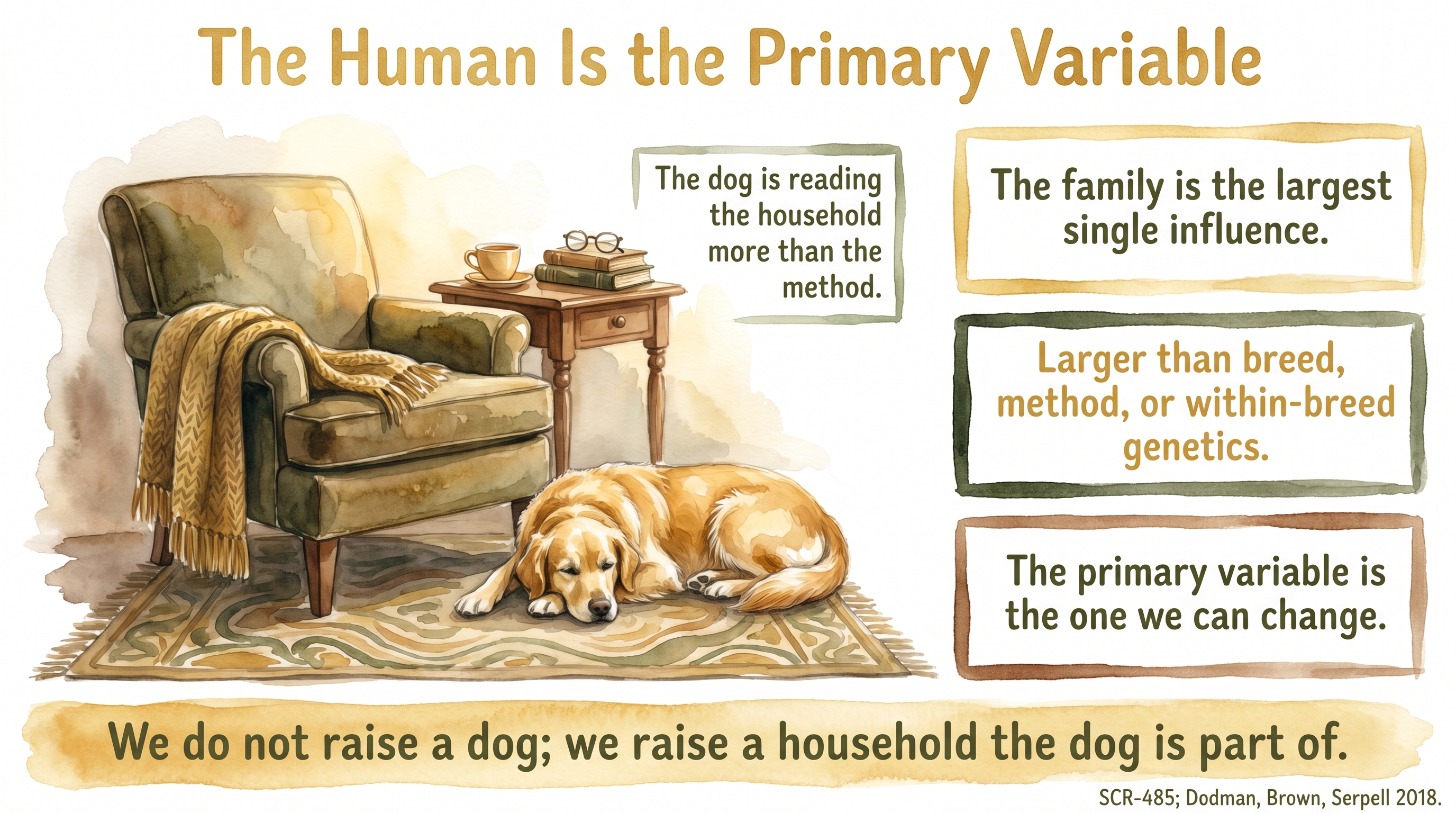
Before adjusting the dog, read the room around the dog.
Key Takeaways
- The dog's behavior and physiological state are coupled to the family's state through at least four documented channels: long-term cortisol synchronization, dyad-specific HRV co-modulation, stress odor detection with cognitive consequences, and the affiliative neurochemistry of touch and gaze.
- The cortisol coupling flows predominantly human-to-dog rather than the reverse, and the synchronization is breed-dependent in ways that put Golden Retrievers squarely inside the synchronizing population.
- The component findings are documented; the JB ranking that the human is the primary modifiable variable is interpretive, well-supported by the multi-channel transmission evidence but not directly proven against a head-to-head comparison with breed, genetics, or formal method.
- Operationally, this means the highest-leverage moves a family can make are upstream of the dog: quieter household autonomic environment, consistent response patterns, calm slow-stroking touch, and a deliberate first thirty seconds at the front door.
The Evidence
This entry uses mixed-evidence claim-level tags beyond the dedicated EvidenceBlocks below. These tags mark claims that combine documented findings with observed practice, heuristic application, or unresolved gaps.
- Sundman, A.-S. et al. (2019)domestic dogs (Shetland sheepdogs and border collies, N=58 dog-owner dyads)
Hair cortisol concentration measured at two seasonal time points showed significant human-to-dog synchronization. Owner Big Five personality (Neuroticism, Conscientiousness, Openness) predicted dog cortisol; dog personality did not predict owner cortisol. Shared physical activity and training frequency did not explain the synchronization. The coupling operates on a weeks-to-months integration window. - Höglin, A. et al. (2021)domestic dogs (ancient breeds and solitary hunting dogs, N=42)
No long-term cortisol synchronization detected in ancient breeds or solitary hunting breeds, suggesting the synchronization is specific to breeds selected for close human cooperation. Golden Retrievers fall within the synchronizing population.
- Koskela, A. et al. (2024)domestic dogs and human owners
HRV measured in dog-owner pairs during free-behaving baseline showed dyad-specific co-modulation. When dogs were paired with random unfamiliar humans, the correlation disappeared. Analytic controls ruled out shared-task pseudocorrelation. The coupling is relationship-dependent.
- Wilson, C. et al. (2022)domestic dogs
Dogs discriminated breath and sweat samples from stressed versus non-stressed humans well above chance under controlled experimental conditions, establishing olfactory detection of human stress as a documented canine sensory capacity. - Parr-Cortes, Z. et al. (2024)domestic dogs
Exposure to stress odor from an unfamiliar person shifted dogs' performance on a cognitive bias task, demonstrating functional consequence of stress odor detection. The studies use unfamiliar persons; the chronic effect of familiar-owner stress odor in household contexts is biologically plausible but directly untested.
- Nagasawa, M. et al. (2015)domestic dogs and human owners (with hand-raised wolf comparison)
Mutual gaze between dog and owner activated a positive feedback loop in which dog gaze triggered owner oxytocin, which produced affiliative calm behavior, which triggered dog oxytocin and further gazing. The cascade was domestication-specific in their sample: an identical paradigm with hand-raised wolves did not activate the loop, though the wolf sample was statistically modest. The loop is maintained by calm, quiet interaction styles and suppressed by activating, commanding interaction. - Handlin, L. et al. (2011, 2012)domestic dogs
Slow stroking is associated with calming endocrine effects, while activating touch (scratching, patting) is associated with cortisol elevation at the 15-minute mark. The same human hand produces different physiological outcomes depending on the style of contact.
- Dodman, N. H., Brown, D. C., & Serpell, J. A. (2018)domestic dogs (N=1,564 owner-dog pairs)
Lower owner agreeableness, conscientiousness, extraversion, and emotional stability predicted higher canine behavior problem scores across multiple behavioral domains. Training method accounted for only a small portion of the link between owner personality and dog behavior. The influence operated primarily through unstructured daily micro-interactions, not formal training sessions. - Brubaker, L. & Udell, M. A. R. (2023); van Herwijnen, I. J. H. et al. (2018, 2020); Bouma, E. M. C. et al. (2024)domestic dogs
Dog-directed caregiving styles operationalized using Baumrind-derived parenting typology. Authoritative-style caregiving (high warmth + high structure) was associated with the most securely attached and most persistent dogs in problem-solving tasks. The findings are association-based; no interventional study has yet demonstrated that converting caregiving style experimentally produces the predicted outcome change in dogs.
- JB Methodology synthesisfamily-raised Golden Retrievers
The argument that families should treat the household human as the primary modifiable lever is JB's synthesis of multi-channel human-to-dog transmission evidence, dog-directed caregiving-style associations, and population-scale owner-personality findings. The component evidence is documented across cortisol, HRV, olfaction, oxytocin, and behavioral outcome research. The ranking of human as primary above breed, genetics, diagnosis, and method has not been directly tested in a head-to-head comparative model and is best understood as a well-supported operating principle rather than a settled empirical claim (per SCR-486).
No published study has directly ranked the magnitude of owner-state effects against breed, early developmental history, veterinary diagnosis, and formal training method in a single comparative model.
The chronic effect of familiar-owner stress odor inside a household has not been directly measured; the existing odor literature uses unfamiliar persons under controlled conditions.
No interventional trial has demonstrated that experimentally shifting an owner's caregiving style or autonomic baseline produces the predicted change in the dog's behavioral or physiological profile.
The onset timeline for the oxytocin-gaze loop in newly formed puppy-owner dyads is not directly mapped; the loop literature is adult-dog-heavy.
SCR References
Sources
Bouma, E. M. C., Reijgwart, M. L., Rodenburg, T. B., & Vinke, C. M. (2024). Pet parenting style and its relation to dog behavior and the human-dog relationship. Animals, 14(3), 421.
Brubaker, L., & Udell, M. A. R. (2023). Does pet parenting style predict the social and problem-solving behavior of pet dogs? Animal Cognition, 26(1), 345-356.
Dodman, N. H., Brown, D. C., & Serpell, J. A. (2018). Associations between owner personality and psychological status and the prevalence of canine behavior problems. PLOS ONE, 13(2), e0192846.
Handlin, L., Hydbring-Sandberg, E., Nilsson, A., Ejdebäck, M., Jansson, A., & Uvnäs-Moberg, K. (2011). Short-term interaction between dogs and their owners: Effects on oxytocin, cortisol, insulin and heart rate. Anthrozoös, 24(3), 301-315.
Handlin, L., Nilsson, A., Ejdebäck, M., Hydbring-Sandberg, E., & Uvnäs-Moberg, K. (2012). Associations between the psychological characteristics of the human-dog relationship and oxytocin and cortisol levels. Anthrozoös, 25(2), 215-228.
Höglin, A., Van Poucke, E., Katajamaa, R., Jensen, P., Theodorsson, E., & Roth, L. S. V. (2021). Long-term stress in dogs is related to the human-dog relationship and personality traits. Scientific Reports, 11, 8612.
Koskela, A., Kareinen, I., Schouten, M., Ekerot, M., Kortelainen, J., & Vainio, O. (2024). Heart rate variability synchrony between dogs and their owners. Scientific Reports, 14, 24518.
Lally, P., van Jaarsveld, C. H. M., Potts, H. W. W., & Wardle, J. (2010). How are habits formed: Modelling habit formation in the real world. European Journal of Social Psychology, 40(6), 998-1009.
Nagasawa, M., Mitsui, S., En, S., Ohtani, N., Ohta, M., Sakuma, Y., Onaka, T., Mogi, K., & Kikusui, T. (2015). Oxytocin-gaze positive loop and the coevolution of human-dog bonds. Science, 348(6232), 333-336.
Parr-Cortes, Z., Müller, C. T., Talas, L., Mendl, M., Guest, C., & Rooney, N. J. (2024). The odour of an unfamiliar stressed or relaxed person affects dogs' responses on a cognitive bias task. Scientific Reports, 14, 15843.
Sundman, A.-S., Van Poucke, E., Holm, A.-C. S., Faresjö, Å., Theodorsson, E., Jensen, P., & Roth, L. S. V. (2019). Long-term stress levels are synchronized in dogs and their owners. Scientific Reports, 9, 7391.
van Herwijnen, I. J. H., van der Borg, J. A. M., Naguib, M., & Beerda, B. (2018). The existence of parenting styles in the owner-dog relationship. PLOS ONE, 13(2), e0193471.
van Herwijnen, I. J. H., van der Borg, J. A. M., Naguib, M., & Beerda, B. (2020). Dog ownership satisfaction determinants in the owner-dog relationship and the dog's behaviour. PLOS ONE, 15(9), e0238858.
Wilson, C., Campbell, K., Petzel, Z., & Reeve, C. (2022). Dogs can discriminate between human baseline and psychological stress condition odours. PLOS ONE, 17(9), e0274143. https://doi.org/10.1371/journal.pone.0274143