Guests, Visitors, and Novel Situations
Compound evidence detail2 SCRs / 5 parts
- Documentedthe Baumrind authoritative-parenting literature in human child development
- Documentedthe canine correlational evidence linking dog-directed caregiving styles to attachment, attention, sociability, and problem-solving outcomes (van Herwijnen 2018/2020, Brubaker and Udell 2023)
- Heuristicthe JB inference that one specific caregiving style experimentally produces the best long-term developmental outcomes in dogs
- Documenteddog attachment studies showing that classification systems can produce reliable groupings while still exposing distribution and method-design friction
- Heuristicclaims that canine attachment categories are a closed Ainsworth-equivalent taxonomy rather than an informative but still unsettled framework
In the JB methodology, novelty is an environmental variable the family modulates on the dog's behalf. It is not a behavioral demand to be offloaded to the dog through expanded exposure hours. Heuristic The guest who enters the home, the novel environment the family takes the dog into, and the unexpected event during a walk are all novelties the family can absorb at the household level, or can hand off to the dog to process without structural support. The methodology's position is that the family's handling of novelty is the primary variable in how the dog experiences it. The dog's apparent "sociability" or "reactivity" is in the first instance an expression of the novelty grammar the family has built around the dog, not an intrinsic property of the dog. The canine socialization literature is large, but the specific claim that exposure quality matters substantially more than exposure quantity is well-supported by findings on caregiver-modulated overimitation (SCR-010), authoritative caregiving and attachment (SCR-019), and the handler-state coupling channels (SCR-058, SCR-105, SCR-106, SCR-107). The family's state when novelty arrives is chemically, physiologically, and behaviorally available to the dog.
For Families
The way a household handles novelty teaches the dog whether novelty is interesting or alarming. Families who treat every visitor as a high-arousal event raise dogs who treat every visitor as a high-arousal event. Families who treat novelty as a normal part of the household rhythm raise dogs who handle novelty calmly.
The Just Behaving pattern is to absorb visitors into the existing household tone rather than letting visitors set a new one. Guests enter calmly. The dog is greeted by visitors only after the dog has settled. The visit proceeds at the household's normal tempo, not at the elevated tempo a guest's energy might suggest.
This applies to novel situations more broadly. New environments, new sounds, new people, new dogs - the dog reads the household for whether to be alarmed. A household that stays calm in novel situations builds a dog who stays calm in novel situations.
What It Means
The operating position is a reframe of the socialization question. In the broader dog-raising culture, socialization is often described as exposure: take the puppy to new places, let the puppy meet new people, count the meetings, check the boxes. The methodology holds that exposure count is substantially less important than exposure quality, and that exposure quality is substantially a function of how the family handles the novelty at the moment it occurs. Heuristic The claim is well-supported by convergent canine findings (caregiver-mediated social learning; handler-state transmission; authoritative caregiving and attachment) but has not been tested as a direct controlled comparison of count-based versus quality-based socialization protocols.
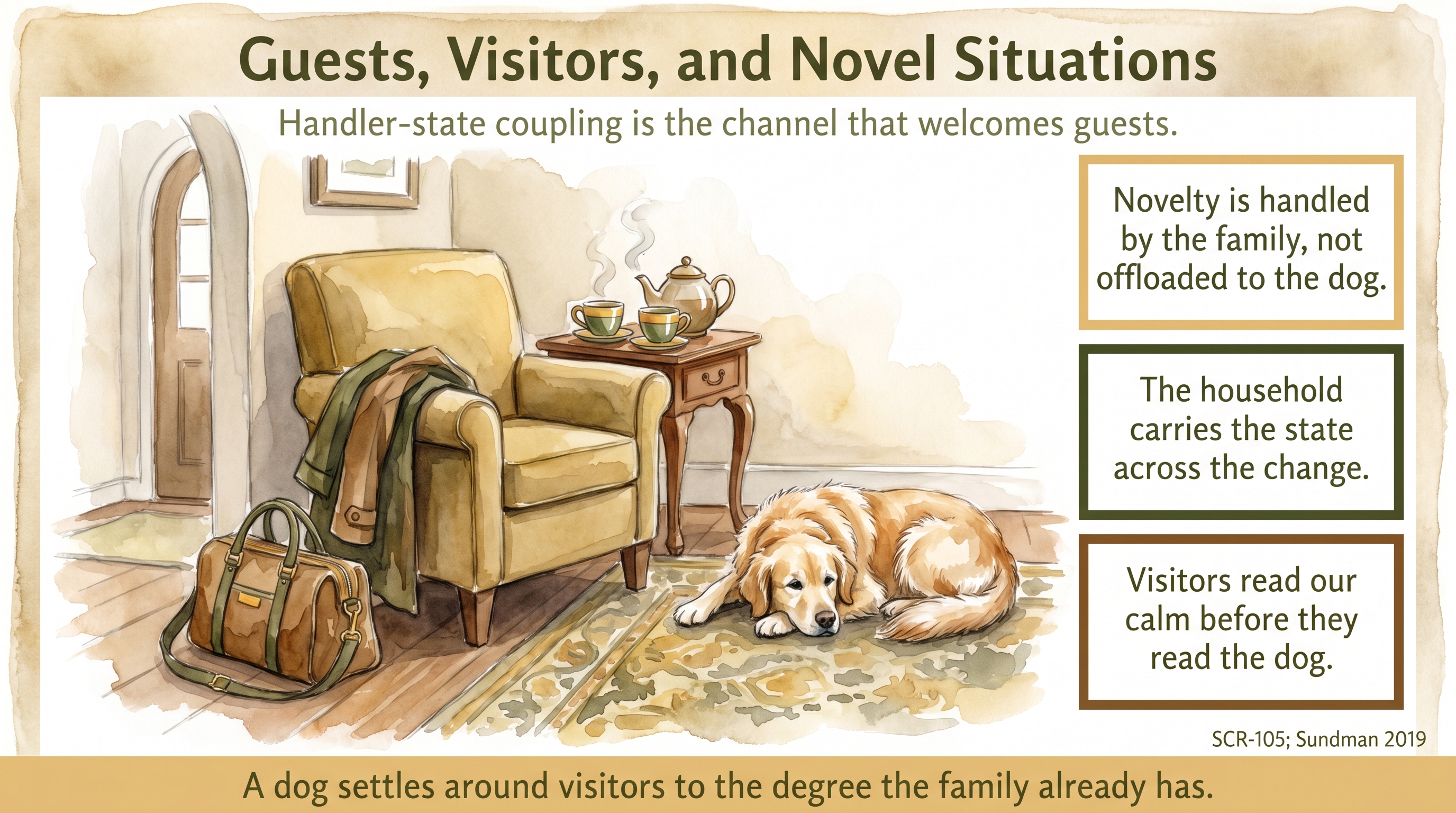
The family-as-absorber frame. When a guest arrives in the household, there is an environmental shift. The handler can absorb the shift (greet the guest at the door, invite them in, transition to ambient household activity; allow the dog to observe and process without being the center of the interaction), or the handler can offload the shift (direct the guest's attention to the dog, require the dog to perform greetings, make the dog's reaction to the guest the conversational focus of the first minutes). The absorbed version of the event is one in which the dog experiences novelty as manageable because the family has demonstrated how to handle it. The offloaded version is one in which the dog experiences novelty as a behavioral demand because the family has made it one. The overimitation literature (Huber et al. 2018, 2020, 2022; SCR-010) supports that the family's demonstrated behavior is what the dog preferentially absorbs. Documented
The handler-state channels apply immediately. The guest's arrival is a handler-state shift (see the Thresholds, Doorbell, and Visitor Arrivals entry). The shift transmits through the HRV coupling channel (Koskela 2024; SCR-106), the cortisol channel (Sundman 2019; SCR-105), and the olfactory chemosignal channel (Wilson 2022; SCR-058; Parr-Cortes 2024; SCR-107). Documented The dog is receiving information about how to appraise the guest from the handler's autonomic state before any interaction with the guest has occurred. The family that arrives at guest events in a regulated state transmits regulation; the family that arrives in a dysregulated state transmits dysregulation. The dog's response to guests is partially the output of the transmission channels that opened the moment the guest arrived.
The novelty budget. Novelty has a cumulative physiological cost, and the methodology's preference is to budget it. A puppy that has been in the car for an hour, at a new location for two hours, with new people for the duration, and is then brought home to a family dinner with additional guests is experiencing a novelty load that exceeds the dog's regulatory capacity. The dog's response (overstimulation, difficulty settling, sleep disruption) is the cumulative output of the day, not a failure of a specific moment. Families that budget novelty, pacing exposure to fit the dog's current regulatory capacity and allowing recovery between novel events, report different behavioral outcomes than families that treat exposure quantity as the primary socialization variable. Observed-JB The specific numerical claim (how much novelty a specific dog can absorb on a specific day) is not a published finding; the general pattern is a methodology observation consistent with the broader developmental and arousal-recovery literatures.
Socialization as exposure-quality, not exposure-count. The classic canine socialization literature emphasizes the sensitive period between approximately three and twelve weeks of age, during which exposure to human and canine social stimuli has outsized effects on the adult dog's social responses. The period is real; the methodology accepts it. Documented The methodology's operational refinement is that exposure within the sensitive period is not equally valuable regardless of quality. Exposure that occurs in a regulated state, with a present and attentive caregiver, in which the puppy can approach or retreat at its own pace and the family absorbs most of the environmental load, produces different adult outcomes than exposure in which the puppy is placed in a stressed state and left to self-regulate. The specific comparison (count-maximizing versus quality-controlled socialization) has not been tested as a head-to-head intervention, but the quality-controlled version is consistent with documented attachment, overimitation, and handler-state findings.
A boundary on attachment classification. The canine attachment literature adapts Ainsworth's strange-situation framework to dogs (Solomon et al. 2019; Brubaker and Udell 2023). Canine attachment classifications capture meaningful variance and have produced real findings (authoritative caregiving associated with secure attachment; SCR-019), but the classification framework carries a mixed evidence ceiling (SCR-477). Mixed Evidence The methodology uses the attachment framing as a useful interpretive frame rather than as a bright-line diagnostic category, and carries the attachment-based claims at the confidence level the SCR specifies.
Why It Matters for Your Dog
The practical starting position is that the family's handling of a guest event sets the grammar for how the dog handles guest events. The ten-to-sixteen-week puppy who has experienced twenty guest events in which the family absorbed the novelty and allowed the puppy to observe without being the center of interaction has learned, through repetition, that guests are a routine household feature. The ten-to-sixteen-week puppy who has experienced twenty guest events in which the family ritualized the puppy's performance for the guest has learned that guests are behavioral-demand events. The cumulative pattern shapes the adult dog.
The handling of novel environments follows the same logic. A trip to a new location is a novelty the family can absorb (the family is settled, directional, attentive to the dog's orientation) or can hand off (the family arrives, cues the dog into behaviors, runs through a protocol). The absorbed version pairs the novel environment with the regulated family state; the offloaded version pairs it with behavioral demand. The dog's future response to novel environments is the cumulative output of which kind of pairing has been repeated.
The practical grammar of hosting. The methodology's preference is that guests are welcomed into the household as routine additions to the ambient state. The dog is neither hidden nor centered. The guest is guided past the dog in the initial moments, the dog is allowed to orient without being commanded into a specific greeting behavior, and the guest is asked to refrain from direct approach for the first minutes. The family's state during the first minutes is the primary variable the dog is reading. The family that says "welcome, come in, we were just finishing dinner" in the same tone used for any household conversation is producing a different event than the family that says "oh, Goldie is so excited to meet you, Goldie, sit, sit, say hi!" The two events feel similar to the humans; they produce substantially different information for the dog.
Guests, visitors, and novel situations is a Structured Leadership operation. The family's role as structural leader is to absorb the environmental shift on the dog's behalf and to demonstrate, through repetition, how the household handles novelty. Compassionate, firm, calm assertiveness at the doorway, at the novel-environment threshold, and at the guest-greeting moment is the mechanism through which the dog learns that novelty is handleable. The Brubaker \u0026 Udell (2023) authoritative-caregiving finding (SCR-019) is specifically about the combination of warmth and structural clarity; guest events are daily occasions on which both are displayed. The family that is warm with the guest and structurally clear about the household's novelty grammar is, in the documented evidence, producing the attachment profile associated with the best canine outcomes.
The most common novelty-handling failure modes are specific. First, the performance expectation: the puppy is expected to greet every guest with a specific sequence (sit, shake, calm), and the puppy's failure to produce the sequence is treated as a training gap. The demand itself produces the state the family is trying to prevent. Second, the novelty overload: the puppy is taken to many novel environments in rapid succession under the assumption that exposure count is what matters. The puppy's cumulative physiological load exceeds its regulatory capacity, and the sleep disruption, settle failures, and reactivity increases that follow are interpreted as problems rather than as consequences of the load. Third, the guest-as-stimulus handoff: the family invites a guest over specifically to "socialize" the puppy and directs the guest's attention at the puppy for the duration of the visit. The puppy is receiving concentrated novelty with no family-absorbed buffer. Fourth, the social-hierarchy invitation: every guest is invited to pet, greet, or engage with the dog regardless of the dog's current state, with the framing that the dog needs to learn to tolerate any approach from any person. The methodology's position is that tolerance is not the right target; the right target is that the dog has not needed to negotiate the approach because the family has managed the pacing.
A note on the limit of the inference. The documented evidence supports caregiver-modulated overimitation (SCR-010), authoritative caregiving and secure attachment (SCR-019 within the mixed SCR-477 attachment-classification ceiling), handler-state coupling across HRV (SCR-106), cortisol (SCR-105), olfactory discrimination (SCR-058), and cognitive-bias effects of stressed-human odor (SCR-107). The convergent claim that novelty handled at the family level produces a categorically different dog than novelty offloaded to the dog is JB's synthesis of those documented channels, well-supported mechanistically rather than directly compared in a count-versus-quality socialization trial. The methodology presents the position with the boundary visible.
The visitor changes; the house does not.
Key Takeaways
- Novelty is a variable the family modulates on the dog's behalf, not a behavioral demand offloaded to the dog. The guest event, the novel environment, and the unexpected walk stimulus are each events the family can absorb at the household level or hand off to the dog to process without structural support.
- Exposure quality matters substantially more than exposure count. The canine socialization sensitive period (approximately three to twelve weeks) is real; within it, exposure that occurs in a regulated state with a present caregiver produces different outcomes than exposure in which the puppy is placed in a stressed state and left to self-regulate. Well-supported mechanistically; not yet tested head-to-head in a count-versus-quality intervention trial.
- Handler state transmits through multiple documented channels (HRV coupling, cortisol synchrony, olfactory chemosignal, cognitive-bias effects of stressed-human odor). The family's state during a novelty event is information the dog receives before any deliberate communication occurs.
- Novelty has a cumulative physiological cost. A budget-conscious approach, pacing exposure to current regulatory capacity and allowing recovery, produces behaviorally different dogs than a count-maximizing approach. The pattern is methodology observation consistent with the developmental and arousal-recovery literatures; specific numerical budgets are not published findings.
The Evidence
- Huber, L. et al. (2018, 2020, 2022); Mackie & Huber (2023)domestic dogs
Dogs preferentially copy demonstrated actions from caregivers; caregiver relationship quality modulates what is copied. Huber, Kubala, & Cimarelli (2022) specifically links overimitation to caregiver relationship quality. The family's handling of guest arrivals, novel environments, and unexpected events is the demonstration the dog absorbs over repetition.
- Brubaker, L. & Udell, M. A. R. (2023), Animal Cognitiondomestic dogs (N=48 dog-owner dyads)
Authoritative dog-directed caregiving (high warmth combined with clear structural expectations) associated with the most secure attachment and best problem-solving persistence. The guest event is a moment at which both warmth (presence, hospitality) and structure (threshold choreography, novelty pacing) are displayed simultaneously. The family's authoritative handling of novelty is one of the repeated daily contexts in which the caregiving-attachment association operates. - van Herwijnen, I. R. et al. (2018, N=518; 2020); Bouma, E. M. C. et al. (2024); Dale, R. et al. (2024)domestic dogs (multiple cohorts)
Convergent cohort findings on dog-directed parenting styles and their behavioral correlates. The family's general structural stance toward the environment (including novelty handling) is one of the variables captured in the parenting-styles literature.
- Sundman, A.-S. et al. (2019), Scientific Reports; Koskela, A. et al. (2024), Scientific Reportsdomestic dogs and their owners
Long-term cortisol synchrony (Sundman 2019) and dyad-specific HRV coupling (Koskela 2024) establish that dog-human physiological coupling is a documented canine phenomenon. Novelty events are moments of handler-state shift; the shift transmits through the coupling channels. - Wilson, C. et al. (2022), PLOS ONE; Parr-Cortes, Z., Rooney, N. J., & Mills, D. S. (2024), Scientific Reportsdomestic dogs
Dogs discriminate human stress odor (Wilson 2022) and show cognitive-bias impairment from stressed-human chemosignal (Parr-Cortes 2024). The family's state when guests arrive or novel environments are entered is chemically available to the dog independent of deliberate communication.
- Solomon, J. et al. (2019); Brubaker & Udell (2023); Bouma et al. (2024)domestic dogs
Canine attachment classifications adapted from Ainsworth's strange-situation framework capture meaningful variance and produce real findings. Authoritative caregiving is associated with secure attachment in dogs (SCR-019). The underlying classification framework, however, carries a mixed evidence ceiling: the Ainsworth-adapted approach produces usable categories but is not as definitively established in canine populations as in human developmental populations (SCR-477). The methodology uses attachment framing as a useful interpretive frame rather than as a bright-line diagnostic category.
- SCR-047 methodological guardraildomestic dogs
The canine arousal literature does not support a blanket anti-novelty or anti-exposure framing. Exposure within the canine socialization sensitive period is important. The methodology's claim is narrower: exposure quality (regulated handler state, family-absorbed environmental load, pacing that respects cumulative physiological cost) is a substantial variable in the outcome, and count-maximizing socialization protocols that disregard quality produce different outcomes than quality-controlled protocols.
- JB cohort observationfamily-raised Golden Retrievers
JB cohort observation across families raising Golden Retrievers is that novelty-budgeted, family-absorbed novelty handling is associated with adolescent and adult dogs for whom novelty is routine rather than destabilizing. The observation is consistent with the documented caregiver-modulated overimitation, authoritative-caregiving-attachment, and handler-state-transmission findings. The observation is reported at observed confidence; the specific head-to-head intervention trial (count-maximizing versus quality-controlled protocols) has not been published.
- JB Methodology synthesisfamily-raised Golden Retrievers
The convergent claim that novelty handled at the family level (absorbing the environmental shift; demonstrating the handling; pacing the exposure) produces a categorically different dog than novelty offloaded to the dog (performance expectations; count-maximizing exposure; guest-as-stimulus handoff) is JB's synthesis of the documented caregiver-modulated overimitation, authoritative-caregiving-attachment, handler-state-transmission, and developmental-arousal-recovery findings. Each component is documented in dogs. The convergent synthesis has not been tested as a direct comparison.
No controlled canine trial has directly compared count-maximizing versus quality-controlled socialization protocols on adolescent and adult behavioral outcomes.
The specific novelty-budget claim (that cumulative physiological load has a ceiling beyond which exposure produces negative returns) is consistent with the broader arousal-recovery literature but has not been measured in a canine cohort study at the precision families need for operational guidance.
The interaction between handler-state channels and specific exposure contexts (guest arrival, novel environment, unexpected stimulus) has not been systematically partitioned in the published literature; the channels are documented individually but not measured by specific novelty context.
Cross-breed comparisons of novelty-budget sensitivity are not yet available; Golden Retriever-specific novelty-load tolerance thresholds have not been directly studied.
SCR References
Sources
Bouma, E. M. C., Reijgwart, M. L., \u0026 Dijkstra, A. (2024). Dog-directed parenting styles and intergenerational patterns in dog-owner dyads. Animals, 14(3).
Brubaker, L., \u0026 Udell, M. A. R. (2023). The effects of dog-directed parenting style on dog cognition and behavior. Animal Cognition, 26(2), 363-377.
Dale, R. et al. (2024). Risk factors associated with separation-related behaviours and other potentially undesirable behaviours in puppies. Animal Welfare, 33, e22.
Dodman, N. H., Brown, D. C., \u0026 Serpell, J. A. (2018). Associations between owner personality and psychological status and the prevalence of canine behavior problems. PLOS ONE, 13(2), e0192846.
Huber, L., Popovová, N., Riener, S., Salobir, K., \u0026 Cimarelli, G. (2018). Would dogs copy irrelevant actions from their human caregiver? Learning and Behavior, 46(4), 387-397.
Huber, L., Salobir, K., Mundry, R., \u0026 Cimarelli, G. (2020). Selective overimitation in dogs. Learning \u0026 Behavior, 48, 113-123.
Huber, L., Kubala, D., \u0026 Cimarelli, G. (2022). Overimitation in dogs: Is there a link to the quality of the relationship with the caregiver? Animals, 12(3), 326.
Koskela, A., Kareinen, I., Somppi, S., Törnqvist, H., Vainio, O., Kujala, M. V. (2024). Heart rate variability coupling in dog-human dyads. Scientific Reports, 14, 8213.
Mackie, J., \u0026 Huber, L. (2023). Socially priming dogs in an overimitation task. Animal Cognition, 26, 1473-1486.
Parr-Cortes, Z., Rooney, N. J., \u0026 Mills, D. S. (2024). The odour of an unfamiliar stressed or relaxed person affects dogs' responses on a cognitive bias test. Scientific Reports, 14, 15843.
Smith, B. P., Browne, M., Mack, J., Kontou, T. G., \u0026 Tomkins, L. M. (2025). Predictors of behavioral outcomes in 3,044 Golden Retrievers across the first three years of life. Preventive Veterinary Medicine, 234, 106101.
Solomon, J., Beetz, A., Schöberl, I., Gee, N., \u0026 Kotrschal, K. (2019). Attachment security in companion dogs: Adaptation of Ainsworth's strange situation and classification procedures to dogs and their human caregivers. Attachment \u0026 Human Development, 21(4), 389-417.
Sundman, A.-S., Van Poucke, E., Svensson Holm, A.-C., Faresjö, Å., Theodorsson, E., Jensen, P., \u0026 Roth, L. S. V. (2019). Long-term stress levels are synchronized in dogs and their owners. Scientific Reports, 9, 7391.
van Herwijnen, I. R., van der Borg, J. A. M., Naguib, M., \u0026 Beerda, B. (2018). The existence of parenting styles in the owner-dog relationship. PLOS ONE, 13(2), e0193471.
van Herwijnen, I. R., van der Borg, J. A. M., Naguib, M., \u0026 Beerda, B. (2020). Dog ownership satisfaction determinants in the owner-dog relationship and the dog's behaviour. PLOS ONE, 15(8), e0237854.
Wilson, C., Campbell, K., Petzel, Z., \u0026 Reeve, C. (2022).