The Quiet Moments
Compound evidence detail1 SCR / 3 parts
- Documentedthe Baumrind authoritative-parenting literature in human child development
- Documentedthe canine correlational evidence linking dog-directed caregiving styles to attachment, attention, sociability, and problem-solving outcomes (van Herwijnen 2018/2020, Brubaker and Udell 2023)
- Heuristicthe JB inference that one specific caregiving style experimentally produces the best long-term developmental outcomes in dogs
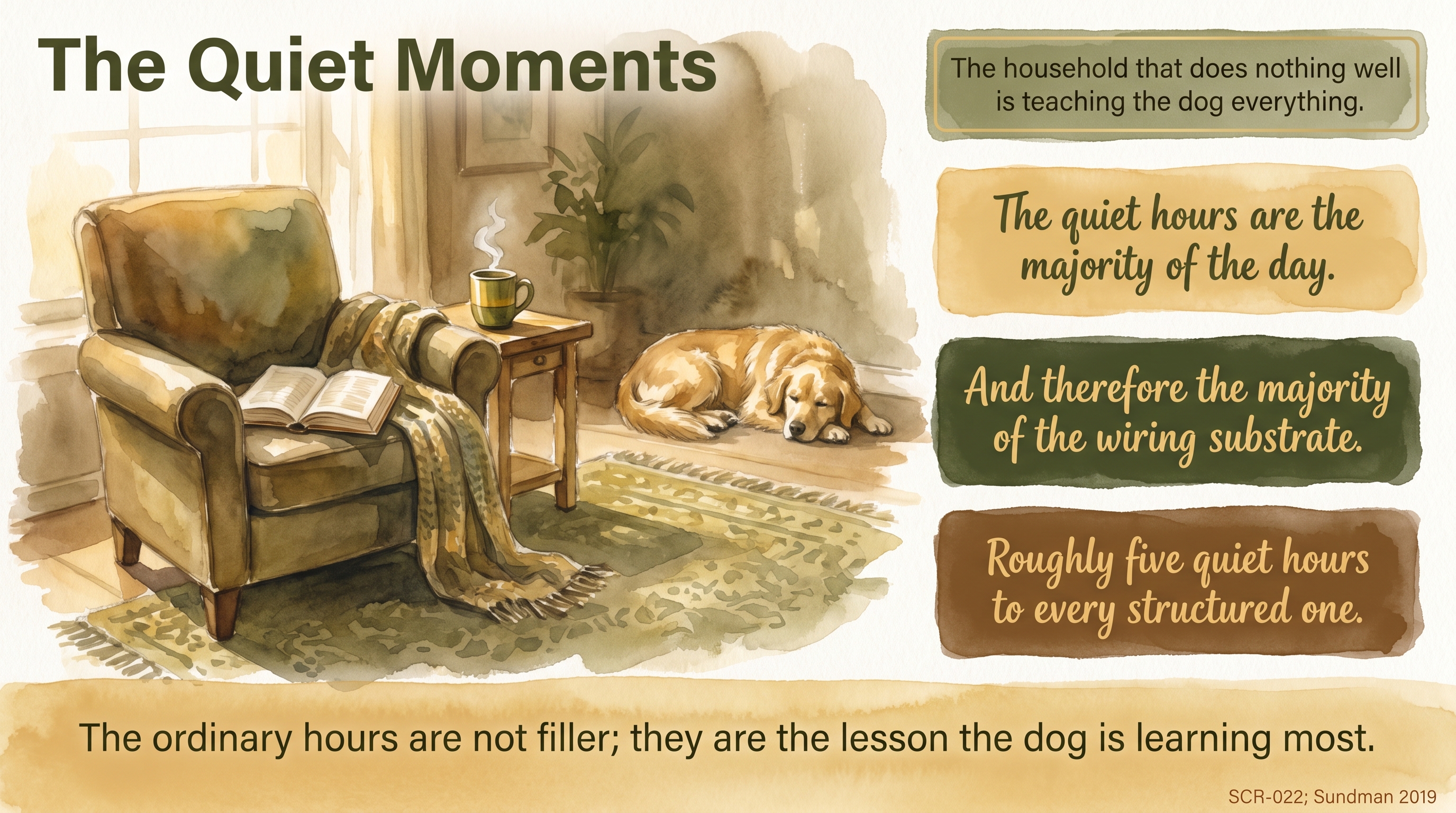
In the JB methodology, the quiet moments are not the filler between the important moments. The quiet moments are the majority of the dog's day and therefore the majority of the wiring substrate the dog's behavior is being built on. Heuristic The walk is roughly thirty minutes. The meal is roughly ten minutes. The training moment, the visitor moment, the play moment, the cue-delivery moment, the grooming moment, each occupies minutes in a twenty-four-hour window. The remaining hours, ten, twelve, fifteen, depending on household, are unstructured. The dog lying at the family's feet while the family reads. The dog resting in the shared room while the household hums. The dog dozing in the middle distance while a person cooks dinner. These hours are where the dog is reading the household's baseline, where the parasympathetic channel is the baseline channel being wired, where the handler-state coupling carrier wave is most clearly the carrier wave. The methodology's operational position is that the household that does nothing well is teaching the dog everything, and the household that fails to do nothing well is teaching something different at the same scale.
For Families
Most of a dog's life is the quiet moments. Not the walks, not the meals, not the play sessions - the long stretches in between, where nothing in particular is happening and the dog is simply present in the household.
Families often miss this because the visible parts of dog ownership are the events. But what the dog actually is, day after day, is the sum of the quiet moments. A dog who rests easily in the household's quiet hours has built a calm foundation. A dog who fidgets, paces, or escalates during quiet hours is telling the household that the calm baseline has not been built yet.
The Just Behaving framework asks families to value the quiet moments rather than feel obligated to fill them. The dog resting on the floor while the family does ordinary things is not a wasted hour. It is the developmental work of becoming a calm adult.
What It Means
The "dog is always learning" premise (cross-referenced to the Dog Is Always Learning operating principle) has a direct numerical consequence when it is applied to the hours of the day. Documented Associative learning is a continuous process; the dog is not learning only during structured training episodes (Reid 1996; Bekoff 2002; Udell and Wynne 2008 on canine social learning architecture). The hours the dog is awake and perceiving are hours the dog is forming associations. The majority of those hours, in any household, are not structured episodes. The ratio is not close. Even in a family that delivers multiple walks, multiple training sessions, multiple play episodes, and multiple cue-delivery moments per day, the structured episodes sum to a small fraction of waking hours. The remaining majority is the quiet-moment category. Whatever associations the dog is forming in the quiet-moment category are being formed at scale.
The parasympathetic-baseline wiring claim is the neuroscience-facing way to state the same finding. The dog whose hours sum to predominantly regulated, calm, shared-space time has a Hebbian substrate (SCR-022; Hebb 1949; Bliss and Lømo 1973; Bi and Poo 1998) in which the parasympathetic-baseline circuit is wired by the cumulative repetitions. The dog whose hours sum to predominantly aroused, stimulated, high-engagement time has a Hebbian substrate in which the sympathetic-activation circuit is wired more often instead. The wiring claim is conserved-mechanism neuroscience; the operational application to the household's daily balance is the methodology's interpretive move. Neurons that fire together wire together, and what fires together over ten quiet hours wires together at a different scale than what fires together over one stimulating hour.
The handler-state coupling channels operate continuously during quiet moments. Documented Sundman et al. (2019)'s long-term hair-cortisol synchrony (SCR-105) and Koskela et al. (2024)'s dog-human HRV coupling (SCR-106) are not effects that switch on only during structured interactions. They are continuous couplings; the dog is reading the handler's chronic baseline and real-time physiology during the quiet hours as much as during the active hours, and possibly more, because the quiet hours are when the handler's arousal channel is itself most clearly reading as a baseline rather than as a response to an event. The dog resting on the floor while the family reads is reading the family's HRV coupling in its least-contaminated form. The dog at the family's feet while the family works is reading the family's cortisol chronic carrier wave across hours of shared stillness. The chronic carrier wave is what the quiet-moment hours deliver most clearly.
The density concept. The methodology's quiet-moment claim is not "the dog should have fewer experiences." The methodology's quiet-moment claim is that the ratio of quiet-regulated hours to arousing-activity hours, across the day and across the week, is the variable the household is operating on. A dog that experiences a one-hour walk, a thirty-minute training session, a twenty-minute play session, and a ten-minute guest arrival in a day has ingested roughly two hours of structured stimulus. That dog, in a household operating inside the methodology, also has roughly ten to twelve waking hours of quiet-regulated time. The ratio is approximately 5:1 quiet to structured, and the Hebbian substrate is being written at that ratio. Heuristic A dog in a household where the family feels the dog needs constant engagement, constant cue-delivery, constant enrichment, constant play, may have its ratio inverted or driven close to parity. The dog in the inverted-ratio household is having a different substrate written; the household is not delivering less care, but the care is being delivered in a form that wires a different circuit.
The quiet-moment failure modes are bidirectional. Observed-JB On one side, the over-engagement failure mode: the family treats every waking dog hour as an opportunity for cue, enrichment, play, or interaction, and the dog never experiences the extended parasympathetic-baseline window the wiring claim requires. On the other side, the isolation failure mode: the family confines the dog to a crate or separate room for the hours the family is not actively engaging the dog, and the dog experiences hours of absence rather than hours of shared stillness. Neither is a quiet moment in the methodology's sense. A quiet moment is the dog in the shared space with the regulated family, not interacting at high frequency, and not being left alone. The shared-space, low-interaction, regulated-channel condition is the one that produces the substrate the methodology operates on.
The Dale sleep correlates bridge into the quiet-moment category. Mixed Evidence Dale et al. (2024)'s finding (SCR-036) that at least nine uninterrupted hours of sleep in a sheltered location before sixteen weeks is correlated with lower rates of separation-related behaviors and fussing is documented. The step from that sleep finding to the broader quiet-moment argument is interpretive: the household that produces the sleep conditions often also appears to produce the waking quiet-moment conditions. Sleep and the waking quiet moments are continuous in the methodology's frame, but the waking-hours extension is the methodology's architectural inference rather than a directly measured Dale outcome.
Why It Matters for Your Dog
The practical starting position is that the household is already running the quiet-moment channel whether the family is conscious of it or not. Heuristic The hours are being spent one way or another; the question the methodology raises is what the household is doing with them. A family that places the puppy's rest space in the shared room where the family reads, works, and cooks is running a quiet-moment channel. A family that places the puppy in a separate room while the family does those things is running an isolation channel. A family that keeps the puppy in motion and engagement during the family's waking hours is running an over-engagement channel. The three channels write three different substrates at the scale of the majority of the dog's life.
The quiet-moment discipline can be observed in specific household arrangements. First, the rest-space location: the dog's primary resting area is in a shared room, not a separate room, so the dog is learning to rest in the presence of household activity rather than in the absence of it. Second, the non-interaction discipline: the family is comfortable having the dog in the room without acknowledging the dog every few minutes; the dog can lie there uninterrupted for thirty, sixty, ninety minutes. Third, the handler-state discipline during quiet moments: the family is not performing calm for the dog, the family is being calm because the family is doing something the family finds calm. The dog reads the performance and reads the real thing differently; the real thing is what the coupling channels are carrying.
The dose-response relationship is roughly linear in the methodology's operational frame. Heuristic A puppy who experiences ten quiet-regulated hours per day across the first sixteen weeks is wiring the parasympathetic-baseline circuit with sixteen weeks of cumulative repetitions at ten hours per day. A puppy who experiences two or three such hours per day is wiring the same circuit at a smaller scale, and is wiring something else at the rest of the hours. The difference at maturity is not a difference of degree inside a narrow range; it is a difference of substrate, and the substrate is what subsequent life experience is layering onto.
The Quiet Moments are the Calmness pillar's lived expression at the scale of the day. The calm floor is not a state the household delivers for a minute and then releases; the calm floor is the baseline state of the household's hours, and the quiet moments are the hours the baseline is most clearly the baseline. The parasympathetic tone (SCR-047, the guardrail version: the claim is about the baseline the household maintains most of the time, not about blanket absence of arousal) is the tone the household is wiring during the quiet-moment hours. When the methodology says "build the calm floor first," the operational consequence is that the household is honoring the hours of quiet in the shared space as the actual floor, not as empty time between the real moments.
The first-veterinary-visit, the first-guest-arrival, the first-car-ride, the first-loud-noise, the first-separation, all layer onto the substrate the quiet-moment hours have been writing. Heuristic A dog with ten weeks of regulated-quiet-hour substrate brings that substrate to the first-veterinary-visit; a dog with two weeks of regulated-quiet-hour substrate and eight weeks of over-engaged-hour substrate brings a different substrate to the same visit. The method is consistent across Daily Grammar entries: the event-day performance is the output of the baseline-day wiring, and the baseline days are mostly quiet moments. Treat the quiet moments as the subject of attention, and the event-day performance follows without event-day intervention.
The signal-economy consequence. The quiet-moment hours are also the hours in which the household's signal economy (SCR-019) is being calibrated. The family that interacts with the dog every time the dog enters a shared room is using interaction-signals at high frequency and therefore at low per-signal value. The family that lets the dog enter the shared room and settle without interaction is preserving the per-signal value of the moments when interaction does happen. The signal economy is a function of the ratio of signal-delivered to signal-not-delivered, and the quiet-moment hours are the larger denominator. The family that does nothing well is also the family whose signals carry the highest value when they are finally delivered.
A note on the limit of the inference. The documented evidence supports continuous associative learning (cross-species and canine-specific), Hebbian circuit-level plasticity at the cumulative-repetition scale (SCR-022), handler-state coupling channels operating continuously across timescales (SCR-105, SCR-106), Dale et al. (2024) sleep correlates in a prospective cohort (SCR-036), and the owner-variable cohort predictor literature (SCR-485, SCR-486). The methodology's specific claim (that the ratio of regulated-quiet hours to structured-stimulating hours across the day is the primary variable the household is operating on, and that roughly 5:1 quiet-to-structured is the working target) is JB synthesis applied to the documented record. The specific ratio has not been operationalized in a published canine cohort study.
The dog is learning the most when you notice it the least.
Key Takeaways
- The quiet moments are the majority of the dog's day and therefore the majority of the wiring substrate. In any household, structured episodes (walks, training, play, events) sum to a small fraction of waking hours; the unstructured hours are the larger denominator, and whatever is being wired there is being wired at scale.
- Hebbian plasticity (SCR-022) applies at the scale of cumulative daily repetitions. A dog whose hours sum to predominantly regulated quiet time is wiring the parasympathetic-baseline circuit; a dog whose hours sum to predominantly aroused engagement is wiring a different circuit. The ratio is the variable, not the absolute presence or absence of any single event.
- Handler-state coupling channels (Sundman 2019; Koskela 2024) operate continuously during the quiet hours, and those hours are when the chronic carrier wave is read most clearly as the carrier wave. The dog at the family's feet during unstructured time is reading the baseline in its least-contaminated form.
- The quiet-moment discipline is bidirectional: not over-engagement (constant cue, enrichment, interaction) and not isolation (hours alone in a crate or separate room). The methodology's quiet moment is the dog in the shared space with the regulated family, not interacting at high frequency and not being left alone.
The Evidence
- Hebb, D. O. (1949); Bliss, T. V. P., & Lømo, T. (1973); Bi, G.-Q., & Poo, M.-M. (1998)foundational neuroscience (rabbit, rat, cultured hippocampal neurons); conserved mechanism across mammals
Cumulative repetition is the wiring currency. Applied at the scale of the day, the circuit being written most is the one whose firing pattern dominates the waking hours. For a dog whose waking hours are predominantly regulated quiet time, the parasympathetic-baseline circuit is the circuit being written most often. For a dog whose waking hours are predominantly aroused or stimulated, a different circuit is being written at the same cumulative scale. The ratio is the operational variable at the methodology's scale of observation.
- Udell, M. A. R., & Wynne, C. D. L. (2008), Journal of the Experimental Analysis of Behavior; Reid, P. J. (1996), Excel-Erated Learningdomestic dogs
Canine associative learning is documented as a continuous process across contexts, not a phenomenon limited to structured training episodes. The dog in the shared room during unstructured family time is forming associations between the family's baseline state, the room's sensory conditions, and the dog's own regulatory state. The hours are the hours; they are wiring something regardless of whether the household considers them training.
- Sundman, A.-S. et al. (2019); Koskela, A. et al. (2024)domestic dogs and their owners
Long-term hair-cortisol synchrony (Sundman 2019) is a months-to-years-scale coupling that operates across all hours of shared life, not only during structured interactions. HRV coupling (Koskela 2024) is a real-time, dyad-specific coupling that operates continuously while the dog and handler are in shared space. The quiet-moment hours are when those couplings are most cleanly reading as baseline, because the signal is not being contaminated by response to a specific event.
- Dale, R. et al. (2024), Animal Welfaredomestic dogs (N=145, prospective longitudinal cohort)
Puppies with at least nine uninterrupted hours of sleep, in a sheltered location, in an overnight crate or enclosed space before sixteen weeks showed lower rates of separation-related behaviors and fussing. Sleep is the largest single quiet-hour block, which makes the quiet-moment extension operationally reasonable, but Dale did not directly measure waking quiet-hour architecture. Correlational from prospective cohort, not causal from intervention.
- JB cohort observationfamily-raised Golden Retrievers
JB cohort observation across families raising Golden Retrievers is that families whose daily structure preserves substantial hours of regulated quiet time (the dog in the shared space, not interacting at high frequency, not isolated) report mature dogs who carry the regulatory baseline through events, visitors, travel, and change of environment. Families whose daily structure fills the dog's waking hours with engagement, enrichment, and cue-delivery report different outcomes at maturity: higher regulatory variance, greater event-sensitivity, longer recovery from arousing moments. The observation is consistent with the Hebbian and handler-state coupling mechanisms; it has not been tested in a controlled canine cohort. Reported at observed confidence.
- Smith, B. P. et al. (2025), Preventive Veterinary Medicinedomestic dogs (N=3,044 Golden Retrievers, Golden Retriever Lifetime Study)
Household-management variables are significant predictors of behavioral trajectory across the first three years. The ratio of regulated-quiet to structured-engaged hours is one expression of the household-management cluster, though the cohort methodology has not partitioned that ratio at the precision the methodology operates inside. - Brubaker, L., & Udell, M. A. R. (2023), Animal Cognitiondomestic dogs
Owner caregiving-style attributes are associated with measurable canine attachment and behavioral outcomes. The quiet-moment discipline is a caregiving-style attribute expressed at the scale of the daily hours.
- JB Methodology synthesisfamily-raised Golden Retrievers
The methodology's claim that the ratio of regulated-quiet hours to structured-stimulating hours across the day is the primary variable the household is operating on, that roughly 5:1 quiet-to-structured is the working target, and that the quiet hours are the wiring substrate the rest of life layers onto, is JB's synthesis of continuous associative learning, Hebbian plasticity at cumulative-repetition scale, handler-state coupling channels, the Dale et al. (2024) sleep correlates, and the owner-variable cohort predictor literature. Each component is documented; the operational synthesis is heuristic.
No controlled canine cohort study has operationalized the quiet-to-structured hours ratio as an independent variable and tested it against behavioral and regulatory outcomes.
The specific 5:1 working target is methodology observation; the minimum threshold for regulated-quiet hours that produces the cohort-observed substrate has not been quantified in a published study.
The interaction between the quiet-moment discipline and downstream attachment-classification outcomes has not been partitioned in a published canine cohort.
Whether the shared-space-low-interaction configuration produces a different substrate than the isolated-regulated-quiet configuration has not been tested in a controlled canine cohort, though the cohort observation is that it does.
SCR References
Sources
Bi, G.-Q., \u0026 Poo, M.-M. (1998). Synaptic modifications in cultured hippocampal neurons: Dependence on spike timing, synaptic strength, and postsynaptic cell type. Journal of Neuroscience, 18(24), 10464-10472.
Bliss, T. V. P., \u0026 Lømo, T. (1973). Long-lasting potentiation of synaptic transmission in the dentate area of the anaesthetized rabbit following stimulation of the perforant path. Journal of Physiology, 232(2), 331-356.
Brubaker, L., \u0026 Udell, M. A. R. (2023). The effects of owner-reported caregiving style on dog attachment and behavior. Animal Cognition, 26(2), 701-712.
Dale, R. et al. (2024). Risk factors associated with separation-related behaviours and other potentially undesirable behaviours in puppies. Animal Welfare, 33, e22.
Hebb, D. O. (1949). The Organization of Behavior: A Neuropsychological Theory. New York: Wiley.
Koskela, A., Kareinen, I., Somppi, S., Törnqvist, H., Vainio, O., \u0026 Kujala, M. V. (2024). Heart rate variability coupling in dog-human dyads. Scientific Reports, 14, 8213.
Reid, P. J. (1996). Excel-Erated Learning: Explaining in Plain English How Dogs Learn and How Best to Teach Them. Berkeley: James \u0026 Kenneth Publishers.
Smith, B. P., Browne, M., Mack, J., Kontou, T. G., \u0026 Tomkins, L. M. (2025). Predictors of behavioral outcomes in 3,044 Golden Retrievers across the first three years of life. Preventive Veterinary Medicine, 234, 106101.
Sundman, A.-S., Van Poucke, E., Svensson Holm, A.-C., Faresjö, Å., Theodorsson, E., Jensen, P., \u0026 Roth, L. S. V. (2019). Long-term stress levels are synchronized in dogs and their owners. Scientific Reports, 9, 7391.
Udell, M. A. R., \u0026 Wynne, C. D. L. (2008). A review of domestic dogs' (Canis familiaris) human-like behaviors: Or why behavior analysts should stop worrying and love their dogs. Journal of the Experimental Analysis of Behavior, 89(2), 247-261.