The Dog Is Always Learning
In JB, The Dog Is Always Learning is the operating principle that there is no off switch on canine learning. Every interaction teaches. Every non-interaction teaches. The ambient character of the household, not the formal training session, is the most consistent classroom the methodology has. Heuristic The component findings, that Hebbian plasticity operates continuously, that early experience sets durable behavioral patterns, and that the human nervous system's state transmits physiologically into the dog's, are documented at the levels stated below. The convergent operational claim, that families should treat the unremarkable hours of daily life as load-bearing developmental input rather than as off-the-clock background, is JB's synthesis of that science.
What It Means
Families typically conceive of learning as something that happens during a formal session. They sit down with treats, work through a protocol, practice a behavior, and put the treats away. The rest of the day is treated as background. This is not how nervous systems work, and it is not how dogs experience their environment. The mechanism is continuous, and the mechanism is documented.
Hebbian plasticity operates moment to moment, not on the family's schedule. Hebb's 1949 principle, that neurons that fire together wire together, is foundational neuroscience documented across mammalian species and applied to canine developmental practice as conserved-mechanism inference (SCR-022). Documented A circuit activated repeatedly is a circuit being strengthened, regardless of whether the activation occurs during a deliberate exercise or during what the family considers non-learning time. When the puppy paces in front of the dinner table and nobody responds, the puppy is wiring something about the relationship between persistence and outcome. When the puppy is calm on its bed and nobody acknowledges the calm, the puppy is wiring something about which states generate attention and which do not. When the family greets the puppy with high-energy exuberance every time they return to the house, the puppy is wiring a threshold-arousal circuit that will eventually present as a doorbell problem, a leash-pulling pattern, or separation anxiety. All of it is instruction. The plasticity does not pause between sessions.
The substrate this instruction acts on is itself maturing. Gross and colleagues (2010) documented in 17 dogs across 1 to 36 weeks that postnatal myelination is most active during the developmental window in which JB families receive a puppy, with continued white-matter maturation extending well beyond (SCR-040). Documented What is being insulated by myelin during this period plausibly includes whatever circuits the puppy is most actively engaging, though the link between repetition of a specific behavior and insulation of its specific underlying circuit has not been mapped directly in dogs. The window during which the family receives the puppy is the same window in which the canine brain's overall white-matter architecture is undergoing its most rapid maturation. Ambient repetition during this period is not less consequential than deliberate repetition. It is more consequential, because there is more of it.
Sensitive-period research extends this picture beyond the cellular level into long-term behavioral patterning. Scott and Fuller's multi-breed studies (1965) established that early social experience during specific developmental windows produces durable behavioral patterns and that the field of canine behavioral genetics rests on that demonstration (SCR-354). Documented Serpell and Jagoe (1995) noted that conditioning during the canine sensitive period "is not easily changed in later years" and that early experience "will set a general pattern of responses to the major influences the puppy encounters in later life." The patterns being established are not only those from deliberate exercises. They are the patterns of the whole household, the ambient rhythm of daily life, the consistency of expectations between Tuesday and Friday, between the adult who reads this document and the teenager who does not.
The household's ambient input includes a channel that families almost never consciously manage: their own physiological state. Sundman and colleagues (2019) measured hair cortisol in 58 dog-owner pairs across two seasons and found that owner personality predicted dog cortisol while dog personality did not significantly predict owner cortisol (SCR-105). Documented The direction of information flow was predominantly human to dog. Höglin and colleagues (2021) extended the finding by showing that coupling was strongest in breeds selected for close human cooperation. For Golden Retrievers, a breed at the high end of human-cooperative selection history, this supports the inference that the household's ambient emotional climate is being recorded by the dog's endocrine system, not only by its behavioral repertoire. The Golden-specific extension is breed-classification inference rather than direct measurement; the documented finding is the human-to-dog directionality and its enhancement in cooperative breeds. The dog is not waiting for a deliberate exercise to start absorbing the household. The household is the exercise.
The synthesis JB takes from this body of work is operational rather than reductive: the ambient texture of the household's daily life is the methodology's most consistent classroom. Heuristic Each component, Hebbian continuity, the active myelination window, sensitive-period imprinting, and human-to-dog physiological coupling, is independently documented at the level stated. The convergent claim that family-side ambient design carries more developmental weight than the deliberate training session does is well-supported synthesis, and it stays inside the SCR-486 ceiling on the human-as-primary-variable framing.
Why It Matters for Your Dog
The practical implication is not exhausting. The principle does not require that families perform parenting at every waking moment with self-conscious intentionality. What it requires is alignment: that the ambient character of the household, its level of calm, its consistency, its relational patterns, is coherent with what the family is trying to build. The quiet stretches of ordinary life where nothing dramatic is happening are the methodology's most consistent classroom precisely because they are the most repeated input the puppy's nervous system encounters.
For Golden Retrievers, the principle has particular practical weight. The behavioral attunement to human emotional state that anchors the breed's suitability for therapy and assistance work is consistent with the same household-level pattern: a dog that reads ambient family state with sensitivity is a dog that is also being shaped by it. The Höglin extension of Sundman's coupling finding to cooperative breeds supports the inference that Golden Retrievers sit in the breed range where ambient household state has the highest documented likelihood of being recorded, though the inference is from breed-classification, not direct Golden-specific measurement. The Golden Retriever is not waiting for the training session to begin being socialized by its environment. It is always being socialized by its environment.
The Dog Is Always Learning is the operating-principle expression of the Mentorship pillar applied across the whole day rather than only during the deliberate session. Mentorship names the role: thoughtful adult presence guiding the developing dog through observational learning. The principle names the time horizon: the role is not occupied during the training window and vacated during the rest of the day. It is occupied continuously, because the dog's circuit-building, myelination, and ambient absorption do not pause for the household's convenience.
The risk this principle is designed to address is the family that believes that as long as they are doing JB things during the training session, the rest of the day can be whatever it needs to be. That framing misunderstands the methodology at a structural level. A family that creates a calm, structured, mentorship-rich morning routine and then abandons all consistency for the afternoon has not done a half-strength version of the methodology. They have created two competing learning environments, and the dog's nervous system is being educated by both of them simultaneously. Hebbian plasticity does not preferentially encode the high-quality hour and ignore the chaotic three. It encodes everything in proportion to repetition.
The corrective is design, not surveillance. The family that arranges its household around the methodology's grammar, calm rhythm, predictable expectations, structured companionship, parental relational frame, finds that the dog is being instructed correctly during the unremarkable hours without anyone having to perform anything. The family that has not arranged the household around that grammar will find that the dog is also being instructed during those hours, but instructed in something else.
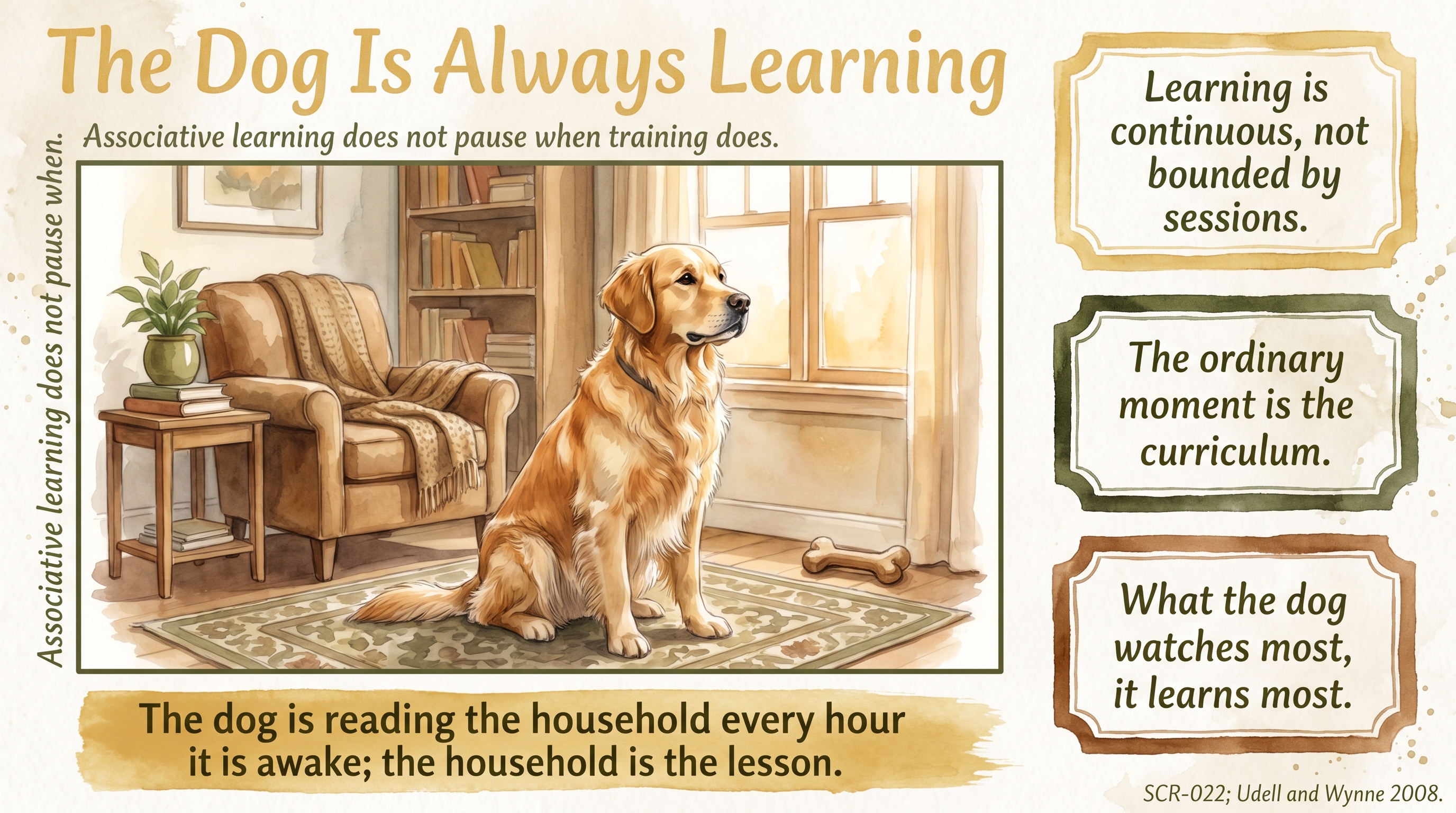
The lessons happen outside the lessons.
Key Takeaways
- The dog is always learning. Hebbian plasticity, postnatal myelination, sensitive-period imprinting, and human-to-dog physiological coupling all operate continuously, not only during deliberate training time. The unremarkable hours of household life are load-bearing developmental input.
- The mechanism is documented at multiple levels. Hebbian circuit-building (SCR-022) and canine postnatal myelination (SCR-040) are foundational neuroscience. Scott and Fuller (SCR-354) established sensitive-period imprinting. Sundman et al. (2019) documented human-to-dog cortisol coupling, strongest in breeds selected for close human cooperation (SCR-105).
- The convergent operational claim, that family-side ambient design carries more developmental weight than the deliberate training session does, is JB synthesis. The component evidence is documented; the operational ranking is well-supported synthesis that stays inside SCR-486's heuristic ceiling on the human-as-primary-variable framing.
- Practically, the principle calls for design rather than surveillance. The family that arranges the household around the methodology's grammar finds that the dog is being instructed correctly during the unremarkable hours. The family that has not done so finds the dog being instructed during those hours in something else.
The Evidence
- Hebb, D. O. (1949); Bliss, T. V. P. & Lømo, T. (1973); Bi, G.-Q. & Poo, M.-M. (1998)foundational neuroscience principle; rabbits (Bliss & Lømo); rats (Bi & Poo)
Hebbian plasticity, the principle that repeated co-activation of neuronal populations produces lasting changes in efficiency and stability of that activity pattern, is foundational neuroscience documented across mammalian species. Long-term potentiation and spike-timing-dependent plasticity have been directly demonstrated. The mechanism does not toggle on and off with the family's schedule. Behavioral application to canine ambient learning is conserved-mechanism inference.
- Gross, B. et al. (2010), Veterinary Radiology & Ultrasounddomestic dogs (N=17, longitudinal 1-36 weeks)
Longitudinal MRI and histology correlation documented progressive postnatal myelination, with the canine brain approaching adult-like appearance by approximately 16 weeks and continued subcortical white-matter arborization extending to at least 36 weeks. The window in which the family receives and raises the puppy overlaps a period of active postnatal myelination; the link between specific practiced circuits and myelination remains mechanistic inference.
- Scott, J. P. & Fuller, J. L. (1965); Serpell, J. & Jagoe, J. A. (1995)domestic dog
Scott and Fuller's multi-breed studies established canine behavioral genetics as a field by demonstrating heritable breed differences under standardized conditions and clarifying the developmental importance of early social experience. Serpell and Jagoe noted that conditioning during the canine sensitive period is not easily changed in later years and that early experience sets a general pattern of responses to the major influences the puppy encounters later. The general pattern includes ambient household conditions, not only deliberate training inputs.
- Sundman, A.-S. et al. (2019), Scientific Reportsdomestic dogs (N=58 dog-owner pairs across two seasons; Shetland Sheepdogs and Border Collies primary)
Hair cortisol concentrations in dogs significantly predicted by owner cortisol; dog personality did not significantly affect owner cortisol. The direction of long-term endocrine synchronization was predominantly human to dog. - Höglin, A. et al. (2021)domestic dogs (multiple breeds)
Coupling between owner and dog cortisol was strongest in breeds selected for close human cooperation. The Golden Retriever, at the high end of cooperative-selection history, is in the breed range where ambient owner state has the highest documented likelihood of being recorded by the dog's endocrine system, not only by its behavioral repertoire.
- JB Methodology synthesisfamily-raised Golden Retrievers
The convergent operational claim that family-side ambient design carries more developmental weight than the deliberate training session does is JB's synthesis of Hebbian continuity, the active myelination window, sensitive-period imprinting, and human-to-dog cortisol coupling. Each component is independently documented at the level stated. The operational ranking is well-supported synthesis rather than a directly demonstrated controlled comparison. JB stays inside SCR-486's heuristic ceiling on the broader human-as-primary-variable framing.
No controlled comparative trial has tested ambient-design household structure against deliberate-session-only training on long-term canine behavioral, physiological, or relational outcomes in companion dogs. The component mechanisms are documented; the integrated operational ranking is synthesis.
Dog-specific synaptic pruning timelines that would tighten the link between ambient repetition during the window and circuit-level outcomes are not established (per SCR-024 evidence boundary). The pruning machinery is confirmed; the developmental calendar is not.
Direct measurement of how much of the daily ambient household input enters durable canine behavioral patterning, versus how much the puppy filters out, is not available. The principle treats ambient input as load-bearing because Hebbian plasticity does not pause; the proportion that becomes consequential remains an open empirical question.
SCR References
Sources
Bi, G.-Q., \u0026 Poo, M.-M. (1998). Synaptic modifications in cultured hippocampal neurons: Dependence on spike timing, synaptic strength, and postsynaptic cell type. The Journal of Neuroscience, 18(24), 10464-10472.
Bliss, T. V. P., \u0026 Lømo, T. (1973). Long-lasting potentiation of synaptic transmission in the dentate area of the anaesthetized rabbit following stimulation of the perforant path. The Journal of Physiology, 232(2), 331-356.
Gross, B., Garcia-Tapia, D., Riedesel, E., Ellinwood, N. M., \u0026 Jens, J. K. (2010). Normal canine brain maturation at magnetic resonance imaging. Veterinary Radiology \u0026 Ultrasound, 51(4), 361-373.
Hebb, D. O. (1949). The Organization of Behavior: A Neuropsychological Theory. New York: Wiley.
Höglin, A., Van Poucke, E., Katajamaa, R., Jensen, P., Theodorsson, E., \u0026 Roth, L. S. V. (2021). Long-term stress in dogs is related to the human-dog relationship and personality traits. Scientific Reports, 11, 8612.
Scott, J. P., \u0026 Fuller, J. L. (1965). Genetics and the Social Behavior of the Dog. University of Chicago Press.
Serpell, J., \u0026 Jagoe, J. A. (1995). Early experience and the development of behaviour. In J. Serpell (Ed.), The Domestic Dog: Its Evolution, Behaviour and Interactions with People (pp. 79-102). Cambridge University Press.
Sundman, A.-S., Van Poucke, E., Svensson Holm, A.-C., Faresjö, Å., Theodorsson, E., Jensen, P., \u0026 Roth, L. S. V. (2019). Long-term stress levels are synchronized in dogs and their owners. *Sci