Ordinary Life Beats Optimization
Compound evidence detail2 SCRs / 4 parts
- Documentedhuman behavior-change research showing that identity-congruent action supports persistence
- Heuristicthe JB application that mentor identity may improve family adherence to Pillar-consistent routines
- Documentedhuman relapse-prevention research on lapse interpretation, recovery planning, and avoiding total-failure framing
- Heuristicthe JB application that family reset scripts can help owners recover from mistakes without abandoning the raising framework
In JB, Ordinary Life Beats Optimization is the operating principle that names ordinary shared life as the methodology's goal and corrects the drift, common in intellectually serious families, toward treating dog-raising as a performance project. Heuristic The documented findings on long-term dog-owner cortisol coupling, on the association between owner Neuroticism and reduced canine HPA-axis flexibility, and on the psychology of long-term behavioral maintenance are cross-species and canine in various combinations. The convergent claim that anxious optimization undermines exactly the state the JB methodology is built to produce is JB's synthesis rather than a directly demonstrated intervention finding.
What It Means
Families who are intellectually serious about doing well by their dog sometimes turn the methodology into a project. They read everything. They track behaviors. They second-guess every interaction. They bring a quality of anxious perfectionism to what should be the ambient steady state of daily life. The Ordinary Life principle exists to name this drift and to correct it. The correction is not lowered standards. It is a more accurate understanding of what the methodology's goal is.
The drift produces a physiological problem that is documented, not hypothetical. Sundman and colleagues (2019) measured hair cortisol in 58 dog-owner pairs across two seasonal time points and found that human hair cortisol significantly predicted dog hair cortisol at both time points, with the coupling flowing human-to-dog rather than dog-to-human (SCR-105). Documented The strongest predictor of the synchronization was the human's personality profile on the Big Five inventory, with Neuroticism, Conscientiousness, and Openness all carrying weight. Höglin and colleagues (2021) found that the coupling did not appear in ancient or solitary-hunting breeds; the effect appears specific to breeds selected for close human cooperation, which makes the Golden-specific extension a breed-classification inference rather than a direct measurement. Schöberl and colleagues (2017) sharpened the picture in a separate dog-owner sample: owner Neuroticism specifically predicted lower canine cortisol flexibility, measured as individual coefficient of variation, indicating a rigid and less responsive stress-regulation system in the dog (SCR-059). Documented The association is documented; the inverse, that therapeutically altering an owner's Neuroticism directly resolves a dog's HPA-axis inflexibility, is an untested intervention hypothesis JB does not claim.
What this means for the Ordinary Life principle is the following. The anxiously optimizing family may not be neurotic in the clinical sense. But the physiological signal they generate, a nervous system running a continuous quality-assessment loop about whether the household is doing the methodology correctly, is in the same direction as the variable the coupling literature documents. The effort to do well produces an ambient state that works against doing well. This is not a rhetorical flourish. It is the coupling literature pointing at a category of household behavior the methodology was never meant to produce.
The positive framing, what the methodology actually is aiming for, is structured companionship. The goal is not a perfectly trained dog that performs on cue. The goal is not a dog that has been optimized along a set of measurable dimensions. The goal is a relationship in which both parties are relaxed in each other's company, the dog is calm and well-mannered by default, and ordinary life unfolds with minimal drama. The unremarkable afternoon (the dog sleeping under the table while the family has lunch), the quiet evening walk where nothing in particular happens, the morning in which the family and the dog move through their respective routines in easy parallel, these are not the absence of the methodology or the background against which training happens. They are its expression. Ordinary life is the target state.
The psychology of long-term maintenance supports this reframing. Kwasnicka and colleagues (2016), reviewing the human behavior-change maintenance literature, found that long-term behavioral maintenance is sustained by different psychological drivers than initial behavior change. Initial motivation decays; what sustains behavior over time is satisfaction with outcomes, identity integration, and environmental support (SCR-489). The canine-application extension is interpretive but directionally legible: the family that maintains the methodology over months and years does so not because they are working hard at it every day, but because the methodology has integrated into their identity as dog-raisers and the household environment supports it without requiring continuous deliberate effort. Oyserman (2009, 2010) adds the identity piece directly. When a behavior is identity-congruent, difficulty is interpreted as a signal of importance and persistence increases; when a behavior is identity-incongruent, the same difficulty signals impossibility and disengagement follows (SCR-488). The application to dog-raising identity integration is interpretive. The family that thinks of themselves as dog trainers using JB techniques will method-shop whenever the techniques feel insufficient. The family that thinks of themselves as parents raising a dog will interpret difficulty as a natural feature of parenting and persist. The identity frame is not cosmetic. It determines cognitive appraisal of challenge.
The resolution the principle offers is practical. The family does not have to do the methodology harder. The family has to integrate it into identity and environment so that doing it is what ordinary life looks like when the family is not trying to do anything in particular. The measurement of success is not daily performance against a benchmark. It is the texture of the afternoon when nothing is scheduled.
Why It Matters for Your Dog
The immediate practical implication is that families should stop treating the quiet stretches as empty time. The dog lying at your feet while you answer email is not a gap in training. It is the training. The walk where you both move through the neighborhood without agenda is not an absence of the methodology. It is what the methodology is producing. The evening in which the household settles toward rest without ceremony is not something the family has to improve. It is the condition the family was building toward.
The reframing is protective. An anxiously optimizing family will read their quiet afternoons as undertrained. They will notice the dog sleeping peacefully and feel a pull to do something with the dog. They will interpret the absence of behavioral incidents as evidence of complacency rather than as evidence that the household architecture is working. The Ordinary Life principle gives the family a different interpretation of the same observable facts. The quiet is the outcome. The peace is not something to add to.
The principle also protects the family from method-shopping. A family whose identity is "we are raising a calm, well-mannered Golden" is structurally different from a family whose identity is "we are using the JB method and hoping it works." The first family reads difficulty as a parenting challenge to move through. The second family reads difficulty as a sign the method might be wrong and starts looking at alternatives. Oyserman's identity research makes that asymmetry legible. The JB methodology is not a technique the family is practicing on their dog. It is a way of living the family has integrated into who they understand themselves to be. That integration is what produces persistence through the unavoidable difficult stretches.
Ordinary Life Beats Optimization is the operating-principle expression of the Calmness pillar at the scale of the family's self-concept. The pillar names parasympathetic tone as the physiological target. The principle names the identity frame that keeps that target aligned with ordinary living rather than with anxious optimization. A family whose baseline posture is performance pressure cannot produce a calm dog, because the coupling literature suggests the family's state is the upstream variable. Ordinary Life is not a low bar. It is a specific state that takes real work to establish and real discipline to protect from the drift toward optimization.
There is a particular Golden Retriever dimension to this principle worth naming. The breed's sensitivity, the documented willingness to read and respond to human emotional state, is what makes the anxiously optimizing family's physiological signal especially costly. A less socially attuned breed may absorb household anxiety without reflecting it back as clearly. A Golden will reflect it. The ambient state of the household is a significant part of what the dog's nervous system is being calibrated by, and the Golden's attunement makes that calibration precise. The family reading this principle carefully is the family whose breed choice makes the principle especially important to get right.
The final frame is the one the methodology ends on, because it is the frame the methodology is actually for. A dog that has been raised in a JB household does not spend its life as a training subject being developed toward some more finished version of itself. It spends its life as a family companion, in a relationship in which the family is relaxed enough to enjoy the dog and the dog is regulated enough to be worth enjoying. The unremarkable Tuesday evening is the point. The methodology's goal is not a more impressive dog. It is a household that works, across years, without drama. The quiet moments are the methodology in its fullest expression.
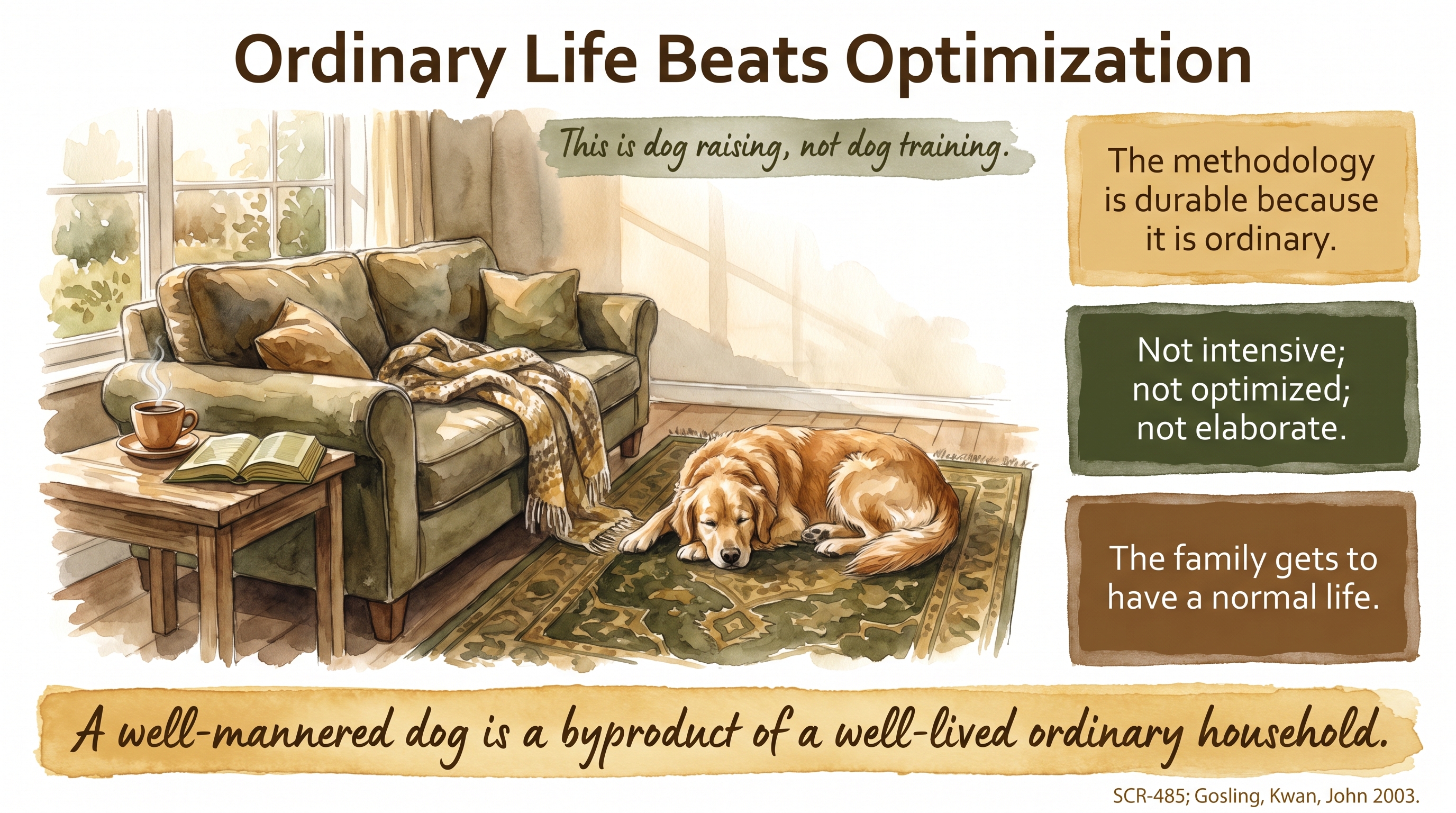
The life the dog actually lives is the one that shapes it.
Key Takeaways
- Ordinary life is the methodology's goal, not its background. The unremarkable afternoon, the quiet evening walk, the morning where the family and the dog move through their routines in easy parallel, these are the outcome the JB household is building toward.
- The anxiously optimizing family inadvertently reintroduces the physiological state the methodology is designed to dissolve. Dog-owner cortisol coupling (Sundman 2019; Höglin 2021) flows human-to-dog, with owner Neuroticism specifically predicting reduced canine HPA-axis flexibility (Schöberl 2017). The effort to do well produces the state that works against doing well.
- Long-term maintenance is sustained by identity integration and environmental support rather than by effortful motivation (Kwasnicka 2016; Oyserman 2009/2010). The family that thinks of themselves as raising a dog will interpret difficulty as parenting and persist. The family that thinks of themselves as applying a technique will method-shop when difficulty arrives.
- For Golden Retrievers, the breed's documented social attunement makes household emotional climate an especially precise input to the dog's calibration. The principle is especially important to get right for a breed whose nervous system is especially ready to reflect what it reads.
The Evidence
- Sundman, A.-S., Van Poucke, E., Svensson Holm, A.-C., Faresjö, Å., Theodorsson, E., Jensen, P., & Roth, L. S. V. (2019)domestic dogs and humans (N=58 dog-owner pairs, two seasonal time points)
Hair cortisol concentration measured across two seasonal time points demonstrated significant human-to-dog coupling at both time points. Activity-collar data confirmed that shared physical activity and training frequency did not explain the synchronization. The strongest predictors were human personality traits (Big Five: Neuroticism, Conscientiousness, Openness). Dog personality did not significantly affect owner cortisol; the coupling was directionally asymmetric, flowing human-to-dog. - Höglin, A. et al. (2021)domestic dogs and humans (comparative across breed groups)
Follow-up work found no long-term stress synchronization in ancient breeds or solitary hunting breeds, suggesting the coupling appears specific to breeds selected for close human cooperation. The Golden Retriever's inclusion in cooperative breed groups makes the breed-specific inference directionally consistent with the documented finding; the Golden-specific extension remains breed-classification inference rather than direct measurement in a Golden Retriever sample.
- Schöberl, I. et al. (2017), PLOS ONEdomestic dogs and humans
Owner psychological profile, especially Neuroticism and insecure attachment variables, predicts lower cortisol variability and flexibility (individual coefficient of variation) in dogs. Schöberl et al. (2016) additionally found that securely attached dogs showed lower cortisol reactivity during social challenge. The owner variable carried more predictive weight than the dog's own personality traits. Boundary: the evidence is associational, not interventional. No study has demonstrated that therapeutically altering an owner's Neuroticism directly resolves a dog's HPA-axis inflexibility. JB presents this as evidence for why owner calm matters, not as proof that changing the owner fixes the dog.
- Kwasnicka, D., Dombrowski, S. U., White, M., & Sniehotta, F. (2016)humans (behavior-change maintenance review)
Systematic review of the human behavior-change maintenance literature found that initial behavior change and long-term maintenance require different psychological drivers. Initial motivation decays; what sustains behavior over time is satisfaction with outcomes, identity integration, environmental support, and habit formation. The canine-application extension to dog-owner behavioral maintenance is interpretive; the mechanism described is human-directed and documented in human samples. - Marlatt, G. A. & Gordon, J. R. (1985); Marlatt (1984)humans (relapse-prevention framework)
Foundational work on relapse prevention establishing that lapses are normal and recoverable when the behavior is integrated with identity and environment, and that the response to a lapse (abstinence-violation effect versus normalization) predicts whether a single deviation becomes sustained recurrence. Canine-application relevance is that a JB family's response to a difficult day in dog-raising follows the same psychological pattern: interpreting the day as evidence of method failure predicts disengagement; interpreting it as ordinary difficulty predicts persistence.
- Oyserman, D. (2009, 2010)humans (identity-based motivation research)
Experimental and field research on identity-based motivation documented that when a behavior is identity-congruent, difficulty is interpreted as a signal of the behavior's importance and persistence increases. When the same behavior is identity-incongruent, identical difficulty signals impossibility and disengagement follows. The framework is documented in humans. The application to dog-raising identity integration (the family that identifies as raising a dog versus the family that identifies as applying a technique) is interpretive; the mechanism described is human-directed and documented in human samples.
- JB Methodology synthesisfamily-raised Golden Retrievers
The operational claim that the anxiously optimizing family generates exactly the state the JB methodology aims to dissolve is JB's synthesis of the documented dog-owner cortisol coupling literature (Sundman 2019; Höglin 2021), the Schöberl finding on owner Neuroticism and canine HPA-axis flexibility, and the human behavior-change maintenance and identity-based motivation literatures (Kwasnicka 2016; Oyserman 2009/2010). The component findings are documented in their source contexts. The convergent claim that identity integration and environmental support are the correct household posture, and that performance-project framing is counterproductive, has not been tested as a direct intervention in a controlled canine household trial. JB presents the principle as mechanistically coherent operating guidance rather than as a directly demonstrated household-intervention finding.
No controlled canine trial has compared identity-integrated households against performance-project households on long-term dog-owner cortisol synchronization, canine HPA-axis flexibility, or behavioral maintenance.
Sundman et al. (2019) and Schöberl et al. (2017) are associational; the intervention hypothesis that reducing owner Neuroticism resolves canine cortisol inflexibility is untested.
Höglin et al. (2021) established breed-group specificity for the cortisol coupling but did not include a Golden Retriever-specific sample; the Golden-directed inference remains breed-classification extension.
Kwasnicka (2016) and Oyserman (2009, 2010) are documented in human behavior-change and identity-motivation research; direct canine-owner studies operationalizing identity integration as a dog-raising variable have not been published.
SCR References
Sources
Höglin, A., Van Poucke, E., Katajamaa, R., Jensen, P., Theodorsson, E., \u0026 Roth, L. S. V. (2021). Long-term stress in dogs is related to the human-dog relationship and personality traits. Scientific Reports, 11, 8612.
Kwasnicka, D., Dombrowski, S. U., White, M., \u0026 Sniehotta, F. (2016). Theoretical explanations for maintenance of behaviour change: A systematic review of behaviour theories. Health Psychology Review, 10(3), 277-296.
Marlatt, G. A. (1984). Relapse prevention: A self-control program for the treatment of addictive behaviors. In R. B. Stuart (Ed.), Adherence, compliance, and generalization in behavioral medicine (pp. 329-378). New York: Brunner/Mazel.
Marlatt, G. A., \u0026 Gordon, J. R. (1985). Relapse Prevention: Maintenance Strategies in the Treatment of Addictive Behaviors. New York: Guilford Press.
Oyserman, D. (2009). Identity-based motivation: Implications for action-readiness, procedural-readiness, and consumer behavior. Journal of Consumer Psychology, 19(3), 250-260.
Oyserman, D. (2010). Identity-based motivation: Implications for intervention. The Counseling Psychologist, 38(7), 993-1018.
Schöberl, I., Wedl, M., Beetz, A., \u0026 Kotrschal, K. (2017). Psychobiological factors affecting cortisol variability in human-dog dyads. PLOS ONE, 12(2), e0170707.
Schöberl, I., Beetz, A., Solomon, J., Wedl, M., Gee, N., \u0026 Kotrschal, K. (2016). Social factors influencing cortisol modulation in dogs during a strange situation procedure. Journal of Veterinary Behavior, 11, 77-85.
Sundman, A.-S., Van Poucke, E., Svensson Holm, A.-C., Faresjö, Å., Theodorsson, E., Jensen, P., \u0026 Roth, L. S. V. (2019). Long-term str