Rest, Sleep, and Crate Architecture
In the JB methodology, sleep is not the quiet interval between the events of the dog's day. It is physiological scaffolding, the biological substrate across which learning is consolidated, the nervous system is restored, and the regulatory capacity of the next day is built. Heuristic The arrangement of resting places, the total daily sleep load, and the structural role of the crate are architectural decisions the family makes once, and the decisions propagate forward through every subsequent behavior the dog is said to exhibit. Dale et al. (2024), the Generation Pup prospective longitudinal cohort (N=145), identified sleeping for at least nine uninterrupted hours, sleeping in a location free of human disturbance, and sleeping in an overnight crate or enclosed space before sixteen weeks as correlates of better behavioral outcomes, with fussing about six times more common among puppies without these arrangements (SCR-036). Documented The evidence is correlational rather than interventional, and the methodology carries it at that confidence level: the correlates are real, the mechanism is plausible, and the causal intervention study has not yet been published.
For Families
A puppy needs more sleep than most families realize - often 18 to 20 hours in early puppyhood. Most behavioral problems in young puppies are sleep problems, not training problems. The over-tired puppy nips, refuses food, whines, and resists settling, and families often misread these as defiance.
The framework treats rest as architecture, not as something the dog does between activities. The household rhythm has natural rest periods built in. The crate or settle space is a calm refuge, not a punishment, and the puppy learns to use it voluntarily. Quiet hours during the day are protected - not silent, just calm - so the puppy can actually sleep.
A well-rested puppy is a different animal from an over-tired one. Most "behavioral" problems disappear when sleep architecture is sound. The fix is rarely more training. It is more sleep, more often, in a calmer environment.
What It Means
The operating position is that sleep is an architectural variable rather than a behavioral output. The family does not build sleep the same way it builds a recall or a settle-on-mat. It builds the conditions that make the biologically appropriate quantity and quality of sleep available to the dog, and the dog's nervous system uses those conditions. The conditions are physical, temporal, and relational.
The physical conditions are the resting places themselves. A resting place is not a bed in the abstract. It is a specific location in the house, with specific acoustic and lighting properties, specific proximity to household traffic, and a specific predictability about whether the dog will be interrupted. The dog with three designated resting places, each with stable acoustic and lighting properties and each with a predictable interruption profile, has an architecture that supports sleep. The dog without designated resting places, or with resting places that are continuously disturbed by household traffic, has an architecture that produces intermittent rest but not consolidated sleep.
The temporal conditions are the daily sleep load. The literature on domestic dog sleep is thinner than the literature on human or rodent sleep, but the available canine-direct findings support that dogs sleep substantially more than households typically expect, that puppies sleep substantially more than adult dogs, and that the sleep architecture resembles the broader mammalian pattern of polyphasic sleep with distinct non-REM and REM stages (Kis et al. 2014; Bódizs et al. 2020; Iotchev et al. 2020). Documented The canine sleep neuroscience literature has specifically demonstrated that memory consolidation in dogs occurs during sleep in the same general architecture documented in other mammals, with sleep spindles and slow-wave activity associated with learning outcomes (Kis et al. 2017; Iotchev et al. 2020). Documented The puppy who has been active during the day is not benefiting from the activity in isolation. The benefit is the activity plus the consolidation period that follows, and the consolidation period requires adequate sleep to do its work.
The relational conditions are the family's stance toward the sleeping dog. The dog that is continuously surveilled, interrupted, or cued into interaction while attempting to rest is a dog whose resting places are not functioning as resting places. The family's discipline around leaving the sleeping dog alone is, in practice, one of the variables that determines whether the sleep architecture is intact. The methodology's position is that the sleeping dog is doing developmental work. The household treats the work with the same respect it would treat any other developmental work, which is to say, by not interrupting it without cause.
The crate enters this architecture as a specific structural tool with specific purposes. The methodology's position on the crate is neither enthusiastic advocacy nor reluctant concession. The crate is a tool with a defined role. The role is to provide a sheltered, predictable, low-stimulus resting environment that the dog associates with rest and with independence from household traffic. The crate is not a behavioral-management device deployed to prevent mischief, and it is not a time-out box for corrective purposes. Those framings have produced a cultural position in which the crate is either uncritically adopted or uncritically rejected, and neither position maps onto what the crate is actually doing in the JB architecture. The crate, deployed well, is the physical form that the "sleeping in an overnight crate or enclosed space before sixteen weeks" variable in Dale et al. (2024) represents.
A boundary on Dale et al. (2024). The findings are correlational from a prospective cohort, not causal from an intervention trial. Documented The correlates (at least nine uninterrupted hours of sleep, overnight enclosed-space sleeping before sixteen weeks, reduced fussing) have been observed in a well-designed prospective study with adequate sample size, and the direction of effect is the direction the methodology predicts. The claim the methodology carries is the documented correlational one: puppies with these architectural features fuss about six times less than puppies without them, and the overall prevalence of separation-related behaviors in the sample was 46.9%. The causal step (that installing these features prevents the behavioral outcomes) is a reasonable inference but has not yet been intervention-tested. The methodology presents the correlates as load-bearing but does not overstate the causal warrant.
The Hebbian frame applies here too. Each night the puppy sleeps in the sheltered, predictable, low-stimulus environment before sixteen weeks of age is a repetition of the sleep-location-equals-safety circuit (SCR-022). Each night the puppy sleeps in an unpredictable or disturbed arrangement is a repetition of the sleep-location-requires-vigilance circuit. The sensitive-period framing is why the sixteen-week boundary matters: the circuits being wired before that age carry forward into the adult dog's daily architecture in a way that circuits wired later do not replace, they can only be overlaid onto.
Why It Matters for Your Dog
The practical consequence is that most of what families later describe as "behavioral problems" have a sleep architecture underneath them. The puppy that cannot settle in the evening is often a puppy that has not slept adequately during the day. The young dog that is reactive to visitors is often a young dog whose consolidation periods have been interrupted by the visitors themselves. The adolescent that is described as "always on" is often an adolescent whose daily sleep load is running a chronic deficit against what the biology requires. The behavioral symptom is a downstream expression of an upstream architectural variable the family can adjust.
The practical starting position for a family raising a Golden Retriever puppy is to expect the eight-to-twelve-week puppy to sleep between sixteen and twenty hours a day, the twelve-to-sixteen-week puppy to sleep between fourteen and eighteen hours a day, and the four-to-six-month adolescent to sleep between twelve and fourteen hours a day. Estimated The specific numbers are estimated from the broader canine sleep literature and from JB's cohort observations; the general pattern (puppy sleep requirements substantially exceed typical household expectations) is documented. Families that build the household schedule around these sleep budgets tend to have puppies who are behaviorally different from families that have not. The difference is not a training outcome. It is a biological condition the family has honored.
The crate architecture specifically. The methodology's preferred arrangement is overnight crate use (or enclosed equivalent) through at least the first sixteen weeks, daytime crate availability as one of the resting places rather than as the primary one, and a transition out of obligatory crate use as the dog matures into a settled, calm adult whose resting habits no longer require the crate's structural support. The exit from crate use is a developmental outcome, not a scheduled event. It happens when the dog's sleep architecture no longer needs the crate to function. For some dogs, this occurs in the first year; for others, it takes longer; for others still, the crate remains part of the household architecture indefinitely because the dog's preference has become to sleep there. The methodology does not prescribe a timeline. It prescribes the function the crate is serving and the evaluation of whether the function is still needed.
Rest, sleep, and crate architecture is a Calmness operation. The calm floor the methodology establishes in the first hours of the day is built during the sleep that precedes the day. A puppy that has slept a consolidated twelve hours overnight in a sheltered environment wakes into a nervous system that can be regulated. A puppy that has slept fragmented five hours, interrupted by household activity, wakes into a nervous system that is already beginning the day with a cumulative deficit. The Dale et al. (2024) finding that puppies with at least nine uninterrupted hours of sleep fuss about six times less (SCR-036) is the Calmness pillar expressed as a sleep correlate. The architecture the family builds around the sleeping puppy is architecture for the whole day.
The most common sleep-architecture failure modes are specific. First, the continuous-companion expectation: the puppy follows the family from room to room throughout the day, with no designated resting periods in a sheltered environment. The puppy is receiving continuous social stimulation and minimal consolidation time. Second, the disturbed resting place: a bed in a high-traffic area where the puppy is stepped around, cued, greeted, or petted every fifteen minutes. The puppy is not resting; it is in intermittent low-grade arousal. Third, the anti-crate principled refusal, adopted without evaluation of what the crate is structurally providing. The family that declines the crate often then recreates the function with a gated room, a designated corner, or a blocked-off space, which works structurally as long as the function is being served; the crate is one implementation of the structural function, not the function itself. Fourth, the overnight crate deployed as behavioral management rather than architectural feature: the puppy is crated with dim expectations, late arrivals, and inconsistent entry, and the crate is not reliably functioning as a sheltered resting environment. The physical object is present; the architecture is absent.
A note on the limit of the inference. The documented evidence supports the Dale et al. (2024) correlates for specific sleep-architecture variables and puppy behavioral outcomes (SCR-036), canine sleep neuroscience findings for sleep-consolidation architecture (Kis et al. 2014, 2017; Bódizs et al. 2020; Iotchev et al. 2020), and the Hebbian circuit-level mechanism for repeated nightly conditions (SCR-022). The causal step from correlate to intervention, and the specific crate-versus-alternative-enclosed-space question, have not been intervention-tested. The methodology presents the position as well-supported correlational architecture with the causal boundary visible.
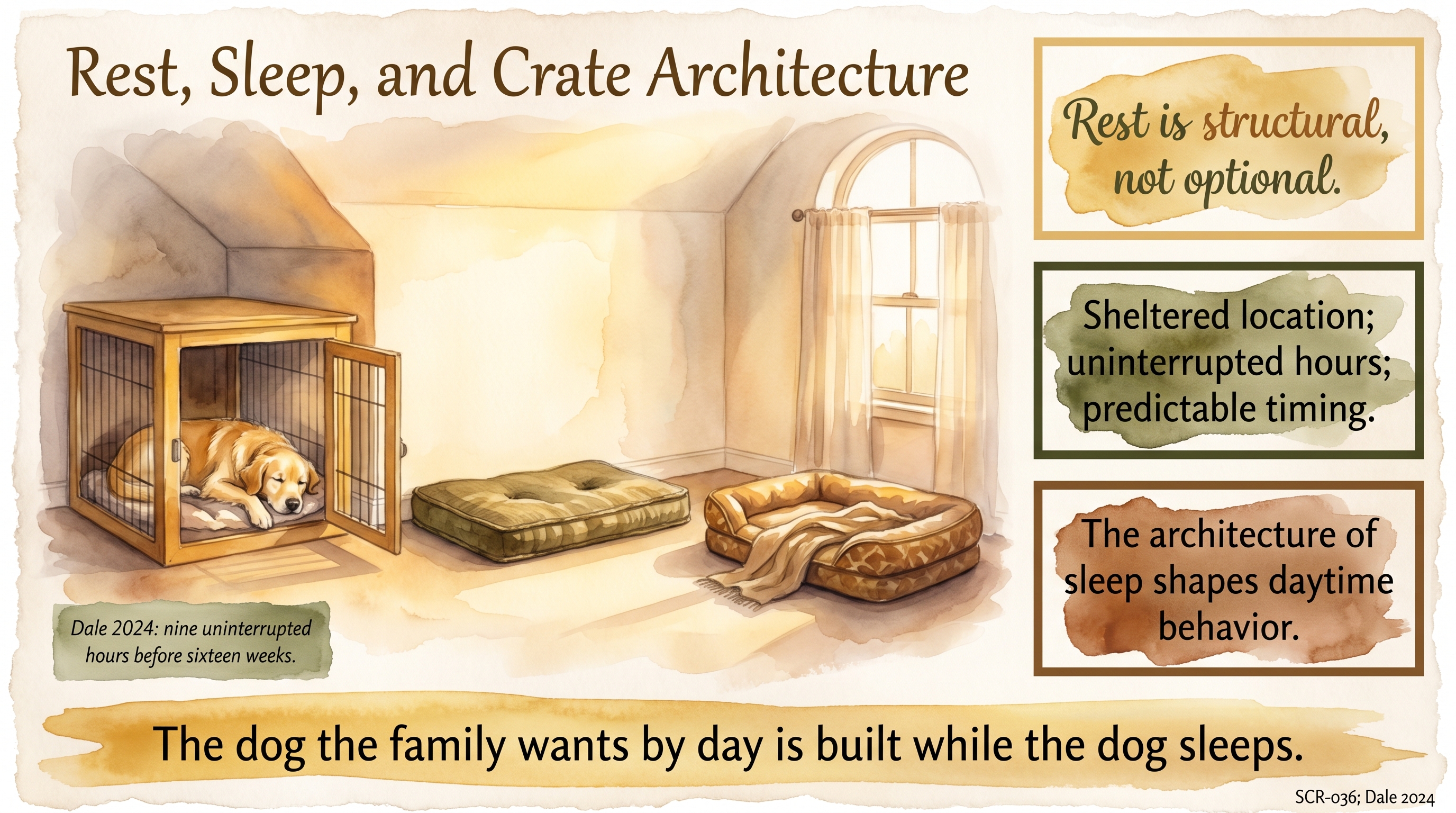
A dog with good sleep is a different dog.
Key Takeaways
- Sleep is physiological scaffolding, not downtime. The arrangement of resting places, the daily sleep load, and the structural role of the crate are architectural variables the family sets once, and the decisions propagate forward through the dog's behavioral life.
- Dale et al. (2024) Generation Pup cohort (N=145) identified specific sleep-architecture correlates of better puppy behavioral outcomes: at least nine uninterrupted hours of sleep, sleeping in a location free of human disturbance, and sleeping in an overnight crate or enclosed space before sixteen weeks. Puppies without these arrangements fussed about six times more. Correlational, not interventional (SCR-036).
- Expected puppy sleep load substantially exceeds typical household expectations: eight-to-twelve-week puppies typically sleep 16-20 hours daily; twelve-to-sixteen-week puppies 14-18; four-to-six-month adolescents 12-14. Families that schedule around these budgets report behaviorally different dogs from families that do not.
- The crate is a structural tool with a defined role (sheltered, predictable, low-stimulus resting environment), not a behavioral-management device and not a time-out box. The exit from obligatory crate use is a developmental outcome, not a scheduled event; it happens when the dog's sleep architecture no longer requires the crate's structural support.
The Evidence
This entry uses estimated claim-level tags beyond the dedicated EvidenceBlocks below. These tags mark approximate ranges or timing claims that should remain bounded by the cited sources.
- Dale, R. et al. (2024), Animal Welfaredomestic dogs (N=145, prospective longitudinal cohort)
Puppies who slept for at least nine uninterrupted hours, in a location free of human disturbance, and in an overnight crate or enclosed space before sixteen weeks showed lower rates of separation-related behaviors and fussing. Fussing was about six times more common among puppies without these arrangements. Overall prevalence of separation-related behaviors in the sample was 46.9%. Findings are correlational from a prospective cohort, not causal from an intervention trial. Direction of effect matches the methodology's architectural predictions; the causal step has not yet been intervention-tested.
- Kis, A., Szakadát, S., Kovács, E., Gácsi, M., Simor, P., Gombos, F., Topál, J., Miklósi, Á., & Bódizs, R. (2014), PLOS ONEdomestic dogs
Non-invasive polysomnography of domestic dogs established that canine sleep architecture resembles the broader mammalian polyphasic pattern, with identifiable non-REM and REM stages, and that sleep recording in dogs is methodologically feasible. Provides the empirical base from which subsequent canine sleep-learning work proceeds. - Kis, A., Szakadát, S., Gácsi, M., Kovács, E., Simor, P., Török, C., Gombos, F., Bódizs, R., & Topál, J. (2017), Scientific Reportsdomestic dogs
Memory consolidation in domestic dogs is associated with specific sleep features; the sleep-learning relationship documented in other mammals operates in dogs at the level of direct measurement. Establishes that interrupting canine sleep has consequences for the learning the dog has attempted during the preceding waking period. - Bódizs, R., Kis, A., Gácsi, M., & Topál, J. (2020), Sleep Medicine Reviewsdomestic dogs (review)
Review of canine sleep architecture findings and their implications. Confirms sleep spindles, REM/NREM architecture, and homeostatic regulation patterns in domestic dogs consistent with the mammalian pattern. - Iotchev, I. B., Kis, A., Bódizs, R., van Luijtelaar, G., & Kubinyi, E. (2020), Scientific Reportsdomestic dogs
Sleep spindles in dogs are associated with learning outcomes. Adds specific spindle-learning evidence to the broader sleep-consolidation framework.
- Hebb, D. O. (1949); Bliss & Lømo (1973); Bi & Poo (1998)foundational neuroscience principle (rabbit, rat); cross-species
Neurons that fire together wire together; circuits strengthen with repetition. Each night in a specific sleep arrangement is a repetition of the sleep-location conditions and the nervous system states associated with them. Sensitive-period framing is why the sixteen-week Dale et al. (2024) window matters architecturally: circuits wired before that age are not replaced by later circuits, only overlaid onto.
- Smith, B. P. et al. (2025), Preventive Veterinary Medicinedomestic dogs (N=3,044 Golden Retrievers, Golden Retriever Lifetime Study)
Household management variables identified as significant predictors of behavioral trajectory across the first three years of life. Sleeping arrangement is one of the variables in the cluster. The correlational pattern is cross-cohort and convergent with Dale et al. (2024). - Dale, R. et al. (2024); Dodman, N. H. et al. (2018); Powell, L. et al. (2021); Bouma, E. M. C. et al. (2024)domestic dogs (multiple cohorts)
Convergent evidence that owner-managed architectural variables predict canine behavioral outcomes. The stronger ranking claim (owner variables as the primary determinant across all contexts) is well-supported synthesis but not definitively established (per SCR-486 ceiling).
- SCR-047 methodological guardraildomestic dogs
The methodology's sleep claim is narrower than any anti-activity position. The claim is that sleep is a documented architectural variable with documented behavioral correlates, and that families underestimate the daily sleep requirement. The claim does not imply that daytime activity is problematic; it implies that daytime activity and adequate sleep are complementary, not substitutable.
- JB Methodology synthesisfamily-raised Golden Retrievers
The convergent claim that the crate (or enclosed equivalent) is one structural implementation of the overnight sheltered-sleep variable, and that the specific object matters less than the architectural function it serves, is JB's synthesis of the Dale et al. (2024) correlates and the canine sleep-consolidation literature. The specific crate-versus-alternative-enclosed-space question has not been intervention-tested; the architectural-function claim is carried as heuristic.
No published intervention trial has tested whether installing the Dale et al. (2024) sleep-architecture correlates in a previously non-compliant household produces the behavioral improvements the correlational findings predict.
Specific canine sleep-load requirements by age are estimated from published observations and cohort studies; no consensus pediatric sleep guideline exists for domestic dogs at the precision the human pediatric sleep guidelines achieve.
The crate-versus-alternative-enclosed-space question has not been intervention-tested; the architectural function is reasoned rather than directly compared.
Long-term outcome studies tracking dogs from controlled sleep-architecture interventions into adulthood are not yet available in the canine literature.
SCR References
Sources
Bi, G.-Q., \u0026 Poo, M.-M. (1998). Synaptic modifications in cultured hippocampal neurons: Dependence on spike timing, synaptic strength, and postsynaptic cell type. Journal of Neuroscience, 18(24), 10464-10472.
Bliss, T. V. P., \u0026 Lømo, T. (1973). Long-lasting potentiation of synaptic transmission in the dentate area of the anaesthetized rabbit following stimulation of the perforant path. Journal of Physiology, 232(2), 331-356.
Bódizs, R., Kis, A., Gácsi, M., \u0026 Topál, J. (2020). Sleep in the dog: Comparative, behavioral and translational relevance. Sleep Medicine Reviews, 51, 101283.
Bouma, E. M. C., Reijgwart, M. L., \u0026 Dijkstra, A. (2024). Dog-directed parenting styles and intergenerational patterns in dog-owner dyads. Animals, 14(3).
Dale, R. et al. (2024). Risk factors associated with separation-related behaviours and other potentially undesirable behaviours in puppies. Animal Welfare, 33, e22.
Dodman, N. H., Brown, D. C., \u0026 Serpell, J. A. (2018). Associations between owner personality and psychological status and the prevalence of canine behavior problems. PLOS ONE, 13(2), e0192846.
Hebb, D. O. (1949). The Organization of Behavior: A Neuropsychological Theory. New York: Wiley.
Iotchev, I. B., Kis, A., Bódizs, R., van Luijtelaar, G., \u0026 Kubinyi, E. (2020). Sleep spindles in dogs are associated with learning performance. Scientific Reports, 10, 20196.
Kis, A., Szakadát, S., Kovács, E., Gácsi, M., Simor, P., Gombos, F., Topál, J., Miklósi, Á., \u0026 Bódizs, R. (2014). Development of a non-invasive polysomnography technique for dogs (Canis familiaris). PLOS ONE, 9(4), e93883.
Kis, A., Szakadát, S., Gácsi, M., Kovács, E., Simor, P., Török, C., Gombos, F., Bódizs, R., \u0026 Topál, J. (2017). The interrelated effect of sleep and learning in dogs (Canis familiaris); an EEG and behavioural study. Scientific Reports, 7, 41873.
Powell, L., Chia, D., McGreevy, P., Podberscek, A. L., Edwards, K. M., Neilly, B., Guastella, A. J., Lee, V., \u0026 Stamatakis, E. (2021). Expectations for dog ownership: Perceived physical, mental and psychosocial health consequences. PLOS ONE, 16(7), e0230770.
Smith, B. P., Browne, M., Mack, J., Kontou, T. G., \u0026 Tomkins, L. M. (2025). Predictors of behav