Play and Social Interaction
Compound evidence detail2 SCRs / 5 parts
- Documentedthe Baumrind authoritative-parenting literature in human child development
- Documentedthe canine correlational evidence linking dog-directed caregiving styles to attachment, attention, sociability, and problem-solving outcomes (van Herwijnen 2018/2020, Brubaker and Udell 2023)
- Heuristicthe JB inference that one specific caregiving style experimentally produces the best long-term developmental outcomes in dogs
- Documenteddog attachment studies showing that classification systems can produce reliable groupings while still exposing distribution and method-design friction
- Heuristicclaims that canine attachment categories are a closed Ainsworth-equivalent taxonomy rather than an informative but still unsettled framework
In the JB methodology, play is a state-modulating activity, not a state-setting one. Heuristic Play does not create the calm floor; it operates on top of it, and what families read as "play" in the dog-culture vocabulary is often arousal generation in costume. The published canine and canid play-behavior literature (Bekoff on play signals; Bauer and Smuts on canid play asymmetry; Bradshaw, Pullen, and Rooney on why adult dogs play; Palagi and colleagues on play self-handicapping) describes a structured social activity with documented signaling discipline, role reversal, and self-handicap as standard features. The methodology's operational position is that play in a household is the dog's training ground for those signaling disciplines, and that a household that uses play as an arousal generator is wiring the dog into the absence of the discipline rather than into its presence.
For Families
Play is not training. Play is not exercise. Play is the developmental space where the puppy learns social fluency - turn-taking, signal reading, rough-and-tumble with appropriate inhibition, and disengagement when one party has had enough.
The Just Behaving pattern values play but does not over-engineer it. Puppies play with calm adult dogs and with each other under attentive but unintrusive supervision. The human is not the primary play partner - that role belongs to other dogs, where the social signals translate cleanly. The human role is to keep play in the regulated zone, to interrupt before play tips over into over-arousal, and to model the calm-after-play return.
What this is not is constant high-arousal play with humans, which builds a dog whose default mode is excited and whose social compass for other dogs is poorly calibrated. The point of play is the social development, not the energy expenditure.
What It Means
Play is a documented behavioral category in canids with structural features that distinguish it from agonistic interaction or simple high-arousal activity. Documented Bekoff's work on play signals (1995, 2001) established that the play bow operates as a signal that punctuates the play sequence: it announces that what follows is play and not aggression, it re-recruits a partner whose engagement is flagging, and it can re-frame an interaction that has crossed into ambiguous territory. Bauer and Smuts (2007) documented self-handicap and role reversal in dyadic dog play: the larger or stronger partner pulls punches, the typically dominant partner takes the subordinate role, and the asymmetry is what makes the play sustainable. Palagi and colleagues extended the play-signal and self-handicap findings across canid species (2016, 2019). The methodology's reading of this literature is that play is signaling-discipline practice; when play is structured, signals are precise, role asymmetry is honored, and the activity stays inside the band of mutual engagement. When play is unstructured, signals collapse, asymmetry breaks, and the activity slides into one-sided pursuit, mounting, or escalation that no longer has play's defining features.
The state-modulating distinction is operationally critical. The methodology's preference is to read play as a function that takes the dog's current state and either amplifies it, sustains it, or in some cases regulates it back down. A dog already in parasympathetic baseline who engages in structured play with a fluent partner can return to baseline through the play itself: the play signals discharge potential energy, the role reversal modulates intensity, and the activity ends in regulation. A dog in elevated arousal entering unstructured play with an under-modulated partner is having the arousal amplified; the play signals collapse, the activity escalates, and the activity ends in further dysregulation, panting, zoomies, or post-play crash. The behavioral surface looks similar from the outside ("they're playing") but the physiological trajectory is opposite. The methodology's position is that the second pattern is what the broader pet-dog culture has normalized as play and what JB explicitly does not recommend.
The play-versus-arousal distinction has documentation in the play-behavior literature even where it is not framed in those terms. Documented Pellis and Pellis's mammalian rough-and-tumble play research (2009, 2017), conducted primarily in rats, established that play has documented effects on prefrontal-cortex maturation, social-skill acquisition, and stress-system regulation, but only when the play retains its structural features (role reversal, self-handicap, mutual engagement); play stripped of those features produces different outcomes. The cross-species claim is conserved-mechanism inference; the canine application has been operationalized in the dog-play ethology literature (Bekoff, Bauer & Smuts, Palagi) but not tested in a controlled canine cohort against alternative play-protocol comparisons.
The puppy-party and dog-park failure modes. The methodology's observation across the JB cohort is that the structured play-signaling discipline fails predictably in two specific contexts: high-density mixed-age, mixed-temperament puppy socials and large public off-leash dog parks. Observed-JB In both contexts the conditions for sustained play (a small number of partners, partners with fluent signaling, partners with comparable engagement bandwidth, an environment with low ambient arousal) are absent. What the dog learns is the absence of the discipline: signals do not work, partners do not respond to play bows, role reversal does not happen, and the operational rule the dog absorbs is that signals are decorative rather than communicative. The downstream cost shows up later as a dog who reads canine signals less precisely than it should and who has had its signal-economy practice undermined by the very activity (play with other dogs) the family thought was building it.
The handler is part of the play. Play with the human partner is structurally different from dog-dog play but operates on the same principles. Heuristic The human is one of the play partners, the human's regulation state is one of the carrier waves the dog is reading (Sundman 2019; Koskela 2024; SCR-105, SCR-106), and the human's self-handicap and role reversal (the deliberate slowing, the deliberate pause, the deliberate signal that "this is play and play is going to end now") are what makes the activity stay regulated. A handler who plays at high arousal is delivering high arousal as the play state; the dog is being trained into that arousal as the play default. A handler who plays inside a regulated state is delivering regulation as the play default. The handler-state-as-primary-variable principle applies to the play moment as fully as to any other moment in the day.
The Feuerbacher and Wynne (2015) finding on praise-versus-contact (SCR-052) is relevant in the play moment too. Documented Dogs preferred physical contact over verbal praise in their experimental design, and the verbal-praise channel showed habituation across successive sessions while the contact channel did not. The implication for play is that the channels of engagement that work best (touch, body proximity, calm vocal acknowledgment) are not the channels the broader dog-culture vocabulary defaults to (excited verbal praise, high-pitched cheering, rapid clapping). The methodology's preference is the channels the literature supports, used inside the regulated state the methodology recommends.
Why It Matters for Your Dog
The practical starting position is that the family chooses play partners deliberately. Play partners for a Golden Retriever puppy in the JB methodology are: an adult dog with documented fluent play-signaling (often the JB breeder dam or another adult in the household); a small number of known, predictable canine partners whose temperaments and signaling patterns the family has observed; the family's adult humans operating inside the regulated state. Play partners explicitly not preferred: large groups of unknown puppies in puppy-class settings; high-density public dog parks; high-arousal humans operating outside the regulated state.
The structured-play test. A play sequence that is operating inside the methodology's preferences has identifiable features. The play bow appears at the start and at re-engagement moments. Role reversal happens, and the larger or older partner pulls punches. Both partners pause periodically, and the pauses are not interrupted by either partner immediately re-initiating. The arousal stays inside a band that does not produce panting beyond brief recovery, does not produce zoomies, and does not produce a post-play crash that suggests the dog overshot its regulatory capacity. The play ends with both partners returning to baseline within minutes. A play sequence missing these features is not the structured play the methodology is recommending; it is arousal generation in costume.
The duration question. The methodology's operational preference is that play is delivered in shorter, structured bouts with clear endings, not in long undifferentiated sessions. A five-to-ten-minute structured play sequence with a known partner ending in regulation is operationally preferred over a thirty-to-sixty-minute open-ended play session that produces a high-arousal trajectory and a depleted recovery. The shorter structured pattern is consistent with the play-behavior literature on natural play bouts in canid social groups, and it is consistent with the methodology's broader preference for delivering activity in dosages calibrated to the dog's regulatory capacity rather than in volumes that exceed it.
The post-play observation. The state the dog returns to within thirty minutes of play ending is the operational read of whether the play was within the methodology's band. A dog who returns to a calm, settled, parasympathetic baseline within minutes is a dog whose play stayed in the band. A dog who is still panting, restless, or actively seeking re-engagement after thirty minutes overshot the band, and the family's operational response is to deliver shorter or less intense play next time rather than to extinguish the seeking behavior in the moment. The post-play state is the diagnostic, not the play itself.
Play and Social Interaction is a Calmness operation. The methodology\u0027s position is not that play is opposed to calm; the methodology\u0027s position is that play sits on top of calm and is calibrated to it. Play that exits the band of mutual engagement is no longer calmness-compatible play; play that stays inside the band is one of the activities through which the calm floor is reinforced rather than disrupted. The play-bow signaling discipline (Bekoff), the self-handicap and role reversal (Bauer \u0026 Smuts; Palagi), and the handler-state-as-carrier-wave finding (Sundman 2019; Koskela 2024) all converge on the operational rule: the regulated state is the substrate the play is being delivered on, and the play returns to that substrate when it ends.
The most common play failure modes are specific. First, arousal-as-bonding: the family treats high-arousal play as the affection currency of the relationship, and the dog learns that the relationship lives in elevated arousal rather than in the regulated channel. Second, play as exercise substitute: the family uses play to discharge the dog's energy budget rather than to practice signaling discipline, and the play becomes whatever produces the most physical exhaustion in the shortest time. Third, the puppy-party assumption: the family delivers the dog to high-density mixed-age socials on the assumption that "socialization" is what is happening, and the dog is actually being trained into signal collapse. Fourth, the dog-park assumption: the family treats the dog park as the daily play ration, and the dog absorbs the dog-park norms as the dog-play norms. Fifth, the humans-do-not-play assumption: the family offloads play entirely to other dogs, and the dog never builds the cross-species play-channel with the humans who are the primary partners across the lifetime.
A note on the limit of the inference. The documented evidence supports canid play-signal discipline (Bekoff 1995, 2001), self-handicap and role reversal in dog dyadic play (Bauer & Smuts 2007; Palagi et al. 2016, 2019), the broader mammalian play function literature (Pellis & Pellis 2009, 2017; cross-species), the praise-versus-contact preference (Feuerbacher & Wynne 2015; SCR-052), and the handler-state coupling channels (SCR-105, SCR-106). The methodology's specific operational claims (that play is state-modulating rather than state-setting; that the puppy-party and dog-park contexts produce signal collapse; that the post-play state is the diagnostic) are JB synthesis applied to the documented record. The specific play-protocol intervention has not been tested in a controlled canine cohort against alternative play protocols.
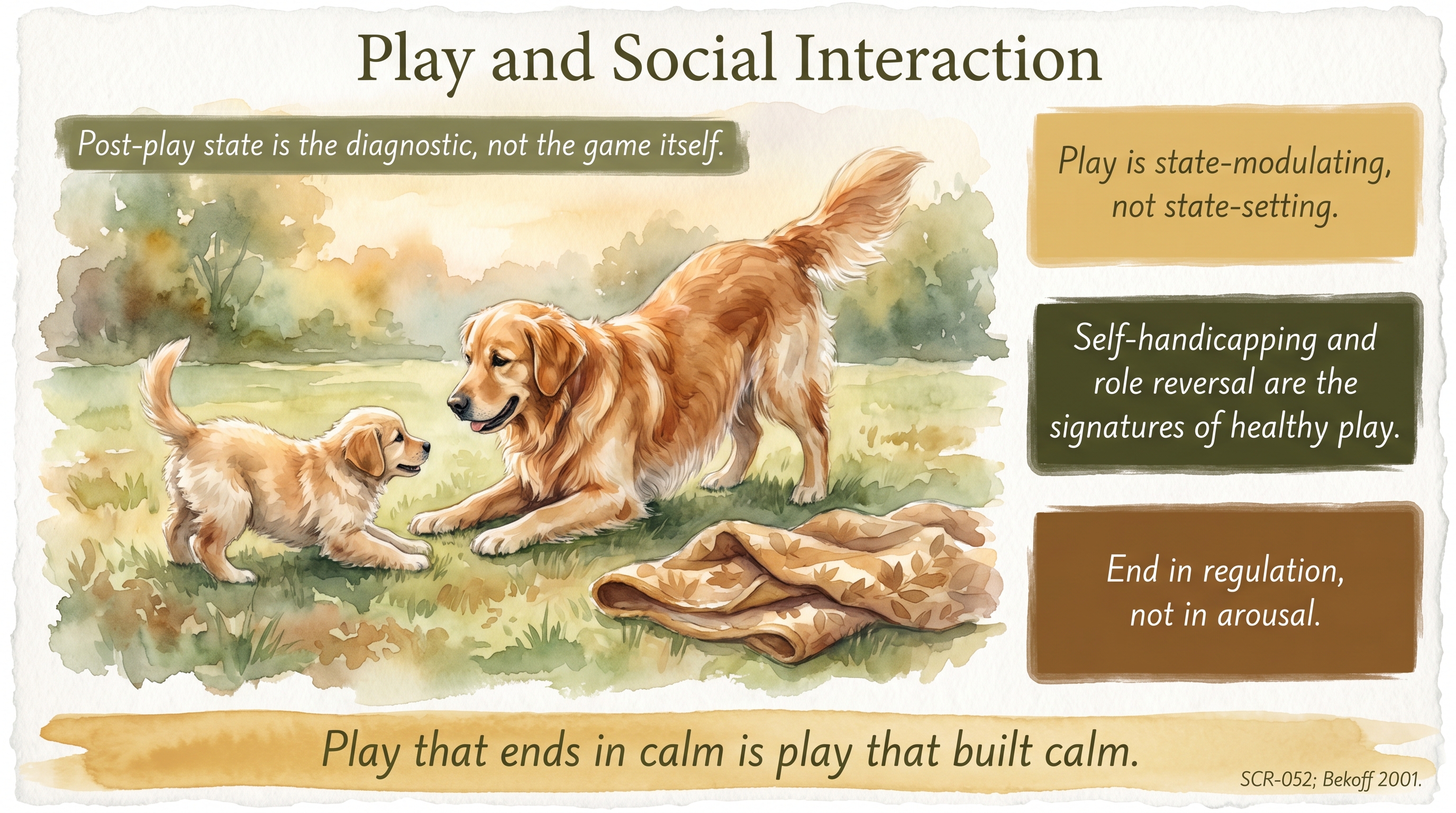
The best play ends quieter than it started.
Key Takeaways
- Play is a state-modulating activity, not a state-setting one. Play takes the dog's current state and amplifies, sustains, or regulates it; a household that uses play as an arousal generator is wiring the dog into arousal as the play default.
- The structural features of canid play (Bekoff play signals; Bauer & Smuts self-handicap and role reversal; Palagi extensions) are signaling discipline in action. Structured play with fluent partners practices the discipline; unstructured play with under-modulated partners trains its absence.
- High-density puppy parties and large public dog parks predictably produce signal-collapse contexts. The dog learns that signals are decorative rather than communicative, and the downstream cost shows up later as degraded canine-signal precision.
- The handler is one of the play partners and the handler's regulation state is the carrier wave the play is delivered through. Short structured bouts with clear endings, in regulated channels, with the post-play return to baseline as the diagnostic, are the operational form of methodology-compatible play.
The Evidence
- Bekoff, M. (1995, 2001), Behaviour, Animal Behaviourcanids (domestic dogs, coyotes, wolves)
Play bows operate as signals that punctuate the play sequence: announcing that what follows is play, re-recruiting a flagging partner, re-framing an ambiguous interaction. Play signals are documented as a structured signaling discipline distinct from agonistic communication. - Bauer, E. B., & Smuts, B. B. (2007), Animal Behaviourdomestic dogs
Documented self-handicap and role reversal in dyadic dog play: the larger or stronger partner pulls punches, the typically dominant partner takes the subordinate role, the asymmetry is what makes the play sustainable. The structural features of play distinguish it from one-sided pursuit or escalation. - Palagi, E., Burghardt, G. M., et al. (2016, 2019), Behavioural Processes; Biological Reviewscanids (multiple species, comparative)
Self-handicap, role reversal, and play-signal discipline documented across canid species. The structural features of play are conserved across the canid family; the documented features are not unique to dogs and reflect a deeper canid social-play architecture.
- Bradshaw, J. W. S., Pullen, A. J., & Rooney, N. J. (2015), Behavioural Processesdomestic dogs
Adult-dog play functions surveyed and reviewed. Play retains its signaling discipline into adulthood and serves social-bonding, communication-practice, and state-modulation functions. Activity that lacks the structural play features (signals, role reversal, mutual engagement) is functionally distinct from play even where the surface behavior resembles it.
- Pellis, S. M., & Pellis, V. C. (2009, 2017), The Playful Brain; Behavioural Processesfoundational play research (rat, comparative mammalian); cross-species
Mammalian rough-and-tumble play has documented effects on prefrontal-cortex maturation, social-skill acquisition, and stress-system regulation, but the effects are contingent on the play retaining its structural features (role reversal, self-handicap, mutual engagement). Play stripped of structure produces different outcomes. Cross-species claim; canine application is conserved-mechanism inference.
- Feuerbacher, E. N., & Wynne, C. D. L. (2015), Journal of the Experimental Analysis of Behaviordomestic dogs
Dogs preferred physical contact (petting) over verbal praise as a reinforcer in operant choice procedures. Verbal praise lost functional reinforcement value rapidly across successive lab sessions; contact did not show the same habituation. Implication for play: the engagement channels with the strongest documented support are touch, body proximity, and calm vocal acknowledgment, not high-pitched verbal cheering.
- Sundman, A.-S. et al. (2019); Koskela, A. et al. (2024)domestic dogs and their owners
Long-term hair-cortisol synchrony (Sundman 2019) and dyad-specific HRV coupling (Koskela 2024) establish that the dog reads the handler's physiology continuously. Play delivered by a regulated handler transmits a different signal than the same play delivered by a dysregulated handler. The handler-state-as-primary-variable principle applies to the play moment.
- JB cohort observationfamily-raised Golden Retrievers
JB cohort observation across families raising Golden Retrievers is that dogs whose primary play-socialization context was high-density mixed-age puppy parties or large public dog parks showed degraded canine-signaling precision compared to dogs whose primary play-socialization context was small numbers of known fluent partners. The observation is consistent with the structured-play literature's requirement that signals be exchanged with partners who can read and respond to them; it has not been tested in a controlled canine cohort. Reported at observed confidence.
- Smith, B. P. et al. (2025), Preventive Veterinary Medicinedomestic dogs (N=3,044 Golden Retrievers, Golden Retriever Lifetime Study)
Household management variables are significant predictors of behavioral trajectory across the first three years. Play-context selection is one variable in the household-management cluster. The cohort finding does not partition play-context type at the precision the methodology operates inside.
- JB Methodology synthesisfamily-raised Golden Retrievers
The methodology's claim that play is a state-modulating activity (taking the dog's current state and amplifying, sustaining, or regulating it), that puppy-party and dog-park contexts predictably produce signal collapse, and that the post-play state is the operational diagnostic for whether the play stayed in band, is JB's synthesis of the canid play-signal literature, the mammalian play-function literature, the praise-versus-contact preference, and the handler-state coupling channels. Each component is documented; the operational synthesis is heuristic.
No controlled canine cohort study has tested structured-play protocols (small numbers of fluent partners, short bouts with clear endings) against unstructured high-density play protocols on matched downstream signaling-precision and arousal-regulation outcomes.
The post-play physiological recovery curve has not been measured in a published canine cohort with the operational precision the methodology implies; the post-play diagnostic is methodology observation rather than instrumented data.
The interaction between play context and downstream attachment-classification stability has not been partitioned in a published canine cohort.
Cross-species play research on prefrontal-cortex maturation has not been replicated in dogs at the precision the rat literature establishes.
SCR References
Sources
Bauer, E. B., \u0026 Smuts, B. B. (2007). Cooperation and competition during dyadic play in domestic dogs, Canis familiaris. Animal Behaviour, 73(3), 489-499.
Bekoff, M. (1995). Play signals as punctuation: The structure of social play in canids. Behaviour, 132(5-6), 419-429.
Bekoff, M. (2001). Social play behaviour: Cooperation, fairness, trust, and the evolution of morality. Journal of Consciousness Studies, 8(2), 81-90.
Bradshaw, J. W. S., Pullen, A. J., \u0026 Rooney, N. J. (2015). Why do adult dogs "play"? Behavioural Processes, 110, 82-87.
Burghardt, G. M. (2005). The Genesis of Animal Play: Testing the Limits. Cambridge, MA: MIT Press.
Feuerbacher, E. N., \u0026 Wynne, C. D. L. (2015). Shut up and pet me! Domestic dogs (Canis lupus familiaris) prefer petting to vocal praise in concurrent and single-alternative choice procedures. Journal of the Experimental Analysis of Behavior, 103(2), 261-271.
Koskela, A., Kareinen, I., Somppi, S., Törnqvist, H., Vainio, O., Kujala, M. V. (2024). Heart rate variability coupling in dog-human dyads. Scientific Reports, 14, 8213.
Palagi, E., Burghardt, G. M., Smuts, B., Cordoni, G., Dall'Olio, S., Fouts, H. N., Řeháková-Petrů, M., Siviy, S. M., \u0026 Pellis, S. M. (2016). Rough-and-tumble play as a window on animal communication. Biological Reviews, 91(2), 311-327.
Palagi, E., Cordoni, G., \u0026 Tarli, S. M. B. (2019). Possible roles of consolation in captive chimpanzees and play asymmetry across canids. Behavioural Processes, 168, 103940.
Pellis, S. M., \u0026 Pellis, V. C. (2009). The Playful Brain: Venturing to the Limits of Neuroscience. Oxford: Oneworld Publications.
Pellis, S. M., \u0026 Pellis, V. C. (2017). What is play fighting and what is it good for? Learning \u0026 Behavior, 45(4), 355-366.
Smith, B. P., Browne, M., Mack, J., Kontou, T. G., \u0026 Tomkins, L. M. (2025). Predictors of behavioral outcomes in 3,044 Golden Retrievers across the first three years of life. Preventive Veterinary Medicine, 234, 106101.
Sundman, A.-S., Van Poucke, E., Svensson Holm, A.-C., Faresjö, Å., Theodorsson, E., Jensen, P., \u0026 Roth, L. S. V. (2019). Long-term stress levels are synchronize