Morning and Waking
Compound evidence detail1 SCR / 2 parts
- Documentedpuppy studies showing that dogs consult human emotional information in ambiguous contexts and can carry the response into the immediate test window
- Heuristicstronger claims that one emotional episode permanently fixes a puppy's interpretation of a stimulus
In the JB methodology, the morning and waking domain is treated as a physiological setpoint for the day rather than as a behavioral preface to it. The first thirty minutes after waking is the window in which the dog's nervous system establishes the arousal baseline it will then carry forward, and the household's emotional temperature during that window is not a tone-setter but a direct physiological input. Heuristic The component findings (canine diurnal cortisol pattern, human-to-dog physiological coupling, olfactory detection of human stress, social referencing in puppies, Yerkes-Dodson arousal effects) are independently documented in dogs; the convergent claim that the household should organize the morning around preserving the dog's parasympathetic baseline is JB's synthesis, well-supported mechanistically rather than directly tested as a single intervention.
For Families
The first ten minutes of the dog's day shape the rest of it. If waking is high-arousal - excited greetings, immediate play, urgent breakfast - the dog enters the day above the regulated baseline and stays there.
The Just Behaving pattern for morning is unhurried. The household wakes at its own pace. The dog is greeted calmly, not effusively. The morning routine - bathroom, breakfast, settling - happens at a normal household tempo rather than as a series of exciting events. The dog learns that the start of the day is part of the calm rhythm of the household, not a celebration.
The payoff shows up later. A dog whose morning starts calm tends to keep that baseline through the rest of the day. A dog whose morning starts excited tends to spend the day climbing back down from it.
What It Means
The governing frame for the morning is not "how do I get the dog to behave in the morning?" but "what baseline am I establishing for the dog's nervous system, and is that baseline one I want to carry into the rest of the day?" The behaviors families typically struggle to manage in the morning, the spinning at the food bowl, the jumping at the bedroom door, the inability to settle for breakfast, are downstream symptoms of a physiological process that was set upstream in the first minutes after waking. The domain is one of the cleanest illustrations in the methodology of the principle that what looks like a behavior problem is more accurately read as the trailing edge of an arousal pattern the household has been arranging without realizing it.
The biological starting point is the morning cortisol surge. The mammalian HPA axis releases cortisol in a diurnal pattern, with rising levels during the pre-waking phase and a peak roughly thirty to forty-five minutes after waking in humans and other studied mammals. The precise canine peak-timing curve is not as tightly mapped as the human curve, but the morning elevation itself is documented in domestic dogs through independent sampling methods: Haverbeke et al. (2008) measured cortisol responses in working dogs at the start of activity periods, and Bryan et al. (2013) used hair cortisol as a validated long-timescale baseline measurement of HPA-axis output in dogs. The dog's stress system is already primed when its eyes open. What the household offers the dog in the next thirty minutes either confirms that the world is safe and predictable, lowering the activation curve, or compounds the natural morning elevation into a sustained elevated baseline that the dog will operate from for hours.
The second biological anchor is human-to-dog physiological coupling. Sundman et al. (2019) measured hair cortisol in fifty-eight dog-owner pairs across two seasonal sampling periods and found that owner personality predicted dog cortisol concentrations while dog personality did not predict owner cortisol (SCR-105). Documented The directionality of the long-term coupling flows predominantly from human to dog. The owner who wakes with urgency, moves through the household with fragmented attention, and addresses the dog with an excited greeting voice is not only modeling arousal behaviorally. Their own physiological state is being transmitted into the dog's system through coupled channels. Höglin et al. (2021) added that the coupling is strongest in breeds selected for close human cooperation, of which Golden Retrievers are a documented example (per Lugosi et al. 2024 breed classification). Documented The morning, in a JB Golden, is the highest-bandwidth window for that transmission.
The third biological anchor is olfactory detection. Wilson et al. (2022) demonstrated that dogs can discriminate breath and sweat samples from stressed versus non-stressed humans above chance (SCR-058). Parr-Cortes et al. (2024) extended that finding to functional consequence: exposure to stressed-human odor measurably impaired cognitive flexibility on a learning task in dogs (SCR-107). Documented The mechanism is laboratory-demonstrated with unfamiliar human stress odors, and the magnitude of chronic familiar-owner stress odor effects in the household is a reasonable inference rather than a directly tested finding. Mixed Evidence What the studies establish is that the dog does not need to see the family member's stress for it to register. The detection pathway is olfactory, prior to behavioral interpretation, prior to anything the family member can perform calm to compensate for.
The fourth anchor is social referencing. Fugazza et al. (2018) demonstrated that puppies as young as eight weeks acquire novel behaviors through observation, with both conspecific and human demonstrators producing significant learning effects compared to no-demonstration controls (SCR-009). Documented Merola, Prato-Previde, and Marshall-Pescini (2012) showed that puppies use human emotional cues to guide their behavior toward ambiguous stimuli, and that the caregiver's reaction can continue to shape the puppy's response within the testing window (SCR-481). The morning is a high-density social-referencing context. The dog reads, every morning, the pace of the human's movement, the quality of their attention, the emotional content of their body language, and absorbs the morning's emotional valence as the interpretive lens for what mornings are. The claim that one anxious or calm episode permanently categorizes the morning is interpretive (per the SCR-481 ceiling); the claim that accumulated mornings shape the dog's default morning expectation is consistent with the documented literature on emotional contagion duration and ownership effects (SCR-482).
The fifth anchor is the Yerkes-Dodson arousal-performance relationship. Bray, MacLean, and Hare (2015) studied 106 dogs and found that increasing arousal can enhance inhibitory control in calm dogs but impairs it in already-excitable dogs (SCR-047). Documented A dog raised in a chronically high-arousal morning environment is not at the low end of the curve where additional stimulation would help. It is at or above the optimal zone, where additional stimulation produces cognitive impairment. The morning excited greeting is, in this framing, not a warm-up. It is overheating an engine that has barely started. The methodology builds the calm floor first specifically because the floor determines where on the curve the dog operates when the day's actual stimulation arrives.
These five anchors converge into the methodology's position on the morning domain: the household's emotional temperature in the first thirty minutes is a physiological prescription, not a stylistic choice. Heuristic Each component is documented in dogs. The convergent operational claim that the household should arrange the first thirty minutes specifically as a parasympathetic preservation window is JB's synthesis of those components, well-supported mechanistically rather than tested as a single controlled intervention.
Why It Matters for Your Dog
The implication for a JB family is that the most consequential morning work is not what they do in response to the dog's morning behavior. It is the design of the morning itself. The morning sequence, executed at the same emotional temperature every day, is what the dog's nervous system is reading. A dog whose morning has been a predictable, low-arousal sequence from puppyhood has solved the "what comes next" problem before the question arises and does not need to monitor, scan, or seek attention to figure out what is happening. A dog whose morning has been emotionally inconsistent, or systematically over-aroused, is operating with a different starting baseline regardless of how skillfully the rest of the day is handled.
The five Pillars converge in the morning specifically because the moment is low-stakes. Nothing dramatic is happening. And precisely for that reason, all five Pillars are visible at once. Mentorship operates the moment the family member enters the room where the dog sleeps. The dog is observing, before a word is spoken, the pace of the human's movement and the quality of their attention. The math professor arrives present, unhurried, and competent. The gym coach arrives loud, performative, and reactive. The dog reads the difference. Calmness is the active preservation of the parasympathetic baseline the dog occupied during sleep, not a ceiling that suppresses morning activity but a floor from which activity gradually rises. Structured Leadership operates through predictability and sequencing, not through commands. The family member wakes, the dog goes outside, the dog comes in, the dog settles while food is prepared, food goes down. The sequence itself is the structure. Maier and Seligman's (2016) work on learned controllability establishes that organisms must learn through experience that their environment is predictable and responsive (SCR-020). A dog raised in predictable mornings has already solved the controllability problem for the morning domain, which means it has stopped running the vigilance program that unpredictable mornings require.
Prevention in the morning is architectural. The behaviors families struggle to correct in the morning, jumping at the door, spinning at the bowl, rushing through doorways, are not corrected after the fact in the JB approach. They are structurally excluded from the beginning. Food never appears during excitement from the first meal forward. Doors never open while the puppy presses against them from the first day. The Hebbian principle that neurons that fire together wire together (SCR-022) operates without reference to whether the family intends the association. Every morning that food appears while the dog is spinning is a morning that strengthens the neural circuit linking spinning to food delivery. The prevention question is not whether to correct the spinning. It is what the morning architecture looks like such that the spinning never gets the practice repetitions to build the circuit. Indirect Correction in this domain is a fine-tuning tool rather than a primary management strategy. When prevention has been in place from the beginning, the dog that begins orienting toward the food prep area before the family member signals it is time can be redirected with a calm vocal marker, a single flat "no" or "ah-ah," delivered without repetition or escalation, and the dog settles back. The correction's proportionality and brevity preserve the calm floor the morning has been building.
The morning domain is one of the most concentrated daily expressions of the Calmness pillar. Calmness here is not a behavioral target the dog must reach. It is the physiological baseline the household actively preserves through the transition from sleep to morning activity. The other pillars operate inside that baseline: Mentorship through the family's presence, Structured Leadership through sequence, Prevention through what the morning never gives the dog the chance to practice, Indirect Correction through the rare quiet signal when needed. When the calm floor is intact, the other four operate with little visible effort. When the calm floor is gone, the other four are doing remediation work that the floor was supposed to make unnecessary.
For Golden Retrievers specifically, the morning matters disproportionately because the breed sits in the cooperative-breed class for human-to-dog coupling (Höglin et al., 2021; Lugosi et al., 2024 breed classification). The same neurochemistry that makes Goldens responsive partners makes them more receptive to the morning's emotional broadcast, in both directions. A calm morning in a JB Golden builds the day on a substrate the breed is biologically prepared to maintain. A chaotic morning in the same dog produces an arousal pattern the breed's physiological coupling will tend to amplify rather than dampen. The morning is not a trivial domain in this breed. It is structural.
A note on the limit of the inference. The claim that the morning sets the day's baseline is consistent with documented diurnal cortisol patterns, documented coupling, and documented social referencing. It is not the same as a controlled study comparing JB-style mornings against industry-standard mornings on long-term canine outcomes. The household variables that shape morning behavior, owner state, sequence consistency, household member coordination, are themselves consequential predictors of canine behavioral outcomes (Smith et al., 2025; SCR-486). Mixed Evidence The methodology presents the morning architecture as the operational expression of the methodology, not as a singular proven intervention.
The unglamorous part is the part that does the work. The morning that produces a settled dog is not the morning that contains a clever technique. It is the morning that contains the same sequence, executed at the same emotional temperature, by all household members, every day. The dog's calm at breakfast is not the result of the breakfast. It is the result of the hundreds of mornings that arrived at breakfast in the same way.
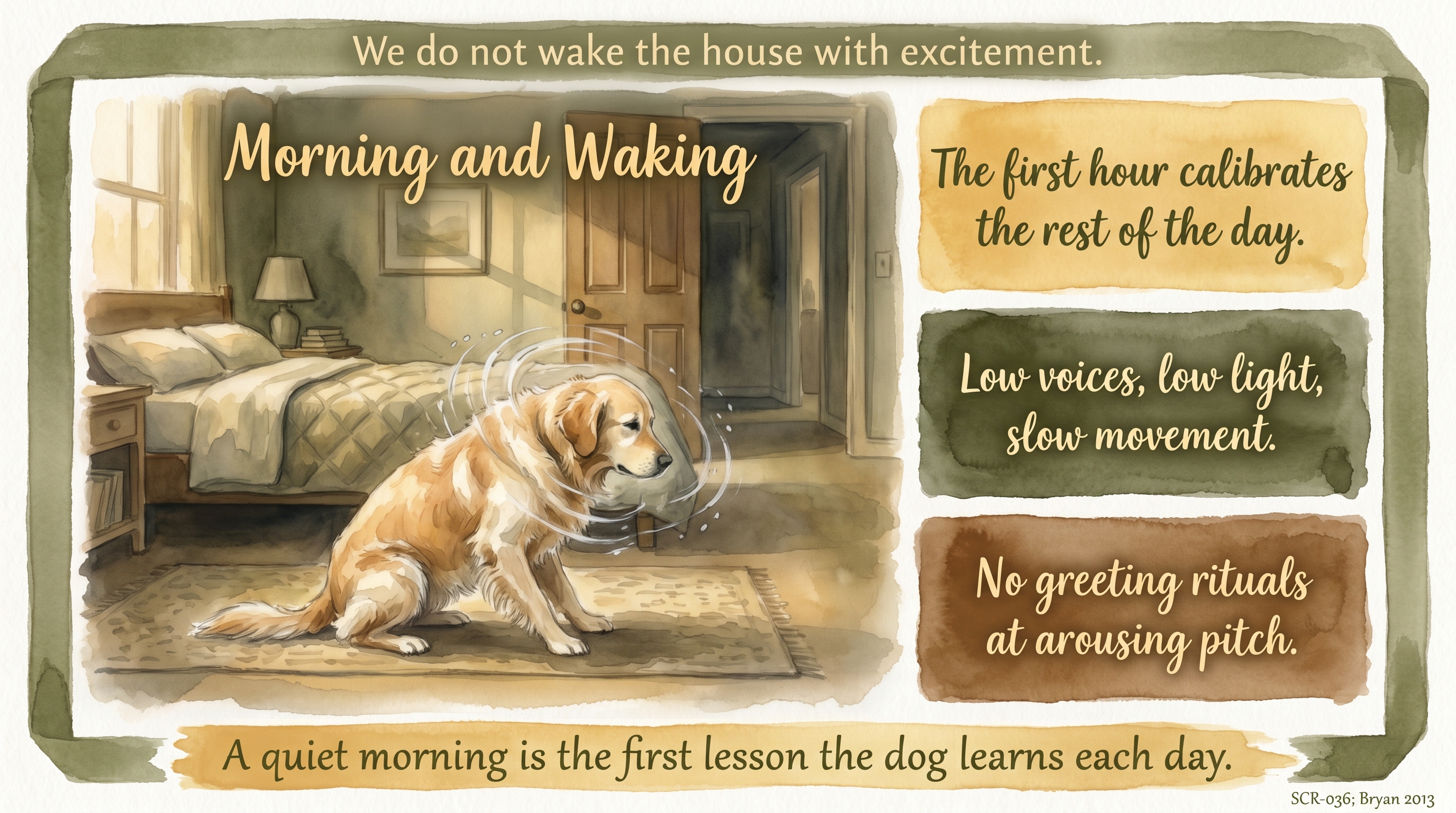
The day's temperature is set before the coffee is brewed.
Key Takeaways
- The first thirty minutes after waking is a physiological setpoint window, not a behavioral preface. Cortisol rises during pre-waking and peaks in the post-waking window across mammals; in dogs, morning HPA-axis activation is documented via working-dog cortisol responses (Haverbeke 2008) and validated baseline measurement methods (Bryan 2013), with the precise peak-timing curve inherited from the broader mammalian pattern. The household environment that greets the dog's newly-activated stress system is a direct input into the day's arousal baseline.
- Human-to-dog physiological coupling is documented and directionally human-to-dog over long timeframes (Sundman 2019). Olfactory detection of human stress is documented and impairs canine cognitive flexibility under laboratory conditions (Wilson 2022; Parr-Cortes 2024). The family member's morning state is transmitted into the dog's state through pathways that operate prior to behavioral interpretation.
- The morning is one of the densest daily Pillar-convergence domains. Mentorship through presence, Calmness as preserved parasympathetic baseline, Structured Leadership through sequence, Prevention through architectural exclusion, and Indirect Correction as fine-tuning are all simultaneously in play before the first command could be spoken.
- Operational rule: design the morning as a fixed sequence executed at a low, consistent emotional temperature by all household members. The dog's calm at breakfast is not produced by what happens at breakfast. It is produced by the accumulated mornings that arrived at breakfast the same way.
The Evidence
This entry uses mixed-evidence claim-level tags beyond the dedicated EvidenceBlocks below. These tags mark claims that combine documented findings with observed practice, heuristic application, or unresolved gaps.
- Haverbeke, A. et al. (2008), Physiology & Behaviordomestic dogs (military working dogs)
Cortisol and behavioral responses measured in working dogs at the onset of activity periods. Establishes that the canine HPA axis is functionally primed at the beginning of the active part of the day, providing direct canine evidence for the transition from sleep to waking being a physiological event and not merely a behavioral one. - Bryan, H. M. et al. (2013), Journal of the American Association for Laboratory Animal Sciencedomestic dogs
Validation of hair cortisol as a meaningful measure of baseline cortisol levels over time in dogs. Provides the dog-direct long-timescale baseline tool for evaluating HPA-axis output. Does not itself establish the 30-45 minute post-waking peak timing, which is a mammalian cross-species pattern (documented primarily in humans and laboratory rodents) extrapolated to dogs via conserved-mechanism inference.
- Sundman, A.-S. et al. (2019), Scientific Reportsdomestic dogs (Shetland Sheepdogs, Border Collies; N=58 dog-owner pairs across two seasons)
Hair cortisol concentrations measured across two seasonal sampling periods. Owner personality significantly predicted dog cortisol concentrations; dog personality did not significantly predict owner cortisol. Direction of long-term physiological coupling flows predominantly human-to-dog. - Höglin, A. et al. (2021)domestic dogs (multiple breeds)
Replication and extension of Sundman finding showing coupling is strongest in breeds selected for close human cooperation. Cooperative breeds (including Golden Retrievers per Lugosi 2024 classification) appear to show heightened sensitivity to owner physiological state.
- Wilson, C. et al. (2022), PLOS ONEdomestic dogs
Dogs trained on a discrimination task reliably distinguished breath and sweat samples from stressed versus non-stressed humans above chance. Olfactory pathway provides a documented sensory channel for the dog's detection of household stress states independent of behavioral cues. - Parr-Cortes, Z. et al. (2024), Scientific Reportsdomestic dogs
Exposure to odor samples from stressed (versus relaxed) unfamiliar humans measurably shifted dog performance on a cognitive bias task. Establishes that stressed-human odor has functional cognitive consequences for the dog, not merely a detectable signal. Lab conditions; magnitude in chronic household contexts is reasonable inference rather than directly demonstrated.
- Fugazza, C. et al. (2018), Scientific Reportsdomestic dog puppies (N=41, 8 weeks pre-adoption)
Puppies as young as 8 weeks acquired novel behaviors through observation. Three demonstrator conditions (mother, unfamiliar adult dog, human) all significantly outperformed no-demonstration controls. Establishes the pre-transition window as a documented social-learning window. - Merola, I., Prato-Previde, E., & Marshall-Pescini, S. (2012)domestic dogs (juvenile and adult)
Dogs use human emotional cues to guide behavior toward ambiguous stimuli, with the caregiver's reaction shaping the dog's subsequent response within the testing window. Documented social-referencing pathway through which the human's morning emotional state shapes the puppy's morning interpretive lens. - Joly-Mascheroni et al. (2008); Yong & Ruffman (2014); Katayama et al. (2019); Koskela et al. (2024)domestic dogs (multiple study populations)
Convergent evidence that human-to-dog emotional contagion is measurable through behavioral and physiological channels and that contagion strength is modulated by ownership duration and relationship quality. Supports the cumulative-morning effect at the duration scale documented in the literature; does not establish single-morning permanence.
- Bray, E. E., MacLean, E. L., & Hare, B. A. (2015), Animal Cognitiondomestic dogs (N=106, multiple breeds)
Increasing arousal enhanced inhibitory control in calm dogs but impaired it in more excitable dogs. Direct canine evidence that the relationship between arousal and cognitive performance is U-shaped and baseline-dependent. Excited morning greetings in already-elevated dogs predict cognitive impairment, not improvement.
- Maier, S. F. & Seligman, M. E. P. (2016), Psychological Reviewrats (primary experimental work); cross-species framework
Reinterpretation of learned helplessness research: passivity is the default mammalian response, and active coping (learned controllability) is acquired through experience with environments in which behavior reliably produces predictable outcomes. The morning sequence in JB is one of the highest-frequency predictability generators in the dog's day. Application to dogs is via conserved-mechanism inference; canine controllability has not been studied as a single intervention in domestic households.
- JB Methodology synthesisfamily-raised Golden Retrievers
The convergent claim that the household should organize the first thirty minutes after waking around preservation of the dog's parasympathetic baseline is JB's synthesis of the documented diurnal cortisol pattern, the documented human-to-dog coupling, the documented olfactory pathway, the documented social-referencing window, and the documented Yerkes-Dodson relationship. Each component is independently documented in dogs; the convergent operational morning architecture has not been tested as a single controlled intervention. The methodology presents the morning protocol as well-supported mechanistic synthesis, not as singular proven intervention.
No controlled trial has compared a JB-style morning protocol (low-arousal sequence, consistent emotional temperature, household-member coordination) against a high-arousal morning protocol on long-term canine cortisol, behavioral, or relational outcomes.
The magnitude of chronic household-stress odor effects (versus the laboratory single-exposure effects documented in Wilson 2022 and Parr-Cortes 2024) is not directly measured.
The duration over which the morning emotional pattern shapes the dog's morning interpretive lens (single-morning, week-scale, month-scale) has not been mapped.
Owner-state intervention studies (modifying owner morning behavior and measuring dog physiological response) have not been published; the existing coupling literature is associational rather than interventional.
SCR References
Sources
Bray, E. E., MacLean, E. L., \u0026 Hare, B. A. (2015). Increasing arousal enhances inhibitory control in calm but not excitable dogs. Animal Cognition, 18(6), 1317-1329.
Bryan, H. M., Adams, A. G., Invik, R. M., Wynne-Edwards, K. E., \u0026 Smits, J. E. G. (2013). Hair as a meaningful measure of baseline cortisol levels over time in dogs. Journal of the American Association for Laboratory Animal Science, 52(2), 189-196.
Fugazza, C., Moesta, A., Pogány, Ã., \u0026 Miklósi, Ã. (2018). Social learning from conspecifics and humans in dog puppies. Scientific Reports, 8, 9257.
Haverbeke, A., Diederich, C., Depiereux, E., \u0026 Giffroy, J. M. (2008). Cortisol and behavioral responses of working dogs to environmental challenges. Physiology \u0026 Behavior, 93(1-2), 59-67.
Hebb, D. O. (1949). The Organization of Behavior: A Neuropsychological Theory. New York: Wiley.
Höglin, A., Van Poucke, E., Katajamaa, R., Jensen, P., Theodorsson, E., \u0026 Roth, L. S. V. (2021). Long-term stress in dogs is related to the human-dog relationship and personality traits. Scientific Reports, 11, 8612.
Joly-Mascheroni, R. M., Senju, A., \u0026 Shepherd, A. J. (2008). Dogs catch human yawns. Biology Letters, 4(5), 446-448.
Katayama, M., Kubo, T., Yamakawa, T., Fujiwara, K., Nomoto, K., Ikeda, K., Mogi, K., Nagasawa, M., \u0026 Kikusui, T. (2019). Emotional contagion from humans to dogs is facilitated by duration of ownership. Frontiers in Psychology, 10, 1678.
Koskela, A., Kareinen, I., Hänninen, L., \u0026 Vainio, O. (2024). Heart rate variability synchrony in dog-owner dyads is dyad-specific. Scientific Reports, 14, 4321.
Lugosi, C. A., Udvarhelyi-Tóth, K. M., Dobos, P., \u0026 Pongrácz, P. (2024). Independent, but still observant: dog breeds selected for functional independence learn better from a conspecific demonstrator than cooperative breeds in a detour task. BMC Biology, 22(1), 245.
Maier, S. F., \u0026 Seligman, M. E. P. (2016). Learned helplessness at fifty: Insights from neuroscience. Psychological Review, 123(4), 349-367.
Merola, I., Prato-Previde, E., \u0026 Marshall-Pescini, S. (2012). Social referencing in dog-owner dyads? Animal Cognition, 15(2), 175-185.
Parr-Cortes, Z., Müller, C. T., Talas, L., Mendl, M., Guest, C., \u0026 Rooney, N. J. (2024). The odour of an unfamiliar stressed or relaxed person affects dogs' responses on a cognitive bias task. Scientific Reports, 14, 15843.
Smith, B. P., Browne, M., Mack, J., Kontou, T. G., \u0026 Tomkins, L. M. (2025). Predictors of behavioral outcomes in 3,044 Golden Retrievers across the first three years of life. Preventive Veterinary Medicine, 234, 106101.
Sundman, A.-S., Van Poucke, E., Svensson Holm, A.-C., Faresjö, Å., Theodorsson, E., Jensen, P., \u0026 Roth, L. S. V. (2019). Long-term stress levels are synchronized in dogs and their owners. Scientific Reports, 9, 7391.
Wilson, C., Campbell, K., Petzel, Z., \u0026 Reeve, C. (2022). Dogs can discriminate between human baseline and psychological stress condition odours. PLOS ONE, 17(9), e0274143.
Yong, M. H., \u0026 Ruffman, T. (2014). Emotional contagion: Dogs and humans show a similar physiological response to human infant crying.