Movement and Exercise
Compound evidence detail1 SCR / 2 parts
- Documentedthe cross-species behavioral principle that parasympathetic-dominant autonomic states support social engagement, with direct canine HRV evidence (Berg 2026, Wormald 2017, Koskela 2024)
- Ambiguousthe polyvagal-theory-specific neuroanatomical mechanism, with the Grossman 2026 critique and Porges 2026 rebuttal active in current literature
In the JB methodology, the movement and exercise domain is treated as one of the most consequential points of divergence between the approach and the dominant dog-keeping culture. The industry's governing claim that a tired dog is a good dog is a neurochemical inversion, and the methodology names it directly. Heuristic Exercise is essential to canine health at cardiovascular, musculoskeletal, neurological, and social dimensions. The methodology's objection is not to exercise. It is to the use of exhaustion as a behavioral management strategy, and to the cultural confusion between post-exertion recovery and parasympathetic baseline. The component findings (documented canine Yerkes-Dodson curve, direct canine HRV evidence distinguishing physical exertion from emotional arousal, post-learning play consolidation findings in Labrador Retrievers, Golden Retriever breed-specific low resting heart rate, cross-species sympathetic-parasympathetic activation science) are established in dogs. The convergent operational claim that structured movement within the Five Pillar framework produces better long-term behavioral outcomes than exhaustion-for-management is JB's synthesis, well-supported mechanistically rather than tested as a single controlled intervention.
For Families
A tired dog is not necessarily a good dog. That is one of the most expensive misunderstandings in the pet industry. A dog exhausted by high-arousal exercise is a dog whose nervous system has been pushed into excitement and then collapse, and the underlying baseline is no calmer than it was before.
Just Behaving treats movement as part of the calm rhythm of the day rather than as a behavioral fix for excitement. A daily walk that is calm and connective does more for a dog than an hour of fetch that ends in an over-aroused crash. Sniffing, exploring, and moving alongside the family at a regulated pace builds the parasympathetic baseline the framework rests on.
This does not mean Goldens should not run. Of course they should. The point is that running, fetching, and high-arousal play sit on top of a calm baseline, not in place of one. Get the baseline first. The exciting movement is the addition, not the foundation.
What It Means
The neurochemical frame is where the confusion begins and where it has to end. Exercise activates the sympathetic nervous system and elevates catecholamine output. Vigorous physical activity (runs, fetch sessions, extended high-arousal play) produces a sympathetic arousal state during and immediately after the activity. That arousal state is followed by recovery, during which the nervous system shifts back toward parasympathetic dominance and the dog becomes behaviorally calmer. Families observing this pattern conclude that exercise produced the calm. What the exercise actually produced was exhaustion following sympathetic activation, with the calm being the recovery phase of the sympathetic surge, not a baseline reduction. These are not the same state.
The distinction matters because the two states are neurochemically different in ways that determine what the dog is available for. A dog that is calm because its resting nervous system baseline is parasympathetically dominant (the condition the methodology builds through the calm floor) is available for learning, for social referencing, for the kind of relaxed attentiveness that characterizes a well-mentored Golden Retriever at rest. A dog that is temporarily quiet because it has just run a mile is in recovery, not available for much, and destined to return to its elevated activation baseline as soon as recovery is complete. The methodology is not opposed to the post-exercise settle. It is opposed to the confusion that treats the post-exercise settle as proof that the dog's daily baseline has been lowered. Exercise moves the dog temporarily. The baseline is where the dog returns to when the movement is done, and the baseline is what the architecture of the rest of the day has produced.
The Yerkes-Dodson evidence is documented in dogs directly. Bray, MacLean, and Hare (2015, Animal Cognition) studied 106 dogs and found that increasing arousal enhanced inhibitory control in calm dogs but impaired it in more excitable dogs (SCR-047). Documented The canine arousal-performance relationship is U-shaped and baseline-dependent. This is the most important guardrail in the domain: the methodology does not claim that arousal is always bad for learning or performance. It claims that arousal effects depend on the dog's current baseline, and that a dog raised in a chronic high-arousal environment is not at the low end of the Yerkes-Dodson curve where additional stimulation would help. It is already at or above the optimal zone. More exercise, as additional sympathetic activation, pushes that dog further over the peak, producing behavioral chaos during the exercise and a collapse into exhaustion afterward. The calm that follows is real, and temporary, and not a baseline change.
The timing evidence refines the picture further. Affenzeller et al. (2017, Physiology \u0026 Behavior) demonstrated that playful activity delivered post-learning improved training performance in Labrador Retrievers, with effects detectable up to one year later (SCR-047 via Affenzeller stream). Documented The arousal timing matters: arousal during learning can impair encoding in excitable dogs; arousal after learning can enhance consolidation through a distinct pathway. The operational implication is about sequence. A dog that exercises vigorously before a mentorship moment (a morning walk followed immediately by a meal that should be a calm relational interaction) is entering the relational moment with a sympathetically activated nervous system. A dog that exercises after the mentorship work is done is consolidating the learning through a different mechanism. Exercise is not the problem. Exercise in the wrong sequence, or exercise deployed as a substitute for relational architecture, is the problem.
The HRV evidence from Berg et al. (2026, Applied Animal Behaviour Science) adds a distinction the methodology depends on. Berg's team measured HRV across behavioral states and found that heart rate variability reliably distinguished physical exertion from emotional arousal even when the physical activity levels were nearly identical (SCR-013). Documented Spontaneous environmental sniffing and food-motivated searching showed significantly different HRV profiles: the food-motivated search was more sympathetically activating, not because the activity was more physically demanding, but because the anticipatory SEEKING-system engagement added a layer of arousal beyond the physical (SCR-014). Documented A vigorous run in which the dog is highly excited, chasing, competing, or stimulated by other dogs, is not neurochemically equivalent to a brisk walk in which the dog is sniffing, exploring, and maintaining a calm attentive orientation to the family member. Both are exercise. They are not equivalent arousal experiences. The family that believes it is providing the same thing by offering either session is not tracking what the dog's nervous system is actually receiving.
The breed-specific anchor for Goldens comes from the cardiac literature. Chetboul et al. (2025, Frontiers in Veterinary Science, the AI-COLLAR study) measured resting heart and respiratory rates in 703 dogs in their natural home environments using a non-invasive biometric device across a long-term international prospective cohort. Golden Retrievers exhibited a statistically significantly lower resting heart rate than the general canine population (approximately 57.9 bpm), consistent with Doxey and Boswood's (2004) earlier HRV work establishing breed differences in cardiac autonomic regulation (SCR-046). Documented The finding is a documented breed-specific cardiac characteristic, not merely a behavioral observation. Goldens are physiologically predisposed toward parasympathetic baseline dominance when the environment allows it. The exhaustion-for-management strategy is working against the breed's biology in a specific, measurable way. The SCR-046 rhetorical ceiling applies: "built for calm" is a defensible summary of the physiological data; "incapable of arousal dysregulation" is not. The predisposition is real. The predisposition is still a predisposition, and household variables determine whether the breed-level biology is expressed or suppressed.
Why It Matters for Your Dog
The methodology's alternative to the exhaustion model is structured movement: physical activity designed and paced to serve the dog's needs while maintaining the Five Pillar framework, rather than temporarily overwhelming it. Structured movement has a set of distinguishing features. It begins and ends at a calm pace, so the transition into and out of the activity does not constitute high-arousal activation. It includes periods of sniffing, exploratory movement, and attentive orientation to the environment and to the family member, the parasympathetically tonifying activities that are distinct from the sympathetically activating activities of vigorous chase, tug, and fetch. It maintains the family member in the Mentorship role rather than in the role of arousal-generator. The family member is present, attentive, and calm rather than producing the excitement that drives the dog's activity. And it is calibrated to the dog's developmental stage and established baseline, not to a theoretical exhaustion target.
A useful everyday analogy is the difference between a yoga class and an intense aerobics class for a person who is already chronically stressed. Both are physical activity. The aerobics class may produce more calories burned. But for the person whose nervous system is already running hot, the aerobics class produces another sympathetic activation, and the recovery from it does not change the underlying chronic arousal pattern. The yoga class (structured, paced, attentive to the nervous system's state throughout) does something the aerobics class cannot: it builds the capacity for parasympathetic engagement, which is exactly what the chronically stressed person needs. The methodology's exercise approach is yoga, not aerobics. The analogy is heuristic, but the neurochemical distinction it illustrates is documented.
Window-of-tolerance expansion is one of the most important uses of structured movement in the methodology. The window of tolerance is the range of arousal within which the dog can maintain regulatory function, the zone between too little stimulation (boredom, lethargy) and too much (over-threshold dysregulation). A dog raised with a calm floor and structured movement develops a window wide enough to accommodate the normal arousal demands of household life, including visitors, other dogs, walks in novel environments, and veterinary handling. Structured movement contributes to window expansion by repeatedly cycling the dog's arousal through the window in a controlled context. A structured walk that includes a brief active interval, followed by a return to leash walking and settled sniffing, followed by another brief active interval, and that ends with a calm return home and a rest period, is teaching the dog, through accumulated practice, that arousal rises and falls and that the falling is as normal as the rising. This is not teachable through narration. It is built through experience. The Hebbian principle operates on the arousal-trajectory circuit the same way it operates on any circuit: neurons that fire together wire together (SCR-022), and the structured session is wiring the rise-and-fall pattern that gives the adult dog its regulatory flexibility.
The movement domain is where Calmness work is most commonly abandoned for the wrong reason. A family that has been doing the slow, unglamorous architectural work of the calm floor can be pulled off course by the folk-wisdom confidence of "he just needs more exercise." The advice is not merely wrong in the methodology's frame; it is corrosive, because it substitutes sympathetic exhaustion for parasympathetic stability, and because the temporary post-exercise calm reads as confirmation that the strategy is working. The calm floor is built by architecting the environment so that the nervous system settles on its own baseline. Structured movement is one of the supporting activities that serves the floor. Exhaustion-for-management is an alternative strategy that fights the floor by chronically adding sympathetic load and calling the recovery "calm." Calmness is the floor. Movement is designed to serve it.
The governing decision rule for the exercise domain is operationally compact: every exercise session should leave the dog in a neurological state equal to or better than where it began, not merely physically exhausted. A dog that returns from a thirty-minute walk with elevated arousal, continued activation, and behavioral difficulty settling has not been served by its exercise. A dog that returns from the same thirty-minute walk in an attentive, moderately tired, easily settled state has been served precisely. The test is not distance, pace, or intensity. The test is the autonomic state the dog is returning home in, and whether that state supports or undermines the rest of the day's architecture.
The distinction between natural activity and manufactured arousal belongs in the same operational frame. Natural activity is the physical engagement that arises from the normal texture of the dog's life: exploring the environment, navigating social interactions with other dogs, engaging in moderate play, moving through daily routines. Manufactured arousal is physical engagement imported by the family member specifically as a behavior-management or bonding strategy through high-intensity stimulation. The distinction matters because manufactured arousal builds expectations. A dog that receives vigorous fetch sessions, high-arousal play, and constant physical stimulation as its primary mode of family engagement develops an appetite for that level of stimulation. The SEEKING system adapts to the level of stimulation it receives, and chronic overstimulation can force neurological adaptation in which the baseline valuation of low-intensity inputs shifts, requiring progressively higher stimulation to achieve the same hedonic response. Heuristic The claim that chronic overstimulation produces a household-scale shift in the SEEKING system is heuristic, extrapolated from the documented SEEKING-system neurochemistry rather than directly tested in household canine populations. What families report, "the more I exercise him, the more exercise he needs," is consistent with this mechanism. It is also consistent with having raised the dog's stimulation baseline through the accumulated exposure rather than having met a fixed exercise requirement.
The first common mistake in the domain is the belief that exercise is the primary solution to behavioral problems. A dog that is jumping on guests, destroying furniture, or unable to settle in the evening is not, in the methodology's read, expressing an exercise deficit. It is expressing an arousal baseline problem, a nervous system that has not been raised with the calm floor the methodology builds. Adding more exercise to this dog is adding more sympathetic activation to an already sympathetically dominant system. The behavioral calm that follows exhaustion is temporary. The solution is Calmness-Pillar work: reducing the overall arousal demands of the household environment, building predictable structure, and allowing the nervous system to find its actual baseline, which, in a Golden Retriever with an innate resting heart rate around 57.9 bpm (Chetboul et al., 2025), is lower than the general canine population and primed for parasympathetic dominance when the environment allows it.
The second common mistake is using exercise as the primary bonding strategy. A family member who generates excitement through fetch, chase, and high-energy play is bonding through manufactured arousal rather than through the structured companionship the methodology describes. The relationship will form. The dog will form attachments to this family member. But the attachment is indexed heavily to excited engagement, which means the family member's ordinary non-excited presence is less interesting to the dog. This produces the paradox of the dog that loves its family member during play and ignores them during ordinary household time, exactly the pattern that indicates a relationship built on excitement rather than on the relational texture the methodology builds. The fix is not less play. It is more ordinary companionship alongside the play, so that the family member's baseline presence is itself interesting, and play is an occasional feature of the relationship rather than the relationship's primary mode.
A note on the limit of the inference. The claim that structured movement produces better long-term behavioral outcomes than exhaustion-for-management is consistent with the documented Yerkes-Dodson evidence (Bray 2015, Affenzeller 2017), the documented HRV distinction between physical exertion and anticipatory arousal (Berg 2026), the documented breed-specific parasympathetic predisposition in Goldens (Chetboul 2025; Doxey \u0026 Boswood 2004), and the documented SEEKING-system anticipation-versus-consummation distinction. It is not the same as a single controlled trial in which dogs were randomly assigned to structured-movement versus exhaustion-for-management protocols and followed for long-term behavioral outcomes. Household variables that shape exercise practice, owner state, schedule consistency, and household-member coordination are themselves consequential predictors of canine behavioral outcomes (Smith et al., 2025; SCR-486). Mixed Evidence The convergent guidance the methodology carries is well-supported mechanistic synthesis, not singular proven intervention. The methodology presents the position with the boundary visible.
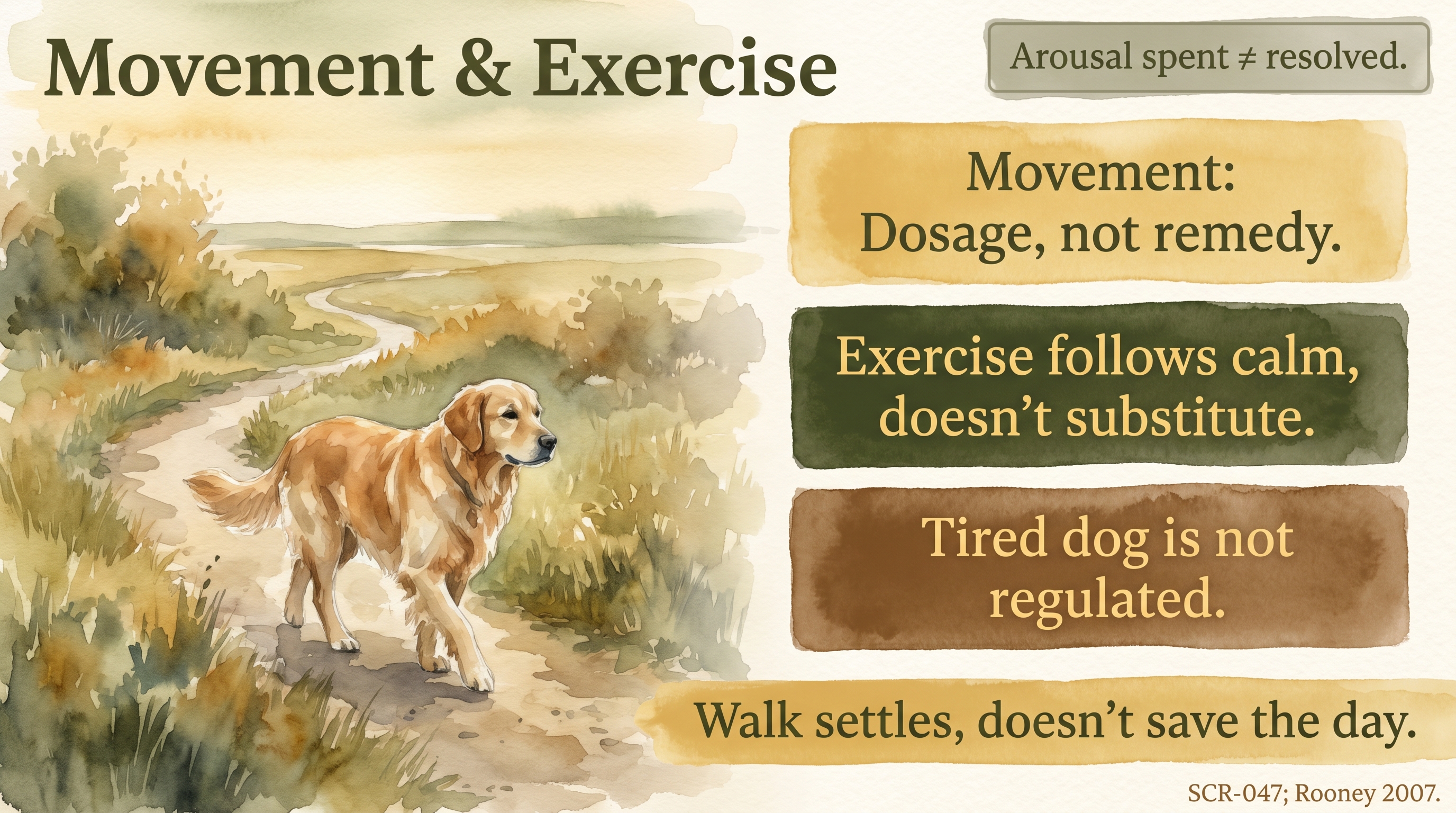
Tired is not the same as regulated.
Key Takeaways
- The exhaustion-for-management model is a neurochemical inversion. Exercise activates the sympathetic nervous system; the calm that follows exercise is recovery from that activation, not a baseline reduction. The resting nervous system baseline is what the calm floor builds through architecture, not what exertion produces through fatigue.
- Canine arousal-performance is U-shaped and baseline-dependent (Bray et al. 2015, SCR-047). Arousal can enhance inhibitory control in calm dogs and impair it in already-excitable dogs. The methodology is not anti-arousal; post-learning play improves consolidation in dogs (Affenzeller 2017). The operational critique is exhaustion as management, not arousal itself.
- HRV distinguishes physical exertion from emotional arousal even at matched activity levels (Berg et al. 2026, SCR-013). Anticipatory SEEKING-system engagement adds an arousal layer beyond the physical (SCR-014). A vigorous chase session and a brisk sniffing walk are both exercise; they are not equivalent autonomic experiences.
- Operational rule: every exercise session should leave the dog in a neurological state equal to or better than where it began, not merely physically exhausted. The test is not distance or intensity; it is the autonomic state the dog returns home in, and whether that state supports the rest of the day's architecture.
The Evidence
This entry uses mixed-evidence claim-level tags beyond the dedicated EvidenceBlocks below. These tags mark claims that combine documented findings with observed practice, heuristic application, or unresolved gaps.
- Bray, E. E., MacLean, E. L., & Hare, B. A. (2015), Animal Cognitiondomestic dogs (N=106, multiple breeds)
Increasing arousal enhanced inhibitory control in calm dogs but impaired it in more excitable dogs. Direct canine evidence for the U-shaped arousal-performance relationship. A chronically high-arousal household is not at the low end of the curve where additional stimulation would help; it is past the peak, where additional stimulation produces cognitive impairment.
- Affenzeller, N. et al. (2017), Physiology & Behavior, 168, 62-73Labrador Retrievers
Playful activity delivered post-learning improved training performance with effects detectable up to one year later. Establishes that arousal effects depend on timing relative to the learning moment: arousal during learning can impair encoding in excitable dogs; arousal after learning can enhance consolidation. The methodology does not claim arousal is always bad for learning; it claims that the sequence of arousal and relational work matters. - Affenzeller, N. (2020)domestic dogs
Extension finding: dog-human play post-learning improved re-training performance up to one year out. Supports the consolidation-mediated mechanism and the sequence-dependence of arousal effects. - Collins-Pisano, C. et al. (2025)domestic dogs (detection dogs)
Arousal timing during and post-training affects memory consolidation. Converging canine evidence that arousal timing, not arousal presence, is the key variable for learning outcomes.
- Berg et al. (2026), Applied Animal Behaviour Science, 296, 106899domestic dogs
Heart rate variability reliably distinguishes behavioral states. Spontaneous environmental sniffing and food-motivated searching show significantly different HRV profiles despite nearly identical physical activity levels. The food-motivated search is more sympathetically activating because the anticipatory SEEKING-system engagement adds an arousal layer beyond the physical. A high-arousal chase and a calm sniffing walk are not equivalent autonomic experiences. - Wormald et al. (2017), Physiology & Behaviordomestic dogs
Reduced HRV in dogs with anxiety-related behavior problems. Convergent evidence that chronic sympathetic elevation registers as depressed autonomic variability, providing physiological support for the claim that cumulative exercise-as-management costs are visible in autonomic measurements.
- Panksepp, J. (1998), Affective Neurosciencemultiple mammals (primarily rats); cross-species framework
The SEEKING system is activated by anticipation of reward, not by habituated consumption. Foundational mammalian affective-neuroscience framework established primarily through rodent work. Conserved-mechanism extension to dogs is the standard inference in comparative affective neuroscience. - Bhave et al. (2024); Cetintav et al. (2025), Applied Animal Behaviour Sciencedomestic dogs
Canine operationalization of Panksepp's seven affective categories using machine-learning classification of facial expression and body posture (dataset: 2,184 images). Canine-direct behavioral evidence that a SEEKING-analog affective state is measurable in dogs. Relevant to the exercise domain because anticipatory motivational states (chase, pursuit, food-search) carry autonomic arousal beyond the physical cost of the activity. Dog-specific PET imaging of SEEKING-system dopaminergic engagement during anticipatory arousal has not been established.
- Chetboul, V. et al. (2025), Frontiers in Veterinary Science, 12, 1667355 (AI-COLLAR study)domestic dogs (N=703, multiple breeds, international prospective cohort)
Long-term non-invasive cardiorespiratory monitoring in home environments. Golden Retrievers show a statistically significantly lower resting heart rate (approximately 57.9 bpm) than the general canine population, consistent with a breed-level genetic predisposition toward parasympathetic dominance. The predisposition is a population-level characteristic, not a guarantee for any individual dog. - Doxey, S. & Boswood, A. (2004), Veterinary Recorddomestic dogs (multiple breeds including Golden Retrievers)
Earlier HRV work establishing breed differences in cardiac autonomic regulation. Converges with the AI-COLLAR findings to establish that the Golden Retriever parasympathetic baseline is a measurable physiological characteristic, not merely behavioral observation.
- JB Methodology / SEEKING-system extrapolationmultiple mammals (primary) with canine anchoring
The claim that chronic manufactured-arousal exposure produces a household-scale shift in the SEEKING system, requiring progressively higher stimulation for the same hedonic response, is heuristic. The underlying reward-adaptation neurochemistry is documented in the cross-species reward literature and has canine anchors, but the specific claim that household exercise practice produces the "the more I exercise him, the more he needs" escalation through this mechanism is a reasoned extrapolation rather than a directly tested canine household finding.
- JB Methodology synthesisfamily-raised Golden Retrievers
The convergent claim that structured movement within the Five Pillar framework produces better long-term behavioral outcomes than exhaustion-for-management is JB's synthesis of the Bray-Affenzeller Yerkes-Dodson literature, the Berg HRV distinction between physical exertion and anticipatory arousal, the Chetboul-Doxey Golden Retriever breed-specific parasympathetic baseline, and the SEEKING-system anticipation neurochemistry. Each component is documented in dogs or in well-anchored cross-species literature; the convergent operational claim has not been directly tested as a single controlled intervention. The methodology presents the structured-movement guidance as well-supported mechanistic synthesis.
No controlled trial has compared structured-movement protocols against exhaustion-for-management protocols on long-term canine behavioral outcomes with random assignment and blind outcome assessment.
The household-scale SEEKING-system adaptation mechanism (chronic manufactured arousal producing escalating stimulation requirements) has not been directly tested in domestic dog populations; the mechanism is supported by cross-species reward neurochemistry but remains heuristic at the household level.
The interaction between Golden Retriever breed-specific parasympathetic predisposition and household exercise practice has not been directly studied; the breed-level cardiac data establishes the predisposition, not the household magnitude of environmental override.
Dose-response studies identifying the specific exercise duration, intensity, and structure that optimize the arousal-baseline outcome in family-raised dogs have not been published.
SCR References
Sources
Affenzeller, N., Palme, R., \u0026 Zulch, H. (2017). Playful activity post-learning improves training performance in Labrador Retriever dogs (Canis lupus familiaris). Physiology \u0026 Behavior, 168, 62-73.
Affenzeller, N. (2020). Dog-human play, post-learning: Implications for training. Dog Behavior, 6(1), 21-30.
Berg, M., Thorsen, J., \u0026 Christensen, J. W. (2026). Behavior-related heart rate variability changes during short-term measurement in domestic dogs. Applied Animal Behaviour Science, 296, 106899.
Bhave, S. et al. (2024). Machine-learning classification of canine emotional states using Panksepp's seven affective categories. Applied Animal Behaviour Science. (preprint/early-access; canine application of Panksepp framework)
Bray, E. E., MacLean, E. L., \u0026 Hare, B. A. (2015). Increasing arousal enhances inhibitory control in calm but not excitable dogs. Animal Cognition, 18(6), 1317-1329.
Cetintav, B. et al. (2025). Canine emotional state classification using Panksepp's framework. Applied Animal Behaviour Science. (extension of Bhave et al. 2024 dataset)
Chetboul, V., Humbert, E., Dougoud, L., \u0026 Lorre, G. (2025). Resting heart and respiratory rates in dogs in their natural environment: new insights from a long-term, international, prospective study in a cohort of 703 dogs using a biometric device for longitudinal non-invasive cardiorespiratory monitoring (the AI-COLLAR study). Frontiers in Veterinary Science, 12, 1667355.
Collins-Pisano, C. et al. (2025). Arousal timing and memory consolidation in working detection dogs. Applied Animal Behaviour Science. (preprint/early-access)
Doxey, S., \u0026 Boswood, A. (2004). Differences between breeds of dog in a measure of heart rate variability. Veterinary Record, 154(23), 713-717.
Hebb, D. O. (1949). The Organization of Behavior: A Neuropsychological Theory. New York: Wiley.
Panksepp, J. (1998). Affective Neuroscience: The Foundations of Human and Animal Emotions. New York: Oxford University Press.
Smith, B. P., Browne, M., Mack, J., Kontou, T. G., \u0026 Tomkins, L. M. (2025). Predictors of behavioral outcomes in 3,044 Golden Retrievers across the first three years of life. Preventive Veterinary Medicine, 234, 106101.
Wormald, D., Lawrence, A. J., Carter, G., \u0026 Fisher, A. D. (2017). Reduced heart rate variability in pet dogs affected by anxiety-related behaviour problems. *Physiology \u0026 Behavior, 1