Signal Economy
Compound evidence detail1 SCR / 2 parts
- Observed-JBthe ethological evidence that adult dogs deploy specific social signals with situational selectivity and brief contextual deployment (Abrantes, Bekoff, Mech) together with the Bray, MacLean et al. 2021 retriever puppy demonstration that canine attention to human gestural cues is biologically pre-loaded
- Heuristicthe JB application generalizing the dog signal-precision pattern into a universal social-signaling principle and the corollary claim that high-frequency human verbal praise categorically degrades communicative information in household contexts
In JB, Signal Economy is the operating principle that every signal a family sends must carry information, because in the channel between a human and a dog, meaning is built by contrast and dissolved by repetition. Mixed Evidence It is what Signal Precision looks like once it stops being a philosophical observation about how dogs communicate and starts being the daily discipline of a household raising a calm, well-mannered Golden Retriever.
What It Means
The dog side of the channel is well understood. Adult dogs do not communicate by saturating the air with output. They communicate by selectivity. In a pilot study by Mariti and colleagues (2017), 96 off-leash dog-dog encounters were analyzed and 2,130 distinct calming signal instances were catalogued across 24 dogs. Documented Zero aggression episodes were preceded by a calming signal from the target dog, and post-aggression calming signals de-escalated conflict in 79.4% of cases. Those signals worked precisely because they were rare, contextual, and timed. A dog that produced calming signals continuously, in every situation, regardless of context, would be communicating nothing at all.
This is not a quirk of a single study. It is consistent with the broader ethological record on canine communication. Dogs use body orientation, approach angle, proximity, pause, and release as a coherent grammar of social information. Documented The grammar functions through contrast. A signal carries weight because the same body, the same animal, was not signaling a moment earlier. Information theory describes this formally: a signal's informational value is inversely proportional to its predictability. A constant signal has entropy near zero. It transmits almost nothing.
The human side of the channel routinely violates this principle. Families talk to their dogs almost continuously. They praise constantly. They issue the same cue three times in rapid succession when the first attempt does not produce a response. They narrate the dog's day. They respond to nearly every behavior with a word, a sound, or a touch. What feels like richer communication is, in the technical sense, the opposite. D'Aniello and colleagues (2016) documented that excessive owner verbalization increased dogs' processing time and response latency. Documented The dog is not ignoring the family. The dog is sorting through a flooded channel and finding nothing reliably worth attending to.
The same pattern appears with reinforcement signals. Feuerbacher and Wynne (2015) found that verbal praise loses effectiveness rapidly when delivered continuously, with dogs clearly preferring brief physical contact over a continuous stream of vocal reinforcement. Documented The habituation is not a flaw in the dog. It is a basic feature of any sensory system that exists to detect change rather than monitor a constant background. A signal repeated until it becomes part of the ambient environment is no longer a signal.
Signal Economy as an operating principle is the family's response to these two facts. It treats every utterance, every cue, every praise, every touch, every body movement directed at the dog as a transmission with an information cost. The cost is paid in clarity. The more transmissions a family sends, the less each one can carry. The discipline is not silence. It is informational restraint. Send fewer signals. Make the ones you send clean. Let the channel rest enough for the next signal to arrive against a quiet background.
The relationship to Signal Precision is straightforward. Signal Precision, treated in the Foundations category, describes why dogs are built to read sparse, contextual signaling and why human flooding undermines that design. Mixed Evidence Signal Economy takes that observation and converts it into a household decision rule. The foundation explains the architecture. The operating principle tells the family what to do tomorrow morning.
The JB-specific framing of constant human signaling as a methodological failure mode rather than a neutral communication style is interpretive. Mixed Evidence The canine ethology and the human-side processing literature are documented. The argument that families therefore should organize their daily behavior around informational restraint is JB's synthesis of those findings, well-supported by the underlying mechanisms but not directly tested in a controlled comparison of high-frequency versus low-frequency household signaling regimes. The mechanism is firm. The household-scale prescription is the program's interpretation of what the mechanism implies.
Why It Matters for Your Dog
Most families assume that better communication means more communication. Signal Economy reverses that. Better communication, in a dog-and-family channel, almost always means fewer transmissions delivered with more care.
What this looks like in an ordinary day is quieter than most families expect. A cue is given once, in a calm voice, with the expectation that it will be received. If it is not, the family does not repeat the cue at increasing volume. They create the condition under which compliance becomes available, and they do that without further verbal input. The puppy is not on the bed when called for dinner. The family does not say "come, come, come" three times. They walk to where the puppy is, position their body so the bed is no longer the easiest place to be, and the puppy moves toward the kitchen. The signal that started as one quiet word now lands the next time it is offered, because the family did not teach the puppy that the word can be safely ignored on the first try.
Praise works the same way. A family that has been narrating every breath of the puppy's day cannot suddenly find words that mean something when the puppy genuinely does something worth noting. The discipline is to praise specifically and to time it, not to deliver it continuously. A calm, brief acknowledgment in the moment a puppy has settled itself unprompted carries more information than an hour of background "good boy" while the puppy does ordinary things. The puppy can detect which moments the family is treating as significant only because the family is not treating every moment as significant.
The body and the voice are held in alignment. When the human's voice says one thing and the body says another, the dog trusts the body. Documented A family member who calls the puppy in a friendly voice while leaning over the puppy from above is not sending one signal. They are sending two, and the second one cancels the first. Signal Economy is partly about not sending signals that cancel each other.
Indirect Correction depends entirely on Signal Economy. A spatial block, a calm "ah-ah," or a quiet disengagement only functions as correction if the family has not been issuing similar signals continuously throughout the day. The correction has to land against a background that was not already saturated with the same kind of input.
The same principle applies to the Mentorship pillar. Mixed Evidence Observational learning depends on legibility. A puppy watching a calm adult navigate a threshold extracts information from the adult's behavior because the adult is not also producing a stream of competing signals. In a household where the adults are constantly verbal, constantly reactive, constantly demonstrative, the puppy cannot easily isolate the demonstration from the noise. Mentorship requires a quiet background. Signal Economy is what creates it.
For Golden Retrievers specifically, the breed's social intelligence makes this discipline more leveraged, not less. Bray, MacLean, and colleagues (2021) demonstrated that 375 eight-to-ten-week-old retriever puppies showed innate success at following human pointing without a learning curve, a heritable signature of selection for reading human communicative intent. Documented The retriever brain is built to read meaningful signals. The job of the family is to ensure that the signals are worth reading, by not burying them in a flood of signals that are not.
The practical takeaway is not silence as an aesthetic. It is informational discipline as a method. Use fewer cues. Make them cleaner. Praise specifically and let the praise sit. Let the body do what the body does best, which is communicate without words. Give the puppy enough quiet between transmissions to notice what the last one meant. The dog does not need more from the family. It needs the family's transmissions to be worth the bandwidth.
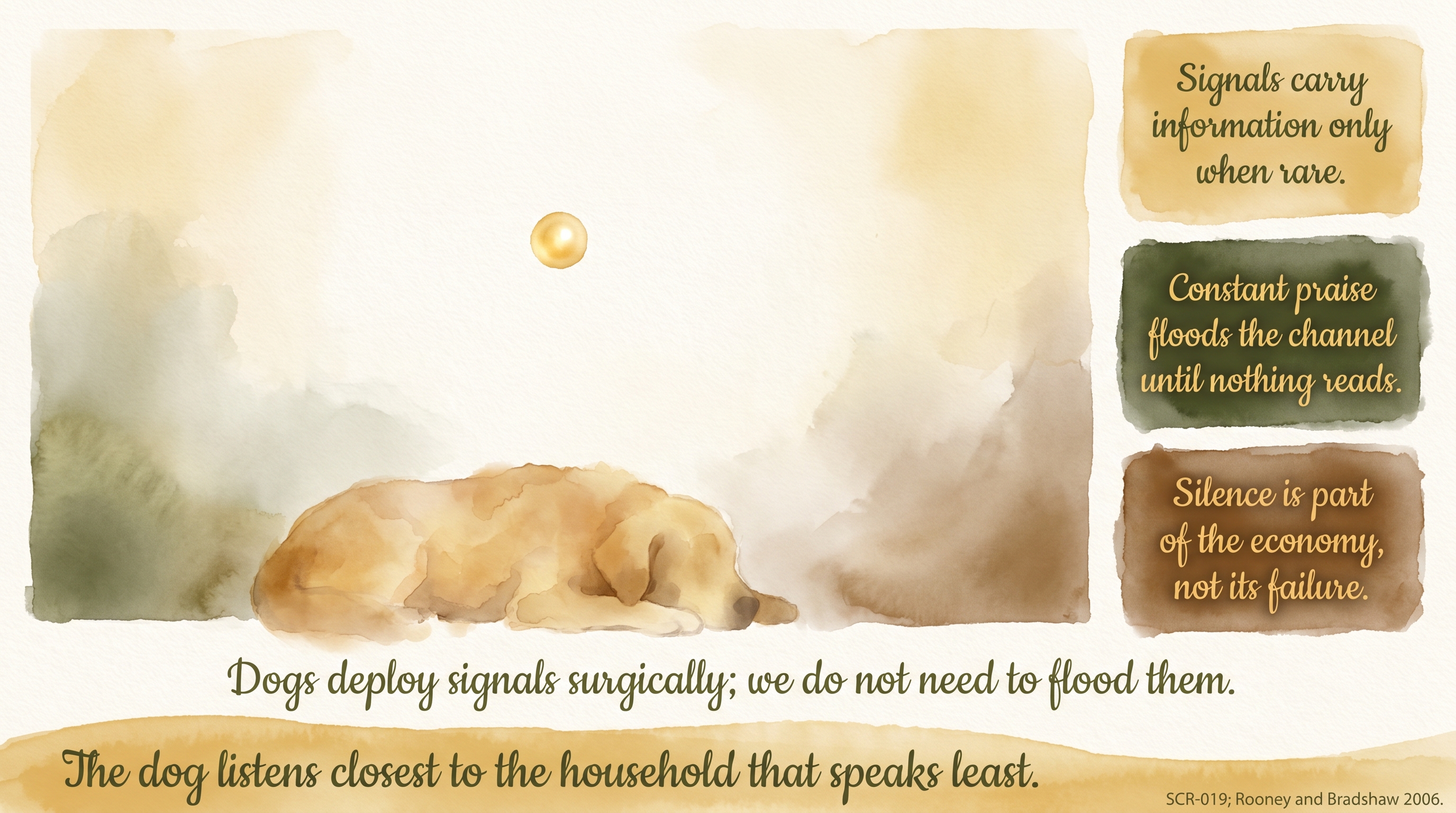
A signal loses value the moment it becomes background.
Key Takeaways
- Adult dogs communicate sparingly and contextually; their signals carry weight because they are not happening constantly.
- Continuous human signaling floods the channel and reduces the informational value of every individual cue, praise, or correction the family delivers.
- Signal Economy is the daily discipline of sending fewer signals, more cleanly, with enough quiet between them for the next signal to land.
- Indirect Correction and Mentorship both depend on a quiet channel: a correction or a demonstration only carries information when it stands out against a background that was not already noisy.
The Evidence
This entry uses mixed-evidence claim-level tags beyond the dedicated EvidenceBlocks below. These tags mark claims that combine documented findings with observed practice, heuristic application, or unresolved gaps.
- Mariti, C. et al. (2017)domestic dogs
Pilot study of 96 off-leash dog-dog encounters cataloguing 2,130 calming signal instances. Zero aggressive episodes were preceded by a calming signal from the target dog; post-aggression calming signals de-escalated conflict in 79.4% of cases. The signals functioned because they were rare and timed. - Byosiere, S. E. et al. (2016)domestic dogs
Documented body orientation as a meaningful component of canine social signaling, supporting the broader claim that fine-grained, sparse postural information carries communicative weight in dog-dog interaction.
- D'Aniello, B., Scandurra, A., Alterisio, A., Valsecchi, P., & Prato-Previde, E. (2016)domestic dogs
Documented that excessive owner verbalization increased dogs' processing time and response latency, indicating a measurable cost to flooding the verbal channel. - Feuerbacher, E. N. & Wynne, C. D. L. (2015)domestic dogs
Verbal praise lost effectiveness rapidly as a reinforcer when delivered continuously, with dogs preferring brief physical contact. The habituation pattern is consistent with sensory systems that detect change rather than monitor constant input.
- Bray, E. E. et al. (2021)retriever puppies (8-10 weeks)
In a sample of 375 eight-to-ten-week-old retriever puppies, success at following human pointing was present without a learning curve, indicating heritable, domestication-selected sensitivity to human communicative intent. This finding is specific to retrievers and should not be generalized to all breeds without additional evidence.
- JB Methodology synthesisfamily-raised Golden Retrievers
The argument that families should organize daily behavior around informational restraint, treating every transmission as carrying an information cost, is JB's synthesis of the canine ethology and human-side processing literature. The mechanism is documented; the household-scale prescription is the program's interpretation.
No published study directly compares high-frequency household signaling against low-frequency, high-precision signaling in family-dog developmental contexts.
The threshold at which human signaling frequency begins to measurably degrade canine signal discrimination has not been quantified outside laboratory verbalization paradigms.
SCR References
Sources
Bray, E. E., Gnanadesikan, G. E., Horschler, D. J., Levy, K. M., Kennedy, B. S., Famula, T. R., & MacLean, E. L. (2021). Early-emerging and highly heritable sensitivity to human communication in dogs. Current Biology, 31(14), 3132-3136.e5.
Byosiere, S. E., Espinosa, J., & Smuts, B. (2016). Investigating the function of play bows in adult pet dogs (Canis lupus familiaris). Behavioural Processes, 125, 106-113.
D'Aniello, B., Scandurra, A., Alterisio, A., Valsecchi, P., & Prato-Previde, E. (2016). The importance of gestural communication: A study of human-dog communication using incongruent information. Animal Cognition, 19(6), 1231-1235.
Feuerbacher, E. N., & Wynne, C. D. L. (2015). Shut up and pet me! Domestic dogs (Canis lupus familiaris) prefer petting to vocal praise in concurrent and single-alternative choice procedures. Behavioural Processes, 110, 47-59.
Mariti, C., Falaschi, C., Zilocchi, M., Fatjó, J., Sighieri, C., Ogi, A., & Gazzano, A. (2017). Analysis of the intraspecific visual communication in the domestic dog