Structured Companionship as a Foundation
Compound evidence detail1 SCR / 2 parts
- Documentedthe canine methylation pattern reported by Awalt 2024 for NR3C1 and OXTR in dogs with measured early-life history
- Heuristicthe JB extrapolation that ordinary calm raising produces durable epigenetic advantages in dogs beyond preventing adverse environments
Structured companionship is the claim that relationship deepens most reliably through calm, purposeful togetherness rather than through manufactured arousal. In JB, that is not a sentimental preference. It is a developmental reading of how regulation, bonding, and social learning reinforce one another inside the same body. Documented
What It Means
Many families have been taught to equate bonding with stimulation. Wrestle on the floor. Wind the puppy up. Make every reunion loud. Treat excitement as proof of intimacy. Structured companionship begins from a different assumption: a relationship can deepen through co-presence, rhythm, touch, and shared calm activity without constantly spiking the nervous system. Mixed Evidence
The biological backdrop makes that idea plausible. In dog-human dyads, long-term cortisol levels synchronize. Dogs also discriminate human stress odor and change their own cognition under that influence. Documented Put plainly, the state the human brings into togetherness matters. If bonding time is routinely noisy, frantic, and activating, the puppy is not only feeling close. It is also learning that closeness comes with activation.
That does not make all play bad. It means play is not the foundation JB chooses for the relationship. The relationship foundation is quieter: carrying the puppy while calm, sitting with the puppy while it settles, walking without theatrical stimulation, grooming without struggle, moving through daily rhythm without turning the puppy into the household entertainment project. These acts look small, but they are dense with informational value.
Structured companionship is therefore companionship with a shape. The adult is present, available, and warm, but not chaotic. The puppy gets contact without being whipped into arousal. Over time, that teaches a profound lesson: proximity to the adult predicts safety, not overstimulation. Documented
Why It Matters for Your Dog
This Foundation matters because the family relationship becomes part of the puppy baseline. Mixed Evidence If every good moment is loud, fast, and over-activating, the dog may come to expect activation as the price of connection. If good moments are often calm, the dog learns that closeness and regulation belong together.
That lesson shows up everywhere later. It shows up in how the dog handles greetings, how easily it settles beside a person, how much stimulation it needs to feel engaged, and how much activation it brings into everyday social contact. Structured companionship is not a trick for after the hard work. It is part of the hard work.
Structured companionship is how Calmness becomes relational. The puppy is not merely calm near the adult by accident. It is learning that the adult itself is a source of regulation.
The practical translation is simple but not always culturally comfortable. Spend more time doing less. Sit together. Walk together. Carry the puppy calmly. Let rest count as relationship. Let the puppy observe rather than perform. These moments feel quiet, but quiet is often exactly what teaches best.
JB observes that families who adopt this posture tend to get a different dog than families who build the bond primarily through arousal. Mixed Evidence That observed pattern still needs direct controlled testing. But it sits on a biologically coherent base: dyadic regulation, emotional contagion, and caregiving-supported stress architecture all point in the same direction.
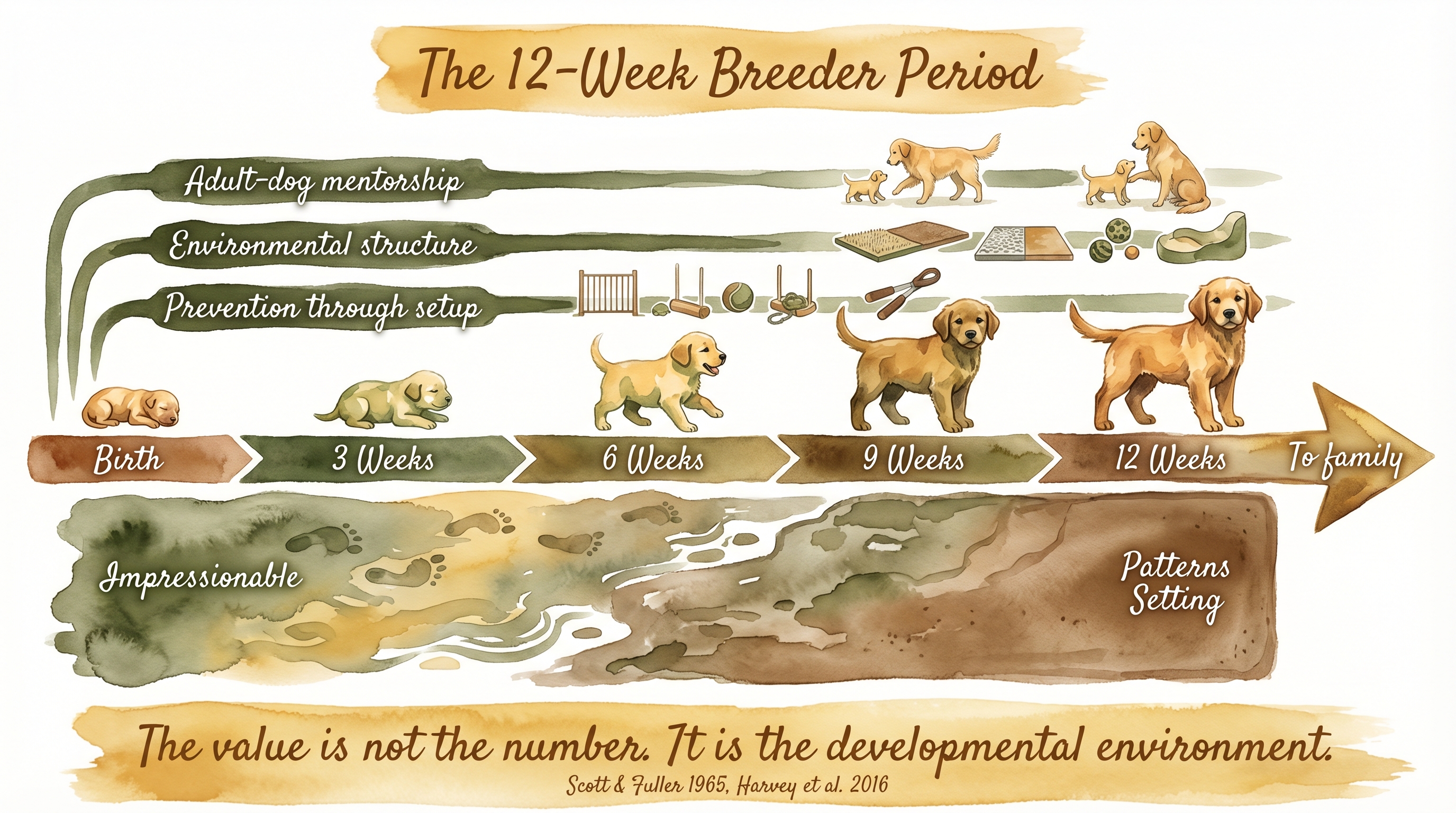
Bonding deepens most reliably through calm, purposeful togetherness - cortisol synchronizes over time, making the adult's emotional tone the puppy's biology.
Key Takeaways
- Structured companionship means bonding through calm, purposeful togetherness rather than through constant arousal manufacture.
- Dog-human physiology synchronizes over time, which means the emotional tone of togetherness matters as much as the fact of togetherness.
- JB treats grooming, carrying, walking, resting, and quiet household participation as relationship-building moments, not as empty downtime.
- The strongest scientific case supports the biology of co-regulation. The stronger claim that calm companionship outperforms excitement-based bonding in every outcome remains more observational.
The Evidence
This entry uses mixed-evidence claim-level tags beyond the dedicated EvidenceBlocks below. These tags mark claims that combine documented findings with observed practice, heuristic application, or unresolved gaps.
- Sundman, A. S. et al. (2019)dog-human dyads
Documented long-term cortisol synchrony between dogs and owners, supporting the idea that relationship tone becomes biology over time. - Wilson, C. et al. (2022)domestic dogs
Showed that dogs discriminate stress odor from humans, reinforcing that the adult emotional state is available to the dog through more than one channel. - Katayama, M. et al. (2019)domestic dogs
Found evidence of emotional contagion from humans to dogs, supporting the relational significance of adult calm versus activation.
- Weaver, I. C. G. et al. (2004)rats
Showed that caregiving quality can alter later stress physiology through epigenetic pathways. - Awalt, K. M. et al. (2024)domestic dogs
Extended early-life epigenetic association work into dogs, supporting the broader claim that the quality of early relational environment matters biologically.
- JB program observationfamily-raised Golden Retrievers
JB consistently observes that puppies bonded through calm togetherness arrive more settle-capable and less socially frantic than puppies whose relationship was built primarily around stimulation and rough play.
No published study directly compares calm companionship and high-arousal play as primary bonding styles in family-raised puppies while measuring later regulation and attachment outcomes.
The dog literature documents dyadic coupling and emotional contagion, but it has not yet isolated which ordinary bonding routines most effectively build calm adult social behavior.
SCR References
Sources
Awalt, K. M., et al. (2024). Early adversity and epigenetic variation in the oxytocin and glucocorticoid receptor genes in dogs. Frontiers in Behavioral Neuroscience.
Katayama, M., et al. (2019). Emotional contagion from humans to dogs is facilitated by duration of ownership. Frontiers in Psychology, 10, 167.
Sundman, A. S., et al. (2019). Long-term stress levels are synchronized in dogs and their owners. Scientific Reports, 9, 7391.
Weaver, I. C. G., Cervoni, N., Champagne, F. A., D'Alessio, A. C., Sharma, S., Seckl, J. R., Dymov, S., Szyf, M., & Meaney, M. J. (2004). Epigenetic programming by maternal behavior. Nature Neuroscience, 7(8), 847-854.
Wilson, C., et al. (2022). Dogs can discriminate between human baseline and stress odours. PLOS ONE, 17(9), e0274143.