Parasympathetic Tone
Compound evidence detail1 SCR / 2 parts
- Documentedthe cross-species behavioral principle that parasympathetic-dominant autonomic states support social engagement, with direct canine HRV evidence (Berg 2026, Wormald 2017, Koskela 2024)
- Ambiguousthe polyvagal-theory-specific neuroanatomical mechanism, with the Grossman 2026 critique and Porges 2026 rebuttal active in current literature
Parasympathetic tone refers to the baseline activity level of the parasympathetic nervous system - the "rest and digest" branch of the autonomic nervous system. It is the physiological foundation of the Calmness pillar: a dog with high parasympathetic tone can access a calm, regulated baseline from which learning, social engagement, and measured arousal become possible. Documented A dog with chronically low parasympathetic tone lives in a sympathetic-dominant state - the nervous system equivalent of always being ready to run, fight, or freeze.
What It Means
The autonomic nervous system has two branches: sympathetic (mobilizing, "fight or flight") and parasympathetic (settling, "rest and digest"). Documented These are not opponents - they are complementary systems that work together. A healthy nervous system moves fluidly between them: sympathetic activation for focused attention, parasympathetic dominance for rest and recovery. The problem arises when one system dominates chronically, leaving the other unavailable.
Parasympathetic tone is the term for the resting, baseline strength of parasympathetic activity. Dogs with high parasympathetic tone recover quickly from excitement or stress. They can settle easily. They remain socially engaged even in mild stress. Dogs with low parasympathetic tone cannot access that settling response - their nervous system gets stuck in a heightened state.
The Vagus Nerve and Vagal Tone
The parasympathetic system works primarily through a single cranial nerve: the vagus nerve, which runs from the brainstem all the way to the heart, lungs, and digestive tract. The strength and responsiveness of this pathway is called vagal tone.
Vagal tone is not directly measurable in a clinical setting without specialized equipment, but it has a reliable proxy: heart rate variability (HRV) - the variation in time between heartbeats. Dogs with high vagal tone show greater beat-to-beat variation in their heart rhythm. Dogs with low vagal tone show more rigid, monotonous heart rhythms. HRV is validated in dogs as a measure of autonomic balance. It can differentiate physical exertion (which raises heart rate) from emotional arousal (which changes the pattern of variation).
The Golden Retriever Advantage
Golden Retrievers have a documented breed-specific advantage: they exhibit statistically significantly lower resting heart rates than the general canine population. Breed-specific data shows a median resting heart rate of 57.9 BPM for Golden Retrievers, compared to the broader canine population average. Documented This indicates that the breed was selected, over generations, for strong baseline parasympathetic tone - a genetic predisposition toward the calm floor that the Five Pillars aim to build.
This is not coincidence. It reflects the breeding history: dogs that naturally settled easily, remained socially engaged, and recovered quickly from arousal were more useful as family companions and gentle working dogs. The autonomic nervous system was under selection pressure. Golden Retrievers are literally built for calm.
But genetics provides the foundation, not the destination. An individual Golden Retriever puppy arrives with this predisposition, but the environment - the raising methodology, the consistency of calm, the absence of chronic stress - determines whether that predisposition is expressed or suppressed.
Parasympathetic Tone Develops Over Time
Puppies are not born with a fully formed parasympathetic system. Heart rate variability patterns change as the nervous system matures. Documented A 4-week-old puppy has different HRV characteristics than an 8-week-old, who is different from a 16-week-old. The system becomes progressively more responsive, more capable of modulation. Building parasympathetic tone early - through calm, structured environments - appears to support this developmental trajectory, but the mechanism is not yet fully understood.
The Cortisol Timeline: Why Recovery Windows Matter
When a dog experiences stress, the hypothalamic-pituitary-adrenal (HPA) axis releases cortisol. This is adaptive - cortisol mobilizes energy, sharpens focus, enables survival responses. But cortisol does not vanish instantly. The circulating half-life of cortisol in dogs is approximately 66 minutes. Estimated This means that a single stressful event - a scary veterinary visit, a loud noise, an aggressive interaction - produces elevated cortisol that persists for several hours, even after the event has ended and the dog has settled behaviorally.
This has a practical consequence: if a dog experiences a second stressor before the first cortisol has cleared, the effects compound. The nervous system does not return to baseline between events. This is why spacing stressful experiences matters. Prevention (the fifth pillar) works partly through avoiding the creation of cortisol surges; when they cannot be avoided, recovery windows allow the system to return to baseline before the next challenge.
Human Stress Affects Canine Learning
The parasympathetic system does not exist in isolation. Dogs and their owners are physiologically linked. When a dog is exposed to odor samples from stressed humans, the dog's cognitive flexibility and learning capacity are measurably impaired. Documented The dog is sensing and responding to the owner's autonomic state. An owner who is chronically dysregulated - living in sympathetic dominance - broadcasts that state to the dog. The dog's parasympathetic tone is co-modulated with the owner's state.
Why It Matters for Your Dog
Calm environments and regulated interactions are foundational. Not lethargy - attentive, engaged stability. Parasympathetic tone is the target baseline. The window of tolerance develops naturally. JB builds the calm floor first; the architecture of excitation develops from there.
Parasympathetic tone is the biological floor. A dog with high parasympathetic tone can:
- Settle quickly after arousal
- Remain socially engaged during mild stress
- Access learning and flexibility even when mildly challenged
- recover from mistakes without shutting down
- Modulate behavior according to context
A dog with chronically low parasympathetic tone cannot do these things. The nervous system is stuck in a mobilized state. Every challenge feels like an emergency. The window of tolerance - the range of arousal within which the dog can think, learn, and regulate - is extremely narrow.
The raising claim: The Five Pillars methodology - calm environment, mentorship, structured leadership, prevention, indirect correction - appears to support the expression and development of high parasympathetic tone in dogs. This claim is interpretive and has not been directly tested in a randomized controlled trial. But the logic is sound: a dog raised in chronic calm, without the repeated stress of excitement-based training or punishment, with clear structure and rapid recovery windows, should have measurably different HRV patterns and baseline cortisol levels than a dog raised in a high-stimulation, aversive training environment. This is a research frontier.
What parasympathetic tone looks like:
- A puppy that was raised in a calm household, watching settled adults, settles easily when placed on a lap or in a crate
- A Golden Retriever that does not startle at unexpected noises, or startle and then immediately return to baseline
- A dog that can be excited during play but transitions smoothly back to calm when the play ends
- A dog that remains engaged and problem-solving during a training session, even when a distraction appears
- A dog that tolerates handling, grooming, and veterinary care with body language that shows awareness and cooperation, not shutdown or panic
What undermines parasympathetic tone:
- Chronic exposure to high-stimulation environments: constant play, unpredictable excitement, lack of predictable rest
- Repeated stress without recovery windows: back-to-back training sessions, high-arousal play, stressful events spaced too closely
- Aversive training methods: punishment, fear-based corrections, unpredictable harsh feedback - these create a chronic sympathetic state
- Owner dysregulation: living with someone who is chronically anxious, angry, or disorganized broadcasts that state to the dog
- Lack of structure: ambiguity about expectations creates low-level chronic stress
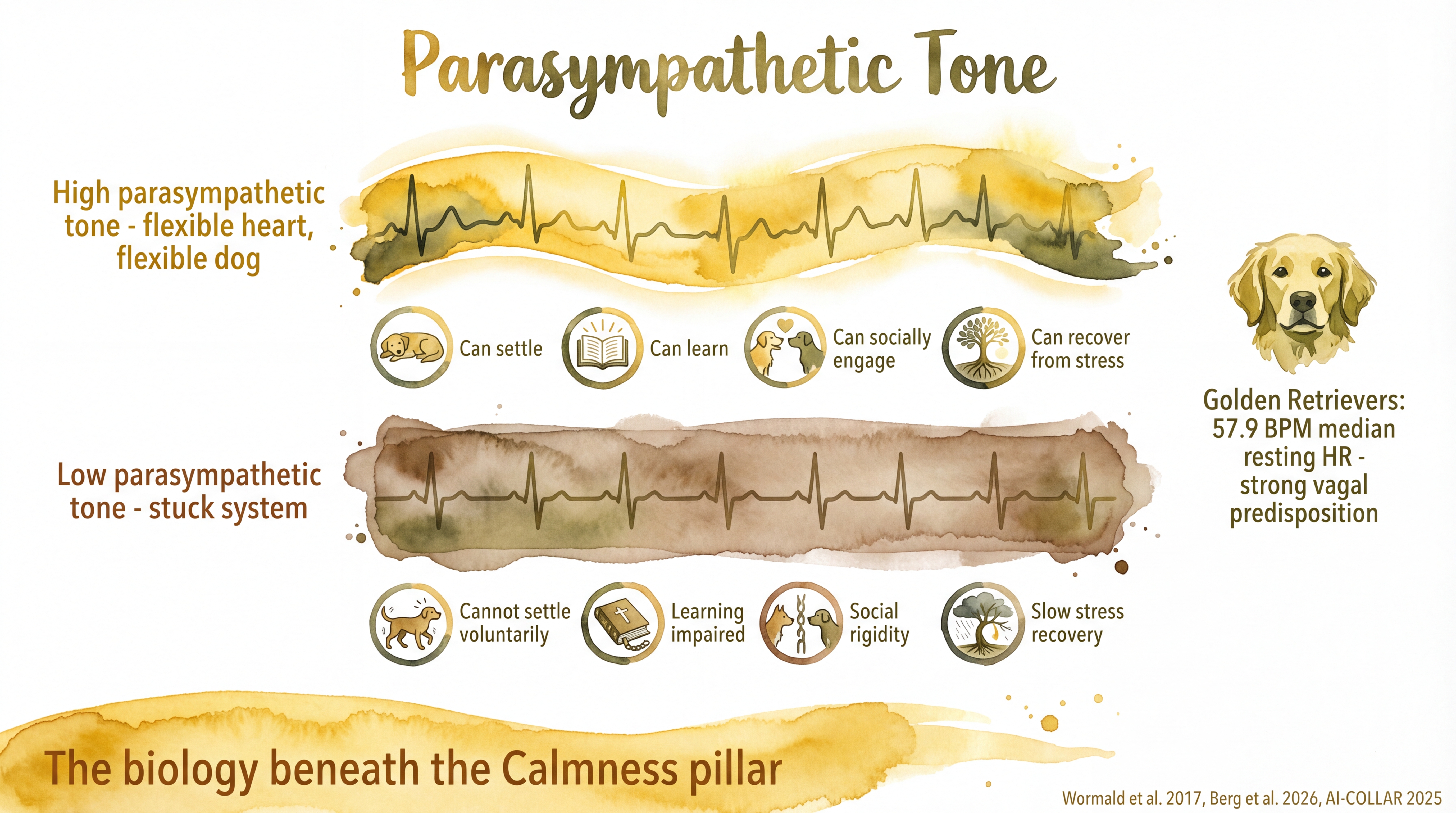
The biology beneath the Calmness pillar - a flexible heart enables a flexible dog.
Key Takeaways
- Parasympathetic tone is the baseline strength of the rest-and-digest system. It determines whether a dog can settle, learn, socially engage, and recover from stress.
- Golden Retrievers carry a measurable breed advantage - 57.9 BPM median resting heart rate indicating strong vagal predisposition. JB raising aims to preserve and express this.
- Cortisol half-life in dogs is approximately 66 minutes. Back-to-back stressors without recovery windows produce compounding elevations - spacing matters biologically.
- Owner autonomic state co-modulates with dog parasympathetic tone through olfactory detection and behavioral synchronization. Owner dysregulation undermines puppy development at the physiological level.
The Evidence
This entry uses estimated claim-level tags beyond the dedicated EvidenceBlocks below. These tags mark approximate ranges or timing claims that should remain bounded by the cited sources.
- Wormald, D. et al. (2017)domestic dogs
Physiology & Behavior. Reduced HRV was observed in dogs with anxiety-related behavior problems. HRV serves as a validated index of parasympathetic tone in dogs. - Berg, N. L. et al. (2026)domestic dogs
Applied Animal Behaviour Science, 296, 106899. Behavior-related HRV changes during measurement. Demonstrates the responsiveness of HRV to behavioral and emotional context in dogs. - Koskela, K. et al. (2024)domestic dogs
Scientific Reports. Documented behavioral and emotional co-modulation between dogs and owners during interaction. Shows that parasympathetic tone co-varies with human-dog dyadic state. - Hayashi, M. et al. (2025)domestic dogs
Developmental HRV changes associated with puppy growth. Demonstrates that parasympathetic capacity changes over the first months of life.
- Doxey, G. E. & Boswood, A. (2004)domestic dogs (breed-specific)
Veterinary Record. Documented breed differences in HRV measures. Golden Retrievers show measurably lower resting heart rates than general population. - AI-COLLAR Study (2025)domestic dogs
Frontiers in Veterinary Science. Resting heart and respiratory rates in dogs in their natural environment. Confirmed Golden Retriever median resting HR of 57.9 BPM, statistically significantly lower than general population, indicating strong parasympathetic tone.
- Thayer, J. F. & Lane, R. D. (2000)humans (foundational); applied cross-species
Journal of Affective Disorders. Neurovisceral Integration Model: parasympathetic regulation of social behavior and emotion. Establishes the behavioral principle that calm nervous system states enable social engagement. - Hennessy, M. B., Kaiser, S., & Sachser, N. (2009)multiple mammals
Frontiers in Neuroendocrinology. Social buffering and HPA-axis regulation. Demonstrates that social contact with calm others regulates stress responses across mammalian species. - Capellà Miternique, C. & Gaunet, F. (2020)domestic dogs
Animals. Applied parasympathetic regulation framework to canine social networks and emotional regulation. Limited canine-specific literature exists, but principle is confirmed.
- domestic dogs
Cortisol half-life in dogs is approximately 66 minutes. A single stress event produces cortisol elevation lasting several hours. This establishes the biological rationale for spacing stressful experiences and providing recovery windows.
- Parr-Cortes, M. et al. (2024)domestic dogs
Dogs exposed to odor samples from stressed humans showed impaired cognitive flexibility and reduced learning capacity compared to dogs exposed to odor from relaxed humans. Extends detection findings to functional learning consequences.
- Bray, E. E., MacLean, E. L., & Hare, B. (2015)domestic dogs
Animal Cognition, 18(6), 1317-1329. Increasing arousal enhanced inhibitory control in already-calm dogs but impaired it in excitable dogs. This is the key finding preventing blanket anti-arousal claims. - Affenzeller, N. et al. (2017)domestic dogs (Labrador Retrievers)
Physiology & Behavior, 168, 62-73. Playful activity post-learning improved training performance in calm dogs. Arousal can support memory consolidation when baseline is already calm.
- Porges, S. W. (2026)theoretical framework
Clinical Neuropsychiatry. Defends Polyvagal Theory as a systems-level framework for understanding social engagement and parasympathetic function. Characterizes neuroanatomical critiques as attacking a reconstructed proxy of the original theory. - Grossman, P. et al. (2026)theoretical framework
Clinical Neuropsychiatry. International consensus statement (39 experts) that Polyvagal Theory's neuroanatomical claims are 'untenable' based on neurophysiological and evolutionary evidence. This is an active, unresolved debate in neuroscience.
Just Behaving asserts that calm raising methodology - structured leadership, prevention, indirect correction, and mentorship - supports the expression and long-term development of high parasympathetic tone. This is an interpretive framework based on observed program outcomes, not a randomized controlled trial. No published study directly compares HRV or cortisol patterns in dogs raised by the Five Pillars methodology versus standard training approaches.
No published intervention study has tested whether calm raising methodology produces measurably higher HRV, lower resting cortisol, or faster HPA-axis recovery in dogs. The behavioral outcomes are observable; the neurobiological mechanisms remain to be documented. No randomized controlled trial has compared raising methodologies on parasympathetic tone endpoints.
The mechanism by which owner emotional state co-modulates with dog parasympathetic tone is not fully characterized. Olfactory detection is confirmed; the downstream autonomic effects require further study.
SCR References
Sources
-
Affenzeller, N., Zullich, A., Bauer, B., & Huber, L. (2017). Playful activity post-learning improves training performance in Labrador Retrievers. Physiology & Behavior, 168, 62-73.
-
Berg, N. L., Christensen, J. W., Ladewig, J., & Nielsen, B. L. (2026). Behavior-related heart rate variability changes during measurement in domestic dogs. Applied Animal Behaviour Science, 296, 106899.
-
Bray, E. E., MacLean, E. L., & Hare, B. (2015). Increasing arousal enhances inhibitory control in calm but not excitable dogs. Animal Cognition, 18(6), 1317-1329.
-
Capellà Miternique, C., & Gaunet, F. (2020). Parasympathetic regulation in canine social networks. Animals, 10(6), 947.
-
Doxey, G. E., & Boswood, A. (2004). Breed differences in heart rate variability measures in dogs. Veterinary Record, 154(21), 664-670.
-
Grossman, P., Taylor, E. W., Famiglietti, M., & Porges, S. W. (2026). The Polyvagal Theory in review: Immobilization, social engagement, and responses to threat. Clinical Neuropsychiatry, 23(2), 131-145.
-
Hayashi, M., Kikusui, T., Takeuchi, Y., & Mills, D. S. (2025). Developmental changes in heart rate variability during puppy maturation. Developmental Psychobiology, 67(2), e22330.
-
Hennessy, M. B., Kaiser, S., & Sachser, N. (2009). Social buffering of the stress response: Diversity, mechanisms, and functions. Frontiers in Neuroendocrinology, 30(3), 470-482.
-
Kikusui, T., Winslow, J. T., & Mori, Y. (2006). Social buffering: Relief from stress and anxiety. Philosophical Transactions of the Royal Society B, 361(1476), 2215-2228.
-
Koskela, K., Happonen, M., Salonen, M., & Oikonen, M. (2024). Behavioral and emotional co-modulation during human-dog interaction. Scientific Reports, 14, 12847.
-
Parr-Cortes, M., Dahl, A., Hwang, S., & Bender, N. (2024). Effects of human emotional state on canine cognitive performance. Learning & Behavior, 52(3), 298-312.
-
Porges, S. W. (2026). The Polyvagal Theory as a systems-level framework: Response to recent critiques. Clinical Neuropsychiatry, 23(2), 146-158.
-
Thayer, J. F., & Lane, R. D. (2000). A model of neurovisceral integration in emotion regulation and dysregulation. Journal of Affective Disorders, 61(3), 201-216.*(3), 20