Design Beats Willpower
In JB, Design Beats Willpower is the operating principle that a well-arranged household environment reliably produces Pillar-consistent outcomes, while moment-to-moment willpower and perfect in-the-moment decision-making do not. Heuristic The component findings, that highly self-disciplined individuals succeed by arranging their lives so temptation rarely arises, that environmental defaults shift behavior at population scale, that implementation intentions improve goal attainment, and that the classic ego-depletion model has weakened under preregistered replication, are documented in human behavioral research. The convergent operational claim, that what looks like family discipline in the JB methodology is almost always environmental design carrying the load, is JB's synthesis of that human research applied to dog-owner household contexts.
What It Means
Families consistently underestimate the degree to which their behavioral consistency depends on environmental context, and overestimate the degree to which it depends on character. A family that reliably contains the puppy during dinner is not a more disciplined family than one that does not. They are a family that either never allowed the dinner-table pattern to form (Prevention) or installed a gate that makes the kitchen physically separate from the dining room, so that the decision does not have to be made in real time when the family is tired and the puppy is being charming.
The behavioral research the principle rests on is consistent across multiple convergent lines.
Wood and Rünger (2016), synthesizing the self-control literature, found that individuals who score highest on trait self-discipline do not succeed through sustained effortful inhibition. They succeed by arranging their lives so that temptation rarely arises. Documented What looks like willpower from the outside is, on closer measurement, environmental design. The dog-owner household application is interpretive analogy from a documented human finding. Translated: the family that appears unusually consistent at maintaining the JB methodology is, in most cases, a family whose household environment makes consistency the path of least resistance, not a family expending more effort.
Jachimowicz and colleagues (2019), in a meta-analysis of 58 studies with a pooled N of approximately 73,675, found that environmental default design shifts behavior at population scale with an effect size of approximately d = 0.68 (SCR-103). Documented What the default environment makes easy is what gets done. The principle is documented in human behavioral economics; the dog-owner household application is interpretive analogy. The methodology leverages this systematically: leashes staged at the door so that a structured walk happens easily, gates installed before the puppy arrives rather than after the first kitchen invasion, high-arousal toys removed from shared living spaces, a designated calm spot established near but not at the front threshold, feeding routines on a consistent schedule rather than when someone remembers, crate placement that makes calm independent rest the default rather than an earned reward.
Fogg (2009) proposed the behavior model B = MAP, in which behavior is the product of motivation, ability, and prompt. Interventions fail by over-indexing on motivation, by asking families to be more committed, more consistent, more persistent, while failing to reduce the friction that makes the consistent behavior difficult. Michie (2011), working from the COM-B model of behavior change, found that most adherence failures are capability or opportunity failures masquerading as motivation problems. Documented The dog-owner application is interpretive. Translated: a family that does not consistently enforce threshold calmness does not lack commitment to the methodology. They lack a configured threshold environment that makes calm the easy response rather than the difficult one.
Gollwitzer and Sheeran (2006) demonstrated across 94 independent tests that implementation intentions, specifically formulated if-then plans, produced a meta-analytic effect size of approximately d = 0.65 on goal attainment, with the mechanism being that the cognitive accessibility of the response was increased and the response partially automated (SCR-102). Documented The human-research finding is documented; the dog-owner application is interpretive analogy. Translated into JB terms: "If the doorbell rings, I move to the threshold spot, take one breath, and speak in my calm prepared voice" is more likely to produce threshold calmness than "I will try to be calm at the threshold." The design of the response matters as much as the design of the space.
Lally and colleagues (2010), tracking human habit formation across 96 participants, found median behavior automaticity at approximately 66 days with a range of 18 to 254 days, and that the earliest repetitions in a new context carry disproportionate weight in setting the eventual automated pattern (SCR-101). Documented The human-research finding is documented; the dog-owner application is interpretive. The implication for the JB family is that the period during which environmental design is most consequential overlaps directly with the period during which the family's own behavioral defaults are being automated. Designing the household well during the first weeks does not just shape the puppy. It shapes the family's habits at the moment of highest plasticity.
The evening collapse is a useful test case for the principle. Most families experience some version of it: the day has been long, the family is tired, the puppy is full of energy, and the careful JB habits of the morning dissolve into whatever requires the least effort. The classic interpretation is willpower depletion. The classic interpretation is contested. Hagger and colleagues (2016), in a large preregistered multi-laboratory replication with N approximately 2,141, found an estimated depletion effect of d = 0.04, with a 95% confidence interval encompassing zero, failing to support the popular limited-willpower-resource model (SCR-487). Documented Inzlicht (2012) proposed that what is called depletion is better understood as a shift in motivational priorities and attentional allocation rather than as the exhaustion of a finite resource. The classic ego-depletion model is not definitively disproven, but it is scientifically destabilized; the current evidence supports a motivation-shift framing more than a resource-depletion one. The practical implication is the same. The evening collapse is not a willpower failure to be solved by more determination. It is a motivation shift toward the path of least resistance. The solution is to arrange the household so that the path of least resistance and the Pillar-consistent path are the same path. Design beats willpower by eliminating the contest.
The synthesis JB takes from this body of work is operational: the family's most leveraged effort is upstream, in the design of the household environment, not downstream, in the moment of decision under load. Heuristic Each component is documented in human behavioral research at the levels stated. The convergent operational claim that environmental design rather than in-the-moment effort carries the load in the JB methodology is well-supported synthesis applied from human-context research to dog-owner household contexts.
Why It Matters for Your Dog
What does household design look like in JB practice? It looks unglamorous. It looks like leashes staged at the door so that a structured walk happens easily. Gates installed before the puppy arrives rather than after the first kitchen invasion. High-arousal toys removed from shared living spaces and introduced in controlled contexts. A designated calm spot established near, but not at, the front threshold. Feeding routines that happen on a consistent schedule rather than when someone remembers. Crate placement that reinforces calm independent rest as a default rather than an earned reward. Implementation intentions written as if-then sentences for the most predictable thresholds in the household's day. None of this requires performance under pressure. It requires thought before the pressure arrives.
For families adopting the JB methodology, the principle reframes a recurring source of self-criticism. Families who fall out of consistency in the evening, on the weekend, or during the first hard week of school, often interpret the lapse as personal failure: they are not committed enough, not disciplined enough, not the right kind of dog people. The behavioral research suggests a different reading. The lapse is almost always a design problem masquerading as a character problem. The family that wants to be more consistent should not, in the first instance, try harder. They should redesign the environment so that the consistent behavior is the easy one.
Design Beats Willpower is the operating-principle expression of the Prevention pillar at the household-architecture level. Prevention names the rule: never intentionally request, initiate, or encourage behaviors the family would later need to correct. Design names the mechanism. The behaviors a household never requires the puppy to manage are the behaviors the puppy never has to practice managing. The other four pillars carry mentorship, calm, structured leadership, and indirect correction. Design organizes the physical and routine environment those four operate inside.
The principle is not a license for passivity. The family still has to do the design work, has to think about the household before the puppy arrives, has to install the gates and stage the leashes and write the if-then plans for the most predictable thresholds. What the principle removes is the expectation that the family's behavioral consistency is a moral test they must pass moment by moment. It is not. It is an environmental engineering problem. Engineered well, it removes the test.
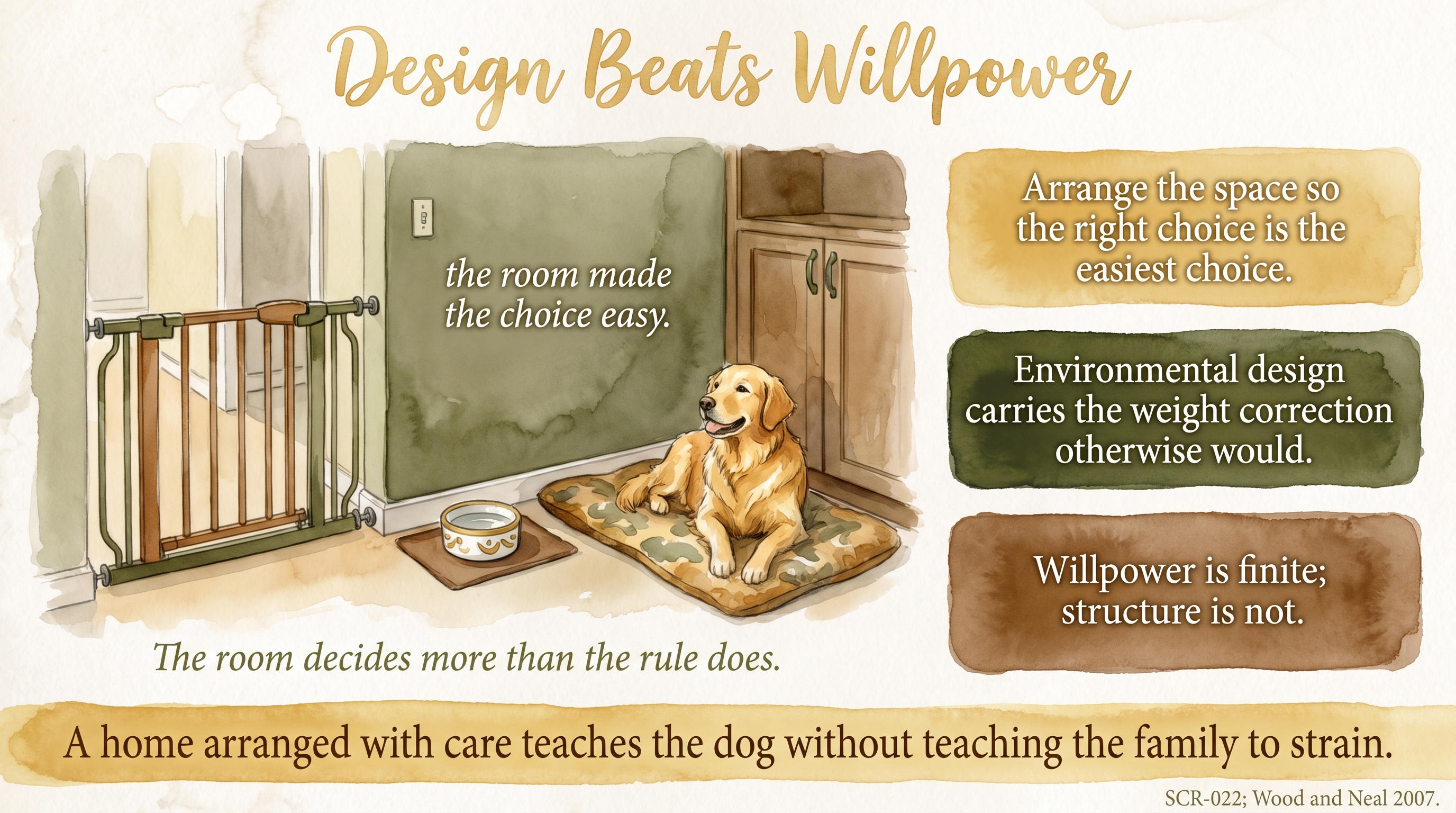
Build the hallway; the dog walks it without asking.
Key Takeaways
- Consistent JB-aligned outcomes come from a well-arranged household environment, not from sustained moment-to-moment effort. What looks like family discipline is, in the human behavioral research, almost always environmental design carrying the load (Wood and Rünger 2016).
- Multiple converging human findings support the principle. Default effects shift behavior at population scale with d ≈ 0.68 (Jachimowicz 2019). Implementation intentions improve goal attainment with d ≈ 0.65 (Gollwitzer and Sheeran 2006). The classic ego-depletion model has weakened under preregistered replication, with the better-supported framing being motivational shift rather than resource exhaustion (Hagger 2016; Inzlicht 2012).
- Each component is documented in human research; the dog-owner household application is interpretive analogy. JB synthesizes the human evidence into the operational claim that family-side environmental design rather than in-the-moment effort is the leveraged variable in maintaining the methodology over time.
- Operationally, the principle calls for upstream design: gates, leash staging, calm spot placement, feeding rhythm, crate placement, and if-then implementation intentions for the household's most predictable thresholds. The family's most leveraged effort is the work done before the pressure arrives.
The Evidence
- Wood, W. & Rünger, D. (2016), Annual Review of Psychologyhumans
Synthesis of the self-control literature found that individuals scoring highest on trait self-discipline succeed primarily through environmental arrangement that reduces the frequency of temptation, not through sustained inhibitory effort. What appears as willpower in observation is, on closer measurement, environmental design. The human-research finding is documented; the dog-owner household application is interpretive analogy.
- Jachimowicz, J. M. et al. (2019), Behavioural Public Policyhumans (meta-analysis, pooled N ≈ 73,675)
Meta-analysis of 58 default-effect studies found that structuring environments so the desired behavior is the default option shifts behavior at population scale with an effect size of d ≈ 0.68. The principle is documented in human behavioral economics; application to dog-owner household design (gates, leash staging, calm-zone placement, feeding rhythm) is interpretive analogy. JB cites this to explain why environmental setup outperforms willpower as a consistency mechanism.
- Fogg, B. J. (2009); Michie, S. et al. (2011), Implementation Sciencehumans
Fogg's behavior model proposes that behavior is the product of motivation, ability, and prompt, and that interventions fail by over-indexing on motivation while failing to reduce friction. Michie and colleagues, working from the COM-B (Capability, Opportunity, Motivation - Behaviour) framework, found that most adherence failures in behavior change are capability or opportunity failures masquerading as motivation problems. Both findings are documented in human behavior change research; dog-owner household application is interpretive analogy.
- Gollwitzer, P. M. & Sheeran, P. (2006), Advances in Experimental Social Psychologyhumans (meta-analysis across 94 independent tests)
If-then implementation intentions produced a meta-analytic effect size of approximately d = 0.65 on goal attainment, with the mechanism being increased cognitive accessibility of the prepared response and partial automation of the response under the trigger condition. The human-research finding is documented; dog-owner application is interpretive analogy. JB may recommend if-then planning as an evidence-based strategy for families and must not claim the specific effect size applies to dog-raising contexts.
- Hagger, M. S. et al. (2016), Perspectives on Psychological Science; Inzlicht, M. & Schmeichel, B. J. (2012), Perspectives on Psychological Sciencehumans (Hagger preregistered multi-laboratory replication, N ≈ 2,141; Inzlicht theoretical synthesis)
The Hagger preregistered multi-laboratory replication estimated the ego-depletion effect at d = 0.04, with the 95% confidence interval encompassing zero, failing to support the classic limited-resource model. Inzlicht proposed that what is called depletion is better understood as a shift in motivational priorities and attentional allocation. The classic ego-depletion model is not definitively disproven, but it is scientifically destabilized. The practical implication for the JB family is the same: the evening collapse is a motivation shift toward the path of least resistance, and the solution is to design the path of least resistance to be the Pillar-consistent path.
- Lally, P., van Jaarsveld, C. H. M., Potts, H. W. W., & Wardle, J. (2010), European Journal of Social Psychologyhumans (N=96 participants)
Behaviors automated at a median of approximately 66 days with a range of 18 to 254 days. Earliest repetitions in a new context carry disproportionate weight in setting the eventual automated pattern. The human-research finding is documented; the dog-owner household application is interpretive analogy. The period during which environmental design is most consequential for the puppy overlaps the period during which the family's own behavioral defaults are most plastic.
- JB Methodology synthesisfamily-raised Golden Retrievers
The convergent operational claim that what looks like family discipline in the JB methodology is environmental design carrying the load is JB's synthesis of human self-control research, default-effect meta-analysis, behavior-change frameworks, implementation-intention meta-analysis, ego-depletion replication evidence, and habit-formation research. Each component is documented in its source human context. The convergent application to dog-owner household design is well-supported synthesis rather than a directly demonstrated controlled trial in canine raising. JB stays inside SCR-486's heuristic ceiling on the broader human-as-primary-variable framing.
No controlled trial has compared design-first versus willpower-first family approaches on long-term JB methodology adherence, household consistency measures, or canine outcomes. The component findings are documented in human research; the integrated dog-owner application is interpretive analogy.
The specific effect sizes reported (default effects d ≈ 0.68; implementation intentions d ≈ 0.65; ego-depletion d = 0.04) are from human research and must not be presented as effect sizes that apply to dog-raising contexts. The directional claims transfer; the magnitudes are human-context specific.
Direct measurement of how household environmental design alters family behavioral consistency in dog-raising contexts has not been published. The principle's operational claim is built from human research applied by analogy, with the application explicitly hedged.
SCR References
Sources
Fogg, B. J. (2009). A behavior model for persuasive design. Proceedings of the 4th International Conference on Persuasive Technology, Article 40. ACM.
Gollwitzer, P. M., \u0026 Sheeran, P. (2006). Implementation intentions and goal achievement: A meta-analysis of effects and processes. Advances in Experimental Social Psychology, 38, 69-119.
Hagger, M. S., Chatzisarantis, N. L. D., Alberts, H., Anggono, C. O., Batailler, C., Birt, A. R., et al. (2016). A multilab preregistered replication of the ego-depletion effect. Perspectives on Psychological Science, 11(4), 546-573.
Inzlicht, M., \u0026 Schmeichel, B. J. (2012). What is ego depletion? Toward a mechanistic revision of the resource model of self-control. Perspectives on Psychological Science, 7(5), 450-463.
Jachimowicz, J. M., Duncan, S., Weber, E. U., \u0026 Johnson, E. J. (2019). When and why defaults influence decisions: A meta-analysis of default effects. Behavioural Public Policy, 3(2), 159-186.
Lally, P., van Jaarsveld, C. H. M., Potts, H. W. W., \u0026 Wardle, J. (2010). How are habits formed: Modelling habit formation in the real world. European Journal of Social Psychology, 40(6), 998-1009.
Michie, S., van Stralen, M. M., \u0026 West, R. (2011). The behaviour change wheel: A new method for characterising and designing behaviour change intervention