Shape of the Day: Structure as Readability
In JB, the Shape of the Day is the operating principle that treats pattern, sequence, and rhythm as the architecture through which a regulated nervous system is built rather than as implementation details around the real work of training. Heuristic The controllability framework that grounds the principle, that predictable and controllable environments build prefrontal circuits for resilient responding while uncontrollable environments produce passivity, is documented cross-species with original experimental work conducted in dogs. The convergent claim that household daily grammar is the load-bearing structure through which JB's Calmness pillar operates is JB's synthesis rather than a directly demonstrated household-intervention finding in dogs.
What It Means
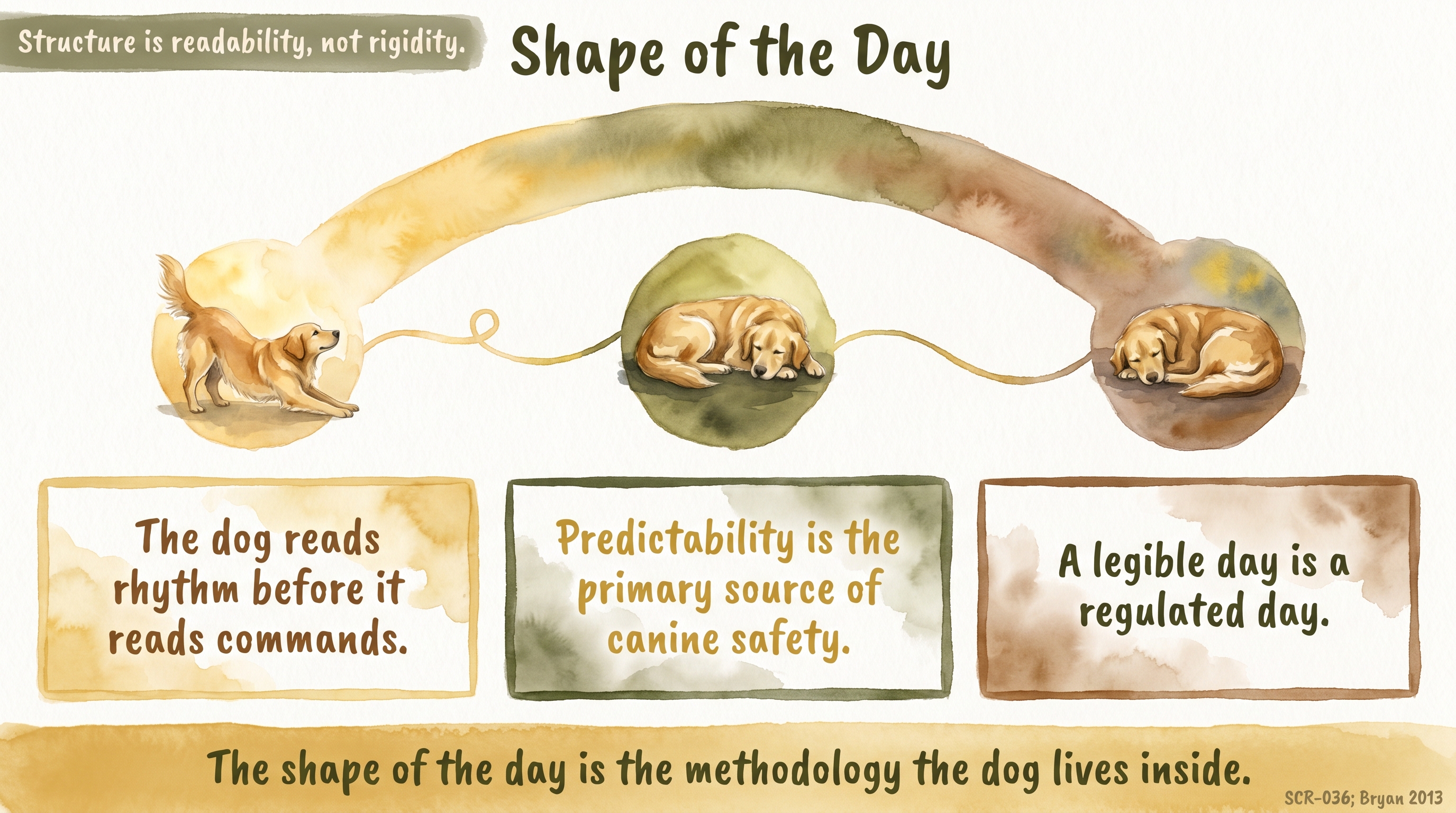
Families routinely mistake predictability for rigidity. The Shape of the Day principle starts by distinguishing them. A household does not need every event to occur on a fixed clock for the dog's nervous system to register the household as predictable. What the nervous system reads is not a timetable. It is a grammar. A recognizable pattern of mornings that begin the same way, middays with a predictable arc, evenings that arrive in a legible sequence. The grammar communicates, in a medium older than language, that the world is operating in a comprehensible way.
The documented neurological argument for why this matters begins with controllability. Maier and Seligman (2016), revising five decades of their own work on the original learned-helplessness framework, concluded that passivity (not helplessness) is the mammalian default response and that organisms must learn controllability through experience with predictable and contingent environments. The revision is especially important for a canine audience because the original learned-helplessness experiments were conducted in dogs, and the 2016 synthesis integrates cross-species neuroscience, including prefrontal circuits, that rests on that foundation (SCR-020). Documented The mechanism matters for the household. A dog that lives in a comprehensible environment, where morning follows a recognizable shape and evening arrives with legible cues, is a dog whose prefrontal architecture is being built to expect and act on controllability. A dog that lives in an unpredictable environment, where sometimes the morning is one thing and sometimes it is another, is a dog whose nervous system is investing prefrontal resources in decoding a pattern that does not exist. The mammalian controllability framework is documented with full confidence. Applying the specific modern controllability circuitry language directly to the JB Calmness pillar as a dog-specific neuroimaging finding would overstep the evidence. JB frames the Calmness pillar as consistent with established controllability science rather than directly demonstrated in canine prefrontal circuitry.
The second thread is what happens under the opposite condition. Arnsten (2015) documented that acute uncontrollable stress shifts behavioral control from flexible, goal-directed processing managed by the prefrontal cortex toward habitual, automatic striatal responses. The work is primarily in rodents and primates; the specific canine neurological application during household unpredictability is interpretive. The behavioral signature, however, is legible in dogs without needing the direct imaging study: a dog whose prefrontal system has been asked to manage chronic unpredictability operates on striatal defaults, which are less flexible, less socially responsive, and more driven by immediate arousal than by situational reading.
The third thread anchors the principle in direct canine neuroimaging. Xu and colleagues (2023) used resting-state functional MRI to compare anxious dogs against non-anxious controls and found that anxious dogs displayed measurably abnormal amygdala-salience network functional connectivity, with the amygdala showing abnormally high global efficiency. That hyperconnectivity correlated behaviorally with stranger-directed fear, general excitability, and impaired learnability (SCR-049). Documented The finding is in clinically anxious dogs and should not be generalized to normal pet populations without qualification, but the direction of the relationship, threat-detection running hot and learning being degraded as a consequence, clarifies what a predictable household architecture is buying for the dog it lives with. A predictable household is not providing enrichment. It is keeping the threat-detection system appropriately calibrated, which keeps the prefrontal system available for the behaviors the family is trying to support.
The integration of those three threads is the operating principle: the daily grammar of the household is one of the primary variables through which the nervous system is either organized into regulated functioning or pushed into chronic vigilance. Structure is not opposed to a natural life. Structure is the architecture of one.
The difference between structured and rigid is where families typically get this principle wrong. Rigid means every event occurs at a precise time, and deviation from the clock produces failure. Structured means events occur in a consistent sequence with a consistent character, and the sequence can flex around weather, appointments, late nights, and the ordinary variability of life without losing its readability. The morning walk does not need to begin at 7:43 a.m. to produce structure. It needs to occur in the morning, following a sequence the dog can anticipate. The evening feeding does not need to land at 5:00 p.m. sharp. It needs to follow a rhythm the dog reads as "evening feeding is coming" rather than "something unpredictable is about to happen." A household that has a shape to its day can absorb variability without losing its fundamental grammar. A household that has no grammar cannot absorb variability because there is nothing consistent underneath the variation.
Why It Matters for Your Dog
The practical consequence is that the family's ambient daily rhythm is doing more developmental work than the family's structured training sessions. This is counterintuitive because daily rhythm feels like the background and training feels like the foreground. The neurological picture inverts that. The nervous system is being calibrated continuously by the predictability of the environment. The training session lasts twenty minutes. The household grammar lasts twenty-four hours a day for the life of the dog. The leverage is in the grammar.
What this means in practice is that families who want to build a calm, regulated dog should think first about the shape of the household, not the content of the training. A household whose mornings are coherent, whose afternoons move through a recognizable arc, whose evenings settle toward rest in a legible sequence, is doing the work. A household that runs structured training sessions inside an otherwise chaotic daily pattern is asking the dog to consolidate skills in a prefrontal system that is being destabilized by the environment the rest of the day. The training is not wasted. It is simply less load-bearing than the family thinks.
The principle also reframes what the family should do when the day goes sideways. Plans fail. Schedules slip. Life introduces variability. The Shape of the Day does not ask the family to keep the clock. It asks the family to keep the grammar. If the morning walk happens at 9:30 instead of 7:30 because the family slept in, the walk still occurs in the morning, follows the same sequence, and reads as "morning walk" to the dog. If dinner is late, the feeding still follows its predictable prelude, so the event itself is recognizable when it arrives. The grammar is forgiving in ways the clock is not. The family does not need to perform the day perfectly. The family needs to keep the day comprehensible.
The Shape of the Day is the operating-principle expression of the Calmness pillar in the temporal dimension. The Calmness pillar names parasympathetic tone as the physiological target; the Shape of the Day names the architecture through which that tone is maintained across hours and days rather than manufactured in isolated sessions. The daily grammar is how the calm floor is kept from eroding. A household whose day has a coherent shape is a household whose dog is not burning cortisol on trying to predict what comes next.
There is a subtle second-order effect worth naming. A predictable household makes prevention easier because the family can anticipate what the dog will encounter and arrange for it. A predictable household makes mentorship easier because the calm adult the puppy is watching is available at the same rhythm, in the same role, in the same relational position every day. A predictable household makes indirect correction rare because the situations that would require it occur less often, and the signals when they are needed are legible against a stable background. Structure is not only a Calmness strategy. It is the substrate that makes the other four pillars operate at their intended cost.
For the Golden Retriever household specifically, there is a practical observation worth naming alongside the general principle. The breed is strongly cooperative and willing to absorb variability without visible protest. That cooperativeness is easy to misread as proof that the household shape does not matter for this dog, when it is at least as plausibly the cost the dog is quietly paying to hold together a household that has no shape. The evidence base carried inside this entry, Maier and Seligman on controllability, Arnsten on prefrontal-to-striatal shift under uncontrollability, Xu on anxious-dog connectivity and learnability, all implies that uncontrollable environments exact a regulatory cost whether or not the dog protests. A Golden family that takes the dog's willingness as license to let structure erode is a family gambling with a cost the dog may be absorbing silently. The family reading this principle carefully is the family that arranges the shape of the day before the absorption begins to show up as anxiety, reactivity, or diminished flexibility later.
Most of the day should be uneventful.
Key Takeaways
- Predictability and rigidity are not the same. The nervous system reads grammar, not clock time. A household can keep events in a consistent sequence and character without pinning them to precise times and still produce the regulatory benefit.
- Maier and Seligman's 2016 controllability revision (original work conducted in dogs) frames predictable and controllable environments as what builds resilient prefrontal responding, while uncontrollable environments produce passivity and reduced behavioral flexibility.
- Arnsten's cross-species work on prefrontal-to-striatal shift under uncontrollable stress, combined with Xu's direct canine finding that anxious dogs show amygdala-salience hyperconnectivity and impaired learnability, clarifies the cost a dog pays when the household architecture runs chaotic.
- The daily grammar is load-bearing. Training sessions are twenty minutes. The household shape operates twenty-four hours a day for the life of the dog. The leverage is in the grammar, not in the session.
The Evidence
- Maier, S. F. & Seligman, M. E. P. (2016)cross-species synthesis; original learned-helplessness research in dogs; 2016 revision integrates rat and human neuroscience
The 2016 revision of learned helplessness reframes passivity as the mammalian default rather than a learned state, with controllability as what must be learned through experience with predictable and contingent environments. Predictable, controllable environments build prefrontal circuits (specifically ventromedial prefrontal cortex inhibition of dorsal raphe serotonergic activity) that support resilient, flexible responding. Uncontrollable environments produce passivity and reduced behavioral flexibility. The framework is documented with full confidence; applying the specific modern controllability circuitry directly to the JB Calmness pillar protocol in dogs is theoretically grounded inference, not a dog-specific neuroimaging finding.
- Arnsten, A. F. T. (2015)rodents and non-human primates (primary experimental work)
Review and primary experimental work documenting that acute uncontrollable stress shifts behavioral control from the flexible, goal-directed prefrontal cortex toward habitual, automatic striatal responses. The mechanism is well-established in rodents and non-human primates; the specific canine neurological application during household unpredictability has not been mapped directly. The behavioral signature, prefrontal-system capacity compromised under chronic arousal, is consistent with the canine picture established in Xu et al. (2023) below.
- Xu, Y. et al. (2023)domestic dogs (resting-state functional MRI in anxious vs. non-anxious dogs)
Direct canine neuroimaging evidence that anxious dogs display measurably abnormal amygdala-salience network functional connectivity, with the amygdala showing abnormally high global efficiency. The hyperconnectivity correlated behaviorally with stranger-directed fear, general excitability, and impaired learnability. The finding is in clinically anxious dogs; generalization to normal pet populations requires qualification. What the finding clarifies for the Shape of the Day principle is the cost an unpredictable environment imposes: threat-detection running hot makes the prefrontal system less available for the learning and self-regulation the family is trying to support.
- JB Methodology synthesisfamily-raised Golden Retrievers
The claim that the shape of the household's day is the load-bearing variable for sustaining parasympathetic baseline is JB's synthesis of the controllability framework (Maier & Seligman 2016), the prefrontal-to-striatal shift under uncontrollable stress (Arnsten 2015), and the direct canine evidence that anxious dogs show amygdala-salience hyperconnectivity with impaired learnability (Xu 2023). The component findings are documented in their source contexts; the convergent claim that a coherent household grammar is the primary temporal architecture of the JB Calmness pillar has not been tested as a direct intervention in a controlled canine household trial. JB presents the principle as mechanistically coherent operating guidance rather than as a directly demonstrated household-intervention finding.
No controlled canine trial has compared structured-daily-grammar households against chaotic-schedule controls on long-term behavioral regulation, cortisol profile, or amygdala-salience connectivity.
The specific canine prefrontal-to-striatal shift under chronic household unpredictability has not been mapped directly; Arnsten's work is in rodents and non-human primates.
Xu et al. (2023) is cross-sectional in clinically anxious dogs. Longitudinal work examining whether household predictability changes amygdala-salience connectivity over development has not been published.
The threshold at which household variability becomes perceived as unpredictability by the canine nervous system is unmapped. JB operates on the grammar-vs-clock distinction as practical guidance rather than as a validated tolerance specification.
SCR References
Sources
Arnsten, A. F. T. (2015). Stress weakens prefrontal networks: Molecular insults to higher cognition. Nature Neuroscience, 18(10), 1376-1385.
Maier, S. F., \u0026 Seligman, M. E. P. (2016). Learned helplessness at fifty: Insights from neuroscience. Psychological Review, 123(4), 349-367.
Xu, Y., et al. (2023). Network analysis reveals abnormal functional brain circuitry in anxious dogs. PLOS ONE, 18(2), e0282087.
Seligman, M. E. P., \u0026 Maier, S. F. (1967). Failure to esca