Multi-Person Households
Compound evidence detail2 SCRs / 5 parts
- Documentedthe Baumrind authoritative-parenting literature in human child development
- Documentedthe canine correlational evidence linking dog-directed caregiving styles to attachment, attention, sociability, and problem-solving outcomes (van Herwijnen 2018/2020, Brubaker and Udell 2023)
- Heuristicthe JB inference that one specific caregiving style experimentally produces the best long-term developmental outcomes in dogs
- Documenteddog attachment studies showing that classification systems can produce reliable groupings while still exposing distribution and method-design friction
- Heuristicclaims that canine attachment categories are a closed Ainsworth-equivalent taxonomy rather than an informative but still unsettled framework
In the JB methodology, consistency across humans is the largest single leverage point a multi-person household has. Heuristic The dog is reading each member of the household separately and integrating across them, and what reaches the dog as a behavioral signal is the average of what the members deliver weighted by frequency, intensity, and the regulatory channel each member operates inside. The owner-personality literature (Dodman et al. 2018; Bouma et al. 2024), the dog-owner handler-state coupling channels (Sundman 2019; Koskela 2024), and the cohort-scale predictor literature (Smith et al. 2025; SCR-485, SCR-486) all converge on the operational claim that the household-as-system is what the dog is responding to, and that the household whose members deliver a coherent regulatory channel is the household whose dog has one channel to read rather than three or four contradictory ones.
For Families
A dog raised in a multi-person household needs the household to be coordinated. Not identical - different family members can have different relationships with the dog. But coordinated on the load-bearing decisions: what the dog is and is not allowed to do, who is the calm parental figure when one is needed, how the household handles food, doors, visitors, and rest.
Most household-level dog problems are coordination problems in disguise. One person enforces a boundary, another doesn't. One person treats the dog as a peer, another as a parent. The dog reads the inconsistency and starts negotiating.
The Just Behaving pattern asks families to align on the framework before the dog arrives, not after problems appear. Children can be loving and warm with the dog while still operating inside the household's calm rhythm. The dog reads the household as one coherent system rather than as a set of mixed signals.
What It Means
The multi-person household is operationally a multi-handler system. Each human in the household is a handler, the dog is reading each handler separately, and the dog is integrating the inputs into the dog's working model of what the household is. Heuristic The methodology's reading of the published canine attachment literature (Topál and colleagues' application of Ainsworth's strange situation procedure to dogs; Brubaker and Udell 2023 on attachment-style effects on dog social behavior) is that dogs form differentiated relationships with multiple humans and that the relational reads are not interchangeable. The mother, the father, the older child, the younger child, the grandparent who visits weekly are all distinct handlers in the dog's relational architecture; each has a separate handler-state coupling channel; each delivers a separate carrier wave; each has a different signal-economy fluency. The aggregate is what the dog is being raised inside.
The integration problem. The methodology's operational position is that the dog does not average the household into a single read; the dog tracks each handler separately and switches channels based on which handler is operationally present. Observed-JB The dog's behavior with the consistent-handler parent is one expression of the dog's developmental trajectory; the dog's behavior with the under-modulated other parent is a different expression of the same trajectory. Both expressions are what the dog has learned, in different relational contexts. The household that imagines the dog will adopt the most disciplined handler's pattern as the household-default pattern is making an inference the dog's relational architecture does not support. The dog is not averaging; the dog is segmenting.
The Bouma et al. (2024) findings on dog-directed parenting styles are operationally relevant. Documented Bouma and colleagues documented intergenerational patterns in dog-owner dyads: the parenting style adults received from their own parents predicted the parenting style they applied to their dogs. The finding extends the broader caregiving-style literature (Brubaker and Udell 2023; Bouma 2024) into the household dimension and provides documented support for the claim that adult humans bring inherited patterns to the dog. In multi-person households this means each adult is bringing a separate inherited pattern, and the household-level coherence depends on how those patterns interact. Two adults with similar inherited patterns produce a coherent household; two adults with divergent patterns produce a household with internal channel conflict.
The handler-state coupling channels operate per-handler. The Sundman 2019 (SCR-105) and Koskela 2024 (SCR-106) findings establish that the dog reads the handler's physiology in real time and across months. Documented In single-handler households the finding is dyadic: one dog, one owner, one carrier wave. In multi-person households the finding is per-dyad: the dog has a separate handler-state coupling channel with each member, each channel is operating in real time when that member is present, and the long-term cortisol synchrony is being established with each member differently. The dog whose mother is regulated and whose father is dysregulated is reading a regulated channel from one parent and a dysregulated channel from the other; the dog's cortisol synchrony is being shaped by both inputs across months.
The signal-economy problem multiplies in multi-person households. Documented A household where one member has signal-economy discipline (precise, contextual, sparing signals) and another member floods the channel (constant praise, constant verbal commentary, constant treat delivery) is delivering two different signal-economies to the dog. The dog who is praised continuously by one parent and signaled precisely by the other is reading praise as low-information background noise from the first parent and as informative communication from the second. The dog's signal-economy fluency tracks the family's lowest signal-economy fluency, not the highest, because the lowest is what is teaching the dog that signals can be ignored.
The children dimension. The methodology's position is that children in multi-person households are handlers too, but they are handlers operating with a different developmental capacity for regulation, signal precision, and consistency. Heuristic The methodology's preference is that the children's role in the dog's relational architecture is calibrated to the children's developmental stage, that the adult humans are operationally responsible for the structural channels (regulation, correction, leadership), and that the children are coached into the calm channel rather than expected to deliver it independently. A six-year-old can be coached into not flooding the dog with verbal praise; a six-year-old cannot be expected to deliver authoritative caregiving in the Brubaker and Udell sense. The household that places adult-handler responsibilities on children is producing a household-level consistency failure that no individual member can correct.
The Hebbian wiring is per-channel. The dog who has been in a multi-person household for a year has had thousands of interaction repetitions with each adult and each child separately. Each per-handler channel is being wired by its own cumulative pattern of repetitions; the channels are not interchangeable, and the dog's response to "the family" is the dog's response to whichever handler happens to be operationally present at the moment. The household consistency claim is not that every member must operate identically; the claim is that the channels each member is wiring should not contradict each other at the structural level (calm floor, signal economy, prevention discipline, handler-state regulation), even if surface-level personalities and preferences vary.
Why It Matters for Your Dog
The practical starting position is that the household holds an explicit conversation about how it operates with the dog, and writes the agreement down. The conversation is not philosophical; it is operational. What is the morning sequence and who delivers it? What is the meal protocol and who delivers it? What is the doorbell choreography and who is responsible for it? What are the household's correction-channel rules and how do all members deploy them? The methodology's preference is that the agreement is explicit, written, and revisited, because the alternative is inheritance from each member's prior pattern, and the inherited patterns rarely converge by themselves.
The consistency-across-humans test. A multi-person household operating inside the methodology can pass a specific test: any adult member of the household can deliver any of the household's standard sequences (morning, meals, departures, arrivals, doorbell, settle, walk, sleep) and the dog responds at the same regulatory baseline regardless of which adult is delivering it. A household that fails this test (the dog is calm with one parent and reactive with the other; the dog settles for one and not the other; the dog reads the doorbell event differently depending on who is closer to the door) has identified the consistency gap and can name the channel that needs the work. The diagnostic is the dog's behavior under the variable-handler test, not the household's self-report of how it operates.
The weakest-link frame. The methodology's operational position is that the household's effective channel is approximately the household's weakest member's channel. Heuristic The dog who lives with one disciplined handler and one undisciplined handler does not split the difference; the dog learns that the channel is variable, that signals must be re-read against the operationally-present handler, and that the household's structural rules apply contingently rather than absolutely. The remedy is not for the disciplined handler to deliver more discipline; the remedy is for the household to lift the weakest member toward the household standard. Most of the practical work in multi-person households is here.
The coordination protocols. The methodology's preference is for a small number of operational protocols the household commits to. The morning sequence is the same regardless of which adult is delivering it. The doorbell choreography is the same regardless of who is closest to the door. The correction channel uses the same four micro-behaviors (body block, spatial pressure, calm vocal marker, quiet disengagement) regardless of which adult is correcting. The settle cue is the same regardless of who is asking for it. The protocols do not require all members to be identical personalities; they require the structural channels to be coherent. The household whose adults have very different surface personalities can still deliver a coherent dog if the structural channels are agreed and held.
Multi-Person Households is a Structured Leadership operation at the household-system scale. Structured Leadership at the individual handler scale is the parental, calm-assertive presence each adult delivers; Structured Leadership at the household scale is the coordinated, coherent channel the household delivers as a system. The owner-personality literature (Dodman 2018), the intergenerational parenting-style finding (Bouma 2024), and the per-dyad handler-state coupling channels (Sundman 2019; Koskela 2024) all converge on the operational claim that the dog is responding to the household-as-system, not to the household\u0027s most disciplined member. Structured Leadership is what the system delivers when its members coordinate, not what the most disciplined member delivers in isolation.
The most common multi-person-household failure modes are specific. First, the unspoken-disagreement problem: the adults have not had the operational conversation, each is operating from inherited pattern, and the dog is reading the disagreement in the dog's daily experience. Second, the good-cop-bad-cop dynamic: one adult delivers the discipline and the other adult compensates with leniency, and the dog learns to seek the lenient channel and avoid the disciplined one. Third, the children-as-equal-handlers assumption: the household places adult-handler responsibilities on children, and the children's developmental incapacity to deliver them produces structural inconsistency. Fourth, the visiting-relative loophole: the household maintains consistency among resident members but suspends it when a relative or guest is present, and the dog reads the suspension as evidence the rules are contingent. Fifth, the weakest-member compensation pattern: the disciplined members try to compensate for the undisciplined member's input by delivering more discipline, and the dog absorbs the additional discipline as relational pressure rather than as channel reinforcement.
A note on the limit of the inference. The documented evidence supports owner-personality effects on canine behavior (Dodman 2018), intergenerational parenting-style transmission to dog-owner dyads (Bouma 2024), per-dyad handler-state coupling (Sundman 2019; Koskela 2024), Hebbian circuit-level plasticity (SCR-022), and the broader caregiving-style and household-management literature (Brubaker and Udell 2023; Smith 2025; SCR-485, SCR-486). The methodology's specific claim that household consistency is the largest single leverage point a multi-person household has, that the household's effective channel is approximately the weakest member's channel, and that the children's role should be calibrated to developmental stage, is JB synthesis applied to the documented record. The specific multi-person-coordination intervention has not been tested in a controlled canine cohort.
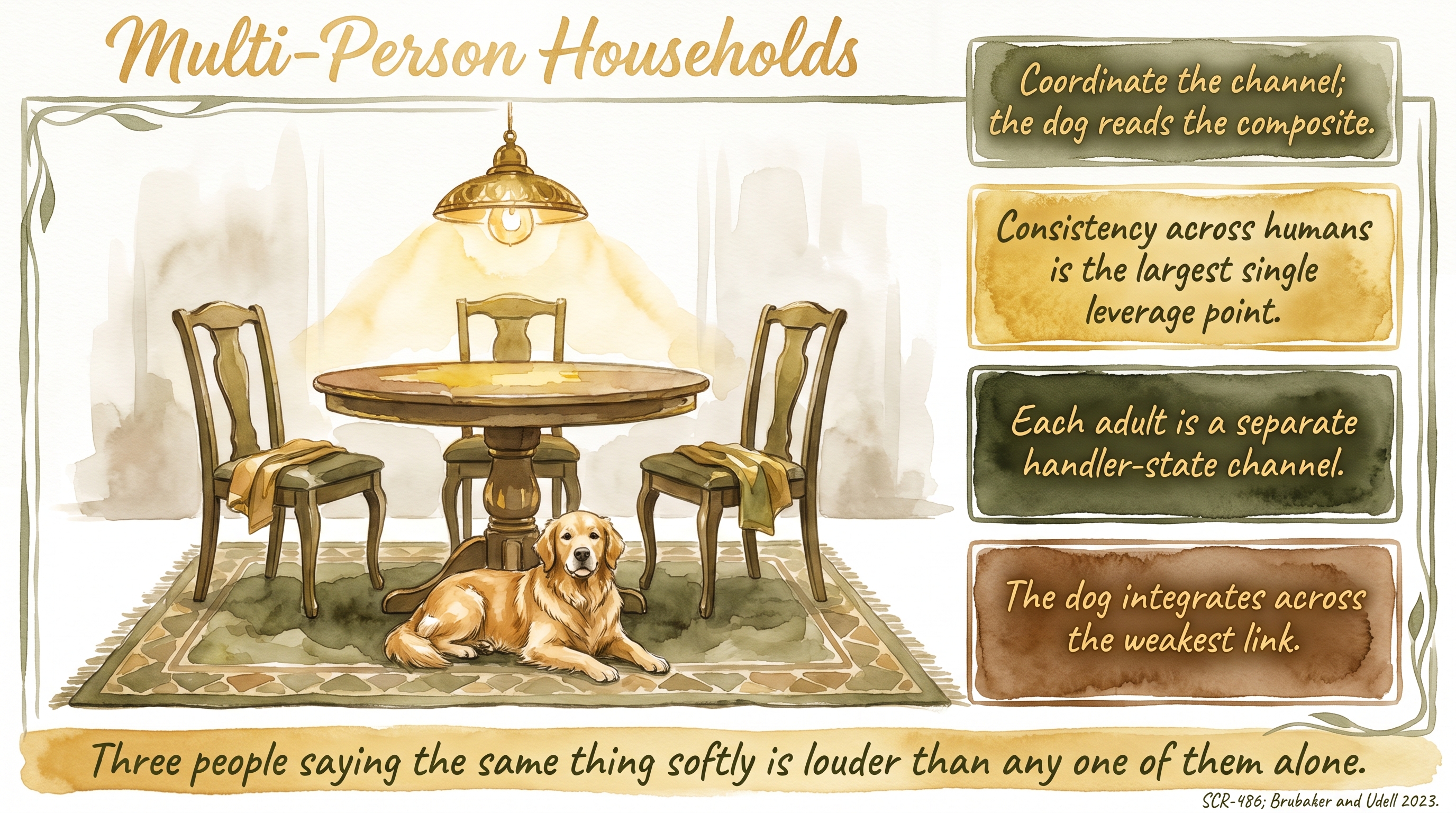
The household speaks in one voice, not three.
Key Takeaways
- Consistency across humans is the largest single leverage point a multi-person household has. The dog is reading each handler separately and not averaging; the household whose members deliver a coherent regulatory channel is the household whose dog has one channel to read rather than several contradictory ones.
- Each adult brings an inherited parenting pattern to the dog (Bouma 2024 documented intergenerational transmission). Two adults with similar patterns produce coherent households; two adults with divergent patterns produce households with internal channel conflict that the dog reads daily.
- The handler-state coupling channels (Sundman 2019; Koskela 2024) operate per-dyad. Each adult has a separate cortisol-synchrony and HRV-coupling channel with the dog. The dog's long-term physiology is being shaped by all handler inputs, not by one.
- Children are handlers operating with developmental constraints. Adult humans are operationally responsible for the structural channels (regulation, correction, leadership); children are coached into the calm channel rather than expected to deliver it independently. The household that places adult-handler responsibilities on children produces structural inconsistency.
The Evidence
- Dodman, N. H., Brown, D. C., & Serpell, J. A. (2018), PLOS ONEdomestic dogs
Owner personality and psychological status are associated with the prevalence of canine behavior problems. The owner is one of the variables predicting canine outcomes. In multi-person households the finding is per-handler: each adult's personality and psychological state is one input to the dog's aggregate experience. - Bouma, E. M. C., Reijgwart, M. L., & Dijkstra, A. (2024), Animalsdomestic dogs and their owners
Documented intergenerational patterns in dog-owner dyads: the parenting style adults received from their own parents predicted the parenting style they applied to their dogs. Each adult in a multi-person household brings an inherited pattern; household-level coherence depends on how those patterns interact. - Brubaker, L., & Udell, M. A. R. (2023), Animal Cognitiondomestic dogs and their owners
Adult human attachment style predicted dog social-behavior outcomes. The relational mode the human brings shapes how the dog responds. In multi-person households the dog is reading each member's relational mode separately.
- Sundman, A.-S. et al. (2019), Scientific Reportsdomestic dogs (N=58 dog-owner dyads)
Long-term hair-cortisol concentrations synchronized between dogs and their owners across months. Owner profile drove the dog's cortisol more strongly than the reverse. The finding is dyadic; in multi-person households each adult-dog dyad is a separate channel and the dog's long-term cortisol is being shaped by all dyads. - Koskela, A. et al. (2024), Scientific Reportsdomestic dogs and their owners
Heart-rate-variability coupling is dyad-specific. In multi-person households the per-dyad coupling means the dog reads each member's real-time physiological state separately and the dog's response calibrates to whichever member is operationally present. - Parr-Cortes, Z. et al. (2024), Scientific Reportsdomestic dogs
Stressed-human odor impairs canine cognitive performance. In multi-person households the chemical channel is operating from each adult separately; a dysregulated member is transmitting through the chemical channel even when not the operational handler at the moment.
- Smith, B. P. et al. (2025), Preventive Veterinary Medicinedomestic dogs (N=3,044 Golden Retrievers, Golden Retriever Lifetime Study)
Household management variables are significant predictors of behavioral trajectory across the first three years of life. Multi-person coordination is one variable in the household-management cluster. The cohort finding does not partition multi-person coordination type at the precision the methodology operates inside. - Powell, L. et al. (2021), PLOS ONEdomestic dogs and their owners
Owner expectations and household configuration variables associated with canine behavioral and welfare outcomes. The household configuration is one of the operationally relevant variables; multi-person households differ systematically from single-person households in the variables the cohort literature is measuring.
- Hebb, D. O. (1949); Bliss & Lømo (1973); Bi & Poo (1998)foundational neuroscience principle (rabbit, rat); cross-species
Neurons that fire together wire together. Application to multi-person households is conserved-mechanism inference. Each per-handler channel is being wired by that handler's cumulative pattern of repetitions; the channels are not interchangeable. The dog's response to the household is the dog's response to whichever handler is operationally present, modulated by what the dog has wired about each handler separately.
- JB cohort observationfamily-raised Golden Retrievers in multi-person households
JB cohort observation across multi-person households raising Golden Retrievers is that dogs whose household members operated with structural-channel coherence (calm floor, signal economy, prevention discipline, handler-state regulation agreed across members) showed less per-handler behavioral variance than dogs whose household members operated with structural-channel divergence. The variable-handler test (any adult delivers any standard sequence and the dog responds at the same regulatory baseline) is the operational diagnostic. The observation is consistent with per-dyad handler-state coupling and Hebbian per-channel wiring; it has not been tested in a controlled canine cohort. Reported at observed confidence.
- Dale, R. et al. (2024); Dodman, N. H. et al. (2018); Bouma, E. M. C. et al. (2024); Brubaker, L., & Udell, M. A. R. (2023)domestic dogs (multiple cohorts)
Convergent evidence that owner-managed and household-management variables predict canine behavioral outcomes. Multi-person coordination is one variable in the cluster. The stronger ranking claim (coordination as the primary determinant) is well-supported synthesis but not definitively established across all contexts (per SCR-486 ceiling).
- JB Methodology synthesisfamily-raised Golden Retrievers in multi-person households
The methodology's claim that household consistency is the largest single leverage point a multi-person household has, that the household's effective channel is approximately the weakest member's channel, and that the children's role should be calibrated to developmental stage with adults responsible for the structural channels, is JB's synthesis of owner-personality and parenting-style findings, per-dyad handler-state coupling, Hebbian per-channel wiring, and the cohort-scale predictor literature. Each component is documented; the operational synthesis is heuristic.
No controlled canine cohort study has tested multi-person household coordination protocols against unstructured multi-handler arrangements on matched behavioral and physiological outcomes.
The weakest-link claim has not been quantified in a published canine study; whether the household's effective channel is approximately the weakest, the median, or the weighted average of member channels is methodology observation rather than measurement.
Per-dyad attachment classification in multi-person households has not been studied at the precision needed to map the dog's differentiated relational architecture; the research currently operates dyadically.
The interaction between household consistency and downstream canine behavioral outcomes has not been partitioned by member-coherence type in a published canine cohort.
SCR References
Sources
Bi, G.-Q., \u0026 Poo, M.-M. (1998). Synaptic modifications in cultured hippocampal neurons: Dependence on spike timing, synaptic strength, and postsynaptic cell type. Journal of Neuroscience, 18(24), 10464-10472.
Bliss, T. V. P., \u0026 Lømo, T. (1973). Long-lasting potentiation of synaptic transmission in the dentate area of the anaesthetized rabbit following stimulation of the perforant path. Journal of Physiology, 232(2), 331-356.
Bouma, E. M. C., Reijgwart, M. L., \u0026 Dijkstra, A. (2024). Dog-directed parenting styles and intergenerational patterns in dog-owner dyads. Animals, 14(3).
Brubaker, L., \u0026 Udell, M. A. R. (2023). The effects of human attachment style on dog social behavior. Animal Cognition, 26(2), 627-640.
Dale, R. et al. (2024). Risk factors associated with separation-related behaviours and other potentially undesirable behaviours in puppies. Animal Welfare, 33, e22.
Dodman, N. H., Brown, D. C., \u0026 Serpell, J. A. (2018). Associations between owner personality and psychological status and the prevalence of canine behavior problems. PLOS ONE, 13(2), e0192846.
Hebb, D. O. (1949). The Organization of Behavior: A Neuropsychological Theory. New York: Wiley.
Koskela, A., Kareinen, I., Somppi, S., Törnqvist, H., Vainio, O., Kujala, M. V. (2024). Heart rate variability coupling in dog-human dyads. Scientific Reports, 14, 8213.
Parr-Cortes, Z., Müller, C. T., Talas, L., Mendl, M., Guest, C., \u0026 Rooney, N. J. (2024). The odour of an unfamiliar stressed or relaxed person affects dogs' responses on a cognitive bias test. Scientific Reports, 14, 15843.
Powell, L., Chia, D., McGreevy, P., Podberscek, A. L., Edwards, K. M., Neilly, B., Guastella, A. J., Lee, V., \u0026 Stamatakis, E. (2021). Expectations for dog ownership: Perceived physical, mental and psychosocial health consequences. PLOS ONE, 16(7), e0230770.
Smith, B. P., Browne, M., Mack, J., Kontou, T. G., \u0026 Tomkins, L. M. (2025). Predictors of behavioral outcomes in 3,044 Golden Retrievers across the first three years of life. Preventive Veterinary Medicine, 234, 106101.
Sundman, A.-S., Van Poucke, E., Svensson Holm, A.-C., Faresjö, Å., Theodorsson, E., Jensen, P., \u0026 Roth, L. S. V. (2019). Long-term stress levels are synchronized in dogs and their owners. Scientific Reports, 9, 7391.
Topál, J., Miklósi, Á., Csányi, V., \u0026 Dóka, A. (1998). Attachment behavior in dogs (Canis familiaris): A new application of Ainsworth's (1969) Strange Situation Test. Journal of Comparative Psychology, 112(3), 219-229.