Parent, Not Playmate
Compound evidence detail3 SCRs / 7 parts
- Documentedthe human attachment evidence base together with the canine-direct secure-base findings (Topal 1998, Horn 2013) and Schoberl-documented physiological effects of secure caregiving in dogs
- Heuristicthe full attachment-theory apparatus transfer to canine relationships, including internal working models and attachment-classification systems
- Documentedthe Baumrind authoritative-parenting literature in human child development
- Documentedthe canine correlational evidence linking dog-directed caregiving styles to attachment, attention, sociability, and problem-solving outcomes (van Herwijnen 2018/2020, Brubaker and Udell 2023)
- Heuristicthe JB inference that one specific caregiving style experimentally produces the best long-term developmental outcomes in dogs
- Documentedcanine welfare evidence on aversive training methods (Vieira de Castro 2020, Ziv 2017, Hiby 2004) and attachment-mediated stress modulation evidence (Schoberl 2015, Asher 2020, Brubaker and Udell 2023)
- HeuristicJB claim that secure attachment context measurably alters how dogs experience mechanically operant-identical correction procedures, RF-flagged in the SCR and formally untested in controlled canine studies
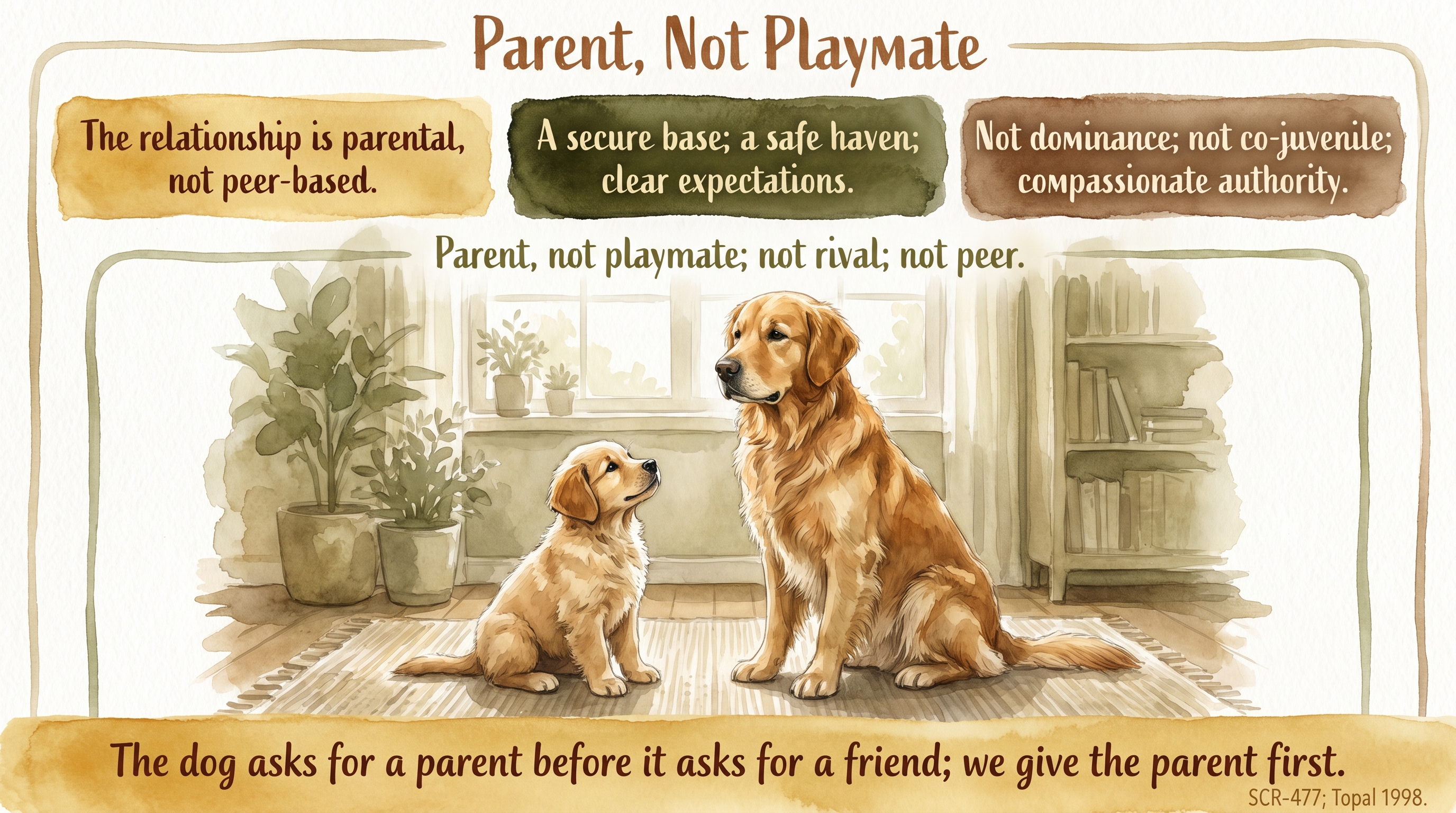
In JB, Parent, Not Playmate is the operating principle that names the human role in the dog's life as parental rather than peer-recreational. The dog's caregiver is asked to be structured, compassionate, consistent, and firm, and to function as a secure base and a safe haven rather than as a source of mutual entertainment. Heuristic Attachment theory, dog-directed parenting-style research, and wolf-family-unit ethology each independently support pieces of this picture. The convergent JB claim, that organizing the relationship around parental structure rather than peer recreation is the operating frame that produces the well-mannered family Golden Retriever, is JB's synthesis of that science, well-supported by association studies but not directly proven by a controlled comparative trial in dogs.
For Families
The most common mistake in raising a dog is treating the dog as a peer. The treats, the cute voice, the negotiated requests, the apologetic tone when the dog ignores a cue - all of it positions the human as a roughly equivalent social partner rather than as the calm parental figure the puppy needs.
Goldens in particular invite this dynamic. They are sociable, soft, and emotionally responsive, and the human reaction is to drop into peer mode automatically. The puppy then has no parent in the household, and starts making decisions about the household that should not be its job.
The fix is not coldness. It is the calm, warm, consistent posture of a parent who is clearly the household's anchor. Affection is generous. Boundaries are held without drama. The dog gets to be a dog rather than a junior partner in household management.
What It Means
The principle is frequently misread in two opposite directions. The first misreading hears "parental" and reaches for dominance, the alpha-roll model that presents the human as a higher-ranking competitor whose job is to keep the dog in its place. That model rests on a captive-wolf misreading that the field has formally retired. Mech (1999) documented from thirteen summers of field observation at Ellesmere Island that wild wolf packs are family units organized around parental relationships and breeder-led leadership, not dominance hierarchies (SCR-021). Documented The American Veterinary Society of Animal Behavior issued a formal position statement in 2008 recommending against dominance-based training. The second misreading hears "not playmate" and becomes anxious that affection and play are forbidden. They are not. What the principle removes is not warmth. It is the relational structure in which the human's primary function is mutual entertainment rather than mentorship.
The scientific framework that fits the parental role most cleanly is attachment theory. Bowlby (1969) and Ainsworth, Blehar, Waters, and Wall (1978) established in human developmental psychology that secure attachment emerges from consistent, predictable, sensitively responsive caregiving (SCR-017). Documented The caregiver functions both as a secure base, from which the child ventures out into exploration, and as a safe haven, to which the child returns when threatened. The caregiver who provides this structure is not the child's peer. The caregiver is the relational architecture inside which the child's nervous system learns what is safe to approach and what is safe to leave behind.
Canine attachment bonds are documented to be functionally analogous. Topál, Miklósi, Csányi, and Dóka (1998) adapted the Strange Situation Procedure for adult dogs in their relationship with the primary caregiver and demonstrated the secure base effect in domestic dogs (SCR-018). Documented Horn, Huber, and Range (2013) replicated and extended the finding in a problem-solving paradigm: dogs persisted at a manipulative task significantly longer in the presence of their owner than in the presence of a stranger or alone. Solomon and colleagues (2019) developed a canine-adapted classification procedure with substantial inter-judge agreement (89%, κ = 0.78) and reported attachment classification distributions in companion dogs broadly comparable to those in human infants. The full theoretical apparatus of attachment classification systems and internal working models remains a heuristic transfer from human developmental psychology, but the existence of canine attachment bonds and the operation of the secure base effect in dogs are documented findings.
The behavioral consequences of different caregiving patterns are now documented in the dog-owner literature directly, not by analogy. Van Herwijnen and colleagues (2018, 2020) operationalized Baumrind's (1966, 1991) parenting typology for dog owners in a sample of 518 Dutch dog owners and confirmed that authoritative components, combining warmth with consistent structure, were recoverable in observable owner-dog interactions (SCR-019). Documented Authoritarian correction style was inversely related to the dog's visual attention to the owner: dogs whose owners corrected with low warmth and high control disengaged from looking at them. Brubaker and Udell (2023) found in 48 dog-owner dyads that owners classified as authoritative produced dogs that scored highest on secure attachment and were the most persistent and successful problem-solvers. The remaining evidence boundary is causal: the canine studies are correlational and cannot yet prove that authoritative caregiving experimentally produces the best long-term outcomes. The boundary on association is closed. The boundary on causation remains open.
Two further canine findings tighten the picture. Schöberl and colleagues (2016) reported that dogs classified as securely attached to their owners secreted significantly less cortisol during attachment and play challenge procedures than insecurely attached dogs (SCR-005, satellite). Documented Owner attachment style mattered: insecure-ambivalent owners produced dogs with higher cortisol reactivity, and the social buffering effect of owner presence operated only when the attachment was secure. The secure base relationship does not just feel better. It is measurably less stressful for the dog. Asher and colleagues (2020) documented in 70 guide dog candidates a transient adolescent-phase reduction in obedience that was directed specifically at the primary caregiver, not at strangers, and that was more pronounced in dogs with behavior indicating less secure attachment (SCR-038). Documented The caregiver is the figure the adolescent dog tests, and the quality of the parental relationship determines what resources are available when the testing arrives.
The synthesis JB takes from this body of work is the load-bearing claim of the principle: the relational structure inside which a Golden Retriever becomes a well-mannered family dog is parental in character. Heuristic Each component, the wolf-family-unit corrective, attachment theory, the canine secure base effect, the dog-directed parenting-style associations, and the cortisol and adolescent findings, is independently documented at the levels stated above. The convergent operational claim that families should organize their relationship with the dog around parental structure rather than peer recreation is well-supported synthesis, not a directly demonstrated controlled comparison.
Why It Matters for Your Dog
In daily life, the parental relationship produces what this methodology calls structured companionship. The dog and the family are together, genuinely together, in a way that involves calm, purposeful co-presence rather than entertainment-driven interaction. The family eats; the dog is present and calm. The family reads; the dog rests nearby. The family prepares to go out; there is no ritual of frantic goodbye. The dog exists alongside the family's life rather than being the center around which the family performs. From that platform, genuine affection and genuine play are available and welcome. The parental relationship does not exclude warmth. It organizes it.
The playmate relationship looks similar on the surface and produces different outcomes. A playmate's primary function is mutual entertainment. When the dog needs a boundary, the playmate hesitates, because saying no risks the fun. When the dog needs calm, the playmate escalates, because calm feels like absence. When the dog enters the adolescent phase Asher and colleagues documented, the playmate relationship has no resources to draw on, because it was never built on relational authority. The cortisol findings of Schöberl and colleagues add the physiological dimension. Insecure attachment is not only behaviorally costly. It is biologically taxing. The dog raised in a relationship with no consistent parental figure has higher baseline reactivity and a smaller social buffer.
Parent, Not Playmate is the operating-principle expression of the Structured Leadership pillar. The pillar names the role: compassionate, firm parental guidance functioning as secure base and safe haven, with clear boundaries, consistent expectations, and calm assertiveness. The principle names the daily reorientation that makes the role livable. The other four pillars carry mentorship, calm, prevention, and indirect correction. Structured Leadership organizes the relational frame those four operate inside.
The analogy that carries the principle most cleanly: a math professor, not a gym coach. The gym coach is loud, energetic, relentlessly encouraging, always pushing. The math professor is present, attentive, and quietly authoritative. The math professor says less and means more. The math professor does not need to shout to get attention. The math professor is the person you look to when something is unclear, not because they entertain you, but because they know something you need.
Families often resist the principle because it sounds cold. It is not cold. It is the relational structure within which genuine affection becomes possible rather than contingent. A dog that has a playmate has fun. A dog that has a parent has security. Security and fun are both available in the JB relationship, but the parent comes first, because fun without security does not produce a well-mannered dog. It produces a social puppy in an adult body, the consequence the methodology is organized around preventing.
Mentorship is a posture, not a schedule.
Key Takeaways
- The human role in the JB methodology is parental, not peer-recreational. The shift from playmate to parent is the single most important conceptual reorientation families make in adopting the methodology, and it is neither dominance nor coldness, it is the secure base and safe haven framework that attachment theory describes.
- The component evidence is documented at three different levels: wolf-family-unit ethology (Mech 1999) is fully documented and refutes dominance theory; canine attachment bonds and the secure base effect (Topál 1998, Horn 2013, Solomon 2019) are documented in the domestic dog; and dog-directed parenting style associations (van Herwijnen 2018, 2020; Brubaker and Udell 2023) are documented as correlations.
- Two physiological and developmental findings sharpen the picture. Schöberl and colleagues (2016) showed that securely attached dogs secrete less cortisol during stress challenge. Asher and colleagues (2020) showed that adolescent reduction in obedience is directed at the primary caregiver, not at strangers, and is more pronounced when attachment is less secure.
- Operationally, the principle produces what the methodology calls structured companionship. The dog is genuinely with the family in calm, purposeful co-presence. Affection and play remain available. They sit on top of a parental relationship rather than substituting for one. The math professor, not the gym coach.
The Evidence
- Mech, L. D. (1999)wild wolves (Ellesmere Island, 13 summers of field observation)
Field observation of free-ranging wolf packs documented that packs are family units led by the breeding pair, who function as parents to the rest of the group. The captive-wolf model that gave rise to dominance hierarchy framing was based on unrelated adults housed together at Zoo Basel (Schenkel, 1947), a social configuration that does not occur in the wild. The American Veterinary Society of Animal Behavior issued a formal position statement in 2008 recommending against dominance-based training in dogs.
- Bowlby, J. (1969); Ainsworth, M. D. S., Blehar, M. C., Waters, E., & Wall, S. (1978)humans (developmental psychology)
Attachment theory established that infants form selective attachment bonds with primary caregivers, and that the quality of those bonds is shaped by caregiver consistency, predictability, and sensitive responsiveness. The Strange Situation Procedure operationalized the secure base and safe haven functions and is among the most replicated paradigms in developmental psychology. Full attachment classification systems and internal working models remain established in humans; transfer of the full theoretical apparatus to dogs is heuristic, while the existence of canine attachment bonds and operation of the secure base effect in dogs are documented separately.
- Topál, J., Miklósi, Ã., Csányi, V., & Dóka, A. (1998)domestic dogs (N=51, adapted Strange Situation Procedure)
First adaptation of the Ainsworth Strange Situation Procedure for adult dogs and primary caregivers. Dogs displayed greeting, contact-seeking, and proximity-maintenance behavior consistent with the operation of an attachment bond, and showed differential responses to the owner versus the stranger across episodes. - Horn, L., Huber, L., & Range, F. (2013), PLOS ONEdomestic dogs (manipulative problem-solving paradigm)
Dogs persisted at a manipulative food-acquisition task significantly longer in the presence of their owner than in the presence of a stranger or alone, demonstrating the secure base effect outside the Strange Situation paradigm. The owner functioned as a base from which the dog more readily engaged with a challenging task. - Solomon, J., Beetz, A., Schöberl, I., Gee, N., & Kotrschal, K. (2019), Attachment & Human Developmentdomestic dogs
Adapted Strange Situation and classification procedure for dogs and human caregivers. Reported 89% inter-judge agreement (κ = 0.78) on attachment classification, with 61% of dogs classified as securely attached, broadly consistent with proportions reported for human infant samples. Confirms that canine attachment can be sorted into secure and insecure patterns with substantial inter-rater reliability, while leaving the canine classification literature open on edge cases and order effects.
- van Herwijnen, I. R., van der Borg, J. A. M., Naguib, M., & Beerda, B. (2018, 2020), PLOS ONEdomestic dogs (N=518 Dutch dog owners; behavioral follow-up)
Adapted Baumrind's parenting typology to the owner-dog relationship and confirmed that authoritative components, combining warmth with consistent structure, were recoverable in observable owner-dog interactions. Authoritarian correction style was inversely related to the dog's visual attention to the owner: dogs of authoritarian owners disengaged from looking at them. - Brubaker, L., & Udell, M. A. R. (2023), Animal Cognitiondomestic dogs (N=48 dog-owner dyads)
Owners were classified into authoritative (high expectations, high responsiveness), authoritarian (high expectations, low responsiveness), and permissive (low expectations, low responsiveness) styles. Dogs with authoritative owners scored highest on secure attachment and were the most persistent and successful in problem-solving tasks. The remaining boundary is causal: the design is correlational and does not yet prove that authoritative caregiving experimentally produces the best long-term outcomes in dogs.
- Schöberl, I., Beetz, A., Solomon, J., Wedl, M., Gee, N., & Kotrschal, K. (2016), Journal of Veterinary Behaviordomestic dogs (N=132 dyads, standardized stress procedure)
Securely attached dogs secreted significantly less cortisol during attachment (P = 0.008) and play (P = 0.031) procedures than insecurely attached dogs. Owner attachment style was directly relevant: insecure-ambivalent owners produced dogs with higher cortisol reactivity. Social buffering by the owner operated only when attachment was secure. The secure base relationship is measurably less stressful for the dog, not only behaviorally preferable. - Asher, L., England, G. C. W., Sommerville, R., & Harvey, N. D. (2020), Biology Lettersdomestic dogs (N=70 guide dog candidates: German Shepherds, Golden Retrievers, Labrador Retrievers, and crosses)
Documented a transient adolescent-phase reduction in obedience around eight months of age, directed specifically at the primary caregiver and not at strangers, mirroring human adolescent-parent conflict dynamics. Reduction was more pronounced in dogs with behavior indicating less secure attachment. Insecure attachment pre-adolescence was associated with earlier puberty onset. The caregiver is the figure the adolescent dog tests, and attachment quality determines what resources are available when the testing arrives.
- JB Methodology synthesisfamily-raised Golden Retrievers
The convergent claim that families should organize the relationship with the dog around parental structure rather than peer recreation, and that this is the operating frame that produces the well-mannered family Golden Retriever, is JB's synthesis of attachment theory, dog-directed parenting-style research, the wolf-family-unit corrective, and the cortisol and adolescent findings. Each component is independently documented at the levels stated; the convergent operational claim is well-supported synthesis rather than a directly demonstrated controlled comparison. No experimental trial has compared a parent-framed relational structure against a playmate-framed structure on long-term canine behavioral, physiological, or relational outcomes.
No experimental trial has compared parent-framed and playmate-framed caregiving structures on long-term canine behavioral, physiological, or relational outcomes. The dog-directed parenting-style literature is associative, not interventional.
The full attachment classification apparatus (internal working models, four-category classification stability across the canine lifespan) has not been validated in dogs to the standard established in human infants. The narrower secure-versus-insecure sorting is well-supported; the full theoretical transfer is heuristic.
Causal direction in the parenting-style associations is not yet established: whether authoritative caregiving produces secure dogs, whether secure dogs draw authoritative caregiving from their humans, or both, remains an open question for canine developmental research.
SCR References
Sources
Ainsworth, M. D. S., Blehar, M. C., Waters, E., \u0026 Wall, S. (1978). Patterns of Attachment: A Psychological Study of the Strange Situation. Lawrence Erlbaum Associates.
American Veterinary Society of Animal Behavior. (2008). AVSAB position statement on the use of dominance theory in behavior modification of animals. AVSAB.
Asher, L., England, G. C. W., Sommerville, R., \u0026 Harvey, N. D. (2020). Teenage dogs? Evidence for adolescent-phase conflict behaviour and an association between attachment to humans and pubertal timing in the domestic dog. Biology Letters, 16(5), 20200097.
Baumrind, D. (1966). Effects of authoritative parental control on child behavior. Child Development, 37(4), 887-907.
Baumrind, D. (1991). The influence of parenting style on adolescent competence and substance use. The Journal of Early Adolescence, 11(1), 56-95.
Bowlby, J. (1969). Attachment and Loss, Vol. 1: Attachment. Basic Books.
Brubaker, L., \u0026 Udell, M. A. R. (2023). Does pet parenting style predict the social and problem-solving behavior of pet dogs? Animal Cognition, 26(1), 345-356.
Horn, L., Huber, L., \u0026 Range, F. (2013). The importance of the secure base effect for domestic dogs - evidence from a manipulative problem-solving task. PLOS ONE, 8(5), e65296.
Mech, L. D. (1999). Alpha status, dominance, and division of labor in wolf packs. Canadian Journal of Zoology, 77(8), 1196-1203.
Schenkel, R. (1947). Expression studies on wolves: Captivity observations. Behaviour, 1(2), 81-129.
Schöberl, I., Beetz, A., Solomon, J., Wedl, M., Gee, N., \u0026 Kotrschal, K. (2016). Social factors influencing cortisol modulation in dogs during a strange situation procedure. Journal of Veterinary Behavior, 11, 77-85.
Solomon, J., Beetz, A., Schöberl, I., Gee, N., \u0026 Kotrschal, K. (2019). Attachment security in companion dogs: Adaptation of Ainsworth's Strange Situation and classification procedures to dogs and their human caregivers. Attachment \u0026 Human Development, 21(4), 389-417.
Topál, J., Miklósi, Ã., Csányi, V., \u0026 Dóka, A. (1998). Attachment behavior in dogs (Canis familiaris): A new application of Ainsworth's (1969) Strange Situation Test. Journal of Comparative Psychology, 112(3), 219-229.
van Herwijnen, I. R., van der Borg, J. A. M., Naguib, M., \u0026 Beerda, B. (2018). The existence of parenting styles in the owner-dog relationship. PLOS ONE, 13(2), e0193471.
van Herwijnen, I. R., van der Borg, J. A. M., Naguib, M., \u0026 Beerda, B. (2020). Dog